
BAR-205 · Lesson 4 of 12 · 18 min
The California bar exam: format, scoring and passing score
▶ Video coming soon A video version of this lesson is on the way.
Marchetti starts the fourth call by asking Sofia to describe exam day from memory, minute by minute. Sofia gets the sessions right but hesitates on the details: when lunch is, whether she can go back to an essay from the morning in the afternoon, and when the State Bar uses a second reading. 'Those details are worth knowing cold,' Marchetti says. 'You don't want to spend any thinking on them in February.'
Two days, in person
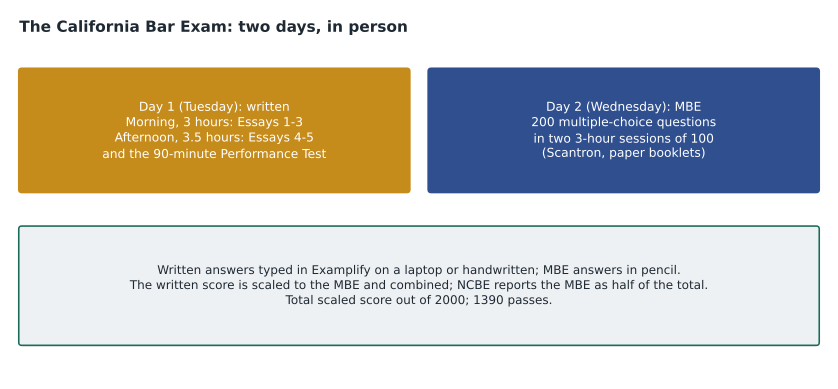
The State Bar's page for the February 2027 exam sets out the structure. The exam runs on Tuesday, February 23 and Wednesday, February 24, 2027, entirely in person at designated California sites. There is no remote option.
Day one is the written portion. The morning session lasts three hours and contains Essays 1, 2 and 3. The afternoon session lasts three and a half hours and contains Essays 4 and 5 and the 90-minute Performance Test. Applicants may answer the questions within a session in any order, but they cannot carry time or answers from one session to another. Each essay is designed as a one-hour question.
Day two is the MBE: 200 multiple-choice questions in two three-hour sessions of 100 questions each. Applicants cannot return to the first 100 questions during the second session. MBE answers go on a Scantron sheet marked with No. 2 pencils, from a hardcopy question booklet, and are not entered in Examplify.
Written answers may be typed in ExamSoft's Examplify software on the applicant's own laptop or handwritten. Typists receive hardcopy exam materials and physical scratch paper, and no internet connection is required during the exam. Applicants who type must register with ExamSoft and complete a mandatory mock exam before the deadline, which for February 2027 is February 19.
| Session | Content | Time |
|---|---|---|
| Day 1 morning | Essays 1, 2 and 3 | 3 hours |
| Day 1 afternoon | Essays 4 and 5 and the Performance Test | 3.5 hours |
| Day 2 morning | MBE questions 1 to 100 | 3 hours |
| Day 2 afternoon | MBE questions 101 to 200 | 3 hours |
The State Bar asks applicants to be seated by 8:20 a.m., with instructions beginning around 8:30. Lunch is provided, and the afternoon session starts around 1:30 p.m. Day one ends around 5:30 p.m. and day two around 5:00 p.m., though times vary by site. Applicants with accommodations may have extended days.
Test sites
For February 2027 the State Bar lists standard sites in the Los Angeles area (the Ontario Convention Center), the San Francisco area (the Oakland Convention Center and the San Mateo County Event Center), the Sacramento area (a banquet and event center in Vacaville) and the San Diego area (the Chula Vista Elite Athlete Training Center), with separate sites for applicants with accommodations. Applicants request a site in the application, and site changes are due by the deadline the State Bar sets, February 1 for this exam.
The essays
The essays test the thirteen subjects listed in the State Bar's exam scope, which Lesson 6 maps. A single essay may combine subjects, such as contracts with remedies, or wills with community property. Some essays name the law to apply, and some ask for answers under California law, which matters most in community property, civil procedure, evidence, wills, trusts and professional responsibility.
Graders score each essay and the performance test in five-point steps on a raw scale from 40 to 100. An answer that does not at least identify the subject and attempt to apply the law to the facts receives a zero. Graders reward what every bar essay rewards: issues spotted, rules stated accurately, facts used in the analysis and conclusions reached, all organized so a grader can follow them quickly.
The performance test
The performance test is a 90-minute lawyering task. The applicant receives a file of facts, such as client interviews, letters and documents, and a library of legal authorities, and must produce a document the task memo assigns, such as an objective memo, a persuasive brief, a letter or a plan. California writes its own performance tests; it does not use NCBE's MPT, although the format is similar. The legal authorities are provided, so the test rewards reading, organization and analysis rather than memorized law.
Sofia's July performance test was middling, and Marchetti knows why: Sofia began writing before she finished the task memo and wrote a summary of the facts that the memo did not ask for. The BAR-121 course on the Multistate Performance Test teaches the method, and it transfers directly to California's test.
The MBE
The MBE is the same national exam given in most of the country: 200 questions, 175 scored and 25 unscored pretest questions, covering civil procedure, constitutional law, contracts, criminal law and procedure, evidence, real property and torts. California returned to it in July 2025 after the February 2025 exam, as Lesson 5 explains. MBE questions test national law, generally majority rules and federal law, not California law.
Scoring
California combines the written and MBE scores into a single total. NCBE's chart for California explains that the written component is scaled to the MBE and the two are combined, with the MBE counting for 50 percent of the combined score. The total is reported on a scale of 2,000 points, and the State Bar's grading page sets the passing score at 1,390. NCBE expresses the same standard as 139 on a 200-point scale.
Scaling matters for strategy. Because the written score is scaled to the MBE, a strong MBE helps the whole cohort's written scores line up with an objective measure, and an applicant's own MBE performance contributes half of her total. Neither part can be ignored.
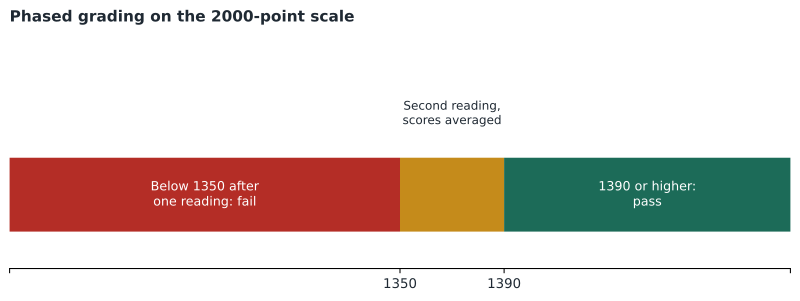
Phased grading
California uses phased grading. Every complete exam is read at least once. A total below 1,350 after the first reading fails. A total of 1,390 or higher after the first reading passes. A total from 1,350 to 1,389 goes to a second reading by a different set of graders, and the two readings are averaged; an averaged total of 1,390 or higher passes. The second reading gives applicants near the line a fresh look.
Worked problem
Phased grading in practice
Three applicants have first-read totals of 1,342, 1,371 and 1,402.
Show solution
- 1,342 is below 1,350: the applicant fails after one reading.
- 1,402 is at or above 1,390: the applicant passes after one reading.
- 1,371 is in the 1,350 to 1,389 band: the written answers are read again by different graders and the scores averaged.
- If the averaged total is 1,390 or more, the applicant passes; otherwise not.
Answer: Only applicants in the band near the line receive a second reading.
Regrading and reconsideration
California does not offer regrading on request. The Committee of Bar Examiners generally will not reconsider grades based on challenges to the grading system or to graders' judgments. It will consider reconsideration only for a documented clerical error that caused a failure or prevented proper grading, and written requests are due within two weeks after results are released. Applicants who fail receive a score report showing their results by component.
Results
For February 2027, results are scheduled for release on April 30, 2027, in the Applicant Portal, with the public pass list posted several days later. NCBE describes California's average reporting time as May for the February exam and November for the July exam.
Repeaters
California places no limit on the number of attempts. An applicant who fails may sit again, and immediate repeaters get a later filing window, as Lesson 2 described. Because the exam has no components that bank separately, a repeater takes the whole exam again, written and MBE. Sofia's plan reflects that: written work every week, and a timed set of 50 MBE questions every Saturday so her MBE score does not slip while she focuses on essays.
Common mistakes
MistakeExpecting a remote option.
InsteadThe California exam is entirely in person at designated sites.
MistakePlanning to go back to a morning essay in the afternoon.
InsteadAnswers stay within their session; plan time within each session.
MistakeAssuming California uses the MPT or the MEE.
InsteadCalifornia writes its own essays and performance test; it uses the MBE for multiple choice.
MistakeCounting on a regrade after a near miss.
InsteadPhased grading already gives a second reading from 1,350 to 1,389; reconsideration is limited to documented clerical errors.
Planning each session
Marchetti turns the structure into a minute-by-minute plan Sofia can rehearse. The morning has three essays in three hours. Sofia's plan is to spend the first five minutes reading all three calls, not the full facts, so she knows what is coming and can start with the subject she is most confident in. Then each essay gets 60 minutes: about 15 minutes to read the facts twice and outline, and 45 minutes to write. If an essay is not finished at the hour, she writes one or two sentences of conclusion and moves on.
The afternoon has two essays and the performance test in three and a half hours. The natural plan gives each essay an hour and the performance test 90 minutes. Many candidates prefer to start with the performance test while they are fresh, because it is the largest single task and its time is the hardest to recover if it runs long. Sofia will try both orders in her January practice days and choose the one that leaves her calmest.
| Time from session start | Morning plan | Afternoon plan (PT first) |
|---|---|---|
| 0:00 to 0:05 | Read all three calls; choose an order | Read the PT task memo twice |
| 0:05 to 1:05 | Essay A: outline 15, write 45 | PT: read the library, then the file (about 45 minutes) |
| 1:05 to 2:05 | Essay B | PT: outline and write (about 45 minutes) |
| 2:05 to 3:00 | Essay C (55 minutes) | Essay D (60 minutes, to 2:35) |
| After | Session ends at 3:00 | Essay E (to 3:30) |
The MBE day
Day two is the MBE in two three-hour sessions of 100 questions. That is 1.8 minutes per question on average. Sofia's habit from the group's Saturday drills is to check her pace every 25 questions, at roughly 45 minutes, 1 hour 30 minutes and 2 hours 15 minutes, and to mark answers on the Scantron as she goes rather than in a batch at the end, which risks running out of time with answers still in the booklet. Because she cannot return to the morning's questions in the afternoon, she finishes each session completely, guessing on any question she has not answered, since there is no penalty for wrong answers.
What scaling means for strategy
Candidates sometimes ask whether they should spend their time on the written portion or the MBE. Because the written score is scaled to the MBE and the two count roughly equally in the total, both matter. A candidate with a strong MBE and weak essays, like Sofia, gains most by improving the essays, but she should not let her MBE slip, because every scaled point there also counts. A candidate with strong essays and a weak MBE should do the reverse. Marchetti's rule: aim study time at the weaker component, and keep the stronger one warm with regular practice.
Common exam-day problems and how to handle them
Marchetti asks Sofia to plan for three things that go wrong on exam day. A laptop problem: if Examplify freezes or the laptop fails, raise a hand immediately; proctors have procedures, and the time to learn them is not mid-essay. Sofia also brings the power cord and confirms in January that her laptop meets ExamSoft's current requirements. A blank essay: if a call makes no sense at first, outline what you do know, write the rule statements you are sure of, apply them to the facts and move on at the hour; partial answers earn partial credit, and a zero comes only from an answer that does not engage the subject at all. A bad session: if the morning goes poorly, eat lunch, walk, and treat the afternoon as a fresh start, because the afternoon carries more points than the morning, with two essays and the performance test.
After the exam, Sofia will write down anything unusual that happened, such as a disruption at her site or a technical failure, and report it through the channels the State Bar provides, as Lesson 5 advises. She will not discuss the questions' content, which the State Bar's rules prohibit.
Summary and key terms
- Day one: three essays in the morning (3 hours), two essays and the 90-minute performance test in the afternoon (3.5 hours). Day two: the 200-question MBE.
- Essays and the performance test are graded in five-point steps from 40 to 100; a nonresponsive answer receives zero.
- The written score is scaled to the MBE and combined; NCBE reports the MBE as 50 percent of the total.
- The passing total is 1,390 of 2,000; totals from 1,350 to 1,389 receive a second reading and are averaged.
- February 2027 results are scheduled for April 30, 2027; there is no limit on attempts.
- Performance Test
- California's 90-minute lawyering task based on a file of facts and a library of authorities.
- Phased grading
- California's system of reading every exam once and rereading those with totals from 1,350 to 1,389.
- Scaling
- Adjusting written scores to the MBE so that the two can be combined on a common scale.
- Examplify
- ExamSoft's software for typing written answers offline.
- Pass list
- The public list of successful applicants posted after results are released.
Practice problems
Work each problem on paper first, then reveal the answer to check.
How long is the afternoon session of day one, and what does it contain?
Show answer
Three and a half hours: Essays 4 and 5 and the 90-minute Performance Test.
An applicant's first-read total is 1,388. What happens?
Show answer
A second reading by different graders; the two readings are averaged, and 1,390 or more passes.
What share of the total does NCBE report for the MBE in California?
Show answer
50 percent.
Lesson quiz · 5 questions
Score 60% or more to complete this lesson.
Create a free account to save your progress, take quizzes and earn a certificate.