
BAR-206 · Lesson 1 of 12 · 18 min
Becoming a lawyer in Colorado
▶ Video coming soon A video version of this lesson is on the way.
Luke Ferraro joins Hollis Marchetti's study group in the fall of 2026 with a plan he can state in one breath: pass the February 2027 bar exam in Colorado, take the oath in the spring, and keep working at the Denver firm where he has clerked since his second year of law school. He grew up in Grand Junction, on the Western Slope, finished law school in Colorado in May 2026, and spends his days on two kinds of files: personal injury cases and water rights. His supervising partner jokes that the firm is the only place in Denver where a car crash and a ditch dispute can land on the same desk before lunch. Luke has heard three things about the Colorado bar from classmates: that the passing score used to be higher, that the exam will change in 2028, and that Colorado makes new lawyers take a professionalism course before they are sworn in. Marchetti tells him that all three are true.
'Every jurisdiction does three things,' she says at their first session. 'It decides who may apply, it tests what you know, and it decides whether you can be trusted with other people's money and secrets. Colorado does all three, and it does them through one office that is unusually busy for a state its size. The same office that admits you will also register you every year, track your continuing legal education, and handle complaints about you if something goes wrong. Learn how that office works now, because you will be dealing with it for the rest of your career.'
This lesson maps the whole process: the bodies involved, the requirements you must meet, the order in which most candidates meet them, and the places where candidates most often go wrong. Later lessons take each step in detail and then turn to the Colorado law that sets the state apart in practice.
Who controls admission
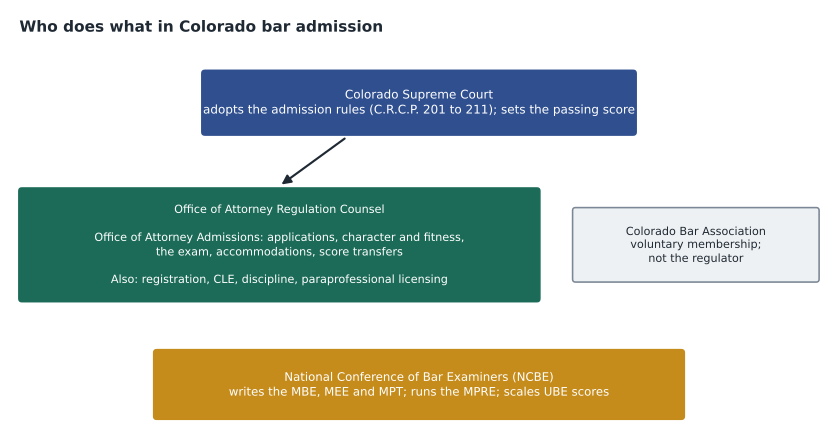
Admission to practice law in Colorado is controlled by the Colorado Supreme Court. The court has exclusive authority over the practice of law in the state. It adopts the admission rules, which appear in the Colorado Rules of Civil Procedure as the 200-series rules on attorney admission (Rules 201 through 211 and related rules), sets the passing score, and changes the rules by order of the full court. When the rules change, the change comes from the court, not from the legislature, the bar association or the law schools. Two recent examples show the pattern. In 2022 the court announced that it would lower the minimum passing score on the Uniform Bar Examination (UBE) from 276 to 270, starting with the February 2023 exam. In March 2024 it announced that Colorado will move to the NextGen bar exam in July 2028. Lessons 4 and 5 cover both decisions.
The day-to-day work is done by the Office of Attorney Admissions, which sits within the court's Office of Attorney Regulation Counsel in Denver. The Office of Attorney Admissions receives and reviews applications, runs the character and fitness investigation, gives the bar exam twice a year, decides accommodation requests, and processes score transfers and motions for admission without examination. Applicants reach it by email at bleinfo@csc.state.co.us. Its pages carry the current exam application instructions, and those instructions are the documents you must follow line by line.
The Office of Attorney Regulation Counsel does much more than admissions. It handles attorney registration, continuing legal education, the attorney discipline system, and the licensing of Colorado's licensed legal paraprofessionals, a newer category of legal professional that Lesson 11 describes. 'That is the point,' Marchetti says. 'In Colorado, the office that admits you is also the office that regulates you. Start the relationship well.'
The National Conference of Bar Examiners (NCBE), a national nonprofit, plays a supporting role. NCBE writes the three tests that make up the UBE, scales and equates the scores, runs the Multistate Professional Responsibility Examination (MPRE), and maintains the score transfer system. NCBE does not admit anyone. 'NCBE builds the exam,' Marchetti says. 'Colorado decides what to do with your score and whether you get in.'
After admission, lawyers deal with a second body that is not part of the regulatory system at all. The Colorado Bar Association is a voluntary organization, so joining it is a choice. Colorado does not have a mandatory or unified bar. Licensing, the annual registration fee, continuing legal education and discipline all run through the supreme court and its offices, not through the bar association.
Three ways in
Colorado offers three main routes to admission, and the route determines almost everything else about your application. The first is admission by examination: you apply to sit the Colorado bar exam, pass it, and complete the other requirements. Almost every recent law graduate uses this route. The second is admission by transferred UBE score: if you sat the UBE in another jurisdiction and earned a score that meets Colorado's standard within the time limits, you can apply to transfer that score rather than sit again. The third is admission on motion, sometimes called admission without examination, for experienced lawyers who were admitted elsewhere by examination and have practiced actively for at least three of the five years before they apply.
Each route has its own rule. Admission by examination is governed by C.R.C.P. 203.4, admission by transferred UBE score by C.R.C.P. 203.3, and admission on motion by C.R.C.P. 203.2. In October 2026 the court added a fourth, narrower path: a pilot rule, C.R.C.P. 203.6, that allows certain applicants who passed the UBE elsewhere but fell short of Colorado's score to be admitted under supervision while working in public defense, prosecution or legal aid. Lesson 11 covers the transfer, motion and pilot routes in detail. Lessons 2 through 6 focus on the examination route that Luke is taking.
| Route | Rule | Who uses it | Key requirement |
|---|---|---|---|
| Admission by examination | C.R.C.P. 203.4 | Recent graduates and others without a qualifying score | Pass the Colorado bar exam with a UBE score of 270 or more |
| Transferred UBE score | C.R.C.P. 203.3 | Applicants who sat the UBE elsewhere | Score of 270 or more (276 for exams before February 2023) within the time limits |
| Admission on motion | C.R.C.P. 203.2 | Experienced lawyers admitted elsewhere by examination | Active practice for three of the last five years |
| Supervised admission pilot | C.R.C.P. 203.6 | Applicants with a passing UBE score elsewhere below 270, working in public-sector or legal aid jobs | Qualifying employment and supervision for two years |
The requirements for admission by examination
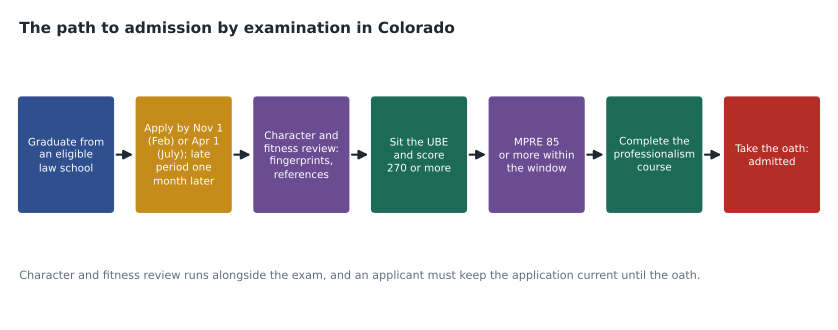
For an applicant seeking admission by examination, the requirements come down to six. You must be eligible, which in Colorado usually means holding a J.D. or LL.B. from a law school approved by the American Bar Association (ABA) by the time of the exam; Lesson 2 explains the narrower routes for graduates of state-accredited and foreign law schools. You must file a complete application by the deadline and pay the fee. You must pass the bar exam, which in Colorado today is the UBE, with a total scaled score of at least 270. You must pass the MPRE with a scaled score of at least 85 within the time window the rules allow. You must satisfy the court that you have the character and fitness to practice law. And you must complete Colorado's professionalism course before you take the oath.
That last requirement is distinctively Colorado. The professionalism course is presented by the Office of Attorney Regulation Counsel together with the Colorado Bar Association's continuing legal education arm. It covers the practical side of professional life in Colorado: the rules of professional conduct as they apply to new lawyers, trust accounts, civility, the attorney registration system and resources for lawyers in difficulty. It is not a test of Colorado law and it does not affect your exam score, but you cannot be admitted until you finish it, and the credit is valid for eighteen months after you complete it. Lesson 3 returns to it.
Look at what is not on the list. As of November 2026, Colorado does not add a separate state-law test to the UBE, and it does not require a separate online course on Colorado substantive law of the kind some states use. NCBE's information for Colorado lists no jurisdiction-specific component for the current exam. Whether the NextGen exam will come with a Colorado component is still listed as to be announced; Lesson 5 explains what that means.
Two numbers to remember: 270 and 85
Colorado's passing score of 270 sits at the top of the range among UBE jurisdictions, where passing scores run from 260 to 270. Its MPRE requirement of 85 is likewise near the top of the national range, which runs from 75 to 86. These numbers matter in two ways. First, they set the target for your preparation: a candidate who would pass comfortably in a 260 jurisdiction can fail in Colorado with the same performance. Second, they shape score portability: a 270 earned in Colorado meets the passing score of every UBE jurisdiction, while a score earned elsewhere must reach 270 to transfer into Colorado.
Colorado once asked for even more. Until the court's 2022 order, the passing score was 276, one of the highest in the country. The court lowered it to 270 for the February 2023 exam and later, and the same change applies to scores transferred from other jurisdictions' February 2023 and later exams. A score from an earlier exam still has to meet the old 276 standard to transfer. Marchetti uses this to make a point Luke will hear again: 'Passing scores are policy decisions. They change. Always check the number that applies to the exam you are actually taking.'
The order of events
Most Colorado applicants move through the process in a predictable order. During law school, they take the MPRE, keeping in mind Colorado's time window for the score, which Lesson 3 explains. In the final year, they gather what the application asks for: ten years of employment history, residence history, records for anything that requires a 'yes' answer on the character questions, and the names of references. They file the electronic application by the regular deadline, upload the minimum documents needed to submit it, and complete fingerprinting through an approved vendor. They then sit the exam on the last Tuesday and Wednesday of February or July. Results follow some weeks later. A successful candidate who has met every other requirement completes the professionalism course if not already done, receives approval from the court and takes the oath of admission.
Two features of the Colorado calendar surprise people. The first is the late filing period: unlike some states, Colorado accepts applications for a month after the regular deadline, until December 1 for February and May 1 for July, but charges a substantial late fee. The second is the repeat window: an applicant who sits the February exam and does not pass may apply for the following July exam until May 31. Lesson 2 covers both, along with the fees.
Worked problem
Planning Luke's calendar
Luke wants to sit the February 2027 exam. He took the MPRE in August 2025 and scored 90. When should his application be filed, and what else must he finish before he can be admitted?
Show solution
- The regular deadline for the February exam is November 1 of the preceding year; the late deadline is December 1, with a late fee. Filing by November 1, 2026 avoids the late fee.
- His MPRE score of 90 exceeds Colorado's required 85.
- He must confirm that the score falls within the time window the rules set for unlicensed applicants (Lesson 3 explains the window and why he should check it against the date his application is accepted).
- Before the oath he must complete the professionalism course, and he must take the oath within the time the court allows after approval.
Answer: File by November 1, 2026; confirm the MPRE window; take the professionalism course before the oath.
Where candidates go wrong
The first common mistake is treating the 270 as a formality. Because UBE scores are equated across administrations, the same performance earns roughly the same score wherever it is earned. The difference between a 266 and a 270 can be a handful of MBE questions and part of one essay grade. Candidates who would pass in a lower-score state sometimes fall just short in Colorado.
The second is relying on the late deadline. The late filing period is a safety valve, not a plan. The late fee is substantial, and late filers have less time to gather third-party documents, answer follow-up questions and arrange accommodations. The exam instructions also say plainly that the application and fees will not be accepted after the late deadline.
The third is forgetting the professionalism course. Some candidates learn about it only after results come out, and then wait for the next available session before they can be sworn in. Others take it too early and let the eighteen-month credit lapse before they are admitted. Plan it as part of the calendar.
The fourth is treating the application as a one-time event. The instructions require applicants to report changes within ten days using an amendment form, and they warn that an applicant's character and fitness status can change at any point until the oath. A new citation, lawsuit, debt problem or change of address after filing must be reported.
Common mistakes
MistakeColorado adds a state-law test or required Colorado law course to the UBE.
InsteadAs of November 2026, Colorado gives the UBE with no jurisdiction-specific component; the required professionalism course is about professional practice, not a test of Colorado law.
MistakeThe Colorado Bar Association licenses and disciplines lawyers.
InsteadThe Colorado Supreme Court controls admission and discipline through the Office of Attorney Regulation Counsel; the bar association is voluntary.
MistakeThe passing score is 276.
InsteadThe court lowered it to 270 for the February 2023 exam and later; 276 still applies to transferred scores from earlier exams.
MistakeThere is no way to file after November 1 for February.
InsteadColorado accepts late applications until December 1 with a late fee; nothing is accepted after that.
How to use this course
Each lesson ends with a short quiz, and the course ends with a twenty-question exam. Lessons 1 through 6 and Lesson 11 cover the admission process: who may sit, what the exam is, how it is scored, what will change and what happens after. Lessons 7 through 10 turn to Colorado law itself: its courts and procedure, its tort law and governmental immunity, its water and property law, and its family law, wills and probate. The current exam does not test Colorado law directly, so treat those lessons as preparation for practice, for the questions clients ask in the first year, and for whatever Colorado component the court may add with NextGen. Lesson 12 pulls the substantive lessons together in original practice questions and an essay, and closes with an exam-week plan.
Facts about the admission process in this course come from the Colorado Supreme Court's rules and announcements, the Office of Attorney Admissions' exam instructions and information pages, and NCBE's published jurisdiction information, as they stood in November 2026. Where a fact could not be confirmed from an official source, the course says so or describes it in general terms. Rules and fees change, so the course keeps telling you to read the current instructions yourself.
Luke leaves the first session with an assignment: find the attorney admission rules, read Rule 203.4, download the instructions for the February 2027 exam, and look up when the next professionalism course sessions are offered. 'You do not need to memorize the rules,' Marchetti says. 'You need to know where they are, and you need to read them yourself before every deadline.'
Summary and key terms
- The Colorado Supreme Court controls admission; the Office of Attorney Admissions, within the Office of Attorney Regulation Counsel, runs the process; NCBE writes and scores the national tests.
- There are three main routes: admission by examination (C.R.C.P. 203.4), by transferred UBE score (203.3) and on motion (203.2), plus a 2026 supervised admission pilot (203.6).
- Exam applicants need an eligible law degree, a timely application, a UBE score of 270 or more, an MPRE score of 85 or more within the window, character and fitness approval and the professionalism course.
- The passing score was lowered from 276 to 270 starting with the February 2023 exam.
- Regular deadlines are November 1 (February) and April 1 (July), with late deadlines a month later and a late fee.
- Office of Attorney Admissions
- The office within the Colorado Supreme Court's Office of Attorney Regulation Counsel that handles applications, character and fitness, the bar exam and score transfers.
- Office of Attorney Regulation Counsel
- The supreme court office that handles admissions, registration, continuing legal education, discipline and paraprofessional licensing.
- Uniform Bar Examination (UBE)
- The NCBE exam made up of the MBE, MEE and MPT, given in Colorado since 2012.
- Professionalism course
- A required course on professional practice that new Colorado lawyers must complete before the oath; credit lasts eighteen months.
- Passing score
- The minimum total UBE score Colorado accepts: 270 for exams from February 2023 on.
Lesson quiz · 5 questions
Score 60% or more to complete this lesson.
Create a free account to save your progress, take quizzes and earn a certificate.