
BAR-206 · Lesson 7 of 12 · 15 min
Colorado courts and civil procedure
▶ Video coming soon A video version of this lesson is on the way.
Luke's supervising partner hands him a new file: a client rear-ended on Interstate 25 in Douglas County, with about 60,000 dollars in medical bills and lost wages, and an insurer that will not move. 'Draft the complaint,' she says, 'and tell me which court, which procedure track and what our deadlines are.' Luke realizes that the bar exam has taught him the Federal Rules of Civil Procedure in detail and Colorado procedure hardly at all. He spends the evening with the Colorado rules and brings his notes to Marchetti, who turns them into a lesson.
This lesson describes the Colorado court system and the parts of Colorado civil procedure that differ most from the federal rules tested on the MBE. It is not a full course in Colorado procedure, but it covers what a new lawyer needs in the first year: which court hears what, how a case starts, how pleading and disclosure work, the simplified procedure for smaller cases, key limitation periods, and how appeals begin.
The court system
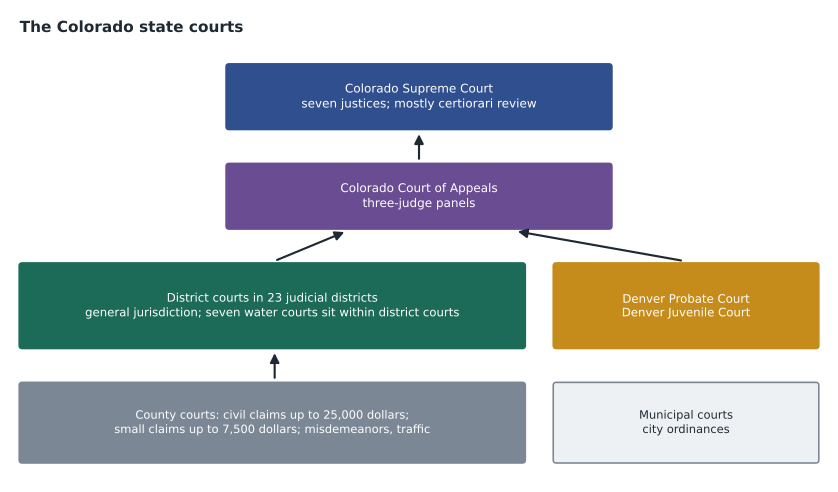
The Colorado Supreme Court is the court of last resort. It has seven justices and hears most cases on discretionary review by writ of certiorari, along with certain direct appeals and original proceedings. It also regulates the practice of law, adopts court rules and supervises the judicial branch.
The Colorado Court of Appeals is the intermediate appellate court. It hears most appeals from the district courts as of right, sitting in panels of three judges. Its published opinions are binding on trial courts unless the Supreme Court or a different panel says otherwise, a nuance Colorado lawyers learn quickly: Court of Appeals panels are not bound by other panels' decisions, so conflicting opinions can exist until the Supreme Court resolves them.
The district courts are the trial courts of general jurisdiction. They hear civil cases of any amount, felony criminal cases, domestic relations cases, probate (outside Denver), juvenile cases (outside Denver) and appeals from county courts. District courts are organized into judicial districts. In January 2025 Colorado created the 23rd Judicial District, covering Douglas, Elbert and Lincoln counties, by splitting off part of the former 18th Judicial District; it was the first new judicial district in more than six decades. Luke's Douglas County crash case therefore belongs in the 23rd Judicial District's district court.
County courts handle limited matters: civil cases up to 25,000 dollars, misdemeanors, traffic cases, preliminary felony proceedings, protection orders and small claims. The small claims division hears cases up to 7,500 dollars, with simplified procedures designed for people without lawyers. Denver has a distinctive structure: the Denver County Court is created by the Denver city charter, and Denver has separate Denver Probate Court and Denver Juvenile Court in place of the probate and juvenile jurisdiction that district courts exercise elsewhere.
Colorado also has specialized water courts, one in each of the state's seven water divisions, which adjudicate water rights. Lesson 9 returns to them. Municipal courts hear violations of city ordinances.
Starting a case and pleading
A civil action starts with the filing of a complaint, and most filing in Colorado's state courts is electronic through the judicial branch's e-filing system. Colorado requires a district court civil cover sheet with the complaint, on which the filing party indicates whether C.R.C.P. 16.1, the simplified procedure rule, applies. The answer has consequences for discovery, as explained below.
For many years Colorado followed the liberal notice pleading standard of Conley v. Gibson even after the federal courts moved away from it. That changed in Warne v. Hall, 2016 CO 50, where the Colorado Supreme Court adopted the plausibility standard of Bell Atlantic Corp. v. Twombly and Ashcroft v. Iqbal for motions to dismiss for failure to state a claim. Under C.R.C.P. 12(b)(5), as interpreted in Warne, a complaint must state enough facts to make the claim plausible, not merely conceivable. For drafting purposes, Colorado and federal pleading are now aligned.
Service and response times are similar to the federal rules in structure but differ in detail, so always check the current Colorado rule. Colorado lawyers also deal with a distinctive local practice rule, C.R.C.P. 121, which contains detailed practice standards for motions, including a duty to confer with opposing counsel before filing most motions and to state in the motion whether it is opposed.
Case management and disclosures
After a case is at issue, C.R.C.P. 16 governs case management. The parties confer, exchange initial disclosures and submit a proposed case management order, and the court enters an order setting deadlines for discovery, experts, dispositive motions and trial. Colorado adopted significant amendments in 2015 emphasizing proportionality and active case management, similar in spirit to the 2015 federal amendments: discovery should be proportional to the needs of the case, and courts are expected to manage cases actively from the start.
Initial disclosures under C.R.C.P. 26(a)(1) require each party, without a discovery request, to disclose witnesses likely to have discoverable information, documents and other materials relevant to the claims and defenses, a computation of damages, and insurance agreements. Colorado's disclosure duty is somewhat broader than the federal one, because it reaches information relevant to the claims and defenses of any party rather than only information the disclosing party may use. Expert disclosures follow under C.R.C.P. 26(a)(2) on the schedule the case management order sets.
Simplified procedure under C.R.C.P. 16.1
Colorado's simplified procedure is one of its most distinctive procedural features. C.R.C.P. 16.1 applies to most civil actions in which no party seeks a monetary judgment of more than 100,000 dollars against any other party, with exclusions for categories such as class actions, domestic relations, water law, probate and certain others listed in the rule. A 2018 revision made simplified procedure mandatory for most eligible cases, ending the earlier practice under which parties could routinely opt out.
The bargain is speed and lower cost in exchange for limited discovery. In a simplified procedure case, parties make expanded initial disclosures, including fuller information about witnesses and documents, and formal discovery is sharply limited: depositions and other discovery are restricted unless the court allows more for good cause. Damages are effectively capped at 100,000 dollars against each party, exclusive of interest and costs, unless the case is removed from simplified procedure. Lawyers must therefore decide at the outset whether a case belongs under 16.1, because claiming no more than 100,000 dollars has real consequences.
Worked problem
Choosing the track for Luke's crash case
The client's economic damages are about 60,000 dollars so far, with noneconomic damages for pain and lost enjoyment of life. The defendant driver has typical liability insurance. Should the case proceed under C.R.C.P. 16.1?
Show solution
- C.R.C.P. 16.1 applies to most cases in which no party seeks more than 100,000 dollars from any other party.
- If the client's total damages, including noneconomic damages, are likely to exceed 100,000 dollars, proceeding under 16.1 would effectively cap recovery at that amount against the driver.
- If the claim is likely to stay under 100,000 dollars and the facts are simple, 16.1's faster track and expanded disclosures may serve the client well.
- The decision must be made at filing and reflected on the civil cover sheet; it should be discussed with the client.
Answer: If damages may exceed 100,000 dollars, plead the full claim outside 16.1; if not, 16.1 may be a sensible, cheaper track.
Limitation periods
Colorado's statutes of limitations appear in article 80 of title 13. Several periods come up constantly. Most tort actions, including negligence, must be brought within two years after the cause of action accrues, under C.R.S. 13-80-102. Actions arising from the use or operation of a motor vehicle, other than for damage to the vehicle alone, generally have three years under C.R.S. 13-80-101. Most contract actions have three years. Some actions to recover liquidated debts have six years. Claims against public entities and employees are subject to the Colorado Governmental Immunity Act's separate notice requirement, which Lesson 8 explains and which can cut off a claim long before the limitation period runs. Always check the specific statute for the specific claim; Colorado has many special periods.
| Claim | Typical Colorado period | Source |
|---|---|---|
| Most tort actions (negligence, many personal injury claims) | Two years | C.R.S. 13-80-102 |
| Personal injury from use or operation of a motor vehicle | Three years | C.R.S. 13-80-101 |
| Most contract actions | Three years | C.R.S. 13-80-101 |
| Certain liquidated debts | Six years | C.R.S. 13-80-103.5 |
| Claims against public entities | Written notice within 182 days of discovering the injury, plus the limitation period | Colorado Governmental Immunity Act |
Anti-SLAPP protection
In 2019 Colorado enacted an anti-SLAPP statute, C.R.S. 13-20-1101, aimed at lawsuits that target speech or petitioning on public issues. A defendant sued over such activity may file a special motion to dismiss early in the case. If the defendant shows the claim arises from protected activity, the plaintiff must establish a reasonable likelihood of prevailing, and a successful movant can recover attorney fees. Colorado courts have looked to California's anti-SLAPP case law in interpreting the statute, which was modeled in part on California's.
Appeals
A party appeals a final judgment of a district court to the Court of Appeals by filing a notice of appeal under the Colorado Appellate Rules. In civil cases, the notice is due within 49 days after entry of the judgment, a period that differs from the federal rule's thirty days. Missing the deadline is generally fatal to the appeal, so new lawyers should calendar it the day judgment enters. Review in the Supreme Court is mostly by petition for writ of certiorari after the Court of Appeals decides. Certain orders can be challenged in the Supreme Court through original proceedings under C.A.R. 21, which the court grants sparingly.
Common mistakes
MistakeColorado still applies Conley v. Gibson notice pleading.
InsteadWarne v. Hall, 2016 CO 50 adopted the Twombly and Iqbal plausibility standard.
MistakeParties can freely opt out of simplified procedure.
InsteadSince the 2018 revision, C.R.C.P. 16.1 is mandatory for most cases seeking no more than 100,000 dollars against any party.
MistakeA Colorado civil notice of appeal is due in thirty days, as in federal court.
InsteadThe Colorado Appellate Rules allow 49 days in civil cases.
MistakeAll negligence claims have three years.
InsteadMost torts have two years; motor vehicle personal injury claims generally have three.
Discovery practice in a standard case
Outside simplified procedure, Colorado discovery resembles federal discovery in its tools: interrogatories, requests for production, requests for admission and depositions. The Colorado rules set presumptive limits on the number of interrogatories, requests and depositions, which the court can adjust in the case management order. Because the 2015 amendments emphasize proportionality, parties seeking more discovery than the presumptive limits should explain why the needs of the case justify it, considering the amount in controversy, the importance of the issues and the burden involved.
Colorado courts take conferral seriously. A motion to compel discovery that does not describe the parties' good-faith efforts to resolve the dispute can be denied on that ground alone. New lawyers should document conferral by email, propose compromises, and keep the tone professional, because judges read the exchanges attached to discovery motions.
Juries, trials and costs
Colorado preserves civil jury trials by statute and rule, and parties must demand a jury and pay a jury fee within the time the rules require, or the case will be tried to the court. The prevailing party generally recovers costs, and Colorado statutes provide for attorney fees in specific situations, such as frivolous or groundless claims and defenses. Colorado also has a statutory offer-of-settlement procedure that shifts certain costs to a party who rejects an offer and then does worse at trial. Each of these rules has precise requirements and deadlines, which new lawyers should check before relying on them.
A first-year litigator's checklist
Luke's supervising attorney gives him a checklist for every new case. Calendar the limitation period and every rule-based deadline the day the file opens. Confirm the right court and venue. Decide whether simplified procedure applies and whether to opt out. Prepare initial disclosures early, because they shape the whole case. Confer in good faith before filing any motion and record the conferral. And read the assigned judge's practice standards, which many Colorado judges publish and which can add requirements beyond the rules themselves.
Summary and key terms
- Colorado has a seven-justice Supreme Court, a Court of Appeals, district courts in 23 judicial districts, county courts (civil up to 25,000 dollars; small claims up to 7,500 dollars), seven water courts and special Denver probate and juvenile courts.
- Warne v. Hall, 2016 CO 50 adopted the plausibility pleading standard.
- C.R.C.P. 16 and 26 require active case management and broad initial disclosures; C.R.C.P. 121 requires conferral before most motions.
- C.R.C.P. 16.1 simplified procedure is mandatory for most cases seeking no more than 100,000 dollars against any party and limits discovery.
- Most torts have a two-year limitation period; motor vehicle injury claims generally three; civil notices of appeal are due in 49 days.
- District court
- Colorado's trial court of general jurisdiction, organized into judicial districts.
- County court
- A limited-jurisdiction court hearing civil cases up to 25,000 dollars, misdemeanors, traffic and small claims.
- Simplified procedure
- C.R.C.P. 16.1's mandatory track for most cases seeking no more than 100,000 dollars, with expanded disclosures and limited discovery.
- C.R.C.P. 121
- Colorado's local practice rule, including the duty to confer before filing most motions.
- Water court
- One of seven Colorado courts, one per water division, that adjudicate water rights.
Lesson quiz · 5 questions
Score 60% or more to complete this lesson.
Create a free account to save your progress, take quizzes and earn a certificate.