
BAR-206 · Lesson 6 of 12 · 15 min
What the exam tests and how Colorado law appears
▶ Video coming soon A video version of this lesson is on the way.
At work, Luke spends a morning researching whether a client's claim against a driver is barred because the client was partly at fault. The answer under Colorado law is clear and specific: a plaintiff recovers only if his negligence is less than the defendant's. That evening he answers an MBE torts question that asks him to apply comparative negligence, and he chooses an answer built on the Colorado rule. He gets it wrong. The question, read carefully, assumed pure comparative negligence. 'Welcome to the bar exam's split personality,' Marchetti says. 'The exam tests general law. Your job tests Colorado law. You need both, and you need to keep them in separate boxes.'
This lesson explains what law the Colorado bar exam tests, what law it does not, where Colorado law comes from, and the places where Colorado's rules differ from the general rules you will use on exam day. It sets up Lessons 7 through 10, which cover Colorado law in more depth.
The exam tests general law
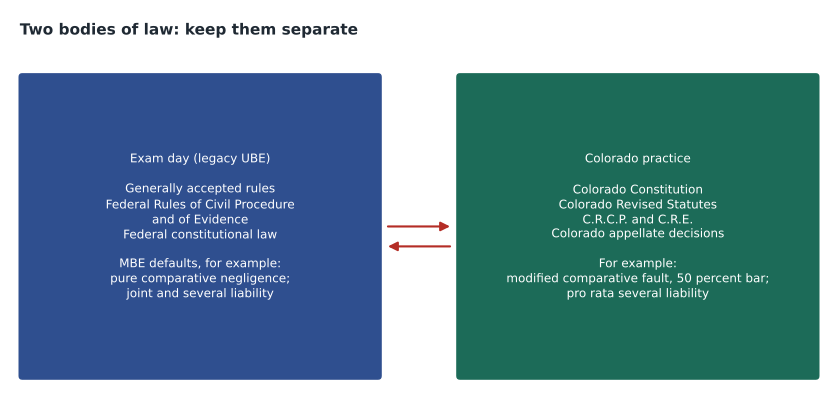
The current Colorado exam is the UBE with no Colorado component. The MBE asks questions under generally accepted principles of law, the Federal Rules of Civil Procedure, the Federal Rules of Evidence and federal constitutional law. The MEE and the MPT are graded using NCBE's materials, which apply generally accepted rules or, on the MPT, the law supplied in the library. No part of the current exam asks what Colorado law requires.
That has a practical consequence for study. When an exam question turns on a point where Colorado differs from the majority rule, the right exam answer is the general rule, unless the question itself tells you to apply something else. NCBE's MBE subject matter outline sets defaults for some topics; for example, torts questions assume pure comparative negligence and joint and several liability unless the question says otherwise. Colorado follows neither of those rules, as Lesson 8 explains. A candidate who answers MBE questions with Colorado's rules will lose points.
The reverse matters after the exam. Once admitted, Luke will advise clients under Colorado law, and the general rules he memorized for the MBE will sometimes be wrong for his clients. The lessons that follow are written for that second job. They also prepare candidates for any Colorado-specific component the court may add with NextGen.
Where Colorado law comes from
The Colorado Constitution, adopted in 1876 when Colorado became the thirty-eighth state, is the foundation. It is long and frequently amended, in large part because Colorado voters can amend it by initiative. Several of the state's best-known legal features came this way: the Taxpayer's Bill of Rights (TABOR) in Article X, section 20, approved in 1992, which limits government revenue and requires voter approval of new taxes; Amendment 64 in 2012, which legalized adult recreational marijuana under state law; and the doctrine of prior appropriation for water, which appears in Article XVI.
Statutes are collected in the Colorado Revised Statutes, cited as C.R.S. with a title, article and section number, such as C.R.S. 13-21-111 for the comparative negligence statute. The General Assembly meets each year from January to May, so statutes change annually, and many take effect in the summer after passage.
Court rules come from the Colorado Supreme Court. The Colorado Rules of Civil Procedure (C.R.C.P.) are modeled on the federal rules but differ in important ways, as Lesson 7 explains. The Colorado Rules of Evidence (C.R.E.) closely follow the Federal Rules of Evidence. The Colorado Rules of Professional Conduct follow the ABA Model Rules with Colorado variations, some of which Lesson 11 covers.
Case law comes from two appellate courts. The Colorado Supreme Court is the court of last resort. The Colorado Court of Appeals is the intermediate appellate court. Since 2012, both courts have used public domain citations: Colorado Supreme Court opinions are cited by year and the abbreviation CO, such as 2021 CO 1, and Court of Appeals opinions by year and COA, such as 2016 COA 50. Paragraph numbers within the opinion serve as pinpoint citations. Earlier opinions are cited to the Pacific Reporter.
| Source | Example | How to cite or find it |
|---|---|---|
| Constitution | TABOR, Article X, section 20 | Colo. Const. art. X, section 20 |
| Statutes | Comparative negligence | C.R.S. 13-21-111 |
| Court rules | Simplified civil procedure | C.R.C.P. 16.1 |
| Supreme Court opinions | Common-law marriage test | In re Marriage of Hogsett and Neale, 2021 CO 1 |
| Court of Appeals opinions | Intermediate appellate decisions | Cited by year and COA, such as 2016 COA 50 |
Where Colorado departs from the exam's rules
Most of the time, Colorado law and the general rules point the same way. A handful of differences come up often enough in practice that every new Colorado lawyer should know them. The list below previews the topics covered in later lessons.
In torts, Colorado uses modified comparative fault: a plaintiff recovers only if his negligence is less than the negligence of the person against whom recovery is sought, and the award is reduced by his share. Colorado has largely abolished joint and several liability in favor of pro rata several liability, under which each defendant generally pays only its share, with exceptions such as defendants who consciously act together. Colorado caps noneconomic damages by statute, and the caps rose substantially for claims accruing on or after January 1, 2025. Claims against public entities are governed by the Colorado Governmental Immunity Act, with its own notice requirement and damages limits. Lesson 8 covers all of these.
In civil procedure, the Colorado Supreme Court adopted the plausibility standard for pleading in Warne v. Hall, 2016 CO 50, aligning Colorado with the federal Twombly and Iqbal standard. But Colorado practice has distinctive features, including mandatory initial disclosures with Colorado's own timing, case management under C.R.C.P. 16, and a simplified procedure under C.R.C.P. 16.1 for many cases seeking no more than 100,000 dollars. Lesson 7 covers these.
In property, Colorado's recording act is a race-notice statute, and Colorado water rights are governed by prior appropriation, adjudicated in special water courts. Colorado recognizes common-law marriage. Colorado is an equitable distribution state for divorce, not a community property state. Its probate code is based on the Uniform Probate Code, recognizes holographic wills, and gives a surviving spouse an elective share that grows with the length of the marriage. Lessons 9 and 10 cover property, family law and probate.
In criminal law, two recent changes stand out. Colorado abolished the death penalty for offenses charged on or after July 1, 2020, and later commuted the sentences of the remaining people on death row. And Colorado's voters have legalized adult recreational marijuana (2012) and, through Proposition 122 in 2022, regulated access to certain natural medicines such as psilocybin, while federal law continues to treat these substances differently. That gap between state and federal law creates questions about what lawyers may advise, which Lesson 11 touches on.
| Topic | General (exam) rule | Colorado rule |
|---|---|---|
| Comparative fault | Pure comparative negligence (MBE default) | Modified: plaintiff recovers only if less at fault than the defendant |
| Multiple defendants | Joint and several liability (MBE default) | Pro rata several liability, with exceptions |
| Pleading standard | Plausibility (Twombly, Iqbal) | Plausibility adopted in Warne v. Hall, 2016 CO 50 |
| Recording act | Varies; questions specify | Race-notice |
| Marital property | Varies; questions specify | Equitable distribution; common-law marriage recognized |
| Water rights | Riparian rights in many states | Prior appropriation; water courts |
Worked problem
Separate boxes in action
An MBE question: a pedestrian 40 percent at fault sues a driver 60 percent at fault; damages are 100,000 dollars; the question does not mention a comparative fault statute. What does the pedestrian recover on the exam, and what would she recover in a Colorado court?
Show solution
- On the exam, the MBE default is pure comparative negligence: she recovers 100,000 dollars reduced by her 40 percent share, or 60,000 dollars.
- In Colorado, C.R.S. 13-21-111 lets her recover because her negligence (40) is less than the driver's (60).
- Her award is also reduced by her share: 60,000 dollars, subject to any applicable damages caps.
- If she were 50 percent at fault, the exam answer would be 50,000 dollars, but Colorado would bar recovery because her negligence would not be less than the driver's.
Answer: Here both give 60,000 dollars; they diverge when the plaintiff's share reaches the defendant's.
How to study both
Marchetti suggests a simple system. Study for the exam using general rules, and keep a separate notebook titled 'Colorado differs' for the points in this lesson and those that follow. When you finish an MBE or MEE practice set, glance at the notebook only after scoring yourself. That keeps the two systems from blurring on exam day while building the Colorado knowledge you will need in practice.
For research in practice, Colorado's statutes are available free from the General Assembly's official publication arrangements and through commercial services, and opinions are available from the Colorado Judicial Branch and commercial databases. The Colorado Bar Association's journal, The Colorado Lawyer, publishes practical articles on Colorado law and rule changes, and its continuing legal education arm publishes practice books on most areas of Colorado law. These are where a new lawyer finds answers the bar exam never asked.
Common mistakes
MistakeOn the MBE, apply Colorado's comparative fault rule because the exam is given in Colorado.
InsteadThe MBE applies its defaults, such as pure comparative negligence, unless the question says otherwise.
MistakeColorado still uses notice pleading as described in Conley v. Gibson.
InsteadThe Colorado Supreme Court adopted the plausibility standard in Warne v. Hall, 2016 CO 50.
MistakeColorado is a community property state.
InsteadColorado divides marital property by equitable distribution.
MistakeColorado opinions are cited only to regional reporters.
InsteadSince 2012 Colorado uses public domain citations such as 2021 CO 1 and 2016 COA 50.
Federal law in Colorado practice
Some of the most important law for Colorado practitioners is federal. Colorado is in the Tenth Circuit, whose decisions bind the federal district court in Denver, and the United States District Court for the District of Colorado is a busy court for civil rights, employment, environmental and public lands cases. Much of western Colorado is federal land, so public lands, mining, grazing and recreation questions often turn on federal statutes and agency decisions. Tribal law matters too: the Southern Ute Indian Tribe and the Ute Mountain Ute Tribe have reservations in southwestern Colorado, and matters involving tribal members and land can raise questions of tribal and federal jurisdiction.
The tension between state and federal law is sharpest for marijuana. Colorado's constitution permits adult use and a regulated industry, while federal law has long classified marijuana as a controlled substance. Banking, taxation, employment and immigration questions for clients in the industry often turn on federal rules. Lawyers advising these clients must understand both systems and explain the federal risks plainly.
A study routine for the 'Colorado differs' notebook
Marchetti suggests that Luke add one entry to his notebook each time he meets a Colorado rule at work that differs from what he studied. Each entry has four lines: the general rule, the Colorado rule, the citation, and one sentence on why it matters to clients. By the time he is sworn in, the notebook becomes a quick reference for his first years of practice. 'Your bar outlines will be out of date within a year,' she says. 'A notebook of real Colorado rules, with citations, will keep paying off.'
She also suggests reading one Colorado Supreme Court opinion a week after the exam, chosen from areas he practices in. The court's opinions are short enough to read in an evening, they use paragraph numbering that makes citing easy, and they show how Colorado's judges reason about Colorado statutes. Over a year, that habit builds familiarity with the court's approach that no outline can provide.
Reading Colorado statutes
Colorado statutes are cited by title, article and section, so C.R.S. 13-21-111 is title 13 (courts and court procedure), article 21 (damages), section 111. Learning the main titles saves time: title 13 covers courts and procedure, title 14 domestic matters, title 15 probate and trusts, title 24 government (including the Governmental Immunity Act), title 37 water, and title 38 property. When reading a statute, check the effective date and any later amendments, because the General Assembly amends many statutes every session and the version that governs a client's matter may depend on when the claim arose or the transaction closed.
Colorado's official statutes are published by the state, and free online versions are widely available. For research that matters, confirm the text against an official or annotated source, and check the session laws for recent changes that online versions may not yet show.
Summary and key terms
- The current Colorado exam tests general law and federal rules; it does not test Colorado law.
- Answer exam questions with general rules and MBE defaults; keep Colorado's differences in a separate notebook for practice.
- Colorado law comes from a frequently amended constitution, the Colorado Revised Statutes, supreme court rules and the opinions of the Supreme Court and Court of Appeals.
- Key differences include modified comparative fault, pro rata several liability, damages caps, governmental immunity, a race-notice recording act, prior appropriation, common-law marriage and equitable distribution.
- C.R.S.
- Colorado Revised Statutes, cited by title, article and section.
- C.R.C.P.
- Colorado Rules of Civil Procedure, adopted by the Colorado Supreme Court.
- Public domain citation
- Colorado's citation format since 2012, such as 2021 CO 1 for the Supreme Court and 2016 COA 50 for the Court of Appeals.
- TABOR
- The Taxpayer's Bill of Rights, Colo. Const. art. X, section 20, adopted by voters in 1992.
- Prior appropriation
- The water law doctrine that the first person to put water to beneficial use has the senior right.
Lesson quiz · 5 questions
Score 60% or more to complete this lesson.
Create a free account to save your progress, take quizzes and earn a certificate.