
BAR-206 · Lesson 8 of 12 · 17 min
Colorado torts: comparative fault, damages caps and governmental immunity
▶ Video coming soon A video version of this lesson is on the way.
Two new files land on Luke's desk in the same week. In the first, a cyclist was struck by a delivery van in Aurora; the van driver ran a red light, but the cyclist was riding at night without a front light. In the second, a hiker broke her ankle on a collapsed boardwalk at a county open space park in Jefferson County, and she did not call a lawyer until four months later. 'Two classic Colorado problems,' his supervising partner says. 'One is about comparative fault and who pays what share. The other is about a public entity and a deadline that has probably already started running. Figure out both before Friday.'
This lesson covers the parts of Colorado tort law that matter most in early practice and differ most from the MBE: modified comparative fault, pro rata several liability and nonparty designation, statutory damages caps, exemplary damages, the Premises Liability Act, and the Colorado Governmental Immunity Act.
Modified comparative fault
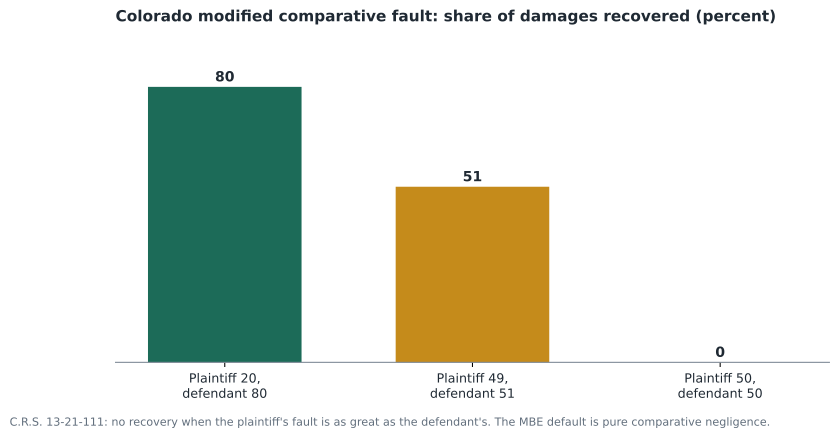
Colorado's comparative negligence statute, C.R.S. 13-21-111, provides that a plaintiff's contributory negligence does not bar recovery if it was not as great as the negligence of the person against whom recovery is sought. Any damages awarded are reduced in proportion to the plaintiff's share of fault. In practical terms, a plaintiff who is 40 percent at fault and a defendant who is 60 percent at fault produces a recovery reduced by 40 percent. A plaintiff who is 50 percent at fault against a single defendant who is 50 percent at fault recovers nothing, because the plaintiff's negligence is as great as the defendant's.
This is often called a 50 percent bar rule, as opposed to the 51 percent bar used in some other states, where a plaintiff can recover when fault is split evenly. The difference matters in close cases, and juries in Colorado are instructed accordingly. On the MBE, by contrast, the default is pure comparative negligence, under which even a plaintiff who is mostly at fault recovers a reduced amount.
Pro rata several liability and nonparty designation
Colorado largely abolished joint and several liability in 1986. Under C.R.S. 13-21-111.5, a defendant is generally liable only for the share of damages that corresponds to its own percentage of fault, not for the whole judgment. Each defendant therefore pays its share, and the plaintiff bears the risk that an at-fault party cannot pay. The main exception is for defendants who consciously conspire or deliberately pursue a common plan to commit a tortious act; they remain jointly liable.
Pro rata liability makes nonparty designation important. A defendant may designate a nonparty, someone not sued, whom the defendant claims is wholly or partly at fault, so that the jury can assign a share of fault to that person. The designation must be made within a deadline set by the statute, generally ninety days after the case begins, with the nonparty's name and the basis for the claim of fault. Fault assigned to a designated nonparty reduces what the named defendants pay, even though the plaintiff cannot collect that share from anyone in the case. For plaintiffs' lawyers, that is a reason to identify and sue every potentially responsible party early.
Worked problem
The Aurora cyclist
The jury finds total damages of 200,000 dollars and assigns fault as follows: van driver 60 percent, cyclist 25 percent, and a designated nonparty (the city, for a poorly timed signal) 15 percent. What does the cyclist recover from the van driver's employer, which is the only defendant?
Show solution
- The cyclist's 25 percent is less than the defendant's 60 percent, so recovery is not barred.
- Under pro rata several liability, the defendant pays only its own share: 60 percent of 200,000 dollars, or 120,000 dollars.
- The 15 percent assigned to the designated nonparty is not paid by the defendant and is not recoverable in this action.
- Noneconomic damages within the award must also respect the statutory cap, but the total here is well below it.
Answer: The cyclist recovers 120,000 dollars from the defendant; the nonparty's share is lost unless pursued separately, and a claim against the city would face the Governmental Immunity Act.
Damages caps
Colorado caps noneconomic damages by statute, and the caps changed significantly in 2024. Legislation adopted that year (House Bill 24-1472) raised the general cap on noneconomic damages in personal injury actions to 1,500,000 dollars for claims accruing on or after January 1, 2025, and raised the cap on noneconomic damages in wrongful death actions to 2,125,000 dollars, both subject to future inflation adjustment. Before the change, the general caps had been far lower and had not kept pace with inflation, which was a major reason for the legislation.
Claims against health care professionals are treated separately. Companion provisions raise the noneconomic damages cap in medical malpractice cases in steps, reaching 875,000 dollars for injury claims in 2029, with a separate total cap in wrongful death cases against health care professionals. Because the caps depend on when a claim accrued and on the type of defendant, lawyers must check the version of the statute that applies to the specific claim.
Economic damages, such as medical expenses and lost earnings, are generally not capped in ordinary personal injury cases. Wrongful death claims are governed by Colorado's wrongful death statute, which defines who may sue and in what order, and which has its own rules on damages, including a cap on noneconomic damages and special treatment of certain claims.
| Claim type | Noneconomic damages cap (as revised in 2024) | Notes |
|---|---|---|
| General personal injury | 1,500,000 dollars | Claims accruing on or after January 1, 2025; inflation-adjusted in future |
| Wrongful death (non-medical) | 2,125,000 dollars | Same timing; inflation-adjusted in future |
| Medical malpractice injury | Rises in steps to 875,000 dollars in 2029 | Separate schedule for claims against health care professionals |
| Claims against public entities | Governmental Immunity Act limits (see below) | Limits on total recovery, not just noneconomic damages |
Exemplary damages
Colorado calls punitive damages exemplary damages, and C.R.S. 13-21-102 controls them. Exemplary damages may be awarded when the injury is attended by circumstances of fraud, malice or willful and wanton conduct, which must be proved beyond a reasonable doubt. Two features stand out. First, a plaintiff may not include a claim for exemplary damages in the initial complaint. The claim may be added by amendment only after the exchange of initial disclosures and after the plaintiff establishes prima facie proof of a triable issue. Second, the award is generally limited to an amount equal to the actual damages awarded, although the court may increase it, up to three times actual damages, in circumstances the statute describes, such as continued misconduct during the case.
The Premises Liability Act
Colorado replaced common-law premises liability rules with a statute, C.R.S. 13-21-115. The act classifies people on land as trespassers, licensees or invitees and sets the landowner's duty to each by statute. A landowner is liable to a trespasser only for damages willfully or deliberately caused. A licensee may recover for the landowner's unreasonable failure to exercise reasonable care with respect to dangers the landowner actually knew about. An invitee may recover for the landowner's unreasonable failure to exercise reasonable care to protect against dangers the landowner actually knew about or should have known about. The statute is the exclusive remedy for injuries caused by the condition of property or activities on it, so a plaintiff cannot avoid it by pleading general negligence.
Colorado also has statutes that shape recreational injury cases, which are common in a state with ski areas, rivers and trails. The Ski Safety Act limits ski area liability for injuries resulting from the inherent dangers and risks of skiing and imposes duties on both skiers and ski area operators. Recreational use statutes limit the liability of landowners who open land to the public without charge. Each has detailed terms, and each should be checked before taking a recreational injury case.
The Colorado Governmental Immunity Act
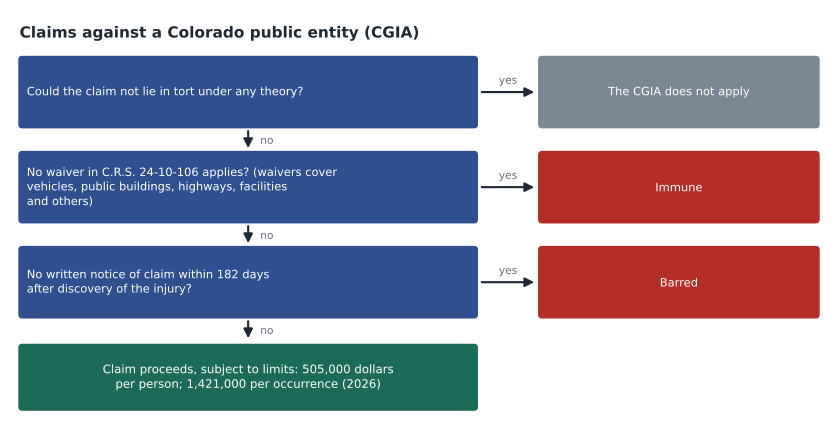
Claims against Colorado public entities, such as the state, counties, cities, school districts and special districts, and against their employees, are governed by the Colorado Governmental Immunity Act (CGIA), C.R.S. 24-10-101 and following. The act starts from immunity: public entities are immune from liability for claims that lie or could lie in tort, unless the act waives immunity for the type of claim. The waivers in C.R.S. 24-10-106 cover specific situations, including the operation of a motor vehicle by a public employee, dangerous conditions of public buildings, dangerous conditions of public highways, roads and streets that physically interfere with traffic, dangerous conditions of certain public facilities such as public hospitals, jails, parks and recreation facilities, and the operation of certain utilities. Whether a claim fits a waiver is a threshold question the court decides early.
The CGIA's notice requirement is where many claims die. A person claiming injury by a public entity or employee must file a written notice of claim within 182 days after the date of discovery of the injury, whether or not the person then knew all the elements of the claim. The notice must contain specified information and be delivered to the right officials. Compliance is a jurisdictional prerequisite: a late or defective notice can bar the claim entirely, even if the limitation period has not run.
The CGIA also limits recovery. The maximum amounts are adjusted every four years. For the 2026 adjustment period, the limits are 505,000 dollars for injury to one person in a single occurrence and 1,421,000 dollars for injuries to two or more persons in a single occurrence, with no one person recovering more than the per-person limit. These limits apply to the total judgment against the public entity, not just noneconomic damages, and they do not apply to claims under federal law, such as civil rights claims.
Worked problem
The Jefferson County boardwalk
The hiker was injured on a collapsed boardwalk in a county open space park on July 10. She calls Luke's firm on November 12. What must the firm do first?
Show solution
- Identify the defendant: the county is a public entity, so the CGIA governs.
- Identify a waiver: a dangerous condition of a public facility located in a park or recreation area may fall within C.R.S. 24-10-106, depending on the facts and the statutory definitions.
- Calendar the notice deadline: 182 days after discovery of the injury on July 10 falls in early January of the following year.
- Prepare and deliver a compliant written notice of claim well before that date; a late notice could bar the claim even though the tort limitation period would not yet have run.
Answer: File a compliant CGIA notice of claim immediately, well inside 182 days, and analyze the facility waiver.
Common mistakes
MistakeA Colorado plaintiff who is 50 percent at fault recovers half her damages.
InsteadUnder C.R.S. 13-21-111 she recovers nothing against a defendant who is equally at fault.
MistakeEach defendant in Colorado is jointly liable for the whole judgment.
InsteadColorado uses pro rata several liability under C.R.S. 13-21-111.5, except for conscious concerted action.
MistakeExemplary damages can be pleaded in the original complaint.
InsteadThey may be added only by amendment after initial disclosures and a prima facie showing.
MistakeThe two-year tort limitation period is the only deadline for claims against a county.
InsteadThe CGIA requires a written notice of claim within 182 days after discovery of the injury.
Workers' compensation and other overlaps
Many injury cases intersect with other systems. If an injured person was working at the time, Colorado's workers' compensation system usually provides the exclusive remedy against the employer, though claims against third parties, such as another driver, remain available. Health insurers and government programs may have liens on any recovery. A careful intake interview asks whether the client was working, who paid medical bills, and whether any public entity was involved, because each answer can change the case.
Reading a tort file in Colorado
When Luke opens a new injury file, he now asks five Colorado questions in order. Who might share fault, including people who are not parties, and should a nonparty designation be made or anticipated? Is the plaintiff's own fault likely to approach half? Does any statute, such as the Premises Liability Act or the Ski Safety Act, replace ordinary negligence? Is a public entity or public employee involved, so that the CGIA's notice and immunity rules apply? And which damages caps apply, given the date the claim accrued? Each answer can change the value of the case before anyone talks about the facts.
Summary and key terms
- C.R.S. 13-21-111 bars a plaintiff whose negligence is as great as the defendant's; otherwise damages are reduced by the plaintiff's share.
- C.R.S. 13-21-111.5 makes liability pro rata and several, with nonparty designation allowing fault to be assigned to people not sued.
- The 2024 legislation raised noneconomic caps to 1,500,000 dollars (personal injury) and 2,125,000 dollars (wrongful death) for claims accruing from January 1, 2025; medical malpractice caps rise to 875,000 dollars by 2029.
- Exemplary damages require amendment after a prima facie showing and are generally limited to actual damages.
- The CGIA requires a waiver, a notice of claim within 182 days, and caps recovery (505,000 and 1,421,000 dollars for the 2026 period).
- Modified comparative fault
- A rule that reduces a plaintiff's recovery by her share of fault and bars recovery when her share reaches the defendant's.
- Pro rata several liability
- Each defendant pays only its own percentage share of damages.
- Nonparty designation
- A defendant's designation of someone not sued as partly at fault, so that the jury can assign that person a share.
- Exemplary damages
- Colorado's term for punitive damages, governed by C.R.S. 13-21-102.
- Colorado Governmental Immunity Act (CGIA)
- The statute that makes public entities immune from tort claims except under specific waivers, with a 182-day notice requirement and damages limits.
Lesson quiz · 5 questions
Score 60% or more to complete this lesson.
Create a free account to save your progress, take quizzes and earn a certificate.