
BAR-206 · Lesson 9 of 12 · 15 min
Colorado water and property law
▶ Video coming soon A video version of this lesson is on the way.
Luke's firm represents a family that has farmed hay outside Montrose since 1911. Their irrigation ditch carries water under a decree from the early twentieth century, and a developer upstream has filed an application in water court to change the use of a neighboring ranch's water rights to supply a new subdivision. The family wants to know whether that change could reduce the water reaching their headgate in dry years. Luke has studied real property for the MBE for months. None of it covered this. 'In Colorado,' his supervising partner says, 'water is property, and it is often worth more than the land it irrigates. You cannot practice real estate law here without knowing at least the basics.'
This lesson covers the distinctive parts of Colorado property law that new lawyers meet early: the prior appropriation doctrine and the water court system, the recording act, deeds and the public trustee foreclosure system, adverse possession, the homestead exemption, and recent changes in residential landlord-tenant law.
Prior appropriation
Most eastern states allocate surface water under the riparian doctrine, which gives owners of land along a stream a right to reasonable use of its water. Colorado rejected riparian rights early and adopted the prior appropriation doctrine, often summarized as 'first in time, first in right.' The doctrine is written into the Colorado Constitution. Article XVI, section 5 declares that the water of every natural stream in the state is the property of the public, dedicated to the use of the people, subject to appropriation. Article XVI, section 6 guarantees that the right to divert unappropriated water to beneficial uses shall never be denied and states that priority of appropriation gives the better right as between those using the water for the same purpose.
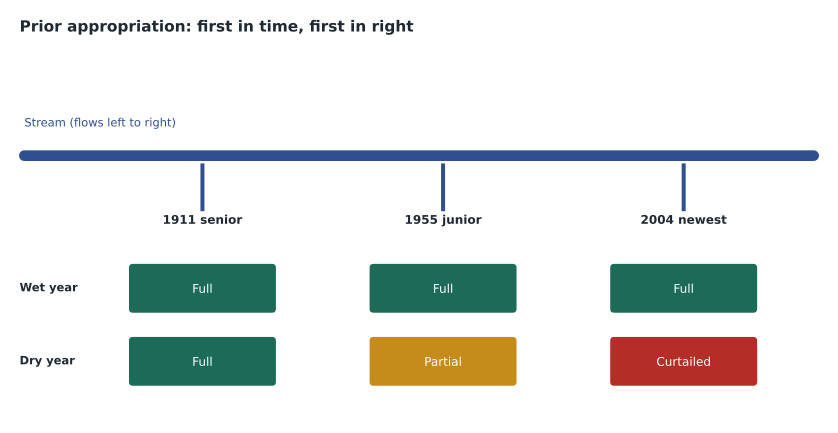
A water right in Colorado is the right to use a specific amount of water, from a specific source, for a specific beneficial use, at a specific place, with a specific priority date. The priority date is usually the date the appropriator first took steps to put the water to use. In times of shortage, senior rights are satisfied in full before junior rights receive any water. A junior appropriator may be curtailed, ordered to stop diverting, so that water flows downstream to a senior user. That is why a ditch decreed in 1911 can be far more valuable than a later right for a larger amount.
Beneficial use is the measure and the limit of a water right. An appropriator may claim only the amount of water actually needed and used for a beneficial purpose, such as irrigation, municipal supply, industrial use, stock watering or recreation. Water rights can be lost through abandonment, which requires both nonuse and intent to abandon, and long periods of nonuse can create a presumption of intent. Water rights are property: they can be bought, sold, mortgaged and changed, and they are often conveyed separately from the land.
Water courts and administration
Colorado adjudicates water rights in specialized water courts created under the Water Right Determination and Administration Act of 1969. There is one water court for each of the state's seven water divisions, which follow the major river basins, such as the South Platte, the Arkansas, the Rio Grande and the Colorado. A district judge designated as water judge presides, assisted by a water referee. Applications for new water rights, changes of water rights and plans for augmentation are filed in the water court for the division where the water is located, published in a monthly resume, and open to statements of opposition from any interested person.
Changes of water rights are where many disputes arise. An owner who wants to change the type, place or time of use of a water right, as the developer upstream of Luke's clients does, must obtain a decree approving the change. The central principle is no injury: a change may not injure other vested water rights. The court typically limits the changed right to the historical consumptive use of the original right, so that the change does not enlarge the water actually taken from the stream to the harm of others. Luke's clients can file a statement of opposition and insist on terms and conditions that protect their senior ditch.
Administration is separate from adjudication. The State Engineer and seven division engineers administer water rights day to day, enforcing priorities by curtailing junior diversions when necessary. Groundwater adds complexity. Groundwater connected to a stream (tributary groundwater) is generally treated like surface water and administered in priority, which is why many wells must operate under an augmentation plan that replaces their depletions. Designated groundwater basins and the nontributary aquifers of the Denver Basin have their own statutory regimes.
Even small details reflect the system. For many years, collecting rainwater from a roof was legally questionable in Colorado, because precipitation was viewed as part of the stream system belonging to senior appropriators. Since a 2016 statute, residential homeowners may collect limited amounts of rooftop rainwater in up to two rain barrels for outdoor use on the property. Interstate compacts, including the Colorado River Compact of 1922, also limit how much water Colorado may consume, and they shape planning across the state.
Worked problem
The Montrose hay farm
A developer applies to change an upstream ranch's 1925 irrigation right to municipal use for a subdivision. Luke's clients hold a 1911 ditch right downstream. What protections does Colorado law give them?
Show solution
- The change requires a water court decree; the application is published in the monthly resume.
- Luke's clients may file a statement of opposition within the deadline set in the resume.
- Under the no-injury rule, the change may not injure other vested rights; the court typically limits the changed right to the ranch's historical consumptive use.
- The clients can seek terms such as limits on the timing and amount of diversions, return flow obligations and measuring requirements; their 1911 priority remains senior to the 1925 right in any case.
Answer: File a statement of opposition and press for terms protecting historical return flows; the clients' senior priority stays intact.
The recording act and conveyancing
Colorado's recording statute, C.R.S. 38-35-109, is a race-notice statute. An unrecorded instrument affecting title to real property is void against a later purchaser or encumbrancer for value who takes without notice of the earlier instrument and records first. A buyer therefore protects herself by searching the records, inspecting the property for possession inconsistent with the record, and recording promptly. Title insurance is standard in Colorado transactions, and title companies typically handle closings.
Colorado statutes provide forms for warranty deeds, special warranty deeds, bargain and sale deeds and quitclaim deeds, and define the covenants each conveys. A general warranty deed warrants title against all claims; a special warranty deed warrants only against claims arising through the grantor. Standard real estate contracts approved by the Colorado Real Estate Commission are used in most residential transactions, and licensed brokers may fill in those forms, a feature that shapes how lawyers fit into residential deals.
The public trustee foreclosure system
Colorado has a distinctive foreclosure system. Most residential mortgages in Colorado are secured by a deed of trust naming the public trustee of the county as trustee. Each county has a public trustee, a public official who conducts nonjudicial foreclosure sales under deeds of trust. Before a sale, the foreclosing party must obtain an order authorizing the sale through a limited court proceeding under C.R.C.P. 120, in which the court considers only narrow questions, such as whether a default exists and whether the debtor is protected by the federal Servicemembers Civil Relief Act. Broader defenses must be raised in a separate action. The statutes give homeowners cure rights and specific notice periods, and the public trustee's office publishes and conducts the sale.
Adverse possession
Colorado's adverse possession period is eighteen years under C.R.S. 38-41-101. A 2008 amendment, enacted after a much-publicized Boulder dispute, added requirements for claims to property of another. The claimant must prove the elements by clear and convincing evidence and must show that she or her predecessors reasonably believed in good faith that they owned the property for the statutory period. The amendment also allows a court to award the former owner compensation for the property's value and certain taxes and assessments paid, along with other relief. The changes make adverse possession harder to establish in Colorado than under the classic common-law test taught for the MBE, especially for knowing encroachers.
The homestead exemption
Colorado's homestead exemption protects equity in a debtor's home from most creditors. Under C.R.S. 38-41-201, the exemption is 250,000 dollars for a home occupied by the owner or the owner's family, rising to 350,000 dollars when the home is occupied by an owner, spouse or dependent who is elderly (sixty or older) or disabled. The exemption does not protect against all debts; mortgages, taxes and certain other obligations are excepted. Bankruptcy lawyers and judgment creditors deal with it constantly.
| Topic | Colorado rule | Source |
|---|---|---|
| Water rights | Prior appropriation; adjudicated in seven water courts | Colo. Const. art. XVI, sections 5 and 6; 1969 Act |
| Recording act | Race-notice | C.R.S. 38-35-109 |
| Foreclosure | Nonjudicial sale by county public trustee after C.R.C.P. 120 order | Deed of trust statutes; C.R.C.P. 120 |
| Adverse possession | Eighteen years; clear and convincing evidence; good faith belief; possible compensation | C.R.S. 38-41-101 |
| Homestead | 250,000 dollars; 350,000 dollars if elderly or disabled | C.R.S. 38-41-201 |
Residential landlord-tenant law
Colorado's residential landlord-tenant law changed substantially in recent years, and new lawyers who handle housing matters must work from current statutes. Two 2024 changes stand out. House Bill 24-1098, effective April 19, 2024, requires cause for a landlord to decline to renew most residential leases or to evict after a lease ends. The permitted grounds include nonpayment, substantial or repeated lease violations, and certain 'no-fault' grounds such as demolition, conversion, substantial renovation, occupancy by the landlord or a family member, withdrawal from the market to sell, a tenant's refusal of a reasonable new lease, and repeated late payment. No-fault grounds generally require ninety days' notice. The law exempts certain tenancies, including tenants who have lived in the unit for less than twelve months, certain owner-occupied homes and short-term rentals.
Senate Bill 24-094, effective May 3, 2024, strengthened the statutory warranty of habitability. Landlords must begin remedial action within seventy-two hours after notice of an uninhabitable condition, or within twenty-four hours for conditions that materially threaten life, health or safety, with presumed completion times of fourteen and seven days. Notice rules were broadened, and the attorney general can enforce the warranty. Combined with earlier reforms on eviction notice periods, security deposits and filing fees, these changes make Colorado housing law markedly more tenant-protective than it was a decade ago.
Common mistakes
MistakeColorado allocates stream water to owners of land along the stream.
InsteadColorado uses prior appropriation; riparian ownership confers no water right.
MistakeA change of water use only needs approval from the State Engineer.
InsteadA change of water right requires a water court decree and may not injure other vested rights.
MistakeColorado is a pure notice jurisdiction.
InsteadC.R.S. 38-35-109 is race-notice: the later purchaser must take without notice and record first.
MistakeAdverse possession in Colorado requires only open, hostile possession for the period.
InsteadSince 2008, claimants must prove a good faith belief of ownership by clear and convincing evidence, and courts may award the former owner compensation.
Water in real estate transactions
Water questions appear in ordinary real estate deals more often than new lawyers expect. A buyer of rural property should confirm what water rights, ditch company shares or well permits come with the land, because they do not always pass with a deed unless the documents say so. The standard Colorado contracts include provisions for water rights and wells, and title commitments may not insure water rights at all. A residential well permit may limit use to household purposes inside one home, ruling out irrigation of a large lawn or livestock. In growing areas, municipal water and sewer tap fees can be a large part of a development budget.
For sellers, accurate disclosure matters. A seller who represents that a property has irrigation water should be sure that the right is decreed, that it has been used, and that it has not been abandoned or changed. A water lawyer or engineer may be needed for valuable rights. Luke's firm keeps a short checklist for every rural transaction, beginning with one question: what water comes with this land, and how do we know?
Luke learns that the same diligence applies to easements and access. Rural parcels in Colorado sometimes rely on unrecorded roads across neighboring land, on ditch easements, or on access across federal land under permits. A title commitment and a survey are the starting point, but they do not always answer whether a family has the legal right to use the road it has driven for decades.
Summary and key terms
- Colorado follows prior appropriation, written into Article XVI of the constitution: senior rights are satisfied first in shortages, and beneficial use limits every right.
- Seven water courts adjudicate new rights, changes and augmentation plans; changes may not injure other vested rights.
- The recording act is race-notice; most residential foreclosures are nonjudicial sales by county public trustees after a C.R.C.P. 120 order.
- Adverse possession takes eighteen years plus good faith belief proved by clear and convincing evidence; the homestead exemption is 250,000 dollars (350,000 dollars if elderly or disabled).
- House Bill 24-1098 (2024) requires cause to decline renewal or evict after most leases end; Senate Bill 24-094 strengthened the warranty of habitability.
- Prior appropriation
- The doctrine that the first to put water to beneficial use holds the senior right.
- Water court
- One of Colorado's seven specialized courts that adjudicate water rights.
- Change of water right
- A decree allowing a change in the type, place or time of use of a water right, subject to the no-injury rule.
- Public trustee
- A county official who conducts nonjudicial foreclosure sales under deeds of trust.
- Race-notice statute
- A recording act protecting a later purchaser who takes without notice and records first.
Lesson quiz · 5 questions
Score 60% or more to complete this lesson.
Create a free account to save your progress, take quizzes and earn a certificate.