
BAR-206 · Lesson 3 of 12 · 16 min
Character and fitness, the MPRE and the professionalism course
▶ Video coming soon A video version of this lesson is on the way.
Luke expects the character and fitness questions to be the easy part of his application. He has no criminal record, no lawsuits and no unpaid debts. Then he reaches the questions about traffic citations, academic discipline and past employment, and remembers a speeding ticket in Mesa County when he was nineteen, a parking-ticket dispute with his undergraduate university, and a summer job at a rafting company that ended badly when he quit with two days' notice. 'Do I really have to list all of that?' he asks.
'If the question asks for it, yes,' Marchetti says. 'And list it plainly. Character and fitness review is less about whether you made mistakes and more about whether you tell the truth about them. The applicants who get into real trouble are almost never the ones with a speeding ticket. They are the ones who left it off.'
This lesson covers three requirements that sit outside the bar exam score but are just as necessary for admission: the character and fitness review, the MPRE, and Colorado's professionalism course.
What character and fitness review is for
Every jurisdiction requires that applicants show they have the character and fitness to practice law. The idea is protective: the court admits lawyers to handle other people's money, secrets and legal rights, and it wants reasonable assurance that a new lawyer will be honest, diligent and able to meet professional obligations. Colorado's rules give the court and the Office of Attorney Admissions authority to investigate applicants and to deny admission to those who do not meet the standard.
The review looks at conduct, not labels. Common areas of concern include dishonesty or misrepresentation, unlawful conduct, academic misconduct, neglect of financial obligations, a history of violating court orders, misconduct in employment, and conduct showing a lack of respect for the rights of others. A record in one of these areas does not automatically disqualify an applicant. The question is what the conduct shows about present fitness, taking into account how long ago it happened, how serious it was, the applicant's age at the time, whether it was repeated, and what the applicant has done since.
Mental health deserves a direct word. National guidance and many jurisdictions have moved away from asking about diagnoses and treatment and toward asking about conduct. Applicants should answer exactly the questions asked on the current Colorado application, no more and no less, and should understand that seeking treatment is not itself evidence of unfitness. If an applicant is unsure how a question applies, the right step is to ask the Office of Attorney Admissions or a lawyer who handles admissions matters, not to guess.
What the Colorado application asks for
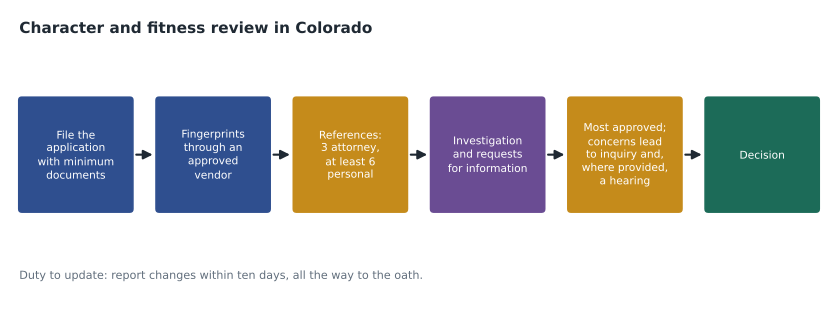
The exam application instructions list the steps of the character and fitness process. Applicants upload a set of minimum documents to submit the application, including a signed fingerprint requirement information form, a photograph, a signed statement of verification, a signed authorization and release, and personal question forms for affirmative answers to the questions that require them. Applicants must have their fingerprints processed through an approved vendor each time they apply; fingerprinting can happen after submission. They then arrange for third-party documents such as driving records, certificates of good standing and disciplinary letters from other jurisdictions.
The application asks for employment history covering the last ten years, or since admission elsewhere if that is longer. It asks for references: the instructions call for three attorney references and at least six personal references. That is more than some states require, and it takes time to line up, so start early. Choose people who know you well rather than people with impressive titles who know you slightly.
Two continuing duties matter as much as the initial filing. Applicants must report changes within ten days using an application amendment form. And the instructions warn that an applicant's character and fitness status can change at any time until the oath of admission. A new arrest, a new lawsuit, a judgment, a change of name, or any other event that would change an answer must be reported promptly.
When questions arise
Most applications move through review without incident. When the Office of Attorney Admissions sees something that needs explanation, the usual first step is a request for more information: court records, a fuller account of an incident, proof that a debt is being paid, or letters from people who can speak to the applicant's conduct since. Applicants should answer such requests promptly, completely and in the same candid tone as the application. A defensive or minimizing answer often does more harm than the underlying event.
If questions remain, Colorado's rules provide further steps, which can include a formal inquiry and a hearing at which the applicant may appear with counsel and present evidence, with review available in the supreme court. The details are in the court's rules, and applicants facing a serious question should read them and consider consulting a lawyer who handles admissions matters. What decision-makers look for is evidence of rehabilitation: time elapsed, consistent good conduct since, restitution where money was involved, treatment where it was relevant, and candid acknowledgment of what happened.
Worked problem
How much to disclose
Luke's application asks about traffic violations, academic discipline and employment terminations. He has a speeding ticket at nineteen (paid), a resolved dispute with his university over parking fines (no discipline imposed), and a summer job he quit on two days' notice. What should he disclose?
Show solution
- Read each question exactly as written. If the traffic question asks for citations other than parking, list the speeding ticket with the date, county, outcome and payment.
- If the academic question asks only about discipline, the parking-fine dispute, which led to no discipline, may fall outside it; if he is unsure, he should ask the Office of Attorney Admissions or disclose with a short explanation.
- Quitting with short notice is not a termination for cause, but he must list the job in his ten-year employment history accurately, with correct dates and a supervisor contact.
- In every case, answer completely and consistently; the investigators will compare his application with his law school application and any records they obtain.
Answer: Disclose what each question asks for, plainly and consistently; when in doubt, ask or disclose with an explanation.
Consistency with earlier applications
Investigators compare the bar application with the applicant's law school application, which often asked similar questions. An applicant who disclosed a minor-in-possession citation to the law school but omits it on the bar application has created a problem far larger than the citation itself. Before filing, applicants should reread their law school application and, if it omitted something that should have been disclosed, contact the law school to amend it. Law schools generally have procedures for this, and correcting the record voluntarily is far better than having the bar examiners find the gap.
The MPRE
The Multistate Professional Responsibility Examination is a two-hour, sixty-question multiple-choice exam written by NCBE. Fifty questions are scored and ten are unscored pretest questions. It tests the ABA Model Rules of Professional Conduct, the Model Code of Judicial Conduct, and controlling constitutional and procedural law on lawyer regulation. It is given at test centers several times a year, separately from the bar exam. BAR-140 in this program covers its content in depth.
Colorado requires a scaled MPRE score of 85. That is near the top of the national range; several jurisdictions accept 75 or 80, and California requires 86. A candidate aiming for Colorado should therefore treat the MPRE seriously rather than as a formality, and should know the rules well enough to score comfortably above 85.
Colorado also limits how old the score can be, and the limit depends on the applicant's licensing history. Under the text of C.R.C.P. 203.4 as published, an applicant who is not licensed in any U.S. jurisdiction must present a score from an MPRE taken within two years before the application is accepted. An applicant licensed elsewhere may use a score from within five years before acceptance. And an applicant licensed elsewhere with fifteen or more years of active practice and no public discipline may use a passing score that another jurisdiction previously accepted, regardless of when it was earned. Because these windows are tied to when the application is accepted, not to the exam date, applicants should check the current rule and the Office of Attorney Admissions' MPRE information for the exact rule that applies to them.
| Applicant | MPRE score window (C.R.C.P. 203.4 as published) |
|---|---|
| Not licensed in any U.S. jurisdiction | Taken within two years before the application is accepted |
| Licensed in another U.S. jurisdiction | Taken within five years before the application is accepted |
| Licensed elsewhere, 15 or more years of active practice, no public discipline | A passing score previously accepted by another jurisdiction, whenever earned |
| All applicants | Scaled score of 85 or more |
Marchetti draws the practical lesson for students. 'Some students take the MPRE in the spring of their second year. For Colorado, check whether that score will still be inside the two-year window when your application is accepted. If you plan to sit in July after graduation, a second-year score may be fine. If your plans slip a year, it may not be. Know your dates.'
The professionalism course
Colorado requires every successful exam applicant to complete a professionalism course before admission. The course is presented by the Office of Attorney Regulation Counsel together with the Colorado Bar Association's continuing legal education organization. It introduces new lawyers to the practical realities of Colorado practice: how the Colorado Rules of Professional Conduct apply in the first years, trust account obligations, civility and professionalism norms, the registration and continuing education system, and the resources available to lawyers who are struggling. The credit is valid for eighteen months after completion and counts toward the new lawyer's first continuing legal education compliance period.
The course is a requirement, not a test. There is no score, and it has no effect on the bar exam result. But it can delay admission if an applicant overlooks it. The most common planning mistake is waiting until results are released and then discovering that the next session is weeks away. The second most common is taking it too early, before the exam, and then needing more than eighteen months to be admitted because of a failed attempt or a delayed character review. Luke plans to take it in the spring of 2027, after the exam and before his expected admission.
Applicants admitted by transferred UBE score and most applicants admitted on motion also must complete the professionalism course, with exceptions for certain lawyers practicing under Colorado's temporary practice rules. Lesson 11 returns to those routes.
Common mistakes
MistakeA minor traffic ticket does not need to be listed.
InsteadIf the question asks for it, list it; omissions cause more trouble than minor events.
MistakeCharacter and fitness review ends when the application is filed.
InsteadChanges must be reported within ten days, and status can change until the oath.
MistakeAny passing MPRE score works whenever it was earned.
InsteadColorado requires 85 and limits score age; for unlicensed applicants the rule as published uses a two-year window measured to acceptance of the application.
MistakeThe professionalism course can be skipped by exam takers who score well.
InsteadEvery successful exam applicant must complete it before admission; credit lasts eighteen months.
Luke rewrites his answers that evening. The speeding ticket goes in with its date, county and payment record. His employment history now runs ten years and includes the rafting company, with a short accurate note. He emails nine people to ask whether they will serve as references, three of them lawyers at his firm. 'That took an hour,' he tells Marchetti. 'It would have taken a lot longer to explain later,' she replies.
Planning the three requirements together
Marchetti asks Luke to put the three requirements in this lesson on a single timeline. His MPRE score of 90 from August 2025 is already in hand. His character and fitness file goes in with his application by November 1, 2026, and he expects follow-up questions about the rafting job by December. He will sit the exam on February 23 and 24, 2027. He books the professionalism course for a date in the spring after the exam, so that the credit will still be valid when he is admitted and will count toward his first CLE period. 'Three requirements, three dates, one calendar,' she says. 'Most delays happen when someone treats them as separate projects.'
She adds one more piece of advice for applicants with complicated histories: request your own records early. Court records, credit reports and driving records sometimes contain errors or surprises. An applicant who discovers an old judgment or a mistaken entry in October has time to correct it or explain it; one who learns about it from the investigator in January has much less.
Marchetti also reminds applicants that candor runs both ways in time. An applicant who discloses an old matter fully and early usually finds the process manageable. One who omits it and is discovered faces a new and more serious question: whether the omission itself shows a lack of honesty.
Summary and key terms
- Character and fitness review asks whether applicants are honest, diligent and fit; candor about past conduct matters more than the conduct itself.
- The Colorado application requires fingerprints each time, ten years of employment history, three attorney and at least six personal references, and updates within ten days until the oath.
- Colorado requires an MPRE scaled score of 85; under the rule as published, unlicensed applicants need a score from within two years before acceptance of the application.
- Every successful applicant must complete the professionalism course before admission; credit lasts eighteen months.
- Character and fitness
- The requirement that an applicant show the honesty, diligence and fitness needed to practice law.
- Application amendment form
- The form Colorado applicants use to report changes within ten days after filing.
- MPRE
- The Multistate Professional Responsibility Examination, a sixty-question NCBE exam on legal ethics; Colorado requires a scaled score of 85.
- Rehabilitation
- Evidence that an applicant has addressed past misconduct, such as time elapsed, restitution and consistent good conduct since.
- Professionalism course
- Colorado's required pre-admission course on professional practice, presented with the Colorado Bar Association's CLE arm.
Lesson quiz · 5 questions
Score 60% or more to complete this lesson.
Create a free account to save your progress, take quizzes and earn a certificate.