
BAR-206 · Lesson 5 of 12 · 15 min
Exam changes ahead: NextGen in July 2028
▶ Video coming soon A video version of this lesson is on the way.
Luke's younger sister, Nina, starts law school in Boulder in August 2026. She will graduate in May 2029, and when she asks Luke what bar exam she will take, he realizes he does not know. He brings the question to Marchetti, who brings in Marcus Bell, the group member who sat Missouri's first NextGen exam in July 2026 and passed. 'Your sister will take a different exam from you,' Marcus tells Luke. 'Same goal, different test. And the switch in Colorado happens in July 2028, so anyone graduating around then has a real decision to make.'
This lesson explains Colorado's decision to adopt the NextGen bar exam, what the new exam looks like, what is still to be announced, and how the transition affects candidates who graduate before, during and after the change.
Colorado's decision
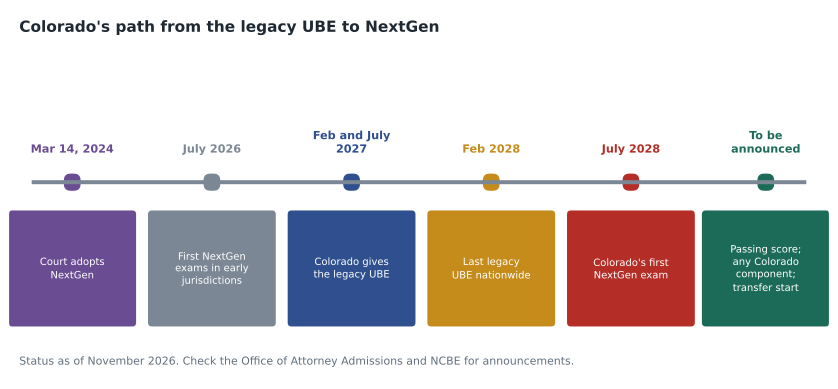
On March 14, 2024, the Colorado Supreme Court announced that Colorado will adopt the NextGen bar exam developed by NCBE. Law school graduates will take NextGen beginning with the July 2028 administration. Until then, Colorado continues to give the current UBE every February and July. The timing follows NCBE's own plan: NCBE stops offering the current UBE components after the February 2028 exam.
The court's announcement described the new exam as testing foundational legal concepts, including subjects such as civil procedure, criminal law, contract law and real property, and foundational lawyering skills, including legal research, legal writing and negotiation, through multiple-choice questions, short-answer questions and performance tasks. Colorado's Attorney Regulation Counsel explained the decision in terms of two goals: making sure that new lawyers have the knowledge and skills to serve clients, and preserving score portability so that lawyers can move between jurisdictions.
At the time of the announcement, fourteen other states had announced plans to adopt NextGen. By November 2026, NCBE's table of decisions showed most UBE jurisdictions moving to NextGen on dates between July 2026 and July 2028, with four jurisdictions not adopting it: Arkansas, Louisiana, Nevada and Puerto Rico. Colorado is in the last group of adopters, alongside states such as California, Florida, New York and Texas, that begin in July 2028.
What the NextGen exam looks like
NextGen is a single exam taken over a day and a half: two three-hour sections on the first day and one three-hour section on the second. Each section contains a mix of three item types. There are about forty standalone multiple-choice questions, some of which ask the examinee to select two answers rather than one. There are integrated question sets, each built around a common fact pattern and combining multiple-choice and short written answers. And there is a performance task, a longer lawyering assignment that may involve legal research using supplied materials. Some questions in each administration are unscored pretest items.
The content has two halves. The first is foundational concepts and principles in core subjects: civil procedure, constitutional law, contract law, criminal law and procedure, evidence, real property, torts, and business associations. Family law joins the tested subjects starting in July 2028, which means Colorado's first NextGen exam will include it. Trusts and estates and family law can also appear in skills questions with the necessary law supplied. The second half is foundational skills: legal research, legal writing, issue spotting and analysis, investigation and evaluation, client counseling and advising, negotiation and dispute resolution, and client relationship and management. A limited set of the ABA Model Rules of Professional Conduct can be tested within the client-facing skills.
NextGen scores are reported on a new scale from 500 to 750. Each jurisdiction sets its own passing score on that scale. NCBE's published results for the first administration in July 2026 reported 2,630 examinees and an overall pass rate of 72.7 percent, with first-time takers passing at a much higher rate than repeaters. Jurisdictions that gave the first exam set passing scores mostly in the low 600s. BAR-130 in this program covers the NextGen exam in depth.
| Feature | Legacy UBE (Colorado through Feb 2028) | NextGen (Colorado from July 2028) |
|---|---|---|
| Length | Two full days (six hours each) | A day and a half (three three-hour sections) |
| Structure | Separate MBE, MEE and MPT | Each section mixes multiple choice, integrated sets and a performance task |
| Subjects tested from memory | Seven MBE subjects; MEE adds business associations | Eight core subjects plus family law from July 2028 |
| Skills | Mainly through the MPT | Seven named skills tested throughout |
| Score scale | 400 points; Colorado passes at 270 | 500 to 750; Colorado's passing score to be announced |
| Local component | None | To be announced |
What is still to be announced
As of November 2026, three Colorado details were still listed as to be announced in NCBE's jurisdiction information. The first is the NextGen passing score. Colorado has not announced what score on the 500 to 750 scale it will require. The second is whether Colorado will add a jurisdiction-specific component to NextGen, such as a Colorado law course or test. The third is the date on which Colorado will begin accepting NextGen scores transferred from other jurisdictions; NCBE lists Colorado as accepting NextGen scores, but with the start date to be announced.
These open questions matter. A candidate who sits NextGen elsewhere in 2027 and hopes to transfer the score into Colorado cannot plan with certainty until Colorado announces when it will accept such scores and what score it will require. Marchetti's advice is direct: 'If any part of your plan depends on an announcement that has not been made, have a backup plan, and check the Office of Attorney Admissions' site and NCBE's tables every few months.'
Who should sit which exam
For most current candidates the choice is made by the calendar. Luke graduated in May 2026 and sits in February 2027, on the legacy UBE. If he does not pass, he can retake the legacy UBE in July 2027 or February 2028. After February 2028, any retake in Colorado would be on NextGen.
The hard cases are candidates who graduate between December 2027 and May 2028. A May 2028 graduate cannot sit the legacy UBE in Colorado at all; her first Colorado exam is NextGen in July 2028. A December 2027 graduate can sit Colorado's last legacy UBE in February 2028, but if she fails, her retake will be on NextGen, a different exam with different preparation. Some candidates in that position choose to wait for July 2028 and prepare once for NextGen; others prefer the familiar legacy exam and accept the retake risk. Neither choice is wrong. The decision depends on the candidate's preparation, school resources and tolerance for risk.
Candidates who might move should also think about portability. A legacy UBE score earned in Colorado through February 2028 remains transferable under each jurisdiction's time limits. Jurisdictions differ on whether they will accept legacy scores after they switch, how long they will accept them, and how they will compare them with NextGen scores. Anyone planning a move in the late 2020s should read the receiving jurisdiction's rules before choosing an exam.
Worked problem
Nina's timeline
Nina starts law school in August 2026 and expects to graduate in May 2029. Which Colorado exam will she take, and what should she watch for?
Show solution
- Her first Colorado exam would be July 2029.
- Colorado gives NextGen from July 2028, so she will take NextGen.
- Family law will be a tested subject by then, so she should consider taking family law in law school.
- She should watch for Colorado's NextGen passing score and any Colorado-specific component, both still to be announced as of November 2026.
Answer: She will sit NextGen; she should plan coursework around its subjects and skills and watch for Colorado's announcements.
Preparing during the transition
Several habits help on either exam. Learn the core subjects as rules you can apply, not facts you can recite; both exams reward application. Practice reading closely under time pressure; the MPT and the NextGen performance tasks both punish candidates who skim the task instructions. Practice writing short, organized answers; the NextGen short-answer questions and the MEE both reward a clear rule and focused analysis. And build skills such as counseling and negotiation through clinics and externships, which NextGen tests directly.
Marcus adds advice from his own experience with the new exam. 'The integrated sets felt like a day at a small firm,' he says. 'You read a file, answer a client's question, draft a paragraph, then the facts change and you answer again. The candidates who struggled were the ones who had only ever done practice questions one at a time.'
Common mistakes
MistakeColorado has already switched to NextGen.
InsteadColorado gives the legacy UBE through February 2028 and NextGen from July 2028.
MistakeNextGen scores use the familiar 400-point scale.
InsteadNextGen scores run from 500 to 750; Colorado has not yet announced its passing score.
MistakeA candidate who fails the February 2028 legacy exam can retake the legacy exam in Colorado.
InsteadFebruary 2028 is the last legacy UBE; retakes after that are on NextGen.
MistakeFamily law will not be tested on Colorado's first NextGen exam.
InsteadFamily law joins NextGen's tested subjects in July 2028, the month Colorado begins.
How the transition affects law schools and employers
The switch affects more than candidates. Colorado's law schools are adjusting their bar support programs to teach NextGen's skills, such as counseling, negotiation and legal research, more explicitly, and some are adding practice integrated question sets and performance tasks to upper-level courses. Commercial bar review companies offer separate legacy and NextGen courses during the transition. Employers who hire recent graduates must plan for the possibility that new associates will sit different exams in the same year, with different study schedules and results dates.
Candidates should ask practical questions of any course they consider. Does it cover the NextGen content scope, including family law for July 2028 and later? Does it include integrated question sets and performance tasks, not only stand-alone multiple-choice questions? Does it use NCBE's study aids, which reflect the real question formats? And does it explain how Colorado's own requirements, such as the professionalism course and any Colorado component the court adopts, fit into the timeline?
Watching for announcements
Because several Colorado decisions remain to be made, candidates and advisers should know where announcements will appear. The Colorado Judicial Branch publishes press releases and rule changes, the Office of Attorney Admissions updates its pages and exam instructions, and NCBE maintains tables of each jurisdiction's NextGen decisions, passing scores and transfer policies. Marchetti tells Luke to suggest a simple habit to his sister: check those three places at the start of every semester, and write down what changed.
She also offers a caution about secondhand information. Bar exam rumors spread quickly, especially during a transition. A classmate's confident statement that Colorado will set its NextGen passing score at a particular number, or will add a Colorado law test, is worth nothing until the court or the Office of Attorney Admissions announces it. Plan on what has been announced, and keep a backup plan for what has not.
What stays the same
Much will not change. Colorado will still require an eligible law degree, a timely application, character and fitness approval, the MPRE and the professionalism course. The deadlines, fees and character and fitness process described in Lessons 2 and 3 are not tied to the exam format. And the substantive Colorado law in Lessons 7 through 10 will matter to new Colorado lawyers whichever exam they passed.
Questions candidates ask most
Marcus fields the same questions from Luke's study group again and again. Can a candidate choose NextGen early in Colorado? No: Colorado gives only the legacy UBE through February 2028 and only NextGen from July 2028. Will a legacy score earned in Colorado still be good after the switch? It remains a Colorado score under Colorado's time limits, and other jurisdictions decide for themselves how long they will accept legacy scores. Is NextGen easier? Neither exam is designed to be easier; NextGen tests fewer subjects from memory but asks more of candidates' skills, and the passing standard each jurisdiction sets determines how demanding it is.
Another frequent question is whether NextGen tests Colorado law. NextGen, like the legacy UBE, is a national exam that tests general principles and supplies any specific law needed for skills questions. Whether Colorado adds anything of its own is one of the details still to be announced. Until it does, candidates should assume that Colorado law will matter mainly in practice, in the professionalism course, and in any component the court may adopt.
Finally, candidates ask whether the MPRE changes. It does not. The MPRE remains a separate exam with Colorado's score requirement of 85, and NextGen's limited testing of professional responsibility within the client-facing skills does not replace it.
Summary and key terms
- On March 14, 2024 the Colorado Supreme Court adopted NextGen for law school graduates beginning July 2028.
- Colorado gives the legacy UBE through February 2028, the last legacy administration nationwide.
- NextGen takes a day and a half, mixes multiple-choice, integrated sets and performance tasks, and reports scores from 500 to 750.
- Colorado's NextGen passing score, any Colorado component, and the start date for accepting NextGen transfers were still to be announced in November 2026.
- Candidates graduating between December 2027 and May 2028 face the hardest choices because of retake risk across the switch.
- NextGen bar exam
- NCBE's new bar exam testing foundational concepts and skills, given in Colorado from July 2028.
- Integrated question set
- A NextGen item built on a common fact pattern combining multiple-choice and short written answers.
- Performance task
- A longer NextGen lawyering assignment, sometimes involving legal research with supplied materials.
- Foundational skills
- The seven lawyering skills NextGen tests, such as legal research, counseling and negotiation.
- Legacy UBE
- The current MBE-MEE-MPT exam, given for the last time in February 2028.
Lesson quiz · 5 questions
Score 60% or more to complete this lesson.
Create a free account to save your progress, take quizzes and earn a certificate.