
BAR-214 · Lesson 1 of 12 · 17 min
Becoming a lawyer in Illinois
▶ Video coming soon A video version of this lesson is on the way.
Marisol Duarte grew up in Cicero, finished law school at an ABA-approved Chicago law school in May 2026 and took a job as a law clerk at a small firm in the Loop. The firm handles slip-and-fall cases for injured clients, a steady run of landlord-tenant disputes, and now and then a privacy class action under the Illinois Biometric Information Privacy Act. She planned to sit the Illinois bar exam in February 2027. When she joined Hollis Marchetti's Tuesday study group, the first thing she asked was whether there was anything special about Illinois she needed to learn. 'Less than you fear and more than you think,' Marchetti said. 'Illinois gives the Uniform Bar Exam, so the test itself is national. The Illinois part comes before and after the exam, and in the law you'll use the week you're sworn in.'
That answer frames this course. Illinois is a Uniform Bar Examination (UBE) jurisdiction. Its exam is the same Multistate Bar Examination (MBE), Multistate Essay Examination (MEE) and Multistate Performance Test (MPT) given in dozens of other jurisdictions, graded to the same standards. There is no separate Illinois essay, no Illinois multiple-choice test and no required online course on Illinois law before admission. What is distinctly Illinois is the path around the exam: the Illinois Board of Admissions to the Bar and its filing rules, the Character and Fitness review run by Illinois committees rather than the National Conference of Bar Examiners (NCBE), the move to the NextGen bar exam in February 2028, the first-year continuing legal education requirement, and the body of Illinois law that a new lawyer meets in practice. Marchetti scheduled a series of undated evening calls with Marisol to work through all of it, and this course follows those calls.
Every practice question in this course was written for it. None comes from the Illinois Board of Admissions to the Bar, NCBE or any released exam. The rules, fees and deadlines in this course were checked against NCBE's published jurisdiction information, the Illinois Supreme Court's announcements, the Illinois Supreme Court Rules and other public sources as of November 2026. They change, and the Board of Admissions has the final word. Confirm anything that matters with the Board before you rely on it.
Who controls admission
Admission to the practice of law in Illinois belongs to the Supreme Court of Illinois. The court's rules on admission are Article VII of the Illinois Supreme Court Rules, beginning with Rule 701. The court appoints the Illinois Board of Admissions to the Bar, which administers the bar examination, processes applications and decides whether applicants have met the educational and testing requirements. The Board's office is in Springfield. The court also appoints a Committee on Character and Fitness for each of the state's judicial districts. Those committees decide whether an applicant has the character and fitness to practice, using investigations prepared by the Board's staff.
Once admitted, an Illinois lawyer registers every year with the Attorney Registration and Disciplinary Commission (ARDC), the court's agency for lawyer registration and discipline. Illinois does not have a unified bar: membership in the Illinois State Bar Association or the Chicago Bar Association is voluntary. A lawyer's license comes from the court, the ARDC keeps the roll, and the Minimum Continuing Legal Education (MCLE) Board tracks continuing education. Marisol found that helpful. 'So there are three offices after admission and two before,' she said. Marchetti agreed: the Board and the character committees before, and the ARDC, the MCLE Board and the court itself after.
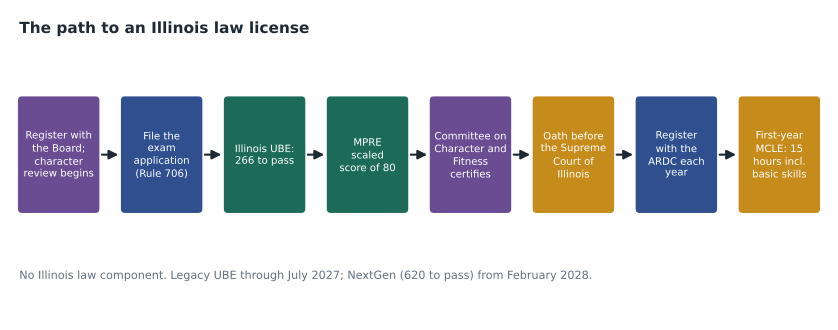
The requirements in one list
A first-time applicant who graduated from an American law school must, in summary:
Hold a JD from a law school approved by the American Bar Association (ABA). NCBE's jurisdiction information for Illinois lists an ABA-approved JD as the education requirement, and Illinois also has a route for graduates of foreign law schools, covered in Lesson 2.
File the character and fitness registration and the bar exam application with the Board of Admissions by the deadlines in Rule 706 and pay the fees.
Pass the UBE with a scaled score of at least 266 on the 400-point scale.
Earn a scaled score of at least 80 on the Multistate Professional Responsibility Examination (MPRE).
Be certified by a Committee on Character and Fitness.
Take the oath, register with the ARDC and, in the first year, complete the continuing legal education required of newly admitted lawyers.
Marchetti points out what is missing from that list. There is no clerkship requirement, as Delaware has. There is no Illinois law course before admission, as Arizona and Alabama require. And there is no Illinois-written essay, as Georgia and Florida give. Illinois relies on the national exam to test general competence and on its character process and first-year education to cover the rest.
The exam in brief
The Illinois bar examination is given twice a year, on the last Tuesday and Wednesday of February and July. The February 2027 exam falls on February 23 and 24, 2027. Day one is the written day: two 90-minute MPT tasks in the morning and six 30-minute MEE essays in the afternoon. Day two is the MBE, NCBE's 200-question multiple-choice test, of which 175 questions are scored. On the UBE, the MBE counts for half of the score, the MEE for 30 percent and the MPT for 20 percent. NCBE lists Illinois's passing score as 266. Lesson 4 explains the scoring.
| Feature | Illinois (February 2027 exam) |
|---|---|
| Exam | Uniform Bar Examination: two MPTs and six MEE essays (Tuesday), MBE (Wednesday) |
| Passing score | 266 on the UBE 400-point scale |
| Dates | February 23 and 24, 2027 |
| MPRE | Scaled score of 80 |
| Character review | Illinois Committees on Character and Fitness, not NCBE's character service |
| Illinois law component | None before admission; newly admitted lawyers complete first-year MCLE |
| Score transfer in | UBE scores of 266 or higher up to four years old; no MBE-only transfers |
| Admission on motion | Three years of practice in the last five |
| Next change | Last legacy UBE July 2027; NextGen from February 2028, passing score 620 |
What makes Illinois different
Candidates who studied for the UBE in another state usually notice four things about Illinois, and each gets its own lesson.
Illinois runs its own character and fitness process. NCBE's Illinois page says that Illinois does not use NCBE's character and fitness services. Applicants file with the Illinois Board, and the review is decided by Illinois committees. The questions are searching, and an applicant has a continuing duty to update answers until admission. Lesson 3 covers the process and the MPRE.
Illinois moves to NextGen in February 2028. NCBE lists July 2027 as the final legacy UBE in Illinois and February 2028 as the first NextGen exam. The Illinois Supreme Court announced a NextGen passing score of 620 in July 2026 and began accepting transferred NextGen scores in July 2026. Lesson 5 explains what that means for candidates near the transition.
Illinois has its own procedural and substantive law. Illinois is a fact-pleading state with its own Code of Civil Procedure and its own Supreme Court Rules on discovery and trial. Its comparative fault and joint liability rules, its land trusts, its Marriage and Dissolution of Marriage Act and its Probate Act all have Illinois features. And Illinois's Biometric Information Privacy Act has produced some of the largest privacy litigation in the country. The bar exam does not test Illinois law directly, but a new lawyer meets it immediately. Lessons 7 to 10 cover what matters most.
Illinois requires continuing education from the start. A newly admitted Illinois lawyer has to complete a set number of hours, including a basic skills course, by the end of the first year. Lesson 11 covers that and the rules on score transfer and admission on motion.
Why Marisol chose Illinois
Marisol asked whether she should sit somewhere else and transfer her score in. Marchetti walked through the logic. Illinois accepts transferred UBE scores, so in theory an applicant could sit in a neighboring UBE state. But Illinois also requires its own character and fitness certification no matter where the exam is taken, the transfer fee is higher than the exam fee, and sitting in Illinois means testing near home. For someone who plans to practice in Chicago, the Illinois exam is the straightforward choice. Someone who plans to practice in both Illinois and Missouri, by contrast, might think carefully about where to test and transfer, since Missouri is also a UBE jurisdiction.
Marchetti also mentioned timing. Because the last legacy UBE in Illinois is in July 2027, Marisol's February 2027 exam and one possible retake in July 2027 are both on the current format. A candidate who missed twice would face NextGen in February 2028. That is not a reason to panic, she said, but it is a reason to take the February exam seriously and prepare as if it were the only attempt.
How this course is organized
Lessons 2 to 5 cover the admission process: eligibility, deadlines and fees; character and fitness and the MPRE; the exam and its scoring; and the move to NextGen. Lesson 6 explains what the UBE tests and how Illinois law appears around it. Lessons 7 to 10 teach the Illinois law a new lawyer most often needs: courts and civil procedure; torts; property, land trusts, family law and estates; and privacy and professional conduct. Lesson 11 covers score transfer, admission on motion and the obligations that begin after admission. Lesson 12 is a capstone with original practice questions and an exam-day plan.
Each lesson ends with a short quiz, and the course ends with a final exam. The quizzes test the facts and rules in the lessons, not general bar review, which the core courses in this program cover. If you are taking the Illinois exam, pair this course with MBE Review I and II for the multiple-choice day and with the essay and performance test courses for method.
Common mistakes
MistakeExpecting an Illinois essay or an Illinois law test on the bar exam.
InsteadIllinois gives the UBE with no state component; Illinois law appears in practice and in the first-year MCLE requirement, not on the exam.
MistakeAssuming NCBE runs the Illinois character investigation.
InsteadIllinois does not use NCBE's character and fitness service; the Board of Admissions and the Illinois Committees on Character and Fitness handle it.
MistakeThinking the Illinois State Bar Association admits or disciplines lawyers.
InsteadThe Supreme Court of Illinois admits lawyers through the Board of Admissions; the ARDC handles registration and discipline; bar association membership is voluntary.
MistakePlanning a retake in February 2028 on the current exam.
InsteadThe last legacy UBE in Illinois is July 2027; February 2028 is the first NextGen exam.
Practice problems
Work each problem on paper first, then reveal the answer to check.
Name the two bodies that decide admission questions before an Illinois applicant is sworn in.
Show answer
The Illinois Board of Admissions to the Bar, which administers the exam and processes applications, and the Committee on Character and Fitness for the applicant's judicial district, which decides character and fitness.
What score passes the Illinois bar exam, and what MPRE score does Illinois require?
Show answer
A UBE score of 266 and an MPRE score of 80.
Does Illinois require an Illinois law course before admission?
Show answer
No. NCBE lists no jurisdiction-specific requirement for Illinois. New lawyers instead complete first-year continuing legal education, including a basic skills course.
Questions people ask at the start
When Marisol first met Marchetti, she brought a page of questions from friends in her graduating class. Most of them had the same answer: check what the Board of Admissions to the Bar says for the specific exam you are sitting, and do not rely on what someone remembers from an earlier year. Still, a few questions come up so often that they are worth answering here.
The first is whether a graduate must live in Illinois to sit the exam or be admitted. Residence is not the test. The Board looks at education, character and fitness, the exam score and the MPRE score. A graduate who lives in Indiana or Wisconsin and plans to work in Chicago follows the same path as Marisol, who lives in Cicero.
The second is whether a graduate of a law school outside Illinois is treated differently. NCBE's jurisdiction information lists a JD from an ABA-approved law school as the standard educational requirement, wherever the school sits. Graduates of law schools outside the United States can also qualify, but they must show that their education meets the Board's standards, and that review takes time, so they should start long before the filing deadline.
The third is whether the MPRE has to come first. It does not. Many Illinois candidates take the MPRE during law school, and others take it after the bar exam. What matters is that the MPRE score reaches 80 and arrives within the time the rules allow before admission. Marisol took the MPRE in her third year and scored 96, so that box is already checked.
The fourth is how long the whole process takes. For a candidate who files the character and fitness registration early and the exam application on time, the usual pattern is about a year from first filing to the oath. Each step depends on the one before it, which is why the course spends two full lessons on dates and fitness before it reaches the exam itself.
Marchetti's last piece of advice in that first session was practical: keep one folder, paper or digital, for every filing, receipt, confirmation email and letter from the Board. 'You will need something from that folder at least once,' she said, 'and you will not remember where you put it.'
Summary and key terms
- The Supreme Court of Illinois controls admission through the Board of Admissions to the Bar and the Committees on Character and Fitness.
- Illinois gives the UBE: two MPTs and six MEE essays on day one, the MBE on day two, with 266 to pass.
- Illinois runs its own character review, requires an MPRE score of 80 and has no state law component before admission.
- The last legacy UBE in Illinois is July 2027; NextGen begins in February 2028 with a passing score of 620.
- Illinois Board of Admissions to the Bar
- The board appointed by the Supreme Court of Illinois that administers the bar exam and processes admission applications.
- Committee on Character and Fitness
- An Illinois committee, one per judicial district, that decides whether an applicant has the character and fitness to practice law.
- ARDC
- The Attorney Registration and Disciplinary Commission, the Illinois Supreme Court agency that registers lawyers each year and handles discipline.
- Uniform Bar Examination (UBE)
- NCBE's two-day exam made up of the MBE, MEE and MPT, with a portable score.
Lesson quiz · 5 questions
Score 60% or more to complete this lesson.
Create a free account to save your progress, take quizzes and earn a certificate.