
BAR-214 · Lesson 3 of 12 · 21 min
Character and fitness and the MPRE
▶ Video coming soon A video version of this lesson is on the way.
Marisol's third call was the one she had been dreading. In her second year of law school she had received a citation for underage drinking from an incident at age nineteen, which had been dismissed after a court supervision program. She had also, during a hard semester, fallen behind on a credit card and sent a payment late more than once. She wanted to know whether either would keep her out of the Illinois bar. Marchetti's answer was the same one she gives every candidate: 'Probably not, if you disclose it fully and explain it honestly. What keeps people out is usually not the old problem but the new one they create by hiding it.'
Who decides
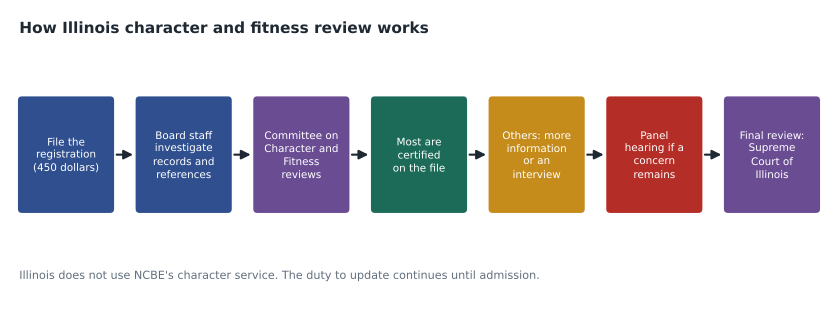
Illinois handles character and fitness itself. NCBE's Illinois page states plainly that Illinois does not use NCBE's character and fitness services, and it tells applicants to contact the state for filing instructions. The Illinois Board of Admissions to the Bar collects the applicant's registration, references and records, and its staff conducts the investigation. The decision belongs to a Committee on Character and Fitness. The Supreme Court of Illinois has a committee for each judicial district, made up of lawyers who volunteer their time, and each committee considers applicants connected with its district.
Most applicants are certified on the file, without a meeting. When a file raises a concern, the committee may ask for more information or invite the applicant to an interview with one or more members. If a concern remains, the matter can go to a panel hearing, where the applicant may be represented by counsel and present witnesses and evidence. An applicant who is denied certification can seek review, and the Supreme Court of Illinois has the final word. The rules place the burden on the applicant to show good moral character and general fitness to practice.
What the committees look for
The standard is good moral character and general fitness to practice law, which the rules tie to the qualities a client and a court need from a lawyer: honesty, trustworthiness, diligence, reliability and respect for the law and the rights of others. The question is not whether the applicant has ever made a mistake. It is whether the applicant's record, taken as a whole and including what has happened since, shows that the applicant can be trusted with clients' money, confidences and causes.
Conduct that commonly draws attention includes criminal charges and convictions, including traffic matters beyond minor infractions if the questions call for them; academic discipline, including plagiarism; dishonesty in employment; neglect of financial obligations, such as defaulted loans or unpaid judgments; discipline in another profession; civil litigation involving fraud or misconduct; and any lack of candor in the application itself. Committees weigh factors that bar admission authorities generally use: the applicant's age at the time, how recent and how serious the conduct was, whether it was repeated, the applicant's candor about it, evidence of rehabilitation and the applicant's positive social contributions since.
Candor is the whole game
Every bar admission authority says the same thing, and Illinois is no exception: the worst problem in a character file is usually a concealment. An applicant who leaves out an arrest, a dismissed charge, an old disciplinary action at school or a lawsuit, and is then found out through fingerprints, court records or a law school report, faces a new and serious question about honesty, which is the very quality the committee is assessing. An applicant who discloses the same matter fully, with documents, usually faces only a question about the old matter itself.
Marisol's underage drinking citation is a good example. The charge was dismissed after supervision, but the application asks about charges, not only convictions. She should disclose it, attach the court disposition and write a short, factual explanation. Her late credit card payments, if the application asks about financial history, should be explained in the same plain way: what happened, what she did about it, and where things stand now. Marchetti tells candidates to write explanations as if the reader were a fair-minded senior lawyer: short, specific, no excuses and no drama.
Law school records are a frequent trap. Applicants should compare their answers with what the law school's dean will certify. If the dean reports an academic integrity matter that the applicant left off, the inconsistency becomes the issue. The safest approach is to ask the law school, before filing, what its records show.
The continuing duty to update
Filing the registration does not end the applicant's obligations. Until admission, an Illinois applicant has a continuing duty to update the answers on file if anything changes: a new charge, a new lawsuit, a new job, a change of address, or anything else the questions cover. Marchetti's rule is that if you have to wonder whether something needs reporting, report it. A late but voluntary update is far better than an investigator finding the change first.
Worked problem
Should Marisol disclose it?
Marisol received a citation at age nineteen for underage drinking. She completed a supervision program and the charge was dismissed. She has no other record. The Illinois application asks about every charge, citation or arrest, regardless of disposition. Should she disclose it, and how?
Show solution
- The question asks about charges regardless of disposition, so a dismissed charge still falls within it.
- Leaving it off risks discovery through court records and turns a minor youthful matter into a candor problem.
- She should disclose the citation, attach the court's disposition showing supervision and dismissal, and give a short factual explanation.
- Factors in her favor: her age at the time, a single incident, its distance in time and her complete disclosure.
Answer: Yes. She should disclose it fully with documents. A single dismissed youthful citation, candidly disclosed, rarely prevents certification.
Mental health and substance use questions
Applicants often worry about questions concerning mental health or treatment. Many jurisdictions, following guidance from the American Bar Association and changes in the law, have narrowed or removed questions that ask about diagnosis or treatment alone and focus instead on conduct. Applicants should answer the questions actually asked on the current Illinois application, accurately and without assuming that seeking help will count against them. The Lawyers' Assistance Program in Illinois offers confidential help to law students, applicants and lawyers, and Marchetti encourages anyone struggling during bar study to use it.
The MPRE: 80 to pass
Illinois also requires a passing score on the Multistate Professional Responsibility Examination. NCBE lists the Illinois minimum passing score as 80, on the MPRE's scale of 50 to 150. The MPRE is a two-hour, 60-question multiple-choice exam, of which 50 questions are scored, given at Pearson VUE test centers several times a year. It tests the law governing lawyers, mainly the ABA Model Rules of Professional Conduct, the ABA Model Code of Judicial Conduct, and controlling constitutional and procedural law.
The MPRE is separate from the bar exam. Applicants may take it during law school, typically after a professional responsibility course, or after graduation. Applicants should check the Board's current rules on how recent the MPRE score must be relative to the bar exam, and should have NCBE send the score to Illinois. Marisol took the MPRE in March of her final year and scored 96. Marchetti noted that 80 sits in the middle of the range of passing scores that UBE jurisdictions use, which run from 75 to 86 on NCBE's chart. A candidate planning to transfer a score to another state later should check that state's MPRE requirement too.
The MPRE Preparation course in this program covers the exam in depth. The point for an Illinois candidate is the timing: if the MPRE is done early, a passing bar exam result leads straight to admission once the character certification is complete.
Putting the file together
Marchetti finished the call with a short list. File the character and fitness registration early, ideally during law school. Gather court dispositions, school records and financial documents before writing explanations. Make every answer consistent with what others will report. Update the file whenever anything changes. Take the MPRE early and have the score sent. Keep copies of everything. Marisol left the call with a list of three documents to request and a draft paragraph about the citation, which Marchetti told her was already better than most.
Common mistakes
MistakeLeaving off a dismissed charge because it did not lead to a conviction.
InsteadAnswer the question asked; if it covers charges regardless of disposition, disclose the dismissed charge with the court record.
MistakeAssuming NCBE investigates Illinois applicants.
InsteadIllinois does not use NCBE's character service; the Board and the Committees on Character and Fitness handle the review.
MistakeTreating the registration as a one-time filing.
InsteadApplicants must update their answers until admission whenever anything covered by the questions changes.
MistakeThinking any MPRE passing score works everywhere.
InsteadIllinois requires 80; other UBE jurisdictions range from 75 to 86.
Practice problems
Work each problem on paper first, then reveal the answer to check.
Who decides whether an Illinois applicant has good moral character and general fitness?
Show answer
A Committee on Character and Fitness appointed by the Supreme Court of Illinois, with review available and the court having the final word.
What MPRE score does Illinois require?
Show answer
A scaled score of 80.
An applicant discovers, after filing, that she forgot to list a law school academic warning. What should she do?
Show answer
Amend her application promptly with a candid explanation, before the investigator finds it through the dean's certification.
The areas that cause the most trouble
Marchetti has reviewed many files with former students, and she says the problems rarely come from the dramatic events applicants worry about. They come from ordinary history that was left out or described carelessly. She groups the trouble spots into five areas.
The first is financial responsibility. Unpaid debts, accounts in collection, defaulted loans and unfiled tax returns are not automatic bars, but the committee wants to see that the applicant knows about them and has a plan. A payment agreement, with proof that payments are being made, says more than any explanation.
The second is academic history. Discipline at college or law school, including findings of plagiarism or a lesser academic integrity matter, must be disclosed even if the school treated it as minor or later cleared the record. The school's dean's certificate often reports the same matter, and a mismatch between the two documents is exactly what draws a closer look.
The third is driving and minor offenses. Traffic citations, especially those involving alcohol, and old arrests that never led to charges must be reported if the question asks for them. Applicants often assume that a sealed or expunged record need not be mentioned; the safest approach is to read the exact wording of each question and to ask the Board when in doubt.
The fourth is employment. Terminations, resignations in lieu of termination and gaps in work history should be explained briefly and accurately. A reference who describes a firing that the applicant called a resignation is a candor problem, not an employment problem.
The fifth is prior applications. An applicant who has applied for admission elsewhere, or for another professional license, must describe what happened. Committees compare applications, and an answer given in one state that differs from an answer given in another can undo an otherwise clean file.
How rehabilitation is shown
When an applicant does have conduct that raises a concern, the question becomes whether the applicant has shown rehabilitation. Committees generally look at how long ago the conduct happened, how serious it was, how old the applicant was at the time, what the applicant has done since, and whether the applicant takes responsibility without excuses. Letters from people who know the history and can describe the change carry real weight. A short, factual personal statement helps more than a long one.
The most persuasive evidence is time spent doing the right thing. An applicant with a single incident in college followed by years of steady work, community involvement and no further problems presents a very different file from one whose most recent problem was last month.
Worked problem
Marisol's parking tickets and a closed credit card
During her review, Marisol remembers two items she had not listed: three unpaid parking tickets from 2021 that went to collection and were paid in 2022, and a credit card account closed by the bank after a late payment in 2020. Her registration has already been filed. What should she do?
Show solution
- The continuing duty to update applies until admission, and it covers items she should have listed as well as new events.
- The financial questions ask about accounts in collection, so the tickets belong in her answer even though they are paid.
- She files an amendment, describes both items briefly, and attaches the proof of payment and a short explanation.
- She does not argue that the items are too small to matter; the committee decides what matters.
Answer: Marisol amends promptly, discloses both items with documents, and moves on. Minor history disclosed promptly is rarely a problem; minor history found by the investigator can become one.
A study plan for the MPRE
Marisol has already passed the MPRE, but two of her study partners have not. Marchetti's MPRE plan is short. Spend two to three weeks on it, not a semester. Learn the ABA Model Rules of Professional Conduct and the leading principles of judicial conduct, since the MPRE tests the national rules rather than the Illinois version. Work through NCBE's official practice exams under timed conditions, and review every wrong answer by finding the rule that decides it. Most candidates find the questions turn on a few recurring areas: conflicts of interest, confidentiality, the client-lawyer relationship, fees and duties to the court.
The Illinois Rules of Professional Conduct, covered in Lesson 10, differ from the Model Rules in places, but those differences matter after admission, not on the MPRE.
Summary and key terms
- Illinois runs its own character and fitness review; Board staff investigate and a Committee on Character and Fitness decides.
- The applicant bears the burden; most applicants are certified on the file, with interviews and hearings for unresolved concerns.
- Candor is decisive: concealment is usually worse than the conduct concealed, and applicants must update answers until admission.
- Illinois requires an MPRE scaled score of 80.
- Good moral character
- The standard an Illinois applicant must meet, showing honesty, trustworthiness, diligence and respect for the law.
- Continuing duty to update
- The obligation to amend character and fitness answers whenever something covered by the questions changes before admission.
- MPRE
- The Multistate Professional Responsibility Examination, NCBE's two-hour ethics exam; Illinois requires a scaled score of 80.
- Lawyers' Assistance Program
- A confidential Illinois program offering help with mental health and substance use to law students, applicants and lawyers.
Lesson quiz · 5 questions
Score 60% or more to complete this lesson.
Create a free account to save your progress, take quizzes and earn a certificate.