
BAR-214 · Lesson 2 of 12 · 18 min
Eligibility, education, deadlines and fees
▶ Video coming soon A video version of this lesson is on the way.
Marisol's second call with Marchetti was about paperwork. She had heard that Illinois deadlines were early and the late fees steep, and she wanted a calendar she could tape to the wall. Marchetti pulled up Illinois Supreme Court Rule 706, which sets the filing deadlines and fees, and NCBE's jurisdiction page for Illinois, which summarizes the education rules. 'Most people who get hurt by Illinois admissions get hurt here,' she said, 'by missing a date they could have met in July.'
Education: the ABA-approved JD
NCBE's jurisdiction information for Illinois lists the education requirement as a JD from an ABA-approved law school. The degree must be conferred before the applicant is certified for admission, and the law school reports the degree to the Board. An applicant who is still in law school may apply for the exam that follows graduation, but the Board will not certify a passing applicant for admission until the degree is confirmed.
Illinois also lets graduates of law schools outside the United States apply, but not by the same route. NCBE lists foreign law graduates as eligible in Illinois, subject to the Board's rules. In practice, a foreign-educated applicant has to show that the education is substantially equivalent to an ABA-approved JD, often with additional study at an ABA-approved school, and must have been admitted and in good standing where the foreign degree was earned, or meet the other conditions in the rules. Applicants on this route should expect an early, document-heavy evaluation and should start well ahead of the filing deadline. Ngozi, the group's New York candidate, noticed that the details differ from New York's Rule 520.6 route. Marchetti told her to treat each state's foreign-education rule as its own requirement, never as a copy of another state's.
Two filings: character and fitness and the exam
Illinois handles character and fitness and the exam through one office, the Board of Admissions, but they are separate pieces of the file. The character and fitness registration starts the Board's investigation, which ends with a decision by a Committee on Character and Fitness. The bar exam application places the applicant on the roster for a particular administration. Rule 706 sets the fees for both, and the Board's instructions explain how the forms are filed through its online system.
Many Illinois law students register for character and fitness during law school, which gives the Board time to complete its work long before graduation. Under Rule 706, the character and fitness registration fee is 450 dollars. Whether a student registers early or files the registration with the exam application, the investigation has to be complete before admission. An applicant who files late in the process risks passing the exam and then waiting weeks or months for the character decision.
The exam application deadlines
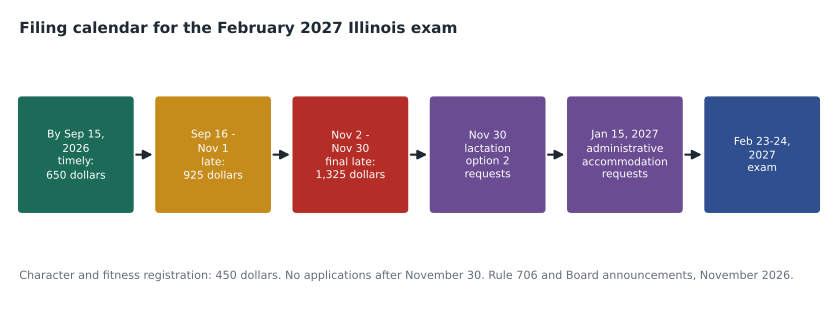
Rule 706 gives each administration a timely deadline, a late period with a higher fee and a final late period with a much higher fee. After the final deadline, the Board does not accept applications for that exam.
| Exam | Timely filing (650 dollars) | Late filing (925 dollars) | Final late filing (1,325 dollars) |
|---|---|---|---|
| February | On or before September 15 | September 16 to November 1 | November 2 to November 30 |
| July | On or before February 15 | February 16 to April 1 | April 2 to April 30 |
For Marisol's February 2027 exam, the timely deadline was September 15, 2026. She filed in August, so she paid 650 dollars. A classmate who waited until mid-October paid 925 dollars, and one who filed during Thanksgiving week paid 1,325 dollars, more than double the timely fee. Marchetti does not soften this: the late fees are the price of missing a date that was published more than a year ahead.
Other dates on the February 2027 calendar
The Board's announcements for the February 2027 exam add several dates that are easy to overlook. Requests for administrative accommodations, which cover things such as religious attire, medications and seating, were due by January 15, 2027, with any medical documentation, by email. Requests for testing accommodations, such as extra time or a private room, go through a separate process for nonstandard testing accommodations, which has its own forms and documentation requirements and should be started early. For lactating examinees, the Board offered two options: stop-the-clock breaks with extra time, with requests due November 30, 2026, or pumping without extra break time, with requests due January 15, 2027.
The Board also posted a hotel rate for examinees at a downtown Chicago hotel for the February 2027 exam, with a reservation cutoff in late January. The Board said it does not guarantee rooms or rates. Marchetti tells candidates to treat lodging like a deadline too: book early, and book somewhere within easy reach of the test site the Board names.
Fees after the exam
The exam and registration fees are not the last costs. An applicant who transfers a UBE score into Illinois instead of sitting the exam pays a transfer fee of 1,500 dollars under Rule 706. Admission on motion also costs 1,500 dollars, paid in two parts: 150 dollars with the preliminary questionnaire, which establishes eligibility, and the remaining 1,350 dollars with the full application. Lesson 11 explains both routes. After admission, Illinois lawyers pay an annual registration fee to the ARDC, which is not an admission fee but is part of the cost of keeping a license.
Worked problem
Calculating Marisol's filing costs
Marisol registered for character and fitness during her last year of law school and filed her February 2027 exam application in August 2026. What did she pay the Board, and what would she have paid if she had filed the exam application on November 10, 2026?
Show solution
- Character and fitness registration under Rule 706: 450 dollars.
- Timely exam application, filed on or before September 15: 650 dollars.
- Total on time: 1,100 dollars.
- An application filed November 10 falls in the final late period (November 2 to November 30): 1,325 dollars instead of 650 dollars.
Answer: On time she paid 1,100 dollars. Filing on November 10 would have cost 1,775 dollars, an extra 675 dollars, and an application after November 30 would not have been accepted for February 2027.
Planning backward from the exam
Marchetti's planning rule is to work backward. For a February exam, the character and fitness registration should be in during the previous year, ideally during law school. The exam application should be filed in the summer, well before September 15. Accommodation requests that need medical documentation should be started in the fall, since doctors' letters take time. Lodging and travel should be settled by January. For a July exam, the same pattern applies, with February 15 as the timely deadline and the spring semester as the time to gather documents.
She also recommends a single folder, paper or digital, with every confirmation the Board sends. Applicants have to update their character and fitness answers if anything changes before admission, and the easiest way to answer the Board's follow-up questions accurately is to have every earlier answer at hand. Marisol set up her folder that evening and put the Rule 706 table at the front.
When something goes wrong
Problems usually fall into three groups. The first is a missing document, such as a transcript or a dean's certification. The Board will contact the applicant, and the fix is to respond quickly and completely. The second is a late discovery, such as an old traffic matter or a forgotten academic warning, that should have been disclosed. The fix is to amend the application promptly and explain, because a late but candid disclosure is treated very differently from one the investigator finds first. The third is a scheduling crisis, such as illness close to the exam. The Board's rules and announcements address withdrawals and transfers between administrations, and applicants should contact the Board directly rather than simply not appearing.
Marchetti adds a caution about advice from friends. Rules and fees change, and classmates often repeat what was true two years ago. The Rule 706 table in this lesson reflects the rule as checked in November 2026. Before filing, check the current rule and the Board's instructions for the specific exam.
Common mistakes
MistakeWaiting until fall to file for a February exam.
InsteadThe timely deadline for February is September 15; after that the fee rises from 650 to 925 dollars, then to 1,325 dollars, and no application is accepted after November 30.
MistakeTreating testing accommodations as a last-minute request.
InsteadNonstandard testing accommodations go through a separate process with documentation; administrative accommodations for February 2027 were due January 15, 2027.
MistakeAssuming foreign-educated applicants follow the same route as JD graduates.
InsteadIllinois lets foreign law graduates apply, but only through its separate evaluation under the Board's rules, which takes time.
MistakeForgetting that a passing score alone does not admit you.
InsteadAdmission also requires the character and fitness certification, the MPRE score of 80 and the oath.
Practice problems
Work each problem on paper first, then reveal the answer to check.
What is the timely filing deadline and fee for the July exam?
Show answer
February 15, with a fee of 650 dollars under Rule 706.
An applicant files for the February exam on October 20. Which fee applies?
Show answer
The late fee of 925 dollars, because October 20 falls between September 16 and November 1.
How much does admission on motion cost, and how is it paid?
Show answer
1,500 dollars: 150 dollars with the preliminary questionnaire and 1,350 dollars with the application.
Building a personal filing calendar
Marchetti asks every student to turn the published windows into a one-page calendar before opening a single outline. Marisol's version has three columns. The first tracks character and fitness: the date she filed her registration, the date she answered the Board's follow-up request for a missing employment reference, and a reminder to update the file whenever anything changes. The second tracks the exam application: the September 15 close of the timely window for the February exam, the November 1 close of the late window, and the November 30 close of the final late window. The third holds the dates that belong to other people, such as the date her law school certifies her degree and the date her former employer returns a reference form.
The point of the exercise is to see which deadlines Marisol controls and which she does not. She controls when she files and pays. She does not control how quickly a court in another county answers a records request, how quickly her school sends a final transcript, or how long a former supervisor takes to fill out a form. Those outside steps are where most late fees and delays begin, so Marchetti tells students to start them first and to write down the date each request went out.
| Item | Who controls it | Marisol's plan |
|---|---|---|
| Character and fitness registration | Marisol | Filed early in her third year of law school |
| Exam application for February 2027 | Marisol | Filed in the timely window, before September 15, 2026 |
| Degree certification | Law school | Requested in writing after graduation; confirmation saved |
| References and employment forms | Former employers and references | Requested in one batch; follow-up calendared two weeks later |
| Accommodation or lactation requests | Marisol, decided by the Board | Not needed for her; dates copied anyway for her study partners |
| Hotel near the exam site | Marisol | Booked before the Board's published hotel cutoff |
Fees in practice
Illinois charges separately for the character and fitness registration and for the exam application, and the exam application fee rises in steps if the applicant misses the timely window. For the February 2027 exam, the timely fee was 650 dollars through September 15, 2026, the late fee was 925 dollars from September 16 to November 1, and the final late fee was 1,325 dollars from November 2 to November 30. The character and fitness registration was 450 dollars. A candidate who files at the last possible moment pays more than twice as much for the same exam as one who files on time.
A candidate who sits again after an unsuccessful attempt files a new exam application and pays the exam fee again. The character and fitness file stays open, but the candidate must keep it current. The Board posts the current fee schedule and any changes, and the schedule in the Supreme Court Rules can be amended, so Marchetti's rule is to read the current notice for the specific exam and copy every date into a calendar with a reminder a week ahead.
Questions from the study group
Tomasz, a classmate who plans to sit in July 2027, asks whether he can file the exam application before the Board finishes his character review. He can. The two run in parallel, and some applicants are certified only after their exam results are out. What he cannot do is be admitted before both are complete.
Aaliyah asks what happens if she files in the timely window but forgets to upload one document. Marchetti's answer is that the Board usually asks for missing items, but she should not count on a grace period. Every request from the Board has its own response date, and each one goes on the calendar the day it arrives.
Rafael asks whether he can change exam sites or switch from typing to handwriting after filing. Marchetti tells him that the Board's notices for each administration explain which changes are possible and by when, and that he should ask early rather than assume. The same rule applies to accommodation requests: for the February 2027 exam, administrative accommodation requests were due by January 15, 2027, and the earlier of the two lactation options was due by November 30, 2026.
Summary and key terms
- Illinois requires an ABA-approved JD and has a separate route for foreign law graduates.
- The character and fitness registration fee is 450 dollars; many students register during law school.
- Exam applications cost 650 dollars on time, 925 dollars late and 1,325 dollars in the final late period, with no filings after the final deadline.
- Timely deadlines are September 15 for February and February 15 for July; score transfer and admission on motion each cost 1,500 dollars.
- Rule 706
- The Illinois Supreme Court Rule that sets filing deadlines and fees for registrants and applicants.
- Final late filing period
- The last window for an exam application, with the highest fee; after it closes the Board accepts no applications for that exam.
- Nonstandard testing accommodations
- Changes to testing conditions, such as extra time or a private room, requested through a separate documented process.
- Preliminary questionnaire
- The first step in an Illinois admission on motion application, used to establish eligibility.
Lesson quiz · 5 questions
Score 60% or more to complete this lesson.
Create a free account to save your progress, take quizzes and earn a certificate.