
BAR-214 · Lesson 9 of 12 · 21 min
Illinois property, land trusts, family law and estates
▶ Video coming soon A video version of this lesson is on the way.
Marisol's firm does not handle divorces or estates, but its clients have them. The injured delivery driver from Lesson 8 was going through a divorce, and the firm needed to know whether his settlement would be marital property. The loading-dock building turned out to be held in an Illinois land trust, and the firm needed to know whom to sue. Marchetti used both questions to tour the Illinois property, family and estates law a new lawyer meets in any practice. As before, citations are for reference, and the current statute controls.
Illinois land trusts
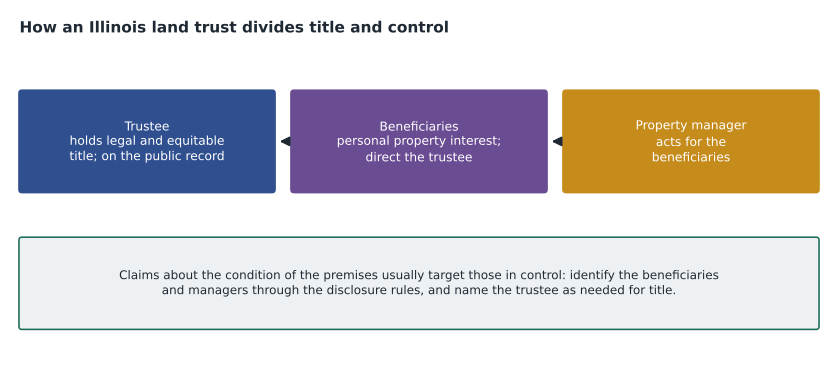
The Illinois land trust is a distinctive Illinois device. Under a land trust agreement, a trustee, often a bank or trust company, holds both legal and equitable title to real estate, while the beneficiaries hold the power to direct the trustee and to manage, use and receive the income from the property. The beneficiaries' interest is treated as personal property, not real property. The arrangement has long been used for privacy, since the public record shows the trustee rather than the beneficiaries, and for ease of transfer, since the beneficial interest can be assigned without recording a deed.
Land trusts matter in litigation. The trustee usually has no duties to manage the property and acts only on the beneficiaries' direction, so the people in control are the beneficiaries. Illinois law requires disclosure of the beneficiaries in certain situations, including in response to some requests from government agencies and in some court proceedings. When Marisol's firm found that the loading-dock building was held in a land trust, it had to identify the beneficiaries and the property manager who actually controlled the premises, and name the right parties.
Other property rules worth knowing
Illinois allows married couples, and parties to a civil union, to hold their homestead as tenants by the entirety, which protects the property from the separate creditors of either spouse. Tenancy by the entirety in Illinois is limited to homestead property. Illinois also provides a homestead exemption from the claims of creditors in a fixed dollar amount per person, set by statute, and allows real estate to pass outside probate through a transfer on death instrument under the Illinois Residential Real Property Transfer on Death Instrument Act, as later amended.
Landlord-tenant law in Illinois combines state statutes, such as the Eviction Act, which in 2018 replaced the old name of forcible entry and detainer, with local ordinances. The Chicago Residential Landlord and Tenant Ordinance gives tenants in most Chicago rental housing detailed rights, including rules on security deposits and interest, repairs and remedies, and makes some violations expensive for landlords. A lawyer handling a Chicago tenancy has to read the ordinance as well as the statutes.
Family law: the Marriage and Dissolution of Marriage Act
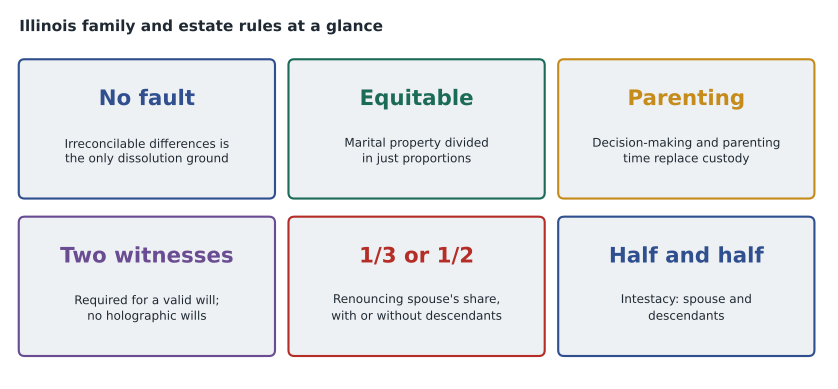
Illinois family law is governed mainly by the Illinois Marriage and Dissolution of Marriage Act, at 750 ILCS 5. Since January 1, 2016, the only ground for dissolution is irreconcilable differences, a no-fault ground. If the parties have lived separate and apart for a continuous period of at least six months before judgment, there is an irrebuttable presumption that irreconcilable differences exist.
Property is divided by equitable distribution. Each spouse is assigned his or her non-marital property, and the marital property is divided in just proportions considering statutory factors. Property acquired during the marriage is presumed marital, subject to exceptions such as gifts, inheritances and property acquired in exchange for non-marital property. Personal injury awards raise a recurring question: courts generally look at what the recovery compensates. For Marisol's client, amounts compensating lost earnings during the marriage and medical bills paid with marital funds may be marital, while amounts for pain and suffering may be treated differently. The firm referred him to family counsel, but it had to understand the issue to settle his case sensibly.
Maintenance, the Illinois term for spousal support, is decided in two steps: whether maintenance is appropriate, and if so, its amount and duration. For many cases, the Act sets guideline formulas. The guideline amount is based on a fraction of the payor's net income minus a fraction of the payee's net income, capped so that the payee's total does not exceed a fixed share of the couple's combined net income. Its duration is based on the length of the marriage multiplied by a statutory factor. The formulas do not apply above a statutory income ceiling, where courts use the general factors. Child support uses an income shares model, adopted in 2017, which bases support on both parents' incomes.
Since 2016, Illinois no longer uses the words custody and visitation. Courts allocate parental responsibilities, divided into significant decision-making responsibilities and parenting time, according to the child's best interests and the statutory factors. Parents usually submit a parenting plan.
Estates: the Probate Act
Wills and estates in Illinois are governed by the Probate Act of 1975, at 755 ILCS 5. A valid will must be in writing, signed by the testator or by someone at the testator's direction and in the testator's presence, and attested in the testator's presence by two or more credible witnesses. Illinois does not recognize unwitnessed holographic wills. Illinois now also allows electronic wills and remote witnessing under the Electronic Wills and Remote Witnesses Act, with its own conditions.
A surviving spouse who is unhappy with the will may renounce it and take a statutory share: one third of the estate if the decedent left descendants, or one half if there were no descendants. If there is no will, the intestacy rules apply. A surviving spouse and descendants each take half; a spouse with no descendants takes everything; and other relatives take in a statutory order if there is no spouse or descendant. The surviving spouse and minor children are also entitled to a spouse's and child's award for support during administration, with statutory minimums.
| Situation | Surviving spouse's share |
|---|---|
| Spouse renounces the will, decedent left descendants | One third of the estate |
| Spouse renounces the will, no descendants | One half of the estate |
| No will, spouse and descendants | Half to the spouse, half to the descendants |
| No will, spouse and no descendants | The entire estate |
Illinois trusts are governed by the Illinois Trust Code, effective January 1, 2020, which modernized Illinois trust law along the lines of the Uniform Trust Code, with Illinois variations. Illinois also has a state estate tax, separate from the federal estate tax, that applies to estates above a fixed exclusion amount, so estate planning for larger estates in Illinois has to account for both.
Worked problem
Whom to sue for the loading dock?
A title search shows the loading-dock building is owned by "Second Federal Trust Company, as trustee under Trust No. 4471." The trust company says it has no role in managing the building. Who are the likely defendants?
Show solution
- In an Illinois land trust, the trustee holds title but usually has no management duties and acts on the beneficiaries' direction.
- The beneficiaries control the property and receive its income; the property manager acts for them.
- Illinois law requires disclosure of land trust beneficiaries in certain proceedings, so the firm can seek their identity.
- Claims about the condition of the premises target those who controlled it.
Answer: The firm should identify and name the beneficiaries and the property manager, and consider naming the trustee only as needed to bind title, rather than relying on the trustee alone.
Common mistakes
MistakeSuing only the land trustee for a premises defect.
InsteadThe trustee usually has no management role; identify the beneficiaries and managers who controlled the property.
MistakeCiting fault grounds in an Illinois dissolution.
InsteadSince 2016, irreconcilable differences is the only ground.
MistakeUsing the terms custody and visitation in an Illinois parenting case.
InsteadIllinois allocates decision-making responsibilities and parenting time.
MistakeRelying on an unwitnessed handwritten will.
InsteadIllinois requires two credible witnesses and does not recognize holographic wills.
Practice problems
Work each problem on paper first, then reveal the answer to check.
What is the only ground for dissolution of marriage in Illinois?
Show answer
Irreconcilable differences.
What share may a surviving spouse take by renouncing the will if the decedent left children?
Show answer
One third of the estate.
In an Illinois land trust, what kind of property is the beneficiary's interest?
Show answer
Personal property.
Who inherits without a will
Marisol's firm gets calls from families after a death, and the first question is often whether there is a will. When there is none, the Probate Act's intestacy rules decide. If the decedent leaves a spouse and descendants, the spouse takes half of the estate and the descendants share the other half by representation. If there is a spouse and no descendant, the spouse takes everything. If there are descendants and no spouse, the descendants take everything. If there is neither, the estate passes to parents, siblings and their descendants under a further order set out in the Act.
| Survivors | Spouse receives | Others receive |
|---|---|---|
| Spouse and descendants | One-half | Descendants share one-half by representation |
| Spouse, no descendants | All | Nothing |
| Descendants, no spouse | Nothing | Descendants share all by representation |
| No spouse or descendants | Not applicable | Parents, siblings and their descendants under the Act |
Worked problem
An estate without a will
Teodoro dies without a will, leaving his wife, Inés, and two adult children from his first marriage. His probate estate is worth 600,000 dollars after debts and expenses. Who takes what?
Show solution
- There is a spouse and there are descendants, so the spouse takes one-half and the descendants share one-half.
- Inés receives 300,000 dollars.
- The two children share the other 300,000 dollars equally, 150,000 dollars each.
- Property that passes outside probate, such as joint accounts with survivorship, life insurance with a named beneficiary, or real estate covered by a transfer on death instrument, is not part of the 600,000 dollars.
Answer: Inés takes 300,000 dollars and each child takes 150,000 dollars, plus any non-probate assets that pass to them directly.
Wills that work
Illinois requires a will to be in writing, signed by the testator or by someone at the testator's direction and in the testator's presence, and attested in the testator's presence by two credible witnesses. Illinois does not recognize unwitnessed handwritten wills. Marisol learned in her clerkship that the witness requirement is where homemade wills fail. A will signed in a kitchen with one neighbor watching is not a valid Illinois will, however clear the intent.
Illinois also permits electronic wills and remote witnessing under its Electronic Wills and Remote Witnesses Act, with specific requirements for how the signing and witnessing must be done. Firms that use those procedures follow the statute step by step and keep records of the session.
Parenting time and decision-making in practice
Since the 2016 reform, Illinois courts no longer award custody. They allocate significant decision-making responsibilities, such as education, health care and religion, and parenting time. Parents are encouraged to agree on a parenting plan, and the court reviews the plan against the child's best interests. When parents cannot agree, the court allocates the responsibilities itself after considering the statutory factors.
For the bar exam, family law is no longer an MEE subject, but it could still appear in an MPT with the law supplied. For practice, Marchetti tells Marisol that family law is one of the areas where Illinois vocabulary differs most from what other states use, and that clients often arrive using the old words. Translating custody into allocation of parental responsibilities is part of the job.
Property rules a new lawyer meets early
Two other property points come up often in a small Chicago firm. Tenancy by the entirety in Illinois is limited to the homestead of a married couple, and it protects that property from the separate creditors of one spouse. Transfer on death instruments let an owner name a beneficiary for real estate without a trust, as long as the instrument is signed, witnessed, notarized and recorded before the owner dies, following the requirements of the Act. Both are areas where a missed formality defeats the plan, so Marisol keeps a checklist for each.
Support in outline
Clients going through a dissolution usually want to know about money before anything else. Illinois uses statutory guidelines for both maintenance and child support. Maintenance guidelines apply in many cases below a combined income level set by the statute, and they produce both an amount and a duration tied to the length of the marriage. Child support uses an income shares model, adopted in 2017, which starts from the combined net income of both parents, finds the amount the schedule assigns to a family of that size and income, and divides it between the parents in proportion to their incomes, with adjustments for shared parenting time.
Marisol does not need the formulas for February, and the statutory figures are updated from time to time, so she would check the current guidelines and schedule before advising any client. What she does need is the vocabulary and the structure: guideline amounts are a starting point, the court may deviate with findings, and either party may later seek a modification when circumstances change substantially.
Marchetti adds one practical point. Clients often assume that the parent with more parenting time automatically receives support, or that support stops if a parent misses a visit. Neither is how the Illinois statute works, and a few minutes spent explaining the structure at the first meeting saves a great deal of confusion later.
Summary and key terms
- In an Illinois land trust, the trustee holds title while beneficiaries control the property; their interest is personal property.
- Illinois divorce is no-fault, marital property is divided equitably, maintenance follows guideline formulas and parenting is allocated as decision-making and parenting time.
- A valid Illinois will needs two credible witnesses; a renouncing spouse takes one third with descendants or one half without.
- Chicago tenancies are governed by the Residential Landlord and Tenant Ordinance as well as state statutes.
- Land trust
- An Illinois arrangement in which a trustee holds legal and equitable title to real estate for beneficiaries who control it.
- Irreconcilable differences
- The sole, no-fault ground for dissolution of marriage in Illinois.
- Allocation of parental responsibilities
- The Illinois framework for decision-making responsibilities and parenting time, replacing custody.
- Spousal renunciation
- A surviving spouse's election to take a statutory share instead of the will's provisions.
Lesson quiz · 5 questions
Score 60% or more to complete this lesson.
Create a free account to save your progress, take quizzes and earn a certificate.