
BAR-214 · Lesson 8 of 12 · 20 min
Illinois torts: comparative fault, joint liability and damages
▶ Video coming soon A video version of this lesson is on the way.
Most of Marisol's work is personal injury, so this lesson was the one she cared about most. Marchetti framed it around the firm's loading-dock fall case and a car crash file the firm had just opened. 'On the MBE you assume pure comparative negligence and joint and several liability,' she said. 'In Illinois neither assumption is right. That gap is worth real money to your clients.' As in Lesson 7, statute numbers are given for reference and the current text controls.
Modified comparative fault
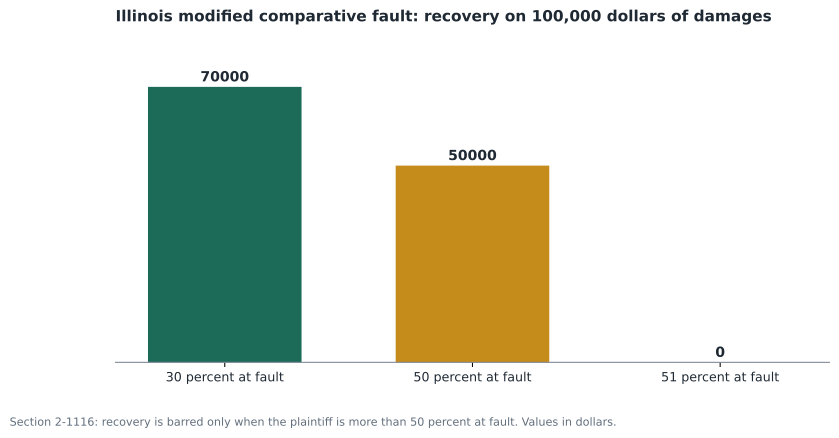
Illinois replaced contributory negligence with comparative fault through the Supreme Court of Illinois's 1981 decision in Alvis v. Ribar, which adopted pure comparative negligence. The General Assembly then moved Illinois to a modified system in 1986. Under section 2-1116 of the Code of Civil Procedure, a plaintiff whose contributory fault is more than 50 percent of the proximate cause of the injury is barred from recovering. A plaintiff whose fault is 50 percent or less recovers damages reduced in proportion to that fault.
The line is more than 50 percent, not 50 percent or more. A plaintiff found exactly 50 percent at fault still recovers half of the damages. That differs from states with a 50 percent bar, such as Georgia, where a plaintiff exactly half at fault recovers nothing.
Joint and several liability, limited
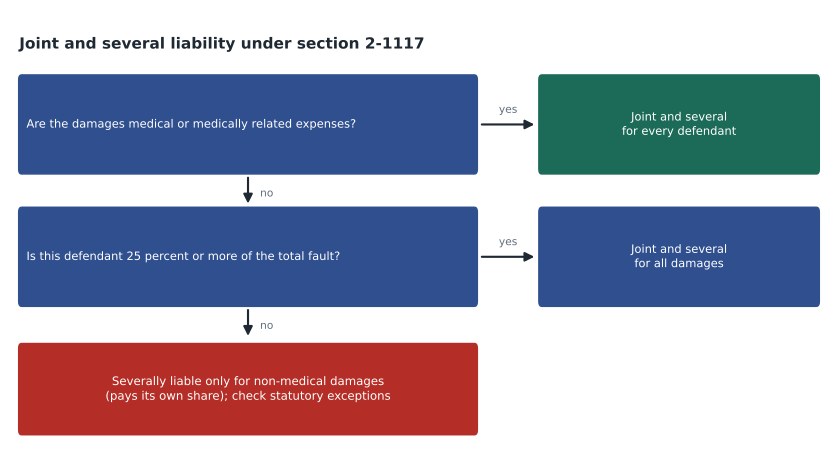
Illinois limits joint and several liability under section 2-1117. In general, a defendant whose fault is less than 25 percent of the total fault attributable to the plaintiff, the defendants sued by the plaintiff and any third-party defendant other than the plaintiff's employer is only severally liable for damages other than medical expenses. Such a defendant pays only its own share of those damages. A defendant whose fault is 25 percent or more remains jointly and severally liable for all of them. All defendants remain jointly and severally liable for the plaintiff's past and future medical and medically related expenses. The statute also has exceptions, including for certain medical malpractice and environmental cases, so the current text should be read for each file.
In practice, this means the allocation of fault among defendants matters a great deal. A plaintiff hurt by two defendants, one solvent and one not, wants the solvent defendant found at least 25 percent at fault so that it can be made to pay the whole of the non-medical damages.
Worked problem
Applying sections 2-1116 and 2-1117
A jury finds Marisol's client, a delivery driver, 20 percent at fault for his fall; the property owner 60 percent; and a snow removal contractor 20 percent. Damages are 200,000 dollars, of which 50,000 dollars are medical expenses. The snow removal contractor is insolvent. What can the client recover from the owner?
Show solution
- Under section 2-1116, the client is not more than 50 percent at fault, so he recovers damages reduced by 20 percent: 160,000 dollars.
- Total fault attributable to the plaintiff and the defendants is 100; the owner's 60 is 25 percent or more, so the owner is jointly and severally liable for all damages.
- The contractor's 20 is less than 25 percent, so the contractor alone would be only severally liable for non-medical damages, but the owner's joint liability covers the full reduced award.
Answer: The owner can be made to pay the full 160,000 dollars and seek contribution from the contractor. Had the owner been under 25 percent at fault, it would have owed only its own share of the non-medical damages, though still jointly liable for medical expenses.
Premises liability
The Illinois Premises Liability Act, at 740 ILCS 130, abolished the common law distinction between invitees and licensees. An owner or occupier owes entrants other than trespassers a duty of reasonable care under the circumstances regarding the state of the premises or acts done or omitted on them. Trespassers are treated differently. Illinois courts also apply a natural accumulation rule for ice and snow: an owner generally has no duty to remove natural accumulations, but may be liable for unnatural accumulations, such as ice formed from a defective downspout, or for undertaking removal negligently. The Snow and Ice Removal Act gives residential property owners some protection for removal efforts on sidewalks. For Marisol's loading-dock case, the key facts are whether the ice was a natural accumulation or the product of a building defect, and what the owner knew.
Claims against public entities
Claims against local governments and their employees are governed by the Local Governmental and Governmental Employees Tort Immunity Act, at 745 ILCS 10. The Act gives a range of immunities, including for discretionary policy decisions and, in many situations, for conduct that is not willful and wanton. It also has a short limitation period: civil actions against local entities and their employees must generally be commenced within one year from the date of injury, under section 8-101. Claims against the State of Illinois itself go to the Illinois Court of Claims. Marchetti tells new lawyers that a file involving a city bus, a public school or a park district needs a different calendar from day one.
Damages
Illinois has repeatedly rejected legislative caps on compensatory damages. In Best v. Taylor Machine Works in 1997, the Supreme Court of Illinois struck down a broad 1995 tort reform law that included a cap on noneconomic damages. In Lebron v. Gottlieb Memorial Hospital in 2010, it struck down a cap on noneconomic damages in medical malpractice cases, holding that it violated the separation of powers clause of the Illinois Constitution. As a result, Illinois juries generally decide compensatory damages without statutory caps, subject to remittitur.
Punitive damages are available for willful and wanton or similarly aggravated conduct, but a plaintiff cannot simply plead them. Under section 2-604.1, a plaintiff in a case based on negligence or product liability must first seek leave of court by a pretrial motion, showing a reasonable likelihood of proving facts sufficient to support punitive damages. A 2023 amendment to the Wrongful Death Act allowed punitive damages in some wrongful death actions, with exceptions, so that statute should be checked for current limits. In 2021, Illinois also adopted prejudgment interest in personal injury and wrongful death cases, at six percent a year from the filing of the action, subject to reductions for settlement offers and other conditions in the statute.
Dram shop and other special statutes
The Dram Shop Act, at 235 ILCS 5/6-21, makes sellers of alcohol liable for injuries caused by intoxicated persons to whom they sold or gave alcohol, without proof of negligence. Recovery under the Act is subject to limits that are adjusted for inflation each year, and the Act has its own limitation and notice rules. Other common statutes in Illinois injury practice include the Wrongful Death Act, the Survival Act and the Workers' Compensation Act, which generally makes workers' compensation the exclusive remedy against an employer but allows third-party claims against others.
| Rule | Illinois | MBE default |
|---|---|---|
| Comparative fault | Barred if more than 50 percent at fault (2-1116) | Pure comparative negligence |
| Joint liability | Several only for some defendants under 25 percent, except medical expenses (2-1117) | Joint and several |
| Noneconomic damage caps | Struck down (Best 1997; Lebron 2010) | Not tested as a default |
| Punitive damages | Leave of court required in negligence and product cases (2-604.1) | Generally available for aggravated conduct |
| Local entity claims | One-year period and immunities (Tort Immunity Act) | Not tested |
Common mistakes
MistakeBarring a plaintiff who is exactly 50 percent at fault.
InsteadIllinois bars recovery only when the plaintiff's fault is more than 50 percent; at exactly 50 percent the plaintiff recovers half.
MistakeAssuming every defendant is jointly and severally liable.
InsteadUnder section 2-1117, defendants less than 25 percent at fault are generally only severally liable for non-medical damages.
MistakePleading punitive damages in an Illinois negligence complaint.
InsteadSection 2-604.1 requires a pretrial motion for leave first.
MistakeCalendaring a two-year period against a park district.
InsteadThe Tort Immunity Act generally requires suit within one year against local entities and employees.
Practice problems
Work each problem on paper first, then reveal the answer to check.
A plaintiff is found 50 percent at fault with 80,000 dollars in damages. What does she recover in Illinois?
Show answer
40,000 dollars; she is not more than 50 percent at fault.
Which Illinois case struck down the cap on noneconomic damages in medical malpractice cases?
Show answer
Lebron v. Gottlieb Memorial Hospital (2010).
Which statute governs premises liability for entrants other than trespassers?
Show answer
The Premises Liability Act, 740 ILCS 130, imposing a duty of reasonable care.
Working through the numbers
Marchetti likes to put numbers on the two statutes because the order of the steps matters. First, the jury finds total damages and assigns fault to the plaintiff and to each defendant. Second, section 2-1116 asks whether the plaintiff's fault is more than 50 percent; if it is, the plaintiff recovers nothing. Third, if the plaintiff is not barred, the damages are reduced by the plaintiff's share. Fourth, section 2-1117 decides which defendants can be made to pay more than their own share.
Under section 2-1117, the 25 percent threshold is measured against the total fault attributable to the plaintiff, the defendants sued by the plaintiff and certain third-party defendants. A defendant below the threshold is severally liable for damages other than medical and medically related expenses, which means it pays only its own share of those damages. Every defendant remains jointly and severally liable for the medical expenses. The statute has exceptions and has been amended over the years, so a practitioner reads the current text before advising a client.
Worked problem
A three-party premises case
A customer slips on a wet floor in a store. The jury finds damages of 400,000 dollars, of which 100,000 dollars is medical expenses. It assigns fault as follows: customer 20 percent, store 60 percent, cleaning contractor 20 percent. How much can the customer collect, and from whom?
Show solution
- The customer is 20 percent at fault, which is not more than 50 percent, so section 2-1116 does not bar recovery.
- Damages are reduced by 20 percent: 400,000 dollars becomes 320,000 dollars, of which 80,000 dollars is medical and 240,000 dollars is non-medical.
- The store is 60 percent at fault, above 25 percent, so it is jointly and severally liable for the whole 320,000 dollars.
- The contractor is 20 percent at fault, below 25 percent. It is jointly and severally liable for the 80,000 dollars of medical expenses, but severally liable for only its share of the non-medical damages: 20 percent of 300,000 dollars, which is 60,000 dollars.
Answer: The customer can collect the full 320,000 dollars from the store. The contractor's exposure is limited to the 80,000 dollars of medical expenses plus 60,000 dollars of non-medical damages, and the defendants sort out contribution between themselves.
Marisol stumbles on the last step the first time. The contractor's several share is a share of the total non-medical damages before the plaintiff's reduction, multiplied by the contractor's percentage of fault. Marchetti tells her to write each step on a separate line, because a single combined calculation hides errors.
Settlements and contribution
Illinois allows defendants who pay more than their share to seek contribution from other tortfeasors. When one defendant settles in good faith before trial, Illinois law generally discharges that defendant from contribution claims by the others and reduces the plaintiff's recovery against the remaining defendants by the amount of the settlement. Whether a settlement was made in good faith is decided by the trial court, and the question comes up often in multi-defendant premises and construction cases.
For Marisol's firm, that rule shapes strategy. A plaintiff may settle early with a defendant who has limited insurance, keep the claim against a defendant with more coverage, and accept the setoff. A defense lawyer for the remaining defendant watches the good-faith hearing closely.
How this compares with the bar exam rules
MBE torts questions use general principles, and they usually tell the examinee which comparative fault rule applies. The modified 51 percent bar, the pure rule and old-style contributory negligence all appear in practice questions. Joint and several liability questions on the exam tend to test the traditional rule that each defendant who caused an indivisible injury can be held for the whole amount, with contribution between defendants. The Illinois 25 percent threshold is a statutory modification that an examinee should not assume on the exam.
Marchetti's summary for Marisol fits on an index card: for February, apply the rule the question gives you; for practice, apply sections 2-1116 and 2-1117 in order, with the arithmetic written out.
Claims against local governments
One more Illinois rule shapes premises practice: claims against local public entities and their employees run through the Local Governmental and Governmental Employees Tort Immunity Act. The Act grants specific immunities and sets a one-year limitation period for most civil actions against local entities, far shorter than the general two-year period for personal injury. When a client is hurt on a city sidewalk, in a park district building or on a school district's property, Marisol's first task is to calendar that shorter deadline and then check which immunities might apply.
Summary and key terms
- Illinois bars recovery when the plaintiff is more than 50 percent at fault and otherwise reduces damages proportionally.
- Defendants under 25 percent at fault are generally severally liable for non-medical damages; medical expenses remain joint and several.
- Illinois courts have struck down noneconomic damage caps; punitive damages require leave of court in negligence and product cases.
- Claims against local public entities face immunities and a one-year limitation period.
- Modified comparative fault
- A system that reduces recovery by the plaintiff's fault and bars it when that fault passes a threshold; in Illinois, more than 50 percent.
- Several liability
- Liability only for a defendant's own share of damages.
- Tort Immunity Act
- The Illinois statute giving immunities to local public entities and employees and setting a one-year limitation period.
- Natural accumulation rule
- The Illinois rule that an owner generally has no duty to remove natural accumulations of ice and snow.
Lesson quiz · 5 questions
Score 60% or more to complete this lesson.
Create a free account to save your progress, take quizzes and earn a certificate.