
BAR-214 · Lesson 11 of 12 · 20 min
Score transfer, admission on motion and practice after admission
▶ Video coming soon A video version of this lesson is on the way.
Marisol's group had three people with Illinois questions that were not about the exam. Dana, preparing for Texas, had a fiancé moving to Chicago and wondered whether a Texas UBE score could follow her. Ngozi, the New York candidate, wanted to know whether she could later add Illinois without another exam. And Marisol wanted to know what she would owe the profession in her first year. Marchetti took all three in one call: transferring a score in, admission on motion, other limited paths, and the obligations that start at admission.
Transferring a UBE score into Illinois
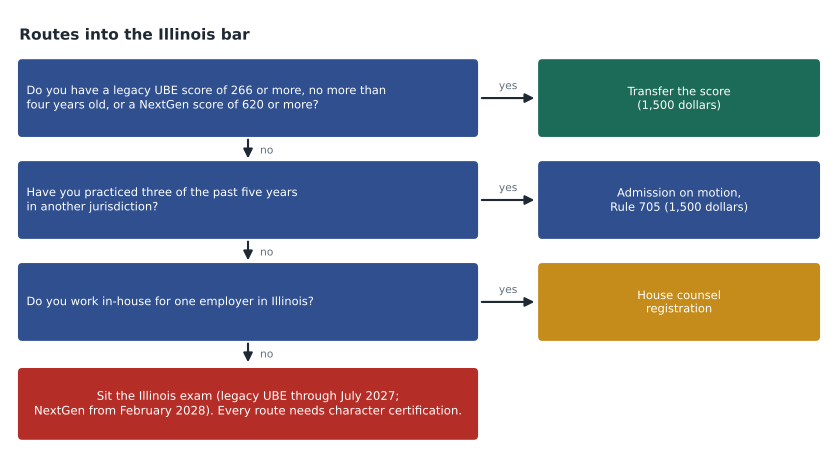
Illinois accepts transferred UBE scores. Under the court's rules and NCBE's jurisdiction information, a legacy UBE score must be at least 266 to be accepted, and the score can be no more than four years old. Since July 2026 Illinois has also accepted transferred NextGen scores, with a minimum of 620 set by the court in 2026. Illinois does not accept a transferred MBE score by itself; the Board ended MBE-only transfers with the July 2022 exam. The transfer fee is 1,500 dollars under Rule 706.
A transfer applicant still has to meet every other Illinois requirement: the education requirement, the MPRE score of 80, and character and fitness certification by an Illinois committee. The transferred score replaces the exam, not the rest of the file. Dana's Texas score could come to Illinois if it is 266 or higher and within the four-year window, but she would also have to complete the Illinois character process, which takes time. Marchetti suggested she file early if she knew Chicago was in her future.
Admission on motion
Experienced lawyers admitted elsewhere may be admitted in Illinois without examination under Supreme Court Rule 705. NCBE lists the core experience requirement as three years of practice in the past five years. The rule has other conditions, including education, good standing, character and fitness and the details of what counts as practice, and applicants should read the current rule in full. The fee is 1,500 dollars, paid in two parts: 150 dollars with the preliminary questionnaire that establishes eligibility, and 1,350 dollars with the full application. If the questionnaire does not establish eligibility and the applicant later reapplies, a new questionnaire and a new 150 dollar fee are required.
Ngozi, once admitted in New York and in practice for three years, would be a candidate for admission on motion in Illinois, subject to the rule's conditions as they apply to her education. Marchetti told her not to assume eligibility from the experience requirement alone, since foreign education raises its own questions under Illinois's rules.
Other limited paths
Illinois also has limited forms of authorization for lawyers who do not need, or cannot yet get, a full license. Lawyers admitted elsewhere may appear in a particular case under the pro hac vice rule with local counsel. In-house lawyers admitted in another jurisdiction may register as house counsel to work for their employer in Illinois, with limits on what they may do. Law students may practice under supervision in approved programs. Each path has its own rule, fee and limits, and none of them is a substitute for a full license for someone who plans to practice broadly in Illinois.
The oath and registration
An applicant who has passed the exam or qualified by transfer or motion, met the MPRE requirement and been certified by a Committee on Character and Fitness is admitted by the Supreme Court of Illinois. Admission ceremonies are held after each exam cycle. After admission, every Illinois lawyer registers with the Attorney Registration and Disciplinary Commission each year under Supreme Court Rule 756, pays the registration fee, and reports information including malpractice insurance coverage and pro bono service. A lawyer who fails to register is removed from the roll of lawyers authorized to practice until the registration is completed.
First-year continuing legal education
Illinois requires continuing legal education from the very start. Under Supreme Court Rule 793, a newly admitted Illinois lawyer must complete 15 hours of continuing legal education by the end of the first year, measured from admission. The hours must include a basic skills course of at least six hours, which introduces Illinois practice and professionalism. Many new lawyers satisfy part of the requirement through the Commission on Professionalism's Lawyer-to-Lawyer Mentoring Program, which pairs them with experienced lawyers. Some providers offer the basic skills course free to new lawyers. Newly admitted lawyers may carry over some excess hours into their next period, subject to limits.
Ongoing MCLE
After the first year, Illinois lawyers must complete 30 hours of continuing legal education in each two-year reporting period under Supreme Court Rule 794. At least six of those hours must be in professional responsibility. Rule 794 lists the qualifying areas: professionalism, civility, legal ethics, diversity and inclusion, and mental health and substance abuse, and, since an amendment effective February 1, 2024, sexual harassment prevention. Lawyers should check the MCLE Board's current guidance on whether any specific number of hours in a particular area is required for their reporting period. Reporting periods run from July 1 to June 30 of the second year: lawyers whose last names begin with A through M report for periods beginning July 1 of even-numbered years, and those with N through Z for periods beginning July 1 of odd-numbered years.
| Requirement | Rule | What it requires |
|---|---|---|
| First-year MCLE | Rule 793 | 15 hours in the first year, including a basic skills course of at least six hours |
| Ongoing MCLE | Rule 794 | 30 hours every two years, including six professional responsibility hours |
| Annual registration | Rule 756 | Register with the ARDC each year; report malpractice insurance and pro bono |
| Admission on motion | Rule 705 | Three years of practice in the past five, plus other conditions |
| Score transfer | Rules 704 and 704A | Legacy UBE 266 within four years; NextGen 620 |
Worked problem
Marisol's first year
Marisol is admitted in Illinois on May 13, 2027. What must she complete, and by when, before her first regular MCLE period?
Show solution
- Rule 793 requires 15 hours in her first year after admission.
- The 15 hours must include a basic skills course of at least six hours.
- She may count hours from the Lawyer-to-Lawyer Mentoring Program toward the total if she completes it.
- She must also register with the ARDC and keep her registration current every year.
Answer: She needs 15 hours, including at least six in a basic skills course, by the end of her first year, roughly May 2028, plus annual ARDC registration.
Common mistakes
MistakeAssuming a transferred UBE score admits you without more.
InsteadTransfer applicants must still meet education, MPRE and character and fitness requirements.
MistakeTrying to transfer an MBE score alone.
InsteadIllinois ended MBE-only transfers with the July 2022 exam.
MistakeWaiting a year to think about MCLE.
InsteadNewly admitted lawyers owe 15 hours, including a basic skills course, in their first year.
MistakeLetting ARDC registration lapse.
InsteadAn unregistered lawyer is removed from the roll of lawyers authorized to practice until registration is completed.
Practice problems
Work each problem on paper first, then reveal the answer to check.
What legacy UBE score and age does Illinois accept for transfer?
Show answer
266 or higher, no more than four years old.
How much practice experience does Illinois admission on motion require?
Show answer
Three years in the past five, plus the rule's other conditions.
How many MCLE hours must an Illinois lawyer complete every two years, and how many in professional responsibility?
Show answer
30 hours, including six in professional responsibility.
A transfer, step by step
Marisol's friend Kwame passed the UBE in another state in July 2025 with a score of 281 and now has a job offer in Chicago. Marchetti uses his case to walk through a transfer. Kwame starts by confirming that his score meets the Illinois minimum for legacy UBE scores, 266, and that it will still be within the four-year age limit when Illinois acts on his application. He then files the character and fitness registration and the transfer application with the Board, pays the 1,500 dollar transfer fee, and asks NCBE to send his official score to Illinois. He also confirms that his MPRE score of 80 or higher is on file.
The score is only one part of the file. Kwame's character and fitness review proceeds on the same standards as for any exam applicant, and he cannot be admitted until it is complete. If he was admitted in the other state, he also needs a certificate of good standing and must disclose any discipline there.
Worked problem
Is the score still young enough?
Kwame earned his UBE score in July 2025. In late 2029 he is still deciding whether to move to Illinois. Does the age of the score matter?
Show solution
- Illinois accepts transferred legacy UBE scores of 266 or higher, up to four years old.
- By late 2029, a July 2025 score is more than four years old.
- The score would no longer support a transfer, however high it was.
- If he has practiced long enough elsewhere, admission on motion may be an alternative; otherwise he would need to sit the Illinois exam.
Answer: The score would be too old by late 2029. Kwame should file while the score is within four years, or look at admission on motion if he qualifies.
Admission on motion in practice
A lawyer admitted in another jurisdiction who has practiced for at least three of the five years before applying may seek admission on motion. The practice must be active and substantial, and the applicant must be in good standing everywhere admitted. The fee is 1,500 dollars in total. The Board looks closely at what counts as practice: full-time work as a lawyer for a firm, a government office, a corporation or a court generally qualifies, while part-time or non-legal work may not.
Marchetti points out that admission on motion avoids the exam, but it does not avoid the character and fitness review, and it can take longer than a transfer because the Board must verify the practice history with employers in other states. A lawyer planning a move should start the paperwork months before the start date.
Limited paths for specific roles
Illinois also has limited licenses for lawyers in particular roles. Lawyers admitted elsewhere who work in-house for a single employer in Illinois can register as house counsel. Lawyers who serve in legal aid programs or are spouses of military personnel stationed in Illinois may qualify for other limited admissions under the Supreme Court Rules. Each path has its own conditions, and the license is limited to the work it describes. A lawyer who wants a full license must still qualify through the exam, a transfer or admission on motion.
The first months after admission
Once Marisol is admitted, three obligations begin almost at once. She must register with the Attorney Registration and Disciplinary Commission each year and pay the annual fee. She must complete her new lawyer continuing legal education in her first year, including the basic skills course. And she must keep her contact information current with the ARDC, because notices about registration and discipline go to that address.
| Obligation | When | What it involves |
|---|---|---|
| ARDC registration | Every year | Annual registration and fee, with disclosures about practice, trust accounts and malpractice insurance |
| New lawyer MCLE | First year after admission | 15 hours, including a basic skills course and professional responsibility credit |
| Ongoing MCLE | Every two years after the first reporting period | 30 hours, of which 6 are professional responsibility |
| Contact information | Whenever it changes | Kept current with the ARDC |
Planning the two-year MCLE cycle
Illinois assigns ongoing MCLE reporting periods by the first letter of the lawyer's last name. Lawyers whose last names begin with A through M report in even-numbered years, and those whose names begin with N through Z report in odd-numbered years, with periods running from July 1. Marisol's last name begins with D, so after her first-year requirement she will report on the even-year cycle. The MCLE Board explains how the first ongoing period is set for a newly admitted lawyer, and she will check that when her admission date is known.
Marchetti's advice is to spread the hours across the period instead of cramming them into the last month, and to choose courses that match the work. A lawyer in Marisol's firm can meet most of the requirement with programs on premises liability, landlord and tenant law and privacy, which also make her better at the job.
Keeping the license in good order
Marchetti closes the lesson with a reminder that admission is the start of a set of continuing duties, not the end of the process. A lawyer who misses ARDC registration can be removed from the roll of lawyers authorized to practice until the registration is completed, and a lawyer who misses an MCLE deadline faces notices, fees and eventually removal from the roll as well. Both problems are entirely avoidable with a calendar entry and a few minutes each year.
Summary and key terms
- Illinois accepts legacy UBE scores of 266 up to four years old and NextGen scores of 620, but not MBE-only scores; transfer costs 1,500 dollars.
- Admission on motion requires three years of practice in the past five, plus other conditions, and costs 1,500 dollars.
- Every route requires character and fitness certification; lawyers register yearly with the ARDC.
- New lawyers owe 15 MCLE hours in the first year, including a basic skills course; afterward, 30 hours every two years with six in professional responsibility.
- Admission on motion
- Admission without examination for experienced lawyers admitted elsewhere, under Illinois Supreme Court Rule 705.
- Basic skills course
- A course of at least six hours on Illinois practice and professionalism that newly admitted Illinois lawyers must complete.
- Rule 756
- The Illinois Supreme Court Rule requiring annual registration with the ARDC.
- Lawyer-to-Lawyer Mentoring Program
- A Commission on Professionalism program pairing new lawyers with experienced mentors, counting toward first-year MCLE.
Lesson quiz · 5 questions
Score 60% or more to complete this lesson.
Create a free account to save your progress, take quizzes and earn a certificate.