
BAR-214 · Lesson 12 of 12 · 36 min
Capstone: Illinois practice questions and an exam-day plan
▶ Video coming soon A video version of this lesson is on the way.
The week before Thanksgiving, Marchetti gave Marisol a capstone in two parts. The first part was a set of original questions drawn from this course, mixing admission rules with the Illinois law she would use in practice. The second part was a written plan for February 23 and 24, 2027. 'The questions check that you know Illinois,' Marchetti said. 'The plan checks that you'll show up ready to pass a national exam.' Marisol worked the questions on her own on Sunday, November 22, 2026, and they reviewed her answers that evening. The questions and model answers below are original to this course.
Part one: practice questions
Work each question before reading the answer. The first group tests the admission rules. The second tests Illinois law from Lessons 7 to 10. The third reminds you where Illinois law and the bar exam part ways.
Admission rules
Worked problem
Question 1: the late filer
Tomás graduates in May 2027 and decides on April 10, 2027 to sit the July 2027 Illinois exam. He has not registered for character and fitness. Can he sit, what will it cost, and what risks does he face?
Show solution
- July's timely deadline is February 15 and the late period runs to April 1; April 10 falls in the final late period, April 2 to April 30.
- He can still file, at the final late fee of 1,325 dollars, plus the 450 dollar character and fitness registration fee.
- His character investigation starts late, so even if he passes he may wait for certification before admission.
- July 2027 is the last legacy UBE in Illinois; a retake would be NextGen in February 2028.
Answer: Yes, he can sit in July 2027 by filing before April 30, paying 1,325 dollars plus 450 dollars. He risks a delayed admission and, if he fails, a switch to NextGen.
Worked problem
Question 2: the transfer
Priya earned a UBE score of 268 in Missouri in July 2023 and wants to practice in Chicago in early 2027. She has an MPRE score of 82. Can she transfer her score to Illinois?
Show solution
- Illinois accepts legacy UBE scores of 266 or higher.
- Scores can be no more than four years old; a July 2023 score is within four years in early 2027 but must be used before the window closes.
- Her MPRE of 82 meets Illinois's 80.
- She must still be certified by an Illinois Committee on Character and Fitness and pay the 1,500 dollar transfer fee.
Answer: Yes, if she applies and completes the process while the score is within the four-year window. She needs Illinois character and fitness certification and must pay 1,500 dollars.
Worked problem
Question 3: the NextGen score
Owen sat the NextGen exam in Oregon in July 2026 and scored 615. Can he transfer the score to Illinois?
Show solution
- Illinois began accepting transferred NextGen scores in July 2026.
- The Illinois NextGen passing score, which also applies to transferred scores, is 620.
- 615 is below 620.
Answer: No. His score is below Illinois's 620 minimum. He would need to sit an Illinois exam or achieve 620 on another NextGen exam.
Illinois law
Worked problem
Question 4: comparative fault and joint liability
A pedestrian sues a driver and a city bus company. A jury finds the pedestrian 40 percent at fault, the driver 45 percent and the bus company 15 percent. Damages are 300,000 dollars, of which 60,000 dollars are medical expenses. The driver is uninsured and insolvent. What can the pedestrian collect from the bus company?
Show solution
- The pedestrian is not more than 50 percent at fault, so she recovers 60 percent of her damages: 180,000 dollars, of which 36,000 dollars are medical expenses.
- The bus company's 15 percent is less than 25 percent, so it is only severally liable for non-medical damages: 15 percent of 240,000 dollars, or 36,000 dollars.
- All defendants remain jointly and severally liable for medical expenses, so the bus company can be made to pay the 36,000 dollars in reduced medical expenses.
- If the bus company were a local public entity, the Tort Immunity Act's immunities and one-year limitation period would also need checking.
Answer: About 72,000 dollars: its 36,000 dollar share of the non-medical damages plus the full 36,000 dollars of reduced medical expenses, subject to any public-entity immunity.
Worked problem
Question 5: the land trust
A tenant is injured by a collapsing balcony at a building titled in "Lakeview Trust Co., as trustee under Trust No. 9120." Who should the tenant's lawyer investigate as defendants?
Show solution
- In an Illinois land trust, the trustee holds title but typically has no management duties.
- The beneficiaries direct the trustee and control the property; any manager acts for them.
- Illinois law requires disclosure of land trust beneficiaries in some proceedings.
- If the building is in Chicago, the Residential Landlord and Tenant Ordinance may also apply.
Answer: The beneficiaries and the property manager, identified through the disclosure rules, along with the trustee as needed for title; the Chicago ordinance may add claims.
Worked problem
Question 6: BIPA
A warehouse used fingerprint time clocks from 2020 to 2025 without a written policy or written releases. A worker who scanned in and out twice a day sues in 2026. What are the key issues?
Show solution
- Under Rosenbach, the worker is aggrieved by the violation without proof of other harm.
- Under McDonald, workers' compensation exclusivity does not bar the claim.
- Under Tims, a five-year limitation period applies.
- Under Cothron each scan accrued a claim, but the 2024 amendment treats the same data from the same person by the same method as one violation for recovery; whether it applies to pending claims must be checked.
Answer: The worker can sue; damages are 1,000 dollars per negligent or 5,000 dollars per reckless violation, but recovery is likely limited to a single violation under the 2024 amendment, depending on how courts apply it.
Where the exam differs
Worked problem
Question 7: the MBE trap
On the MBE, a question describes a plaintiff 60 percent at fault with 50,000 dollars in damages and states no special rule. Marisol's first instinct, from work, is that the plaintiff recovers nothing. Is she right?
Show solution
- NCBE's MBE outline tells examinees to assume pure comparative negligence unless the question says otherwise.
- Under pure comparative negligence, the plaintiff recovers damages reduced by her share of fault.
- Illinois's modified rule would bar recovery, but Illinois law does not govern the MBE.
Answer: No. On the MBE the plaintiff recovers 20,000 dollars. Her Illinois instinct is right for practice and wrong for the exam.
Part two: the exam-day plan
Marchetti asked Marisol to write her own plan in her own words. Her final version, after Marchetti's comments, looked like this.
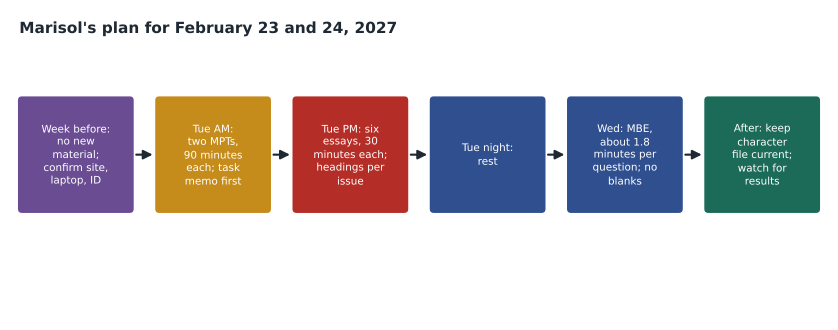
The week before. No new material. Review her error log and the rules she misses most. Read the Board's examinee instructions for February 2027 again, confirm the test site, check her laptop software and her identification, and confirm her hotel reservation. Sleep on a regular schedule.
Tuesday morning: the MPT. Two tasks, about 90 minutes each. Read the task memo first and note the format and audience. Spend roughly half of each task reading and organizing, then write. Use headings that match the task. Never bring in outside law when the library supplies it.
Tuesday afternoon: the MEE. Six essays, about 30 minutes each. Read the call of each question before the facts. Use a heading for each issue, state the rule in a sentence, apply it to the facts and conclude. If stuck, write a reasonable rule and apply it carefully; graders reward analysis. Move on when the time is up.
Tuesday night. Rest. A short look at a few rule summaries is fine; a long review session is not.
Wednesday: the MBE. 200 questions in two sessions, about 1.8 minutes per question. Answer every question, since there is no penalty for wrong answers. Flag and return, but do not spend more than three minutes on any one question in the first pass.
After the exam. Keep the character and fitness file current, since the duty to update continues until admission. Watch the Board's announcements and her online account for results. If the result is good, plan for admission, ARDC registration and the first-year MCLE. If not, review the score report and decide quickly whether to sit in July 2027, the last legacy exam in Illinois.
Common mistakes
MistakeSpending the last week learning new topics.
InsteadUse the final week to review weak rules, confirm logistics and rest.
MistakeLeaving MBE questions blank.
InsteadThere is no penalty for wrong answers; answer every question.
MistakeWriting Illinois rules on the MEE.
InsteadApply the national rules the MEE tests unless the question supplies a rule.
MistakeForgetting the character file after the exam.
InsteadThe duty to update continues until admission.
Practice problems
Work each problem on paper first, then reveal the answer to check.
What should an examinee read first on an MPT task?
Show answer
The task memo, to learn the assignment, format and audience.
About how much time per question does the MBE allow?
Show answer
About 1.8 minutes.
If Marisol does not pass in February 2027, when is her last chance to sit the legacy UBE in Illinois?
Show answer
July 2027.
Three more questions for the last week
On Sunday, November 22, 2026, Marchetti ends the capstone session with three more original questions. They are not bar exam questions; they test whether Marisol can carry the Illinois rules from this course into her first year of practice, while keeping them out of her February answers.
Worked problem
Question 8: the duty to disclose
After admission, Marisol represents a client in a landlord dispute. The client tells her, convincingly, that he plans to set fire to the building that night while the tenants are home. What does the Illinois rule require?
Show solution
- Illinois Rule 1.6 requires disclosure to the extent reasonably necessary to prevent reasonably certain death or substantial bodily harm.
- A fire set in an occupied building creates that risk.
- The disclosure should be limited to what is needed to prevent the harm, such as a call to the police or fire department.
- Under the ABA Model Rule the disclosure would be permitted; in Illinois it is required.
Answer: Marisol must disclose enough to prevent the harm. Staying silent would violate the Illinois rule.
Worked problem
Question 9: the estate without a will
A client's mother died without a will, leaving no spouse and three children. One child died before the mother, leaving two children of her own. The probate estate is 300,000 dollars. How is it divided?
Show solution
- With descendants and no spouse, the descendants take the whole estate by representation.
- The estate is divided at the children's level into three shares of 100,000 dollars each.
- The two living children take 100,000 dollars each.
- The deceased child's share of 100,000 dollars passes to her two children, 50,000 dollars each.
Answer: Each living child takes 100,000 dollars, and each grandchild takes 50,000 dollars.
Worked problem
Question 10: the score that needs a decision
A friend of Marisol's scores 263 on the February 2027 Illinois exam. She asks what her next step is. What should Marisol tell her?
Show solution
- 263 is below the legacy passing score of 266, so she did not pass.
- July 2027 is the last legacy UBE in Illinois, so a retake in July keeps the same format.
- If she waits until February 2028 or later, she must sit NextGen and reach 620.
- Her character and fitness file remains open, but she must keep it current, and she must file a new exam application within the deadlines for July 2027.
Answer: She should file for July 2027 on time if she wants to retake in the legacy format, and keep her character file current.
A checklist for the final week
Marchetti's final checklist is short and practical. Confirm the exam location, the start time and the route, including where to park or which train to take. Confirm that the laptop and exam software meet the Board's instructions and that the software has been tested. Pack the admission ticket, the required identification and any permitted items the Board allows, and nothing that is prohibited. Plan meals for both days, and plan the evening between the two days as rest, not study.
She also reminds Marisol of the things that do not need doing. There is no new law to learn in the last three days. There is no need to read the course outlines again from the start. The best use of the last week is light review of the weakest subjects, a few timed sets to keep the pace, and enough sleep to think clearly on Tuesday morning.
After February
The weeks after the exam are quiet, but not empty. Marisol keeps her character and fitness file current, answers any requests from the Board promptly, and watches for the release of results on the Board's website. When she passes, she will be scheduled for the oath, register with the ARDC and begin her first-year MCLE. If the result is not what she wants, she will look at the score report, decide between July 2027 and NextGen, and start again with the same calendar habits that got her this far.
Marchetti's last words in the session are the same ones she used at the start: read the current notices, write down every date, and answer every question on the character file completely. Those habits outlast the exam.
Summary and key terms
- The capstone tests Illinois admission rules, Illinois practice law and the gap between Illinois law and the national exam.
- Transfers need 266 on the legacy UBE within four years, or 620 on NextGen, plus Illinois character certification.
- In practice, apply modified comparative fault, limited joint liability, land trust rules and BIPA; on the exam, apply the national defaults.
- A good exam-day plan covers the week before, both days and the duties that continue after the exam.
- Error log
- A running record of missed questions and the rules behind them, used for final review.
- Task memo
- The MPT instruction from the supervising lawyer that sets the assignment and format.
- Call of the question
- The specific question an essay asks the examinee to answer.
- Exam-day plan
- A written schedule and checklist covering logistics, timing and recovery for the two exam days.
Lesson quiz · 5 questions
Score 60% or more to complete this lesson.
Create a free account to save your progress, take quizzes and earn a certificate.