
BAR-226 · Lesson 1 of 12 · 20 min
Becoming a lawyer in Missouri
▶ Video coming soon A video version of this lesson is on the way.
Marcus Bell is a Missouri lawyer now. He sat the first NextGen bar exam ever given in Missouri in July 2026, learned on October 2, 2026 that he had passed with a score of 648, and completed his swearing-in soon after. He works as an associate at a small firm in Kansas City, Missouri, where his first months have been a mix of car-accident files, a few family law matters and a great deal of research for the partners. He stayed in Hollis Marchetti's study group after his result because, as he put it, the group had carried him through the hardest summer of his life and he wanted to return the favor.
Hollis took him up on it. Missouri was one of the first jurisdictions to give the NextGen exam, and future Missouri candidates in the group would want to hear from someone who had done it. So she proposed a set of sessions in which Marcus would retrace his own path to admission while she pressed him on the details, and then the two of them would work through the Missouri law a new lawyer actually meets. 'You know what it felt like,' she told him. 'I know where people trip. Between us we can build something a candidate can follow from the first form to the oath.'
This course follows those sessions. The first six lessons cover admission: who admits Missouri lawyers, who is eligible, the filing calendar and fees, character and fitness and the MPRE, the NextGen exam and its 610 passing score, the change from the legacy exam, and the Missouri Educational Component Test. Lessons 7 through 10 cover distinctive Missouri law: the courts and civil procedure, tort law, family law and estates, and the Missouri Rules of Professional Conduct. Lesson 11 covers score transfer, admission without examination and life after admission, and Lesson 12 is a capstone with original practice questions and an exam-day plan.
The Supreme Court of Missouri admits lawyers
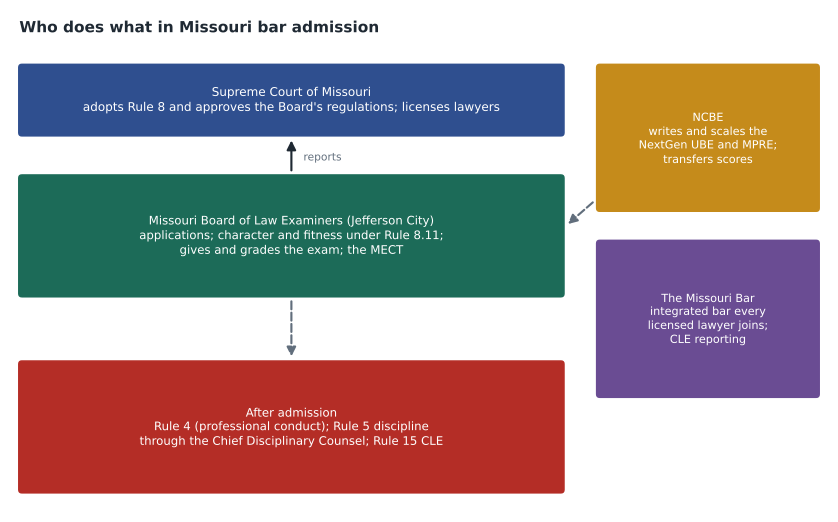
In Missouri, as in every state, the power to admit lawyers belongs to the state's highest court. The Supreme Court of Missouri sits in Jefferson City and has seven judges. Missouri calls the members of its high court judges, not justices, and one of them serves as chief justice for a two-year term. The Court regulates the practice of law through its rules, and the admission rules are collected in Rule 8, titled Admission to the Bar. Rule 8 is supplemented by regulations of the Board of Law Examiners, which the Court approves. When a Missouri candidate reads that the passing score is 610, or that the application must be filed by October 1 for a February exam, the authority for that statement is Rule 8 or its regulations.
Rule 8 is organized by subject. Rule 8.03 deals with exam results and notice. Rule 8.04 lists circumstances that make a person ineligible to apply for a time, such as a pending felony charge. Rule 8.07 governs eligibility to sit and the filing deadlines. Rule 8.08 describes the bar examination itself, including the MPRE requirement and the Missouri Educational Component Test. Rule 8.09 governs admission by a transferred bar exam score, Rule 8.10 admission without examination, and Rule 8.11 character and fitness. Rule 8.12 provides for hearings and appeals when the Board refuses an application. A candidate does not need to memorize those numbers, but recognizing them makes the Board's materials far easier to use.
The Court also adopts the rules that govern lawyers after admission. Rule 4 contains the Missouri Rules of Professional Conduct, numbered with a 4 and a hyphen in front of the familiar Model Rule numbers, so the confidentiality rule is Rule 4-1.6. Rule 5 governs complaints and discipline, Rule 6 sets the annual enrollment fee every lawyer pays, and Rule 15 sets the continuing legal education requirement. Those rules matter on the day a new lawyer takes the oath, and Lesson 10 and Lesson 11 return to them.
The Missouri Board of Law Examiners
The Court does not run the admission process itself. It acts through the Missouri Board of Law Examiners, whose office is in Jefferson City and whose website is mble.org. The Board receives applications, decides whether applicants meet the education and filing requirements, investigates character and fitness, administers and grades the bar examination, offers the Missouri Educational Component Test and certifies to the Court the applicants who have met every requirement. The Board also handles applications for admission by transferred score and without examination, temporary licenses and limited licenses for in-house counsel.
Applications are filed electronically through the Board's online system, and the Board treats an application as properly filed only when the full fee has been paid, every electronic part has been submitted and the signed authorization and release has been received. That last document allows the Board to gather records from schools, employers, courts and agencies during the character and fitness investigation. An application missing any of those pieces is not properly filed, and the filing deadlines in Lesson 2 apply to properly filed applications.
NCBE's part
The National Conference of Bar Examiners writes the exams Missouri uses. It prepares the NextGen Uniform Bar Examination, scores the multiple-choice items, scales and equates the written scores that Missouri graders produce and reports a single score. It also writes and administers the Multistate Professional Responsibility Examination, the ethics exam every Missouri applicant must pass with a scaled score of at least 80. Candidates deal with NCBE directly for an NCBE account number, MPRE registration, score reports and score transfers to other jurisdictions.
Missouri does not use NCBE's character and fitness investigation service. NCBE's jurisdiction page for Missouri tells applicants to contact the Missouri Board for filing instructions, and the investigation is done in Jefferson City under Rule 8.11. That is a small but useful fact: a Missouri applicant who has heard from friends in other states about filling out an NCBE character report will not do that for Missouri.
The Missouri Bar
After admission, every licensed Missouri lawyer belongs to The Missouri Bar, the state's integrated bar. Membership is not optional. The Missouri Bar collects the annual enrollment fee set under Rule 6, keeps the lawyer's contact information and runs the reporting system for continuing legal education. It also publishes practice materials, runs sections and committees and offers programs such as the Annual Law Update that new lawyers admitted without examination must attend. Lawyers in Missouri often say 'the Bar' to mean The Missouri Bar, and the Board of Law Examiners is a separate body that does not regulate lawyers after admission.
Discipline is separate again. Complaints against Missouri lawyers go to the Office of Chief Disciplinary Counsel, which acts under Rule 5 and investigates, prosecutes and recommends. Only the Supreme Court can suspend or disbar a Missouri lawyer. Lesson 10 explains that process.
Three ways in
Missouri admits lawyers in three main ways. The first is admission by examination: the applicant meets the education requirement, files an application, passes character and fitness review, passes the NextGen exam with a score of at least 610, completes the Missouri Educational Component Test and files a passing MPRE score. Marcus took this route, and it is the route most new graduates take.
The second is admission by transferred score under Rule 8.09. An applicant who earned a NextGen score of at least 610 or a legacy UBE score of at least 260 in another jurisdiction, within five years before applying, can ask Missouri to accept that score instead of sitting the exam again. The applicant must still satisfy Missouri's education requirement, pass character and fitness review, complete the MECT and file a passing MPRE score.
The third is admission without examination under Rule 8.10, sometimes called admission on motion. A lawyer with an ABA-approved law degree who is licensed in another jurisdiction that gives Missouri lawyers reciprocal treatment, and who has spent at least five of the last ten years in qualifying full-time practice, can be admitted without any bar exam. Lesson 11 covers both alternative routes in detail.
Missouri also offers narrower licenses: temporary licenses in limited situations, a limited license for in-house counsel employed by a business or government entity whose business is not the practice of law, and certificates for foreign legal consultants. Those are for lawyers already licensed elsewhere and are outside the main path for a new graduate.
The order of the steps
Marcus listed the steps he had taken, in order, and Hollis wrote them on the shared screen. He had finished his JD at an ABA-approved law school. He had sat the MPRE in 2025 and passed. He had filed his bar application in early 2026, ahead of the March deadline for the July exam, and had answered the Board's follow-up questions during the spring. He had taken the MECT, an online open-book test on Missouri law, after his application was submitted, because Rule 8.08 allows it any time from the date the application is submitted until one year after the notice of passing. He had sat the NextGen exam on July 28 and 29, 2026. His result arrived on October 2. Once the Board confirmed that every requirement was met, he was licensed and took the oath.
Hollis pointed out how flexible the Missouri order is compared with some states. The MPRE score must reach the Board no later than one year after written notice of passing the bar exam, so a candidate can take the MPRE before or after the bar exam. The MECT has the same outer deadline, and its earliest date is the date the application is submitted. A candidate can therefore arrange the two smaller requirements around the bar exam rather than letting them crowd the months of bar study. Some candidates take both early to be finished; others save the MECT for the weeks after the exam, when they have time to read the Missouri outlines carefully.
'The one thing you cannot move,' Marcus said, 'is the application deadline. Everything else has a window. That one has a date.'
How Missouri law fits in
The NextGen exam tests general law. It does not test Missouri's own rules, and an answer on the exam should follow the general rule unless the question's materials supply a different one. Missouri teaches and tests its own law through the MECT, which covers eleven subjects, from torts and civil procedure to trust account management. That division of labor shapes a candidate's study. Bar review is for the national exam, and Missouri law is learned for the MECT and, more importantly, for practice.
Missouri law does differ from the general rules in ways that matter to a new lawyer. Missouri uses pure comparative fault, limits joint and several liability to defendants at least 51 percent at fault, picks many of its judges through the Nonpartisan Court Plan, requires fact pleading in civil cases and has its own approved jury instructions. It has a statute that presumes equal or nearly equal parenting time is in a child's best interests. Its Rules of Professional Conduct include advertising disclosures not found in the ABA Model Rules. Later lessons cover each of these.
Worked problem
Mapping the authority
A friend tells a Missouri candidate that she must pass the MPRE before she is allowed to sit the bar exam, and that NCBE will investigate her character. Which bodies and rules actually govern those two points?
Show solution
- The MPRE requirement is in Rule 8.08(b), adopted by the Supreme Court of Missouri.
- Rule 8.08(b) requires a scaled score of at least 80, certified to the Board no later than one year after written notice of passing the bar exam, so the MPRE need not come first.
- Character and fitness is investigated by the Missouri Board of Law Examiners under Rule 8.11.
- NCBE's jurisdiction page says Missouri does not use NCBE's character and fitness services.
Answer: The friend is wrong on both points. The MPRE can come before or after the bar exam, as long as the score reaches the Board within the one-year window, and the Missouri Board, not NCBE, investigates character and fitness.
Common mistakes
MistakeThe Missouri Bar decides who passes the bar exam.
InsteadThe Board of Law Examiners gives and grades the exam; The Missouri Bar is the integrated bar a lawyer joins after admission.
MistakeMissouri's high court has justices.
InsteadIts seven members are judges; one serves as chief justice.
MistakeThe NextGen exam in Missouri includes Missouri law questions.
InsteadIt tests general law; Missouri law is covered by the MECT.
MistakeThe MPRE must be passed before the bar exam.
InsteadThe score must reach the Board within one year after notice of passing; it can come before or after.
MistakeNCBE runs the Missouri character investigation.
InsteadThe Missouri Board investigates under Rule 8.11; Missouri does not use NCBE's character service.
Practice problems
Work each problem on paper first, then reveal the answer to check.
Which rule of the Supreme Court of Missouri governs admission to the bar?
Show answer
Rule 8, supplemented by the Board of Law Examiners' regulations.
Where is the Missouri Board of Law Examiners located?
Show answer
Jefferson City.
Name the three main routes to admission in Missouri.
Show answer
By examination, by transferred UBE score (Rule 8.09) and without examination (Rule 8.10).
What MPRE score does Missouri require?
Show answer
A scaled score of at least 80.
Which body must every licensed Missouri lawyer join?
Show answer
The Missouri Bar, the state's integrated bar.
Summary and key terms
- The Supreme Court of Missouri admits lawyers under Rule 8 and the Board's regulations.
- The Missouri Board of Law Examiners in Jefferson City handles applications, character and fitness, the exam and the MECT.
- NCBE writes the NextGen UBE and the MPRE; Missouri requires an MPRE score of 80 and does not use NCBE's character service.
- The three routes are examination, transferred score and admission without examination.
- The application deadline is fixed; the MECT and MPRE have windows that end one year after notice of passing.
- After admission, every lawyer joins The Missouri Bar and is subject to Rules 4, 5, 6 and 15.
- Rule 8
- The Supreme Court of Missouri's rule governing admission to the bar.
- Missouri Board of Law Examiners
- The Court's board that handles applications, character and fitness, the exam and the MECT.
- The Missouri Bar
- The integrated bar to which every licensed Missouri lawyer belongs.
- MECT
- The Missouri Educational Component Test, an online open-book test on Missouri law required for admission.
- admission without examination
- Admission under Rule 8.10 for experienced lawyers from reciprocal jurisdictions.
Lesson quiz · 5 questions
Score 60% or more to complete this lesson.
Create a free account to save your progress, take quizzes and earn a certificate.