
BAR-226 · Lesson 11 of 12 · 20 min
Score transfer, admission without examination and practice after admission in Missouri
▶ Video coming soon A video version of this lesson is on the way.
The firm Marcus works for sits a few miles from the Kansas line, and a good share of its clients live or work on the other side. By November he had already sat in on a call about a crash that happened in Overland Park, Kansas, to a client who lives in Kansas City, Missouri. 'Every week someone asks whether I can take a Kansas case,' he said. 'Right now the honest answer is no.' The eleventh session looked at that problem from both directions: how lawyers from elsewhere get into Missouri, how a Missouri lawyer like Marcus gets into a second state, and what a new Missouri lawyer must do to stay in good standing.
This lesson covers admission by transferred score under Rule 8.09, admission without examination under Rule 8.10, the narrower licenses, the second-license questions a Missouri lawyer faces and the obligations that begin on the day of admission.
Admission by transferred score
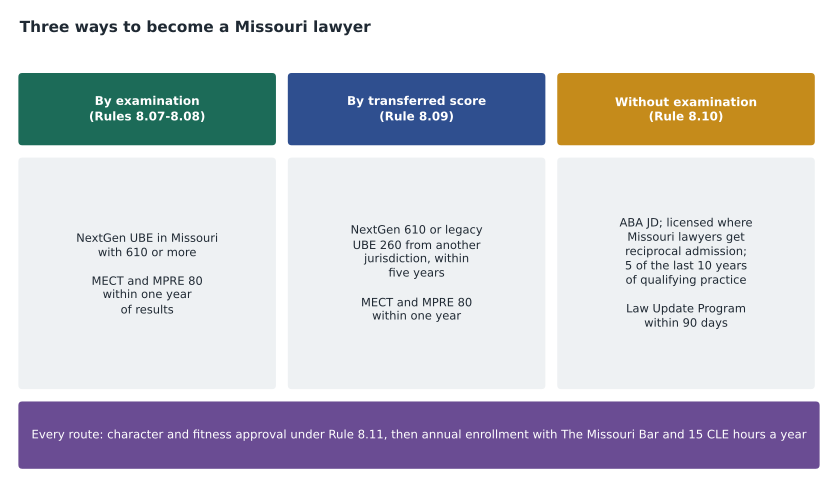
Rule 8.09 lets an applicant who passed a uniform bar exam elsewhere use that score for Missouri admission. The applicant must have earned a scaled total score of at least 610 on the NextGen UBE, or at least 260 on the legacy UBE, in a jurisdiction other than Missouri, on an exam administered within five years before the application is properly submitted. The applicant must hold a JD or LLB from an ABA-approved law school or show that he or she met the alternative education requirements of Rule 8.07 when applying. The applicant must file the Board's application and pay the nonrefundable fee, which NCBE's chart lists at 1,500 dollars, and must obtain character and fitness approval under Rule 8.11.
Two further requirements apply after the Board receives the score. The applicant must complete the MECT no earlier than the date the application is submitted and no later than one year after the Board's written notice that it has received an acceptable transferred score. And the applicant's MPRE score of at least 80 must reach the Board within the same one-year period. Missouri accepts transferred UBE scores but, according to NCBE's chart, does not accept a transferred MBE score by itself.
Rule 8.09 also allows concurrent applications. An applicant who has a pending application to take the NextGen or legacy UBE in another jurisdiction may apply in Missouri at the same time, before the score exists. Such an applicant must meet every requirement except the five-year limit, which cannot yet apply, and the score must reach the Board by December 31 for a July exam or by June 30 for a February exam. A candidate who sits in Kansas in February 2027 and expects to practice in both states could therefore file in Missouri while waiting for results.
Admission without examination
Rule 8.10 provides admission without any examination for experienced lawyers. The applicant must hold a JD or LLB from a law school that was ABA-approved when the applicant graduated. The applicant must be admitted in another state, territory or the District of Columbia and hold an active license in at least one jurisdiction that would admit Missouri lawyers without examination. Missouri's route is therefore reciprocal: a lawyer licensed only in a jurisdiction that does not offer admission without examination to Missouri lawyers cannot use it.
The applicant must also have spent at least five of the ten years immediately before filing in qualifying full-time work. Qualifying work includes the full-time practice of law under an active license in another jurisdiction, full-time service as a lawyer for the United States government or its armed forces, full-time teaching at an ABA-approved law school, service as in-house counsel primarily from an office outside Missouri, full-time practice in Missouri under the limited license rule for in-house lawyers, and combinations of these. The Board's regulations stress that the applicant bears the burden of showing full-time practice, that practice of law is a term of art meaning more than work related to law, and that the requirements must be met as of the date the application is submitted.
After character and fitness approval, a Rule 8.10 applicant must comply with Rule 15.05(d) within ninety days. That rule requires attendance at The Missouri Bar's Annual Law Update program, or an accredited program with substantially equivalent content, no earlier than twelve months before the Rule 8.10 application is filed. The Law Update takes the place of the MECT for this route. NCBE's chart lists the fee for admission without examination at 1,500 dollars and notes that no MPRE time limit applies to this route; applicants should confirm the Board's current MPRE requirements for their situation.
Narrower licenses
Missouri also issues licenses for narrower purposes. Rule 8.105 provides a limited license for lawyers licensed in another United States or foreign jurisdiction who are employed by a business or government entity whose business is not the practice of law. The limited license allows the lawyer to work for the employer but not to represent outside clients. Missouri issues certain temporary licenses and certificates for foreign legal consultants. Lawyers licensed elsewhere may also appear in a particular Missouri case by permission of the court, with local counsel, under the Supreme Court's rules on visiting lawyers. None of these is a substitute for full admission for a lawyer who plans to build a Missouri practice.
Marcus's second license
Marcus had looked into Kansas for months. Kansas still gives the legacy UBE and will not give its first NextGen exam until July 2028, so for a while it was unclear whether it would accept a transferred NextGen score at all. Kansas resolved that question by amending its Rule 717 on December 29, 2025. As amended, the rule accepts transferred NextGen scores that meet the passing score of the jurisdiction where the score was earned. His 648 exceeded Missouri's 610, so he could apply in Kansas by transferred score; the application fee is 1,250 dollars, and his 2025 MPRE score also met Kansas's requirement of 80. Long term, he was also considering Kansas admission on motion once he had enough years of practice, which would not depend on his score at all.
Other questions had come up in the group. A Connecticut firm had asked whether he might move to Stamford; Connecticut accepts NextGen scores of 616 within five years, so his 648 would qualify. An Alaska question turned on a passing score of 620, which his score also cleared. A job offer in Bentonville, Arkansas, had been the exception: Arkansas did not accept his NextGen score, so admission there would have to come later, on motion. 'Every one of those answers came from the other state's rule,' Marcus said, 'not from Missouri's.' Hollis added that score transfer has a clock. Most jurisdictions limit how old a transferred score may be, often to three or five years, so a lawyer who expects to need a second license should not wait until the score is about to expire.
| Route | Rule | Key requirements |
|---|---|---|
| Examination | Rules 8.07, 8.08 | NextGen 610 in Missouri; MECT and MPRE 80 within one year of notice |
| Transferred score | Rule 8.09 | NextGen 610 or legacy 260 within five years; MECT and MPRE 80 within one year |
| Without examination | Rule 8.10 | ABA JD; reciprocal license; 5 of last 10 years; Law Update within 90 days |
| In-house limited license | Rule 8.105 | Employer not engaged in law practice; no outside clients |
The first day as a Missouri lawyer
Admission brings obligations immediately. A new lawyer takes the oath and signs the roll, receives a Missouri bar number and enrolls with The Missouri Bar, which collects the annual enrollment fee set under Rule 6 and maintains the lawyer's official contact information. Courts, clients and the disciplinary system rely on that information, so it must be kept current. The lawyer becomes subject to Rule 4, the Rules of Professional Conduct, and to the discipline system under Rule 5, from the moment of admission.
The continuing legal education requirement starts soon after. Under Rule 15.05, every lawyer must complete and report at least 15 hours a year, including at least 3 hours of ethics, with at least 1 of those on bias, diversity, inclusion or cultural competency, and with no more than 6 hours of self-study. A lawyer is not required to complete or report hours for the reporting year in which he or she is first licensed, but the next year counts in full. The reporting year ends June 30, and compliance is reported through The Missouri Bar.
A lawyer who will handle client money needs a trust account that meets Rule 4-1.15 before the first deposit. A new associate at a firm uses the firm's account but must understand the rule, because responsibility for client funds is personal. A lawyer who opens a solo practice must set up the account, the client ledgers and a monthly reconciliation routine from the start.
Building a practice
Hollis ended the session with advice that had nothing to do with rules. Find a mentor in the first year, whether at the firm, through The Missouri Bar's programs or through a local bar association in Kansas City, St. Louis, Springfield or elsewhere. Read the Missouri Bar's practice materials in the areas of first assignments. Learn the local rules of the circuit where most cases are filed, because Missouri's circuits have their own practices. Keep a running list of Missouri differences learned the hard way. And take the Rules of Professional Conduct seriously from day one, especially the trust account and advertising rules where Missouri is most specific.
Marcus showed the group the list he had started on his first day of work. It had twelve entries by November, starting with 'petition, not complaint' and ending with 'past results need a disclaimer.' Hollis asked him to read the rest aloud, and the group agreed that it was the best summary of Missouri law they had heard.
Worked problem
A Rule 8.10 applicant
Wendell, a hypothetical lawyer, graduated from an ABA-approved law school in 2015 and has practiced full time in Illinois since 2017. He holds an active Illinois license. He wants to join a St. Louis firm in 2027 without taking any bar exam. What must be true for him to use Rule 8.10?
Show solution
- He needs a JD from a school ABA-approved when he graduated, which he has.
- He must be licensed in a jurisdiction that would admit Missouri lawyers without examination; his Illinois license must meet that reciprocity condition.
- He must show at least five of the last ten years of full-time practice, which his practice since 2017 provides.
- He must pass character and fitness and, within 90 days of approval, meet the Law Update requirement of Rule 15.05(d).
Answer: If Illinois offers reciprocal admission without examination to Missouri lawyers, he qualifies under Rule 8.10 once he passes character and fitness and completes the Law Update requirement. He does not need the MECT or a bar exam score.
Common mistakes
MistakeA transferred legacy UBE score of 260 is too low for Missouri.
InsteadMissouri accepts legacy scores of 260 or more within five years.
MistakeTransferred-score applicants skip the MECT.
InsteadRule 8.09 requires the MECT and an MPRE score of 80 within one year of the Board's notice.
MistakeAny lawyer with five years of practice can be admitted without examination.
InsteadRule 8.10 also requires an ABA JD and a license in a reciprocal jurisdiction.
MistakeMissouri decides whether another state accepts a Missouri NextGen score.
InsteadThe receiving jurisdiction's rule decides.
MistakeNew Missouri lawyers must report 15 CLE hours in their first licensing year.
InsteadThe first reporting year is exempt under Rule 15.05(c), except for the Rule 8.10 Law Update requirement.
Practice problems
Work each problem on paper first, then reveal the answer to check.
What transferred scores does Rule 8.09 accept, and how old may they be?
Show answer
NextGen 610 or legacy UBE 260, from an exam within five years before the application.
When must a concurrent Rule 8.09 applicant's score reach the Board?
Show answer
By December 31 for a July exam or by June 30 for a February exam.
What practice history does Rule 8.10 require?
Show answer
At least five of the ten years before filing in qualifying full-time work.
What replaces the MECT for Rule 8.10 applicants?
Show answer
The Missouri Bar's Annual Law Update or an equivalent accredited program.
Under what rule does Kansas accept Marcus's transferred NextGen score?
Show answer
Kansas Rule 717, as amended December 29, 2025.
A checklist for transfer applicants
Hollis gave the group a short checklist for lawyers moving a score into Missouri. Confirm the exam date and score and that the exam falls within five years of the date the application will be properly submitted. Ask NCBE to send the official score to the Board. Gather law school transcripts and records of any bar admissions elsewhere. Complete the application, fee and authorization and release. Take the MECT after the application is submitted and file the certificate. Make sure an MPRE score of at least 80 reaches the Board within one year after the Board's notice that it has an acceptable score. Then keep the application current until licensed.
Summary and key terms
- Rule 8.09 accepts NextGen 610 or legacy 260 scores from within five years, with the MECT and MPRE 80 within one year of notice.
- Concurrent applications are allowed while a score is pending elsewhere.
- Rule 8.10 requires an ABA JD, a reciprocal license and five of the last ten years of qualifying full-time work.
- Rule 8.10 applicants meet the Law Update requirement of Rule 15.05(d) instead of the MECT.
- Second-license questions depend on the receiving state: Kansas accepts Marcus's score under Rule 717; Arkansas does not.
- After admission: The Missouri Bar enrollment, Rule 4 and Rule 5, a compliant trust account and 15 CLE hours a year after the first year.
- Rule 8.09
- The Missouri rule on admission by transferred UBE score.
- Rule 8.10
- The Missouri rule on admission without examination for experienced lawyers from reciprocal jurisdictions.
- reciprocity
- A condition that the applicant's licensing jurisdiction offer comparable admission to Missouri lawyers.
- concurrent application
- A Missouri transfer application filed while a UBE result elsewhere is pending.
- limited license
- A Rule 8.105 license allowing an in-house lawyer to work only for the employer.
Lesson quiz · 5 questions
Score 60% or more to complete this lesson.
Create a free account to save your progress, take quizzes and earn a certificate.