
BAR-226 · Lesson 6 of 12 · 20 min
The Missouri Educational Component Test (MECT)
▶ Video coming soon A video version of this lesson is on the way.
Marcus had taken the MECT in the spring of 2026, a few weeks after filing his bar application. 'People at school talked about it as if it were a second bar exam,' he said. 'It is not. It is an open-book test on outlines the Board gives you. But I learned more Missouri law from those outlines than from anything else before I started work, and I still go back to two of them.' Hollis asked which two. 'Civil procedure and trust accounts,' he said. 'One I use every week. The other I hope never to get wrong.'
This lesson explains what the MECT is, who must take it, when it may be taken, how it is scored and certified, what its eleven subject outlines cover and how a candidate should approach it.
What the rule requires
Rule 8.08(c) requires every applicant for admission by bar examination to complete successfully the Missouri Educational Component Test, which the Board prescribes and the Supreme Court approves. The MECT is Missouri's jurisdiction-specific component. Many UBE jurisdictions have one, in different forms: some use a course, some a test, some both. Missouri's takes the form of an online test built on a set of written outlines of Missouri law that the Board publishes.
The MECT exists because the NextGen exam tests general law. A lawyer licensed in Missouri needs to know at least the outline of Missouri's own rules: how its courts are organized, how its civil procedure differs from the federal rules, how its tort, family, property, estate and business law work, how its administrative agencies operate and how its trust account rule works. The MECT is designed to make sure every new lawyer has read that outline before being licensed.
Who takes it
Applicants for admission by examination take the MECT. So do applicants for admission by transferred score: Rule 8.09 requires them to complete the MECT described in Rule 8.08(c). Applicants for admission without examination under Rule 8.10 do not take the MECT. Instead, under Rule 15.05(d), they must attend The Missouri Bar's Annual Law Update program, or an accredited program with substantially equivalent content, before receiving a license. Lesson 11 covers that route.
The window
Rule 8.08(c) sets both an earliest and a latest date. The MECT may be completed no earlier than the date the applicant submits the initial application and no later than one year after the date of written notice that the applicant has passed the bar exam. The Board's MECT page adds the practical instruction that an applicant must submit the application electronically before taking the MECT. A completion that comes before the application has been submitted does not count.
For transferred-score applicants under Rule 8.09, the window runs from the date the application is submitted to one year after the Board's written notice that it has received an acceptable transferred score.
There is also a rule for candidates who complete the MECT early and then do not pass the bar exam promptly. If an applicant does not pass the bar exam within two years after completing the MECT, the applicant must complete the MECT again. A candidate who takes the MECT in March 2026, sits in July 2026 and passes has no issue. A candidate who takes it in March 2026, fails twice and passes in July 2028 would be more than two years out and would need to retake it.
Format and scoring
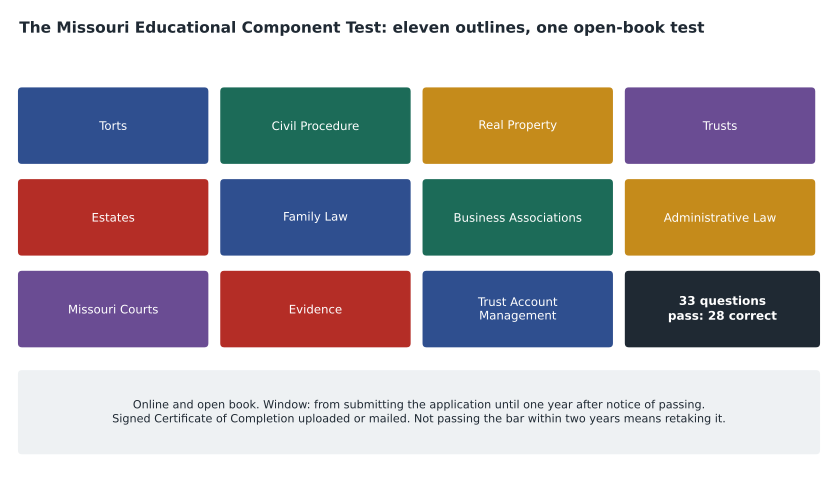
The MECT is taken online and is open book. According to the Board's MECT page, it consists of 33 questions drawn from the outlines, and an applicant must answer at least 28 correctly to pass. The applicant answers all the questions and then uses a button at the end of the test to see the score. When the applicant passes, a link to a Certificate of Completion appears. The applicant completes and signs the certificate and either uploads it through the applicant's online account or mails it to the Board. The Board's page says the score is valid from the date the certificate is issued.
The certificate is the piece candidates forget. Passing the test online does not by itself satisfy the rule; the Board needs the signed certificate within the window set by Rule 8.08(c). Marcus uploaded his certificate the same afternoon he passed and saved a copy. 'I did the same thing with every document in this process,' he said. 'Submit, confirm, save.'
The eleven outlines
The Board's MECT materials consist of eleven outlines: torts, civil procedure, real property, trusts, estates, family law, business associations, administrative law, Missouri courts, evidence and trust account management. Each is a summary of Missouri law in that area, written for new lawyers. The test questions are drawn from the outlines, so the outlines define what the MECT covers. The Board posts the current materials, and candidates should use the current versions rather than copies passed down from earlier years, because Missouri law changes and the outlines are revised.
Some outlines cover subjects that Lessons 7 through 10 of this course discuss in more depth. The Missouri courts outline explains the structure of the Supreme Court, the three districts of the Court of Appeals and the circuit courts, including associate circuit judges and the divisions that handle probate, juvenile and small claims matters. The civil procedure outline covers Missouri's own rules of civil procedure, which differ from the federal rules in important ways, including fact pleading, venue rules set by statute and the mandatory use of approved jury instructions. The torts outline covers comparative fault, joint and several liability, damages and the immunities. The family law outline covers dissolution of marriage, property division, maintenance, custody and child support. The trust account management outline covers Rule 4-1.15 in practical detail.
Others cover areas that new lawyers sometimes overlook. The administrative law outline introduces Missouri's administrative procedure statutes and the review of agency decisions, and the sample questions on the Board's site include Missouri's open meetings and records law, commonly called the Sunshine Law. The business associations outline covers Missouri corporations and limited liability companies. The trusts and estates outlines cover Missouri's trust code, wills, intestacy, the spouse's rights and probate administration. The evidence outline matters because Missouri, unlike the federal system and many states, has not adopted a comprehensive evidence code; much of its evidence law comes from statutes on particular topics and from case law, and in 2017 the legislature adopted a standard for expert testimony modeled on the federal approach.
How to approach it
Because the MECT is open book and the passing mark is 28 of 33, a prepared candidate should pass on the first attempt. Hollis offered a simple method. First, read every outline once, quickly, from start to finish, without trying to memorize anything. Second, make a one-page index for each outline listing its main headings and the page or section where each appears. Third, take the test with the outlines and the index open, reading each question carefully and looking up any answer that is not immediately clear. Fourth, after passing, file the certificate.
Marcus added two points from experience. 'Do not take it on your phone between other things. Sit down at a desk and treat it like a real test, because the questions are specific and the wording matters.' And: 'The outlines are worth reading slowly at some point, even after you pass. They are the closest thing to a map of Missouri law you will get before your first client asks you a Missouri question.'
Choosing when to take it
Candidates make different choices about timing, and each has advantages. Taking the MECT soon after filing the application, as Marcus did, removes one requirement before bar study begins and leaves no loose end after results. The risk is the two-year rule if the bar exam does not go well. Taking it during bar study is possible, but it competes for time with the national exam. Taking it after the exam, while waiting for results or soon after passing, puts it in a quieter period and lets the candidate read the outlines without the pressure of bar review. The outer limit is one year after the notice of passing, but Hollis warned against waiting that long. 'Every month you wait after passing is a month you are not licensed,' she said. 'Your employer will notice.'
| MECT feature | Rule or source | Detail |
|---|---|---|
| Who takes it | Rules 8.08(c), 8.09 | Applicants by examination and by transferred score |
| Earliest date | Rule 8.08(c) | The date the application is submitted |
| Latest date | Rule 8.08(c) | One year after written notice of passing |
| Format and pass mark | Board MECT page | 33 questions online, open book; 28 correct to pass |
| Proof | Board MECT page | Signed Certificate of Completion uploaded or mailed |
| Expiry | Rule 8.08(c) | Retake if the bar exam is not passed within two years |
Where the MECT fits in the larger picture
The MECT is small in time but large in purpose. The NextGen exam certifies that a new lawyer can work with general legal principles and perform core lawyering tasks. The MECT confirms that the same lawyer has at least read the basic map of the jurisdiction where the license will issue. Neither substitutes for learning Missouri law in practice. Marcus's first weeks at his firm were full of Missouri questions the MECT had touched only briefly: which county a case could be filed in, whether a city could be sued for a pothole, how much a client could recover if she was partly at fault. 'The MECT gave me the right words to search for,' he said. 'Practice gave me the answers.'
Worked problem
An early MECT
Nell Ashcroft, a hypothetical candidate, submits her Missouri application on February 10, 2027 for the July 2027 exam and passes the MECT on February 20, 2027. She fails in July 2027 and February 2028 and passes in July 2028, receiving written notice of passing on October 6, 2028. Must she retake the MECT?
Show solution
- Rule 8.08(c) requires the MECT to be completed no earlier than the application date and no later than one year after notice of passing.
- Her February 20, 2027 completion followed her application, so it was timely when completed.
- If an applicant does not pass the bar exam within two years after completing the MECT, the applicant must complete it again.
- She passed the July 2028 exam more than two years after February 20, 2027.
Answer: Yes. Because she did not pass within two years of completing the MECT, she must take it again. She has until one year after October 6, 2028 to complete it and file a new certificate.
Common mistakes
MistakeThe MECT can be taken any time, even before applying.
InsteadIt may be taken no earlier than the date the application is submitted.
MistakePassing the online test is enough.
InsteadThe signed Certificate of Completion must be uploaded or mailed to the Board.
MistakeApplicants admitted without examination take the MECT.
InsteadThey attend the Annual Law Update program or an equivalent under Rule 15.05(d).
MistakeThe MECT is closed book and timed like the bar exam.
InsteadIt is online and open book, with 33 questions and a pass mark of 28.
MistakeAn MECT completion never expires.
InsteadIt must be retaken if the bar exam is not passed within two years after completion.
Practice problems
Work each problem on paper first, then reveal the answer to check.
Which rule requires the MECT?
Show answer
Rule 8.08(c).
How many questions does the MECT have, and how many must be correct?
Show answer
33 questions; at least 28 correct.
What is the latest date for completing the MECT after passing the bar exam?
Show answer
One year after written notice of passing.
Name four of the eleven MECT outlines.
Show answer
Any four of: torts, civil procedure, real property, trusts, estates, family law, business associations, administrative law, Missouri courts, evidence, trust account management.
What do Rule 8.10 applicants complete instead of the MECT?
Show answer
The Missouri Bar's Annual Law Update program or an equivalent accredited program.
A sample MECT day
Hollis sketched a single day a candidate could set aside for the MECT. In the morning, read the eleven outlines quickly, about twenty minutes each, marking headings and any rule that differs from what was learned in law school. Over lunch, build the one-page index for each outline. In the early afternoon, take the test at a desk with the outlines and index open, working steadily and checking the outline for any question that is not certain. Then complete, sign and upload the certificate, and save a copy. A candidate who prefers a slower pace can spread the reading over a week of evenings and take the test on a weekend morning.
Marcus suggested one improvement. While reading, keep a separate list of Missouri rules that are likely to come up at work in the first year, such as the venue statute, the 51 percent rule, the motor vehicle waiver of sovereign immunity and the trust account requirements. 'That list was more useful to me in October than my bar outlines,' he said.
Hollis added a caution: the MECT is open book, but it is not a group exercise. The certificate the applicant signs is a statement about the applicant's own work, and candor with the Board applies to it as much as to the application itself.
Summary and key terms
- Rule 8.08(c) requires the MECT for applicants by examination; Rule 8.09 requires it for transferred-score applicants.
- It may be completed from the date the application is submitted until one year after notice of passing.
- It is online and open book: 33 questions, 28 correct to pass.
- A signed Certificate of Completion must be uploaded or mailed to the Board.
- The eleven outlines run from torts and civil procedure to administrative law, evidence and trust account management.
- If the bar exam is not passed within two years after the MECT, the MECT must be retaken.
- jurisdiction-specific component
- A requirement, such as the MECT, that tests or teaches a jurisdiction's own law.
- Certificate of Completion
- The signed form showing that an applicant passed the MECT.
- Sunshine Law
- Missouri's open meetings and open records law, included in the MECT materials.
- Annual Law Update
- The Missouri Bar program that Rule 8.10 applicants attend instead of the MECT.
- open-book test
- A test taken with the source materials available for reference.
Lesson quiz · 5 questions
Score 60% or more to complete this lesson.
Create a free account to save your progress, take quizzes and earn a certificate.