
BAR-226 · Lesson 8 of 12 · 21 min
Missouri torts: pure comparative fault, joint and several liability, damages and sovereign immunity
▶ Video coming soon A video version of this lesson is on the way.
The car-accident case was still on Marcus's desk when he came to the eighth session, and it had grown. The defendant driver now blamed a delivery truck that had swerved into his lane, the truck's owner blamed the city for a missing lane marking, and Marcus's client admitted she had been glancing at her phone's map when the first impact came. 'Everybody is a little bit at fault,' Marcus said. 'In some states that would kill my client's case. In Missouri it just changes the math.' Hollis asked him to show the group the math.
This lesson covers the Missouri tort rules a new lawyer meets first: pure comparative fault, the limits on joint and several liability, punitive damages, the medical malpractice damages caps, the sovereign immunity statute and the 2026 changes affecting claims against public entities and their contractors.
Pure comparative fault
For most of its history, Missouri followed contributory negligence: a plaintiff whose own negligence contributed to the injury recovered nothing, subject to doctrines like last clear chance and Missouri's humanitarian doctrine. In Gustafson v. Benda, 661 S.W.2d 11 (Mo. banc 1983), the Supreme Court of Missouri replaced that system with comparative fault and directed Missouri courts to apply the principles of the Uniform Comparative Fault Act. Under the Act's approach, which Missouri follows, the plaintiff's damages are reduced in proportion to the plaintiff's share of fault, and the plaintiff recovers even if the plaintiff's share is larger than the defendant's.
That is pure comparative fault. A Missouri plaintiff found 70 percent at fault recovers 30 percent of her damages. In a modified comparative fault state, the same plaintiff would recover nothing, because her fault exceeds the threshold, usually 50 or 51 percent. Missouri's choice is generous to plaintiffs on this point, and it is one reason the NextGen exam's general-rule answer and the Missouri answer can differ. The jury apportions fault among all the parties at trial using percentages, and the court reduces the plaintiff's damages accordingly. The legislature later codified comparative fault for product liability cases in section 537.765, which lists the kinds of plaintiff conduct that count as fault in those cases.
Marcus walked the group through his client's numbers, with the names and amounts changed. Suppose the jury finds damages of 100,000 dollars and assigns 20 percent of the fault to his client, 55 percent to the driver who hit her and 25 percent to the truck's owner. His client's recovery is reduced by her 20 percent share to 80,000 dollars. The next question is who pays that 80,000.
Joint and several liability: the 51 percent rule
Under the traditional rule of joint and several liability, each defendant responsible for an indivisible injury could be made to pay the whole judgment, leaving the paying defendant to seek contribution from the others. Missouri limited that rule in 2005. Section 537.067 now provides that in all tort actions for damages, a defendant is jointly and severally liable for the amount of the judgment rendered against the defendants only if that defendant is found to bear 51 percent or more of the fault. A defendant found less than 51 percent at fault is responsible only for the percentage of the judgment attributed to that defendant.
The statute has narrow exceptions. A party remains responsible for the fault of another defendant who was acting as its employee, and for another's fault where liability arises under the Federal Employers' Liability Act. Punitive damages are always several only: each defendant pays only the punitive damages assessed against it. And the statute forbids telling the jury about the effect of section 537.067, so jurors apportion fault without knowing that crossing 51 percent changes a defendant's exposure.
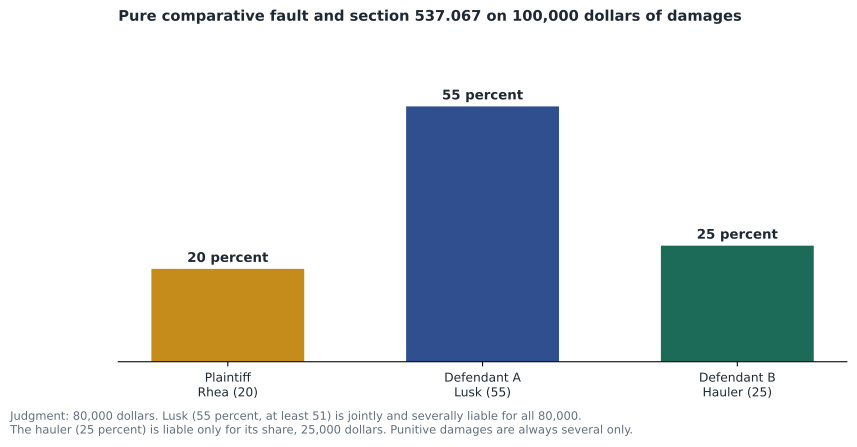
Back to the numbers. The driver, at 55 percent, crosses the 51 percent line and is jointly and severally liable for the whole 80,000 dollar judgment. The truck's owner, at 25 percent, is liable only for its share, 25 percent of the damages, or 25,000 dollars. If the truck's owner cannot pay, the driver can be made to pay the entire 80,000 and seek contribution. If the jury had put the driver at 50 percent instead, each defendant would pay only its own share, and Marcus's client would bear the risk that either could not pay. 'One percentage point,' Marcus said, 'and the jury will never be told it matters.'
Punitive damages
Missouri tightened the law of punitive damages in 2020. Section 510.261, enacted that year, requires the plaintiff to prove by clear and convincing evidence that the defendant intentionally harmed the plaintiff without just cause or acted with a deliberate and flagrant disregard for the safety of others. The plaintiff must also receive more than nominal damages. A plaintiff may not include a demand for punitive damages in the initial pleading. Instead, the plaintiff must file a written motion for leave, supported by evidence, no later than 120 days before the final pretrial conference or trial date, and the court may allow the claim only if it finds that the trier of fact could reasonably conclude that the standard is met. Punitive damages may not be based on harm to nonparties, and the statute limits when an employer can be liable for punitive damages based on an employee's conduct.
Missouri also has a statutory cap on punitive damages, generally the greater of 500,000 dollars or five times the net amount of the judgment, in section 510.265. The Supreme Court of Missouri held in Lewellen v. Franklin (Mo. banc 2014) that the cap cannot constitutionally be applied to causes of action that existed at common law when Missouri's constitution guaranteed the right to jury trial, such as common-law fraud, because a jury's assessment of damages in such cases is part of that right. Whether the cap applies therefore depends on the nature of the claim, a point a careful lawyer checks before advising a client on exposure.
Medical malpractice damages
Medical malpractice in Missouri shows how the constitutional right to jury trial and the legislature's power to define causes of action interact. In Watts v. Lester E. Cox Medical Centers (Mo. banc 2012), the Supreme Court of Missouri struck down the statutory cap on noneconomic damages in medical malpractice cases, reasoning that a malpractice claim existed at common law and that capping a jury's award violated the right to jury trial. In 2015 the legislature responded by abolishing the common-law malpractice claim and creating a statutory cause of action against health care providers, with caps on noneconomic damages. Because the claim is now statutory, the Court later held that the caps may be applied.
Under section 538.210, the caps were set in 2015 at 400,000 dollars for most injuries and 700,000 dollars for catastrophic personal injury or death, and they increase by 1.7 percent each January 1. The Missouri Department of Commerce and Insurance publishes the adjusted figures. For 2026, the caps are 481,493 dollars for non-catastrophic injuries and 842,614 dollars for catastrophic injuries. Economic damages, such as medical expenses and lost earnings, are not capped. The limitations period for malpractice claims is two years, under section 516.105, much shorter than the general five-year period.
Evidence of medical expenses
A related change came in 2017, when the legislature revised the rule on proof of medical expenses. Missouri now allows the parties to introduce evidence of the amounts actually paid or necessary to satisfy medical charges, not just the amounts billed. Because providers often accept much less than their billed charges from insurers, this change can reduce the special damages a jury hears about. Marcus said it was one of the first things the partner had asked him to research on the car case: what had actually been paid on his client's bills, and by whom.
Sovereign immunity
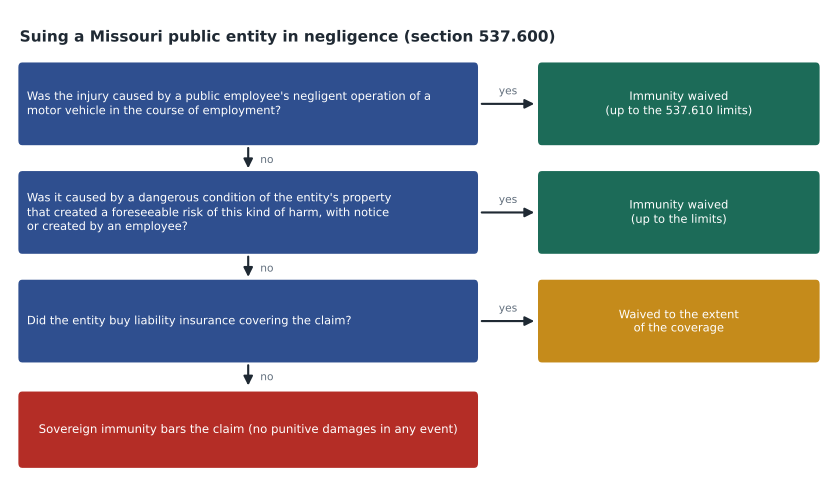
Missouri public entities enjoy sovereign immunity from negligence claims except where the legislature has waived it. Section 537.600 waives immunity in two situations. The first is injury directly resulting from the negligent acts or omissions of public employees arising out of the operation of motor vehicles within the course of their employment. The second is injury caused by the condition of a public entity's property, if the plaintiff shows that the property was in a dangerous condition at the time of the injury, that the injury directly resulted from the dangerous condition, that the condition created a reasonably foreseeable risk of harm of the kind that occurred, and that either a negligent act or omission of an employee within the course of employment created the condition or the entity had actual or constructive notice of it in time to have taken measures to protect against it. The statute says these waivers apply whether the entity was acting in a governmental or proprietary capacity and whether or not it has insurance.
A third route to recovery is insurance. Under section 537.610, a public entity that purchases liability insurance waives immunity to the extent of the coverage for the purposes covered by the policy. Liability under the waivers is capped. The statute sets base limits of 2,000,000 dollars for all claims arising out of a single accident or occurrence and 300,000 dollars for any one person, adjusted each January 1 for inflation, and the Department of Commerce and Insurance publishes the current figures. Punitive damages may not be awarded against a public entity.
Individual public employees are a separate question. Missouri recognizes official immunity, which protects public officials from personal liability for discretionary acts performed in the course of their duties, but not for ministerial acts or for acts done in bad faith or with malice. The Supreme Court of Missouri discussed the doctrine at length in Southers v. City of Farmington (Mo. banc 2008), involving a police pursuit. The line between discretionary and ministerial acts is often the center of the dispute.
The 2026 changes
In 2026 the legislature passed SB 916, which the governor signed on July 13, 2026. The bill repealed and reenacted sections 537.600 and 537.610. Its main purpose was to extend protection to private contractors and engineers working for the Missouri Department of Transportation: in place of certain common-law claims, it creates a statutory framework under which the department is solely liable for injuries arising after a project has been approved and accepted, subject to listed exceptions such as concealed defects or known dangers that were not disclosed. It also restricts contract terms requiring contractors to indemnify the state. A Missouri lawyer handling a highway case should read the reenacted sections closely, because the identity of the proper defendant may have changed.
The same session produced the Act Against Abusive Website Access Litigation, SBs 907, 1154 and 1272, signed in May 2026, which allows courts to award fees and costs to businesses sued in bad-faith website accessibility claims and creates a procedure for challenging such claims. It is a narrow statute, but it illustrates the pattern: Missouri tort and litigation law changes almost every year, and the rules a new lawyer learned in school or for the MECT need checking against the current statutes.
Back at the firm, Marcus applied the lesson to his own file. The city's role turned on the missing lane marking. If the marking was part of a dangerous condition of the city's property, and the other elements were met, immunity was waived up to the statutory limits. If not, and the city had no insurance covering the claim, the city was immune. 'So the first question for the city is not whether it was negligent,' he said. 'It is whether the legislature lets us ask.'
Worked problem
Applying the 51 percent rule
Rhea Castellano, a hypothetical plaintiff, is injured in a three-vehicle collision in St. Louis County. The jury finds total damages of 200,000 dollars and apportions fault: Rhea 10 percent, Bertram Lusk 45 percent and a delivery company 45 percent. The delivery company is insolvent. How much can Rhea collect, and from whom?
Show solution
- Under pure comparative fault, Rhea's damages are reduced by her 10 percent share, so the judgment is 180,000 dollars.
- Under section 537.067, a defendant is jointly and severally liable only if found 51 percent or more at fault.
- Neither defendant reached 51 percent, so each is liable only for its own share: 45 percent of 200,000, or 90,000 dollars each.
- The delivery company's insolvency does not shift its share to Lusk.
Answer: Rhea can collect 90,000 dollars from Lusk. The delivery company's 90,000 dollar share is collectible only from the delivery company, which is insolvent, so Rhea bears that loss.
Common mistakes
MistakeA Missouri plaintiff more than 50 percent at fault recovers nothing.
InsteadMissouri uses pure comparative fault; the plaintiff recovers her damages reduced by her share.
MistakeEvery Missouri defendant is jointly and severally liable for the whole judgment.
InsteadOnly a defendant 51 percent or more at fault is; punitive damages are always several only.
MistakeA Missouri petition may demand punitive damages from the start.
InsteadThe plaintiff must seek leave by motion, with evidentiary support, under section 510.261.
MistakeMissouri's medical malpractice caps were struck down and no longer apply.
InsteadWatts struck the old cap in 2012; the 2015 statutory cause of action has caps that apply.
MistakeSovereign immunity in Missouri is waived for all negligence.
InsteadSection 537.600 waives it for motor vehicle operation and dangerous property conditions; insurance can also waive it.
Practice problems
Work each problem on paper first, then reveal the answer to check.
Which case adopted comparative fault in Missouri, and when?
Show answer
Gustafson v. Benda, 661 S.W.2d 11 (Mo. banc 1983).
At what share of fault does a Missouri defendant become jointly and severally liable?
Show answer
51 percent or more (section 537.067).
What standard of proof does section 510.261 require for punitive damages?
Show answer
Clear and convincing evidence of intentional harm without just cause or deliberate and flagrant disregard for safety.
What are the 2026 medical malpractice caps on noneconomic damages?
Show answer
481,493 dollars for non-catastrophic and 842,614 dollars for catastrophic injuries.
Name the two waivers of sovereign immunity in section 537.600.
Show answer
Negligent operation of motor vehicles by public employees and dangerous conditions of public property.
Summary and key terms
- Gustafson v. Benda (1983) gave Missouri pure comparative fault under the Uniform Comparative Fault Act's principles.
- Section 537.067: joint and several liability only for a defendant 51 percent or more at fault; punitive damages several only; the jury is not told.
- Section 510.261 (2020): punitive damages need clear and convincing proof and leave of court by motion.
- Medical malpractice is a statutory cause of action with noneconomic caps of 481,493 and 842,614 dollars in 2026.
- Section 537.600 waives sovereign immunity for motor vehicles and dangerous property conditions; 537.610 caps liability and allows insurance waiver.
- SB 916 (signed July 13, 2026) reenacted both sections and extended protection to MoDOT contractors.
- pure comparative fault
- A system in which a plaintiff's damages are reduced by her share of fault, whatever its size.
- joint and several liability
- Liability of each defendant for the whole judgment, limited in Missouri to defendants 51 percent or more at fault.
- sovereign immunity
- Immunity of public entities from suit except where the legislature has waived it.
- official immunity
- Protection of public officials from personal liability for discretionary acts.
- statutory cause of action
- A claim created by statute, such as Missouri's medical malpractice claim since 2015.
Lesson quiz · 5 questions
Score 60% or more to complete this lesson.
Create a free account to save your progress, take quizzes and earn a certificate.