
BAR-226 · Lesson 5 of 12 · 20 min
Exam changes: from the legacy UBE to NextGen in July 2026
▶ Video coming soon A video version of this lesson is on the way.
Marcus remembered the moment he learned he would be in the first NextGen group. It was during his second year of law school, at a lunch talk where a professor put up a slide with two columns, old exam and new exam, and said that anyone graduating in May 2026 or later and sitting in Missouri would be on the right-hand side. 'Half the room groaned,' he said. 'The other half started asking whether they could graduate early.' Hollis laughed. 'And the people who did best were the ones who stopped groaning and started reading NCBE's materials.'
This lesson explains why the bar exam changed, how Missouri made the move from the legacy UBE to NextGen, what the transition means for repeaters and transferring lawyers, and where Missouri's neighbors stand.
Why the exam changed
The NextGen exam grew out of a multi-year study by NCBE. Its Testing Task Force surveyed practicing lawyers about the work new lawyers actually do and the knowledge and skills that work requires, and in 2021 NCBE's board approved recommendations for a new exam. The recommendations called for an exam that tests lawyering skills alongside legal knowledge, covers fewer subjects in more depth, integrates the testing of skills and doctrine instead of separating essays from multiple choice, and is delivered on computers. NCBE then spent several years writing and field-testing items, running prototype exams and publishing content outlines, sample questions and score information so that jurisdictions and candidates could prepare.
The legacy UBE had three parts: the 200-question Multistate Bar Examination, six Multistate Essay Examination questions and two Multistate Performance Test tasks, given over two days. It tested a long list of subjects, and many candidates prepared for it largely by memorizing rules. The NextGen exam reduces the list of doctrinal subjects, tests some of them in less detail and adds skills such as client counseling, negotiation, investigation and legal research. Its integrated question sets ask the examinee to use provided materials as a lawyer would, which shifts some of the work from memory to reading and application.
Missouri's choice and timing
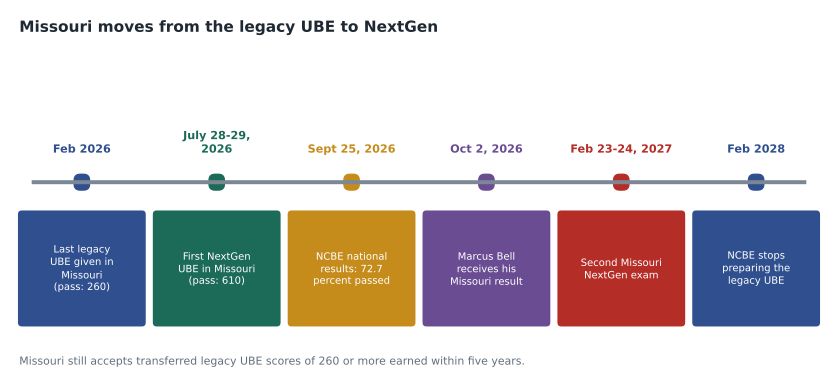
Missouri decided to move early. The Supreme Court of Missouri adopted the NextGen exam by amending Rule 8 and the Board's regulations, and the regulations in effect since January 1, 2026 set out both exams and both passing scores: 260 on the legacy UBE and 610 on the NextGen UBE. Missouri gave its last legacy UBE in February 2026 and its first NextGen exam on July 28 and 29, 2026, as one of ten jurisdictions in NCBE's first operational administration. Other first-wave jurisdictions included Maryland, Connecticut, Oregon and Washington.
For a Missouri candidate today, that means there is no choice to make. Everyone who sits the bar exam in Missouri from July 2026 on takes the NextGen exam. A candidate who prefers the legacy format would have to sit in a jurisdiction that still gives it, and then transfer the score to Missouri. NCBE has said it will prepare the legacy UBE through February 2028, so that option is shrinking, and Hollis discouraged it. 'You would be choosing an exam that is going away, in a state where you do not plan to practice, to avoid an exam that thousands of people have now passed,' she said.
What changed for candidates
The change affected nearly every part of preparation. The schedule changed from two full days to one and a half. The format changed from separate essay and multiple-choice days to mixed sessions. The delivery changed from a choice of laptop or handwriting for essays, and paper answer sheets for the MBE, to fully computer-based testing on the examinee's own laptop. The score changed from a 400-point scale to a 500 to 750 scale. And the content changed: fewer doctrinal subjects, with skills tested directly.
Some things did not change. The exam still tests general law rather than Missouri law. Missouri still requires the MPRE with a scaled score of 80. Missouri still requires its own educational component, the MECT. The character and fitness process, the filing deadlines and the Board's role are the same. And the exam is still a uniform exam, so a Missouri score can be transferred to other jurisdictions that accept NextGen scores.
Marcus described the practical side of preparing for a first administration. Commercial bar review courses had built NextGen programs, but they had less history to draw on than for the legacy exam. NCBE's sample questions and prototype materials were the most reliable guide to what the items looked like. 'I treated NCBE's samples as the real thing,' he said, 'and I treated everything else as practice.' He also noticed that his study habits had to change. On the legacy exam, many of his classmates had planned to spend weeks memorizing rule statements for essays. On NextGen, he spent more time on reading speed, on working with unfamiliar statutes in the integrated sets and on writing short, direct answers.
Repeaters
Candidates who sat the legacy UBE in Missouri and did not pass faced a new exam on their next attempt. A legacy score does not carry over to NextGen, and Missouri does not combine scores across exams or across administrations. A repeater from February 2026 who sat again in July 2026 took a different exam, with different item types and a different scale. NCBE's figures for July 2026 showed a sharp gap between first-time takers and repeaters, 85.2 percent and 41.0 percent passing nationally. That gap is common on any bar exam, but it underlines the point that a repeater moving from the legacy exam to NextGen needs to rebuild preparation around the new format rather than repeat the old plan.
Score transfer during the transition
Missouri accepts transferred scores from both exams. Under Rule 8.09, an applicant may be admitted on a NextGen score of at least 610 or a legacy UBE score of at least 260 earned in another jurisdiction within five years before the application. NCBE's chart notes that Missouri first accepted NextGen scores starting with the July 2026 administration and does not accept a transferred MBE score by itself. That means a lawyer who passed the legacy UBE in another state in 2023 can still transfer that score to Missouri until the five-year window closes, and a July 2026 NextGen examinee in another jurisdiction can transfer a score of 610 or more to Missouri, subject to the other requirements.
Transfer out of Missouri depends on the receiving jurisdiction. A jurisdiction that still gives only the legacy exam may not yet accept NextGen scores, or may accept them only under a rule change. Marcus learned this firsthand. Kansas, across the state line from his office, will give its first NextGen exam in July 2028, but it amended its Rule 717 on December 29, 2025 to accept transferred NextGen scores that meet the passing score of the jurisdiction where they were earned. His 648 met Missouri's 610, so he could apply in Kansas by transferred score. A job offer he weighed in Bentonville, Arkansas, was a different story: Arkansas did not accept his NextGen score, so admission there would have to wait for admission on motion after years of practice. The lesson is that every transfer question has to be checked against the receiving jurisdiction's current rule.
Missouri's neighbors
Missouri borders eight states, and Kansas City and St. Louis lawyers often need a second license. The neighbors are on different timetables. Kansas keeps the legacy UBE, with a passing score of 266, until it moves to NextGen in July 2028. Iowa gives its last legacy UBE in February 2027 and its first NextGen exam in July 2027, with a passing score of 610. Kentucky moves to NextGen in July 2027 with a passing score of 616. Each neighbor sets its own rules for accepting transferred scores. A Missouri lawyer who wants a second license should look at the neighbor's exam, its passing score, its transfer rule and its admission on motion rule before making plans.
| Jurisdiction | Exam now | NextGen begins | NextGen passing score |
|---|---|---|---|
| Missouri | NextGen UBE | July 2026 | 610 |
| Iowa | Legacy UBE (last in February 2027) | July 2027 | 610 |
| Kentucky | Legacy UBE (last in February 2027) | July 2027 | 616 |
| Kansas | Legacy UBE (passing score 266) | July 2028 | Set by Kansas |
Older study materials
Candidates sometimes inherit outlines, flashcards and practice books from friends who took the legacy exam. Hollis advised using them with care. Doctrinal outlines for subjects that remain on NextGen, such as contracts, torts or civil procedure, can still help, as long as the candidate checks NCBE's current content outline for what is tested and in how much depth. Legacy MBE questions can still build doctrinal speed, but they do not practice multiple-select questions, integrated sets or the NextGen performance tasks. Old essay outlines are the least useful, because the NextGen exam has no stand-alone essays. Missouri-specific materials from the legacy era, including older MECT outlines, should be replaced with the current versions the Board provides.
Marcus added a warning about rules. 'Missouri changes its own law like any other state. If you are studying for the MECT, use the Board's current outlines. If you are learning Missouri law for work, check the current statute and rule, not a summary from three years ago.' Lessons 7 through 10 follow that advice and point out where Missouri law changed recently.
Worked problem
A transfer question
Harlan Moody, a hypothetical lawyer, passed the legacy UBE in Nebraska in July 2022 with a score of 270 and wants to join a St. Louis firm. He has practiced only two years. He files a Missouri application in January 2027. Can he be admitted by transferred score?
Show solution
- Rule 8.09 accepts legacy UBE scores of at least 260 earned within five years before the application.
- His July 2022 exam falls within five years of a January 2027 application.
- His score of 270 exceeds 260.
- He must also meet the education requirement, character and fitness approval, the MECT and an MPRE score of 80 within one year after the Board's notice.
Answer: Yes, if he meets the other requirements. He does not need five years of practice, which applies only to admission without examination under Rule 8.10. He should file before July 2027, when his score would pass the five-year limit.
Common mistakes
MistakeMissouri candidates can choose the legacy UBE or NextGen.
InsteadSince July 2026, everyone sitting in Missouri takes the NextGen exam.
MistakeA legacy score can be combined with a NextGen score.
InsteadScores are not combined across exams or administrations.
MistakeMissouri no longer accepts legacy UBE transfers.
InsteadIt accepts legacy scores of 260 or more earned within five years.
MistakeEvery state accepts a Missouri NextGen score.
InsteadEach receiving jurisdiction sets its own rule; some do not yet accept NextGen scores.
MistakeThe move to NextGen ended the MPRE requirement.
InsteadMissouri still requires an MPRE score of 80.
Practice problems
Work each problem on paper first, then reveal the answer to check.
When did Missouri give its last legacy UBE and its first NextGen UBE?
Show answer
February 2026 and July 2026.
Until when will NCBE prepare the legacy UBE?
Show answer
February 2028.
What transferred scores does Missouri accept?
Show answer
NextGen 610 or legacy UBE 260, earned within five years before the application.
Does Missouri accept a transferred MBE score by itself?
Show answer
No.
When does Kansas give its first NextGen exam?
Show answer
July 2028.
Lessons from the first administration
Hollis asked Marcus what a February 2027 candidate should take from the July 2026 experience. He offered four points. First, the integrated question sets rewarded reading discipline more than memory: many of his questions turned on a definition or exception in the provided materials that differed slightly from the rule he had learned. Second, the performance tasks were long enough that time management decided how complete his answers were, so practice under strict time limits mattered. Third, the multiple-select questions felt harder than single-select ones because partial knowledge earned nothing, and he had learned to read every option on its own merits rather than looking for one right answer. Fourth, logistics mattered more than he expected, from the laptop's battery to the delayed start.
Hollis added a point about mindset. The first examinees had no past candidates to tell them what the exam felt like. February 2027 candidates in Missouri do: Missouri lawyers who passed in July 2026 can describe the rooms, the software and the pacing. She encouraged candidates to find one and ask, and to treat NCBE's own materials, including its sample questions and tutorial, as the most reliable guide to content and format. Commercial courses now have one real administration behind them and are adjusting their materials, but the official samples remain the reference point.
The national figures also offer some reassurance. A mean of 640.6 against Missouri's passing score of 610 means that a typical examinee in July 2026 cleared Missouri's line with room to spare. First-time takers passed at a high rate. That does not make the exam easy, but it does show that ordinary, well-organized preparation was enough for most people in the first group.
Marcus summed it up in one sentence for the group's notes: prepare for the exam that exists now, using NCBE's materials, and treat everything written about the legacy exam as history.
Summary and key terms
- NCBE designed NextGen after a multi-year study of new lawyers' work, with recommendations approved in 2021.
- Missouri gave its last legacy UBE in February 2026 and its first NextGen UBE in July 2026.
- Format, schedule, delivery and scale changed; the MPRE, the MECT, character and fitness and the deadlines did not.
- Scores are not combined across exams; repeaters must prepare for the new format.
- Missouri accepts transferred NextGen scores of 610 and legacy scores of 260 within five years.
- Neighbors move on different timetables: Iowa and Kentucky in July 2027, Kansas in July 2028.
- legacy UBE
- The earlier Uniform Bar Examination of MBE, MEE and MPT, scored on a 400-point scale.
- Testing Task Force
- NCBE's study group whose 2021 recommendations led to the NextGen exam.
- first operational administration
- The July 2026 NextGen exam given in ten jurisdictions, including Missouri.
- transferred score
- A UBE score earned in one jurisdiction and used for admission in another.
- Rule 717
- The Kansas rule, amended December 29, 2025, that accepts qualifying transferred NextGen scores.
Lesson quiz · 5 questions
Score 60% or more to complete this lesson.
Create a free account to save your progress, take quizzes and earn a certificate.