
BAR-226 · Lesson 10 of 12 · 20 min
The Missouri Rules of Professional Conduct, trust accounts and lawyer discipline
▶ Video coming soon A video version of this lesson is on the way.
A week before the tenth session, the partner at Marcus's firm had asked him to review a draft radio ad for the firm's injury practice. The script was thirty seconds long, cheerful and, Marcus quickly realized, missing two things Missouri requires. 'I would never have caught it from law school,' he said. 'The MPRE tests the Model Rules. Missouri has its own version, and the advertising rules are where it differs most.' Hollis asked what he had found. 'A missing sentence about choosing a lawyer, and a promise about results with no disclaimer.'
This lesson covers the Missouri Rules of Professional Conduct in Rule 4, with attention to the advertising rules and the trust account rule where Missouri departs from or adds to the ABA Model Rules, and then the discipline system under Rule 5 and the continuing legal education requirement under Rule 15.
Rule 4 and the Model Rules
The Supreme Court of Missouri adopted the Missouri Rules of Professional Conduct as Rule 4. The rules follow the structure and most of the text of the ABA Model Rules of Professional Conduct, and each Missouri rule carries the Model Rule number with 4- in front of it: Rule 4-1.1 on competence, Rule 4-1.6 on confidentiality, Rule 4-1.7 on conflicts and so on. Most of the time, a lawyer who knows the Model Rules knows the Missouri rule. The differences, where they exist, tend to be in areas where Missouri has chosen more detailed regulation, particularly lawyer advertising and the handling of client funds.
That pattern matters for exam preparation and for practice in opposite ways. For the MPRE and the professional responsibility content on the NextGen exam, the Model Rules control. For practice in Missouri, Rule 4 controls, and a lawyer who assumes the Model Rule answer can miss a Missouri requirement. Rule 8.08(b) itself requires applicants to be familiar with the Missouri Rules of Professional Conduct, and the MECT includes a full outline on trust account management.
Advertising: Rule 4-7.1
Rule 4-7.1, like Model Rule 7.1, forbids false or misleading communications about a lawyer or the lawyer's services. Missouri's version goes further by listing specific kinds of communication that are misleading unless the lawyer takes specified steps. Among them: a communication that refers to past results, such as verdicts or settlements, is misleading unless it states that past results afford no guarantee of future results and that every case is different. A communication that promotes services the lawyer routinely refers to other lawyers must say so conspicuously. Paid testimonials or endorsements must be identified as paid. Simulated scenes or portrayals must be identified as simulations. An office staffed only part time or by appointment must be identified that way. And an advertisement for contingent fee or no-recovery, no-fee services must state conspicuously, where applicable, that the client may still owe costs or expenses.
The rule also treats as misleading a communication that creates an unjustified expectation about results, implies the lawyer can achieve results by improper means, compares the lawyer's services with others' without factual support, or advertises for a type of case the lawyer lacks the experience or competence to handle. Missouri's comments add that terms such as cut-rate or discount are misleading unless the comparison can be factually supported, and that portraying a former judge in a robe may be misleading.
Advertising: Rule 4-7.2
Rule 4-7.2 adds a requirement found in few other states. Most Missouri advertising must include, conspicuously, the statement: 'The choice of a lawyer is an important decision and should not be based solely upon advertisements.' The lawyer may add a sentence saying the disclosure is required by rule of the Supreme Court of Missouri. On radio the disclosure must be spoken; on television it may be spoken or written. Required statements must appear in the same language as the advertisement. The disclosure requirement applies to advertisements in Missouri, and written solicitations governed by Rule 4-7.3 follow their own requirements.
Rule 4-7.2 has other Missouri-specific features. A lawyer must keep a copy or recording of each advertisement for two years after its last use, with a record of when and where it was used. An office other than the principal office may be advertised only if a lawyer is present there at least three days a week or the advertisement states the days and hours a lawyer is present or that meetings are by appointment only. And if one lawyer pays for an advertisement for another, the advertisement must disclose the paying lawyer's name and address, the relationship between the lawyers and whether referrals are likely.
Marcus's two corrections to the radio script followed directly. The script needed the spoken disclosure about choosing a lawyer, and its line about 'millions recovered for our clients' needed the statement that past results afford no guarantee of future results. He also suggested adding that clients might owe costs, since the ad promised no fee unless the firm won. The partner accepted all three changes and asked him to start an advertising file so the firm could meet the two-year retention rule.
Client funds: Rule 4-1.15
Rule 4-1.15 governs trust accounts and the property of clients and third persons. Its core matches the Model Rule: client money must be kept separate from the lawyer's own, in an account in a qualifying financial institution, and must be promptly delivered and accounted for. Missouri adds detailed operating requirements, and the MECT's trust account outline covers them in depth.
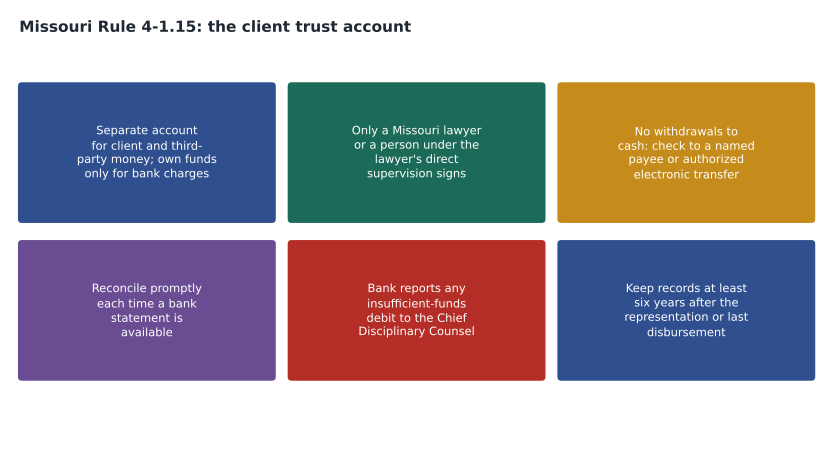
A lawyer may deposit the lawyer's own funds in a client trust account only in the amount necessary to pay the account's bank service charges. Only a lawyer admitted in Missouri, or a person under that lawyer's direct supervision, may be an authorized signatory on the account or authorize transfers from it. Withdrawals must be made by check payable to a named payee or by authorized electronic transfer, never to cash. Records of electronic transfers must show who authorized the transfer, the date, the recipient and the bank's confirmation. The comments limit electronic transfers to payments to or for clients, properly incurred client expenses, earned fees that are not in dispute and transfers between client trust accounts.
Two further requirements catch many new lawyers. First, the lawyer must reconcile the trust account reasonably promptly each time an official statement from the financial institution is provided or available. The reconciliation should compare the bank balance, the lawyer's account register and the total of the individual client ledgers, so that a shortage in any client's money shows up immediately. Second, by maintaining a Missouri trust account the lawyer consents to overdraft reporting: the financial institution must report to the Chief Disciplinary Counsel whenever a properly payable instrument is presented against the account with insufficient funds, whether or not it is honored. A report does not automatically lead to discipline, and the lawyer has a chance to explain, but it does trigger an inquiry.
Records must be kept for at least six years after the later of the end of the representation or the last disbursement. Interest on nominal or short-term client funds held in pooled interest-bearing trust accounts goes to the Missouri Lawyer Trust Account Foundation, which uses it to fund civil legal services, following the IOLTA model used across the country.
The discipline system
Missouri's lawyer discipline system operates under Rule 5. Complaints are filed with the Office of Chief Disciplinary Counsel, which reviews them, investigates those that warrant it and may refer matters to regional disciplinary committees made up of lawyers and non-lawyers. Minor misconduct can be resolved by an admonition. More serious matters proceed by a formal information heard by a disciplinary hearing panel, which makes findings and a recommendation. The Supreme Court of Missouri alone decides whether to reprimand, suspend or disbar a lawyer, and it reviews the record and the recommendation independently. An Advisory Committee oversees parts of the system, and lawyers can request informal ethics guidance from the Office of Legal Ethics Counsel before acting.
Hollis emphasized the practical side for new lawyers. Most disciplinary complaints arise from neglect and poor communication rather than dishonesty: missed deadlines, unreturned calls, files left untouched. A calendar system, prompt replies and careful handling of client money prevent most problems. Trust account errors are a special category because the overdraft reporting system brings them to the disciplinary counsel's attention automatically.
Continuing legal education: Rule 15
Every licensed Missouri lawyer must meet the continuing legal education requirement in Rule 15. Under Rule 15.05, a lawyer must complete and report at least 15 credit hours of accredited programs and activities in each reporting year. At least 3 of those hours must be devoted exclusively to ethics topics, defined broadly to include professionalism, substance abuse and mental health, legal or judicial ethics and malpractice prevention, along with explicit or implicit bias, diversity, inclusion and cultural competency. At least 1 of the 3 ethics hours must be devoted exclusively to that last group of subjects. No more than 6 hours in a reporting year may come from self-study, video, audio or similar programs. Hours above 15 may be carried forward to the next year within limits set by the regulations, generally up to 15 hours, including up to 3 ethics hours. Lawyers report compliance through The Missouri Bar, and the reporting year ends on June 30.
New lawyers get a short reprieve: under Rule 15.05(c), a lawyer need not complete or report hours for the reporting year in which the lawyer is first licensed in Missouri, except that lawyers admitted without examination must meet the Law Update requirement of Rule 15.05(d). The bias and diversity hour has been debated. In January 2025, the lieutenant governor and other statewide officials asked the Supreme Court to repeal it, and a 2026 bill on CLE requirements advanced in the legislature without being enacted. The Court's rule page continued to show the version effective in 2022 as of late 2026, so the hour remained part of the requirement; a lawyer should check the current rule each year.
Marcus was licensed in October 2026, which fell in the reporting year ending June 30, 2027. Under Rule 15.05(c), he would not need to report hours for that year. His first full reporting year would begin July 1, 2027.
Worked problem
A Missouri ad
Ines Valdivia, a hypothetical Missouri lawyer, plans a billboard in Springfield reading: "Injured? We have won over 10 million dollars for our clients. No fee unless we win." What must she add under Rules 4-7.1 and 4-7.2?
Show solution
- The reference to past results is misleading under Rule 4-7.1 unless it states that past results afford no guarantee of future results and every case is different.
- The no-fee promise must state conspicuously, where applicable, that the client may owe costs or expenses.
- Missouri advertising must conspicuously include the statement that the choice of a lawyer is an important decision and should not be based solely upon advertisements.
- She must keep a copy of the ad for two years after its last use, with a record of where and when it ran.
Answer: She must add the past-results disclaimer, the statement about costs and expenses and the required choice-of-lawyer statement, all conspicuously, and keep a record of the billboard for two years after it comes down.
Common mistakes
MistakeThe MPRE tests the Missouri Rules of Professional Conduct.
InsteadIt tests the Model Rules; Rule 4 controls practice in Missouri.
MistakeMissouri advertising rules are the same as the Model Rules.
InsteadMissouri adds a required choice-of-lawyer statement, specific disclaimers and a two-year retention rule.
MistakeA trust account check may be written to cash for a client's convenience.
InsteadMissouri forbids withdrawals to cash.
MistakeBanks report trust overdrafts only if a check bounces.
InsteadThey report any insufficient-funds presentment, whether or not it is honored.
MistakeMissouri requires 12 CLE hours a year.
InsteadRule 15.05 requires 15 hours, including 3 ethics hours.
Practice problems
Work each problem on paper first, then reveal the answer to check.
What statement must most Missouri lawyer advertisements include?
Show answer
The choice of a lawyer is an important decision and should not be based solely upon advertisements.
How long must a Missouri lawyer keep a copy of an advertisement?
Show answer
Two years after its last use.
Who may sign on a Missouri client trust account?
Show answer
A lawyer admitted in Missouri or a person under that lawyer's direct supervision.
How long must Missouri trust account records be kept?
Show answer
At least six years after the later of the end of the representation or the last disbursement.
How many CLE hours must a Missouri lawyer complete each year, and how many in ethics?
Show answer
15 hours, including at least 3 ethics hours, 1 of them on bias, diversity, inclusion or cultural competency.
Getting guidance
Missouri lawyers who face an ethics question before acting can ask for informal guidance from the Office of Legal Ethics Counsel, and The Missouri Bar publishes practice materials on the Rules of Professional Conduct. Asking before acting is a habit worth building early. Marcus said the partner at his firm keeps a short list of questions that must go to someone else before anyone at the firm answers them: any conflict involving a former client, any fee arrangement out of the ordinary, any request to hold money for a nonclient and any advertisement.
Summary and key terms
- Rule 4 follows the Model Rules with 4- numbering; the MPRE tests the Model Rules.
- Rule 4-7.1 lists misleading communications and requires disclaimers for past results, paid testimonials, simulations and costs.
- Rule 4-7.2 requires the choice-of-lawyer statement in Missouri ads and two-year retention of copies.
- Rule 4-1.15: separate account, Missouri signatories, no cash withdrawals, prompt reconciliation, overdraft reporting, six-year records.
- Rule 5 discipline runs through the Chief Disciplinary Counsel; only the Supreme Court suspends or disbars.
- Rule 15 requires 15 CLE hours a year, including 3 ethics hours; the first licensing year is exempt.
- Rule 4
- The Missouri Rules of Professional Conduct.
- Rule 4-7.2 statement
- The required disclosure that the choice of a lawyer should not be based solely upon advertisements.
- overdraft reporting
- The bank's duty to report insufficient-funds presentments on a trust account to the Chief Disciplinary Counsel.
- Chief Disciplinary Counsel
- The office that investigates and prosecutes lawyer discipline under Rule 5.
- IOLTA
- Interest on lawyers' trust accounts, paid in Missouri to the Missouri Lawyer Trust Account Foundation.
Lesson quiz · 5 questions
Score 60% or more to complete this lesson.
Create a free account to save your progress, take quizzes and earn a certificate.