
BAR-226 · Lesson 9 of 12 · 20 min
Missouri family law, property and probate
▶ Video coming soon A video version of this lesson is on the way.
Two of the files Marcus had picked up in his first month came from the same family. A client in her sixties had lost her husband in the summer, and while Marcus helped her through his estate, her adult son asked for advice about his own divorce. 'Same kitchen table, two different chapters of the statutes,' Marcus said. Hollis used his two files as the frame for the ninth session, with the names and details changed: an estate and a divorce, and the property law that ties them together.
This lesson covers the core of Missouri family law under chapter 452 of the Revised Statutes, including the 2023 custody presumption and a 2026 change, the forms of property ownership that matter most to families, and the basics of wills, intestacy, the spouse's elective share and probate administration.
Dissolution of marriage
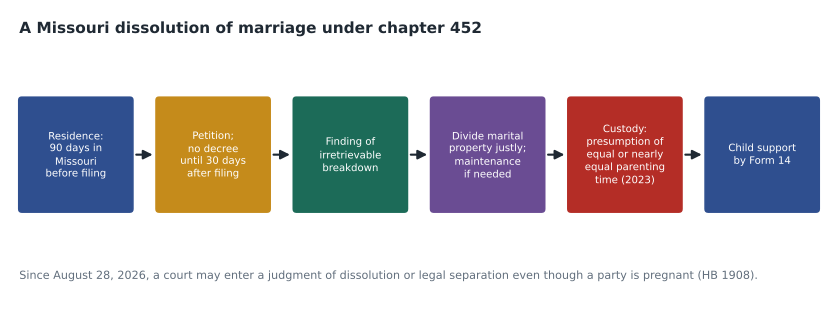
Missouri calls divorce dissolution of marriage, and its law is in chapter 452. A petition may be filed if one of the parties has lived in Missouri for the ninety days immediately before filing, or is a member of the armed services stationed in Missouri for that period. The court may not enter a decree until thirty days after the petition is filed, which gives the parties a minimum waiting period even in uncontested cases.
Missouri is a no-fault state in the sense that the only ground for dissolution is that the marriage is irretrievably broken. Section 452.320 sets out how that is shown. If both parties say under oath, or in a verified pleading, that the marriage is irretrievably broken, or if one says so and the other does not deny it, the court makes the finding after a hearing. If one party denies it, the petitioner must prove one of the facts listed in the statute: that the respondent committed adultery and the petitioner finds it intolerable to live with the respondent; that the respondent behaved in such a way that the petitioner cannot reasonably be expected to live with the respondent; abandonment for at least six months before filing; separation by mutual consent for at least twelve months before filing; or separation for at least twenty-four months before filing. Fault therefore still appears, but as evidence of breakdown when breakdown is contested, not as a separate ground.
Missouri also recognizes legal separation, which resolves property, support and custody without ending the marriage, and it allows a separation judgment to be converted to dissolution later.
Property division and maintenance
Missouri divides marital property under section 452.330. The court first sets apart to each spouse his or her separate property, which generally includes property acquired before the marriage and property acquired during the marriage by gift, bequest, devise or descent, along with property excluded by valid agreement. Property acquired by either spouse during the marriage is presumed to be marital property regardless of how title is held, and the spouse claiming that it is separate must overcome the presumption. The court then divides the marital property in such proportions as it deems just, after considering all relevant factors, including each spouse's economic circumstances, each spouse's contribution to acquiring the property, including the contribution of a spouse as homemaker, the value of the separate property set apart to each spouse, the conduct of the parties during the marriage and custodial arrangements for the children. Missouri law does not presume an equal division, although many divisions end up close to equal.
Maintenance, which other states call alimony, is governed by section 452.335. The court may award maintenance to a spouse who lacks sufficient property, including the marital property apportioned to that spouse, to provide for his or her reasonable needs and who is unable to support himself or herself through appropriate employment, or who is the custodian of a child whose condition or circumstances make it inappropriate for the custodian to work outside the home. The amount and duration depend on factors listed in the statute.
Custody and the 2023 presumption
Custody is governed by section 452.375, and the touchstone is the best interests of the child. Since August 28, 2023, when SB 35 took effect, Missouri law has contained a rebuttable presumption that an award of equal or approximately equal parenting time to each parent is in the best interests of the child. The presumption can be rebutted by a preponderance of the evidence that equal or near-equal time is not in the child's best interests, and it is more easily overcome when the parents agree on a different arrangement or when there is a pattern of domestic violence. The statute also lists factors the court must consider, and each party must submit a proposed parenting plan.
Child support is calculated under Missouri Supreme Court Rule 88.01 and the Form 14 worksheet, which combines the parents' incomes and applies a schedule. The amount produced by Form 14 is presumed to be correct, and a court that departs from it must find on the record that the amount is unjust or inappropriate after considering the relevant factors.
The 2026 change on pregnancy
Missouri practice had long been that a court would not enter a judgment dissolving a marriage while one spouse was pregnant, largely because of the presumption of paternity and the need to address custody and support for the expected child. In 2026 the General Assembly passed HB 1908, which the governor signed on April 7, 2026, and which took effect on August 28, 2026. It allows a court to enter a judgment of dissolution of marriage or legal separation when a party is pregnant. The change was the first non-budget bill of the 2026 session sent to the governor. A Missouri lawyer handling a dissolution for a pregnant client should read the statute's provisions on how custody, support and paternity for the child are to be handled after the judgment.
Property ownership in Missouri families
How a family holds property often decides what happens at divorce or death. Missouri recognizes tenancy by the entirety, a form of co-ownership available only to married couples. Each spouse owns the whole, neither can sever or convey the interest alone, and the survivor takes the whole at the other's death without probate. A creditor of only one spouse generally cannot reach entireties property while the marriage lasts. Missouri law presumes that a conveyance of real property to a married couple creates a tenancy by the entirety unless the deed says otherwise. At dissolution, the tenancy converts to a tenancy in common, and the property is treated as part of the marital estate.
Missouri was also an early adopter of nonprobate transfers. Chapter 461, the Nonprobate Transfers Law, allows an owner of real property to record a beneficiary deed naming who will receive the property at the owner's death. The deed transfers nothing during the owner's life, can be revoked or changed, and passes the property outside probate if it is recorded before the owner dies. Payable-on-death and transfer-on-death designations for bank accounts, securities and vehicles work in a similar way. Many Missouri families avoid probate almost entirely through joint ownership, entireties property, beneficiary deeds and account designations.
Most Missouri home loans are secured by deeds of trust with a power of sale, which permit foreclosure without a court action if the procedures in chapter 443 are followed. That is a practical point for a new lawyer: a client facing foreclosure in Missouri usually hears about it from a notice of trustee's sale, not a lawsuit.
Wills
A Missouri will must be in writing, signed by the testator or by someone else at the testator's direction in the testator's presence, and attested by two competent witnesses who sign in the testator's presence, under section 474.320. Missouri does not recognize unwitnessed handwritten, or holographic, wills; a will entirely in the testator's handwriting is valid only if it meets the same formalities as any other will. Under section 474.337, a will can be made self-proved by an affidavit of the testator and witnesses, which allows it to be admitted to probate without testimony from the witnesses.
A will generally must be presented for probate within the time the probate code allows, which for most purposes is one year after the testator's death, or it loses its effect. A family that finds a will in a drawer two years after a death may be too late to probate it, which is one reason Missouri lawyers ask early whether there is a will and where it is kept.
Intestacy and the surviving spouse
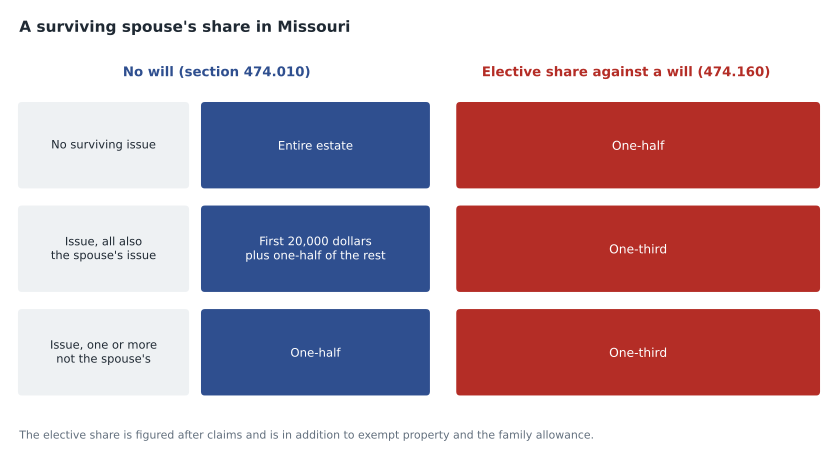
When a Missouri resident dies without a will, section 474.010 controls. If there is no surviving issue, meaning children or other descendants, the surviving spouse takes the entire intestate estate. If there are surviving issue, all of whom are also issue of the surviving spouse, the spouse takes the first 20,000 dollars in value of the intestate estate plus one-half of the balance. If there are surviving issue, one or more of whom are not issue of the surviving spouse, the spouse takes one-half of the intestate estate. The rest passes to the issue, and in their absence to parents, siblings and more remote relatives under the statute.
A surviving spouse who is dissatisfied with a will can elect to take against it. Under section 474.160, the elective share is one-half of the estate if the decedent left no lineal descendants and one-third if the decedent left lineal descendants, in each case subject to the payment of claims. The spouse also receives exempt property and a family allowance in addition to the elective share, and any homestead allowance is charged against it. The election must be made within the time the probate code sets.
Probate administration
Probate in Missouri is handled by the probate division of the circuit court in the county where the decedent lived. The court issues letters testamentary to an executor named in a will, or letters of administration to an administrator when there is no will. The personal representative publishes notice to creditors, and creditors generally must file claims within six months after the first publication of that notice, with an outside limit of one year after death. The personal representative collects and inventories the assets, pays valid claims, expenses and taxes, and distributes the remainder. Missouri also offers simplified procedures, including independent administration with less court supervision and a small estate procedure for estates below a statutory value.
Trusts are governed by the Missouri Uniform Trust Code, chapter 456, adopted in 2005. Revocable living trusts are common in Missouri estate planning, often paired with a pour-over will and beneficiary deeds.
Marcus explained how the pieces had come together in the widow's case. The couple's house had been held as tenants by the entirety, so it passed to her outside probate. Their savings were in a joint account with a right of survivorship. Her husband's small brokerage account had a transfer-on-death designation naming her. What remained in his name alone was a car and a modest bank account, and Marcus was checking whether a simplified procedure would cover them. 'Most of the estate never touched the probate court,' he said. 'Which is the whole point of how they set things up.'
Worked problem
An intestate estate
Mabel Strand, a hypothetical Missouri resident, dies without a will. She is survived by her husband Tobias and two children, one from her first marriage and one born to Mabel and Tobias. Her probate estate, after claims, is worth 220,000 dollars. What does Tobias take?
Show solution
- Section 474.010 sets the surviving spouse's intestate share.
- Mabel left surviving issue, and one of them is not Tobias's issue.
- In that case the spouse takes one-half of the intestate estate.
- One-half of 220,000 dollars is 110,000 dollars; the 20,000 dollar first share applies only when all the issue are also the spouse's.
Answer: Tobias takes 110,000 dollars. The other half passes to Mabel's two children, plus any exempt property and allowances to which Tobias is entitled.
Common mistakes
MistakeMissouri requires proof of fault to grant a divorce.
InsteadThe only ground is irretrievable breakdown; fault facts matter only when breakdown is denied.
MistakeMissouri presumes an equal division of marital property.
InsteadThe court divides marital property in proportions it deems just after considering the statutory factors.
MistakeA handwritten, unwitnessed will is valid in Missouri.
InsteadMissouri requires two attesting witnesses; it does not recognize holographic wills.
MistakeA Missouri court can never enter a divorce judgment while a spouse is pregnant.
InsteadSince August 28, 2026, HB 1908 allows a judgment of dissolution or legal separation during pregnancy.
MistakeThe elective share is always one-half.
InsteadIt is one-half with no lineal descendants and one-third with lineal descendants.
Practice problems
Work each problem on paper first, then reveal the answer to check.
How long must a party live in Missouri before filing for dissolution?
Show answer
Ninety days immediately before filing.
What presumption did SB 35 add to Missouri custody law in 2023?
Show answer
That equal or approximately equal parenting time is in the child's best interests, rebuttable by a preponderance of the evidence.
How many witnesses does a Missouri will need?
Show answer
Two.
What does a surviving spouse take by intestacy if all the decedent's issue are also the spouse's issue?
Show answer
The first 20,000 dollars plus one-half of the balance.
What document lets Missouri real property pass outside probate at the owner's death?
Show answer
A recorded beneficiary deed under chapter 461.
Summary and key terms
- Dissolution requires 90 days of residence, a 30-day wait and a finding of irretrievable breakdown under section 452.320.
- Marital property is divided justly under section 452.330, with no presumption of equality; maintenance is under section 452.335.
- Since 2023, equal or near-equal parenting time is presumed to be in the child's best interests; child support follows Form 14.
- HB 1908, effective August 28, 2026, allows a judgment during pregnancy.
- Tenancy by the entirety and beneficiary deeds keep much family property out of probate.
- Wills need two witnesses; the spouse's intestate share depends on the issue; the elective share is one-half or one-third.
- dissolution of marriage
- Missouri's term for divorce, governed by chapter 452.
- irretrievable breakdown
- The sole ground for dissolution in Missouri.
- Form 14
- The Missouri child support worksheet whose result is presumed correct.
- beneficiary deed
- A recorded deed that transfers real property at the owner's death outside probate.
- elective share
- The share of an estate a surviving spouse may take instead of the will's provisions.
Lesson quiz · 5 questions
Score 60% or more to complete this lesson.
Create a free account to save your progress, take quizzes and earn a certificate.