
BAR-244 · Lesson 1 of 12 · 21 min
Becoming a lawyer in Texas
▶ Video coming soon A video version of this lesson is on the way.
Dana Whitfield finished law school at a Texas law school in May 2026. Since then she has worked as a law clerk at Tejeda & Marwick, a nine-lawyer firm a few blocks from the Travis County courthouse in Austin. She drafts discovery responses, sits in on client meetings, keeps the firm's deadline calendar and spends her evenings and Saturday mornings preparing for the February 2027 Texas bar exam. She has been a member of Hollis Marchetti's online study group since its first session in September 2026, and she already has one hurdle behind her: she scored 93 on the MPRE in the spring of 2026.
In her first one-on-one call with Marchetti for this course, Dana laid out what worried her. 'The partners took the old Texas exam,' she said. 'They talk about Texas essays on oil and gas and community property and a whole day on Texas procedure. My exam is the UBE, which has none of that. Then I hear the exam is changing again in 2028 and that Texas is bringing back a graded Texas test. I want to know exactly what applies to me, what I have to finish before I can be sworn in, and what Texas law I will need on my first day at work even if the exam never asks about it.'
Marchetti's answer framed the course. 'Texas is a big jurisdiction with a lot of moving parts, but the parts fit together,' she said. 'One court controls admission. One board runs the process. You take a national exam now, finish a Texas law course, pass the MPRE, clear character and fitness and take the oath. The 2028 changes matter if you have to retake, and they matter for the people you will mentor. And Texas practice has its own architecture that the exam does not test: two high courts, community property, homestead, proportionate responsibility and a disciplinary system with its own rules. We will cover all of it.'
Who controls admission: the Supreme Court of Texas
The Supreme Court of Texas has final authority over who may practice law in Texas. That authority rests on the Court's constitutional role and on the State Bar Act and related provisions of the Texas Government Code, which give the Court power to regulate the practice of law and to adopt rules for admission. The Court adopts the Rules Governing Admission to the Bar of Texas, and it amends them by order, often after publishing proposed changes for comment. The rules define eligibility, set the passing scores, list the fees and govern transfers and admission without examination.
The Court changes these rules more often than candidates expect. In June 2024 it accepted the recommendation to adopt the NextGen bar exam together with a graded Texas Law Component. In March 2026 it approved the subjects of that graded component. In September 2026 it issued a further order amending the admission rules to define the NextGen exam, restate the passing scores for each exam era, set the required MPRE score at 85 and update the fee schedule. A candidate who learned the rules from a classmate a year ago may be working from an outdated version, so Marchetti's first rule for every Texas candidate is to read the current rules on the Board's website.
Texas has a second high court, the Court of Criminal Appeals, which has final appellate jurisdiction in criminal cases. It has no role in bar admission. Lesson 7 explains how the two high courts divide the work.
Who runs the process: the Texas Board of Law Examiners
The Texas Board of Law Examiners administers admission for the Supreme Court. Its members are Texas lawyers appointed by the Court, and it has a professional staff in Austin led by an executive director. The Board receives applications through its online system, ATLAS; investigates character and fitness; administers the bar exam; grades the written portions; processes score transfers and applications for admission without examination; holds hearings when an applicant's character and fitness is in question; and certifies to the Court the applicants who have met every requirement.
Everything a Texas candidate does runs through ATLAS. The Declaration of Intention to Study Law, the bar exam application, uploaded documents, accommodation requests, messages to staff, eligibility letters and results all appear there. Board staff answer questions through ATLAS messages, and the Board's notices of deficiency or requests for more information arrive there too. Dana checks her ATLAS account every Monday morning, a habit Marchetti recommends to every candidate.
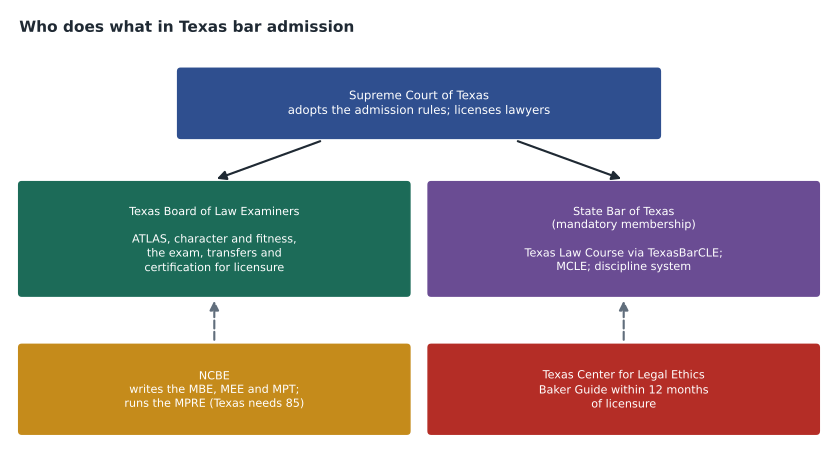
| Body | What it does for a candidate or new lawyer |
|---|---|
| Supreme Court of Texas | Adopts the Rules Governing Admission to the Bar; sets passing scores and fees; licenses lawyers |
| Texas Board of Law Examiners | Runs ATLAS, investigates character and fitness, gives and grades the exam, processes transfers and certifies applicants |
| National Conference of Bar Examiners (NCBE) | Writes the UBE components (MBE, MEE, MPT) and the MPRE; sends score reports to the Board |
| State Bar of Texas | Mandatory membership organization for Texas lawyers; offers the Texas Law Course through TexasBarCLE; administers MCLE |
| Texas Center for Legal Ethics | Administers the Justice James A. Baker Guide to Ethics and Professionalism, due within 12 months of licensure |
| Office of Chief Disciplinary Counsel | Investigates and prosecutes grievances against Texas lawyers |
The State Bar of Texas
Texas has an integrated bar: every lawyer licensed in Texas must be a member of the State Bar of Texas and pay its dues. The State Bar is created by the State Bar Act in the Government Code and operates as an administrative agency of the judicial department under the Supreme Court's supervision. It runs the minimum continuing legal education system, offers continuing education through TexasBarCLE, publishes the Texas Bar Journal and supports the attorney discipline system through the Office of Chief Disciplinary Counsel.
For a candidate, the State Bar matters in three ways. First, the Texas Law Course, which satisfies the current Texas Law Component, is delivered through TexasBarCLE. Second, the new lawyer's membership, dues and MCLE compliance run through the State Bar's online member account. Third, the Texas Disciplinary Rules of Professional Conduct, covered in Lesson 10, are the rules the State Bar's disciplinary system enforces.
The routes into Texas practice
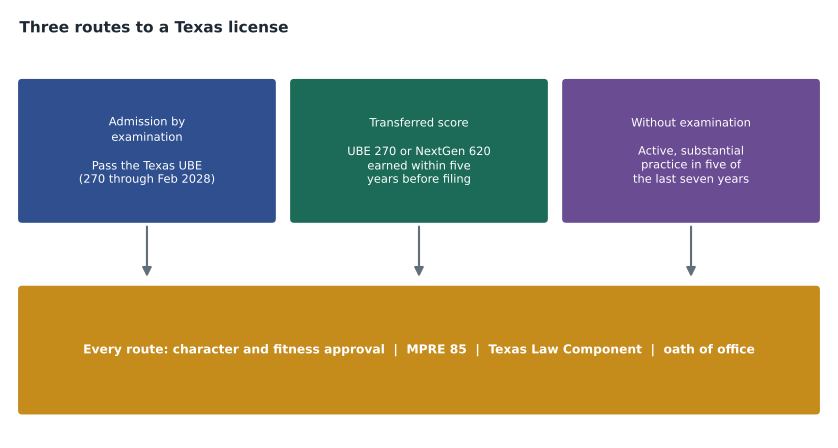
There are three main routes to a Texas license, plus several limited forms of practice.
Admission by examination is the route Dana is taking. She must meet the education requirement, file her application, clear character and fitness, pass the Texas bar exam, earn a qualifying MPRE score, complete the Texas Law Component and take the oath. Today the Texas bar exam is the Uniform Bar Examination with a passing score of 270.
Admission by transferred score lets an applicant who earned a qualifying UBE score in another jurisdiction use it in Texas. Under the current rules, a UBE score of 270, or a NextGen score of 620, earned within the five years before filing can exempt the applicant from taking the Texas exam. The applicant still needs the J.D. or an exception, the MPRE score, the Texas Law Component and character and fitness approval.
Admission without examination is for experienced lawyers licensed elsewhere. The applicant must have been actively and substantially engaged in the practice of law for at least five of the last seven years, among other requirements. There is no filing deadline, but processing commonly takes six to nine months. Lesson 11 covers both of these routes in detail.
Limited forms of practice include appearing in a single case by permission of the court, known as pro hac vice admission, and special programs for military attorneys and their spouses. These are narrow and do not give a general license.
What every route shares
Whatever route an applicant takes, some requirements are common. Every applicant must show present good moral character and fitness to the Board's satisfaction. Every applicant must have a qualifying MPRE score of 85. Every applicant must complete the Texas Law Component. And every applicant must take the oath of office required by the Government Code before practicing. Marchetti calls these the four gates. 'You can be the best essay writer in the country,' she told Dana, 'and still not be sworn in if you forget the Texas Law Course.'
After licensure, two more obligations follow quickly. A newly licensed Texas lawyer must complete the Justice James A. Baker Guide to Ethics and Professionalism within 12 months, and must begin meeting the State Bar's MCLE requirements on the schedule set for new lawyers.
Why Texas matters on a national scale
Texas is one of the largest bar admission jurisdictions in the country. NCBE has reported that in 2024 Texas had the third-largest number of bar examinees, behind New York and California, and the second-largest among UBE jurisdictions, behind New York. That size explains several features of the Texas system: a busy online application platform, a large in-person exam site in Austin, a detailed set of rules that the Court updates regularly, and a strong interest in making sure that new Texas lawyers know Texas law even though the national exam does not test it.
Size also means portability matters. Many Texas candidates intend to practice in Texas for a career, but others want the option of moving, and a UBE score earned in Texas can be transferred to other UBE jurisdictions within their time limits. Dana's target, as she has told the group before, is a score of at least 270, which also keeps open jurisdictions that require higher scores than their neighbors.
A short history: from the Texas exam to the UBE to NextGen
Before 2021, Texas gave its own two-and-a-half-day exam. It included the MBE, the MPT, Texas essay questions on subjects such as family law, oil and gas, trusts, wills and secured transactions, and a separate procedure and evidence section covering Texas civil and criminal procedure. Passing required a combined scaled score of 675 on a 1,000-point scale. That is the exam the partners at Dana's firm remember.
The Supreme Court of Texas adopted the UBE in 2018, and the first Texas UBE was given in February 2021. Texas set the UBE passing score at 270 on the 400-point UBE scale, roughly equivalent to the old 675. At the same time, Texas added the Texas Law Component, which is satisfied today by an online course rather than a graded exam.
In June 2024, the Court accepted the Board's recommendation to move to the NextGen bar exam, with a graded Texas Law Component. NCBE's schedule shows the first NextGen administration in Texas in July 2028 and the last legacy UBE in February 2028. In March 2026 the Court approved the six subjects of the graded Texas Law Component. Lesson 5 explains what that means for current candidates.
Worked problem
Mapping a candidate's next months
Dana's application for the February 2027 exam is on file. She passed the MPRE with a 93 in spring 2026. She has not started the Texas Law Course. Her character and fitness investigation is still pending. List what she must do between November 2026 and licensure, and when.
Show solution
- Exam preparation: study through February 2027 and sit the exam in Austin on February 23 and 24, 2027.
- Texas Law Component: complete the Texas Law Course through TexasBarCLE. It can be completed up to one year before the exam, so she can do it now or after the exam, but she cannot be licensed until it is done.
- MPRE: her 93 already exceeds the required 85; she confirms the official score report has reached the Board from NCBE.
- Character and fitness: respond promptly to any Board requests in ATLAS; she can sit the exam while the investigation is pending.
- After results (expected mid-April 2027): if she passes and every requirement is met, she receives eligibility for licensure, takes the oath and is licensed.
- Within 12 months of licensure: complete the Justice James A. Baker Guide to Ethics and Professionalism and begin MCLE compliance.
Answer: Dana's critical path is the exam itself, but the Texas Law Course is the item most likely to be forgotten. Marchetti suggests finishing it in December, during a lighter study week, so that it cannot delay licensure in April.
Common mistakes
MistakeAssuming the Texas bar exam still has Texas essays
InsteadSince February 2021 Texas has given the UBE. Texas essays and a Texas procedure section are not part of the February 2027 exam.
MistakeThinking the Texas Law Component is an exam you must pass now
InsteadToday it is satisfied by completing the online Texas Law Course; the graded Texas Law Component starts with NextGen in July 2028.
MistakeTreating the State Bar of Texas as the licensing body
InsteadThe Supreme Court of Texas licenses lawyers, acting through the Board of Law Examiners; the State Bar is the mandatory membership organization.
MistakeRelying on a classmate's summary of the rules
InsteadThe Court amended the admission rules several times in 2024 through 2026; read the current rules and the Board's notices.
MistakeForgetting obligations that come after the oath
InsteadThe Baker Guide is due within 12 months of licensure, and MCLE compliance begins on the new-lawyer schedule.
Summary and key terms
- The Supreme Court of Texas controls admission through the Rules Governing Admission to the Bar of Texas and amends them by order.
- The Texas Board of Law Examiners runs the process through ATLAS: applications, character and fitness, the exam, transfers and certification.
- Texas has an integrated bar; every licensed lawyer is a member of the State Bar of Texas.
- The three main routes are admission by examination, by transferred UBE or NextGen score and without examination after five of the last seven years of practice.
- Every route requires character and fitness approval, an 85 MPRE score, completion of the Texas Law Component and the oath.
- Texas gives the UBE (passing score 270) through February 2028 and moves to NextGen with a graded Texas Law Component in July 2028.
- 0
- Rules Governing Admission to the Bar of Texas
- 1
- Texas Board of Law Examiners
- 2
- ATLAS
- 3
- integrated bar
- 4
- State Bar of Texas
- 5
- Texas Law Component
- 6
- admission without examination
- 7
- Justice James A. Baker Guide to Ethics and Professionalism
- 8
- pro hac vice
Practice problems
Work each problem on paper first, then reveal the answer to check.
Which body adopts the rules governing admission to the Texas bar?
Show answer
The Supreme Court of Texas.
What is ATLAS?
Show answer
The Texas Board of Law Examiners' online system for applications, documents, messages, eligibility letters and results.
Name the four requirements shared by every route into Texas practice.
Show answer
Character and fitness approval, a qualifying MPRE score of 85, completion of the Texas Law Component and the oath.
When was the first Texas UBE given, and what passing score applies?
Show answer
February 2021; the passing score is 270.
Must a Texas lawyer join the State Bar of Texas?
Show answer
Yes. Texas has an integrated bar, so membership is required to practice.
Lesson quiz · 5 questions
Score 60% or more to complete this lesson.
Create a free account to save your progress, take quizzes and earn a certificate.