
BAR-244 · Lesson 3 of 12 · 21 min
Character and fitness and the MPRE
▶ Video coming soon A video version of this lesson is on the way.
Two of the four gates in Texas admission have nothing to do with the bar exam itself. The Board must certify that an applicant has present good moral character and fitness to practice law, and the applicant must earn a scaled score of at least 85 on the Multistate Professional Responsibility Examination. This lesson explains how Texas handles each, what the Board looks at, how long it takes and how a candidate can avoid the delays that catch people every year.
Dana's character and fitness file has been open since her first semester of law school. 'I answered the Declaration when I was 23,' she told Marchetti. 'Then I updated it with the application. I keep worrying that I left something out back then.' Marchetti's reply was the theme of the lesson. 'The Board is not looking for a perfect life,' she said. 'It is looking for an honest, complete file. If you left something out, fix it now, explain it plainly and attach the documents. Amending is a sign of candor. Hoping nobody notices is the real risk.'
The standard: present good moral character and fitness
The Texas rules require the Board to find that the applicant has present good moral character and fitness before it certifies the applicant for licensure. Good moral character looks at honesty, trustworthiness, diligence and respect for the law. Fitness looks at whether the applicant can meet the obligations of a lawyer: handling client matters competently and on time, managing money, keeping confidences and complying with court rules.
The word present matters. The question is who the applicant is now, not who the applicant was at 19. Past conduct is relevant as evidence of present character, and the Board weighs it with context: how long ago it happened, how serious it was, what the applicant has done since, and, above all, whether the applicant has been candid about it. The Board looks at patterns more than single events, and at rehabilitation more than at the event itself.
How the investigation works
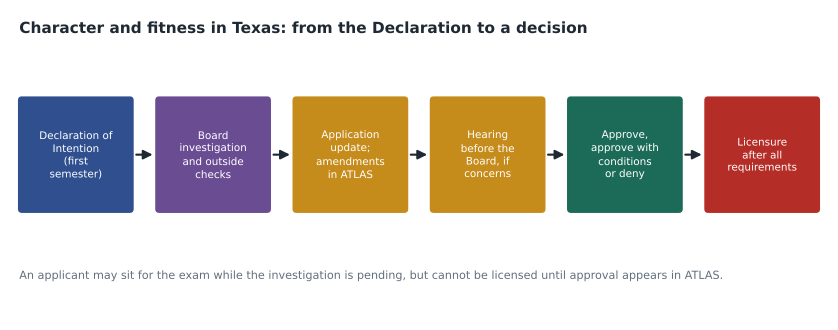
For Texas law students, the investigation starts with the Declaration of Intention to Study Law and continues with the in-state application. Applicants who did not file a Declaration, such as out-of-state students and lawyers licensed elsewhere, start with their application. The Board checks the information the applicant provides against outside sources, which may include criminal records, court records, credit reports, schools, employers and other bar admission authorities.
The process takes time. The Board's FAQ tells transfer applicants that the investigation can take up to nine months, and foreign-educated applicants' investigations may take up to 270 days. An applicant may sit for the exam while the investigation is pending, provided the educational requirements are met. That is a practical advantage, but it creates a trap: an applicant who passes the exam cannot be licensed until the Board certifies character and fitness, so an unresolved issue can delay licensure for months after results.
When the Board approves an applicant's character and fitness, the approval appears as a message in the applicant's ATLAS Application Information box. If the Board cannot approve, it posts a document in ATLAS explaining why and what comes next.
What the Board looks at
Bar admission authorities across the country focus on similar categories of conduct, and Texas is no exception. The most common areas of concern are lack of candor on the application itself, criminal conduct, academic misconduct, dishonesty in employment, neglect of financial responsibilities and disciplinary history in another profession or jurisdiction. Each is evaluated for what it says about the applicant's present character and fitness.
| Area | What the Board weighs | What helps |
|---|---|---|
| Candor on the application | Omissions and inaccuracies, even about minor matters | Complete, consistent answers; prompt amendments |
| Criminal history | Nature, seriousness, age of the conduct, pattern, compliance with sentence | Court records, proof of completion, honest explanation |
| Academic discipline | Plagiarism, cheating, misrepresentation | School records and a direct account of what changed |
| Employment | Terminations for dishonesty or misconduct | Employer records and references |
| Financial responsibility | Defaults, collections, judgments, unpaid taxes or support | Payment plans, current status, proof of good-faith steps |
| Other licenses and bar applications | Discipline, denials or pending matters | Full disclosure and records from the other authority |
Candor is the central issue
In admission decisions across the country, the most damaging problem is not the underlying conduct but the failure to disclose it. An old minor-in-possession citation that the applicant discloses with a short explanation is rarely a serious issue. The same citation, left off the form and then discovered in a records check, raises the question the Board cares about most: will this person tell the truth to a court, a client and the Board itself?
The Texas application asks broad questions, and the safe course is to read each question literally and answer it fully. If a question asks about every arrest, citation or charge, the answer includes matters that were dismissed, deferred or expunged unless the question itself says otherwise. If a question asks about every civil lawsuit, it includes suits the applicant brought, not only suits against the applicant. When in doubt, disclose and explain.
Financial responsibility
Lawyers handle other people's money, and the Board pays attention to how applicants handle their own. Unpaid debts are not disqualifying in themselves, and student loan balances are normal for new graduates. What matters is responsibility: whether the applicant has ignored obligations, defaulted without trying to resolve them, or misrepresented finances. An applicant with old collection accounts helps the file by showing current payment plans, correspondence with creditors and the steps taken since.
Unpaid child support and unpaid taxes deserve special care. Texas law treats child support delinquency seriously across many kinds of state licenses, and a candidate with any support arrears should resolve them, or enter a court-approved payment arrangement, before applying for a license.
Hearings and outcomes
If the Board has concerns it cannot resolve on the papers, it may require the applicant to appear at a hearing. The applicant may be represented by counsel, present evidence and witnesses, and explain the matters at issue. After the hearing, the Board may find that the applicant has present good moral character and fitness, may recommend licensure subject to conditions, or may find that the applicant does not meet the standard at this time. A finding against an applicant generally comes with a period before the applicant may reapply, and the rules provide for review of the Board's decision.
Conditional licensure exists because rehabilitation is real. An applicant who has addressed a substance use problem, for example, may be licensed subject to conditions such as monitoring for a period. The goal is to protect the public while allowing a qualified applicant to practice.
Worked problem
Handling two disclosures
Dewey Krupa is a hypothetical applicant. At 20 he received a deferred adjudication for a misdemeanor theft of a 60 dollar item; he completed the terms, and the record was later sealed. During law school a credit card account went to collections after he lost a part-time job; he now has a written payment plan and has made eight on-time payments. His Declaration answered no to the criminal question because he believed the sealing erased the matter. What should he do now?
Show solution
- Re-read the question: if it asks about every charge or deferred adjudication, sealed or not, the matter is responsive.
- Amend now through ATLAS, before the Board finds the record itself. Explain the facts, the deferred adjudication, the completion of terms and why the original answer was wrong.
- Attach court records showing the disposition and completion.
- For the collection account, disclose it, attach the payment plan and proof of payments, and explain the job loss briefly.
- Expect the Board may ask follow-up questions; respond promptly and completely.
Answer: A prompt, voluntary amendment with documents turns a candor problem into evidence of candor. The underlying matters, a minor offense handled years ago and a debt under a payment plan, are much less serious than an unexplained omission.
The MPRE requirement
The Multistate Professional Responsibility Examination is written and administered by NCBE. It tests the ABA Model Rules of Professional Conduct, the ABA Model Code of Judicial Conduct and generally accepted principles of the law of lawyering, not the Texas Disciplinary Rules. The September 2026 amendments restate the Texas requirement in Rule 5: an applicant must earn a scaled score of at least 85.
The MPRE is a two-hour, 60-question multiple-choice exam, of which 50 questions are scored and 10 are unscored pretest questions. Scores are reported on a scale from 50 to 150. It is given several times a year, typically in March, August and November, at testing centers and, in some cases, by remote proctoring. Candidates register with NCBE, not with the Board, and NCBE sends official score reports to the Board at the candidate's request.
The Board's FAQ states that the MPRE must be completed within five years of passing the bar exam. Most Texas students take it in the second year or early in the third year of law school, so that a weak first attempt leaves time for a retake before the bar exam. Dana scored 93 in spring 2026, comfortably above 85, so her only remaining step is to make sure the score report has been sent to the Board and appears in ATLAS.
Preparing for the MPRE
For candidates who still need the MPRE, preparation is short but should be focused. The heavily tested areas include conflicts of interest, the client-lawyer relationship, confidentiality, competence and diligence, litigation duties, fees, safekeeping client property, communications about legal services, and the regulation of the profession. Candidates should remember that the MPRE tests the Model Rules, not Texas's rules. Where the Texas Disciplinary Rules differ, as Lesson 10 explains they sometimes do, the MPRE answer follows the Model Rules.
Marchetti's MPRE plan for Texas candidates is three weeks of practice questions, an error log and two timed practice exams. 'The MPRE rewards precise reading,' she said. 'The wrong answers are usually things a lawyer may do, offered for a question that asks what a lawyer must do.'
Common mistakes
MistakeLeaving a sealed or dismissed matter off the application
InsteadRead each question literally; if it asks about every charge or deferred adjudication, disclose it and attach the records.
MistakeAssuming the investigation must finish before the exam
InsteadAn applicant may sit while the investigation is pending, but cannot be licensed until the Board certifies character and fitness.
MistakeStudying the Texas Disciplinary Rules for the MPRE
InsteadThe MPRE tests the ABA Model Rules and general principles; Texas rules matter in practice, not on the MPRE.
MistakeThinking any passing MPRE score anywhere works
InsteadTexas requires a scaled score of at least 85, reported directly by NCBE to the Board.
MistakeIgnoring old debts
InsteadDisclose them and show current payment plans or resolution; financial responsibility is judged by conduct, not balances.
Mental health and substance use questions
Bar admission authorities have narrowed the questions they ask about mental health over the last decade, focusing on conduct rather than diagnosis or treatment. The question an applicant must answer is the one on the current Texas form, read literally. Seeking counseling or treatment is not, in itself, evidence of a lack of fitness, and applicants should never avoid help out of fear of the application. Where an applicant's conduct has been affected by a condition, such as a period of academic trouble during an illness, the best course is to explain the conduct and what has changed, with supporting documents if useful.
Texas lawyers and law students also have access to the Texas Lawyers' Assistance Program, a confidential program of the State Bar that helps with substance use, mental health and wellness concerns. Using it is a sign of responsibility, and its confidentiality is protected by statute.
A character file checklist
Before filing or updating, Marchetti asks each Texas candidate to work through a short checklist. Does every address in the residence history connect without gaps? Does every job, including summer and part-time work, appear with accurate dates? Has the candidate pulled a credit report and compared it with the financial answers? Are all traffic citations, court matters and academic discipline listed, even if dismissed or deferred? Is every yes answer explained, with documents labeled by question number?
She also asks candidates to compare the current application with the Declaration filed in the first year of law school. Inconsistencies between the two are a common source of Board questions. If the Declaration was wrong, the application should say so and explain.
Dana found one inconsistency that way. Her Declaration listed a summer job at a restaurant with the wrong year. She corrected it in an ATLAS amendment with a one-sentence explanation. 'That is all it takes,' Marchetti said. 'A small error, corrected by you, is a non-event.'
Summary and key terms
- The Board must find present good moral character and fitness before certifying an applicant; past conduct is judged in context.
- Texas law students begin the investigation with the Declaration of Intention; it can take up to nine months, and longer for some foreign-educated applicants.
- An applicant may sit for the exam while the investigation is pending but cannot be licensed until approval appears in ATLAS.
- Candor on the application is the central issue; amend promptly and attach records.
- The Board may approve, approve with conditions or deny after a hearing.
- Texas requires an MPRE scaled score of 85 (Rule 5); the MPRE tests the ABA Model Rules, and the Board FAQ requires completion within five years of passing the bar exam.
- 0
- good moral character
- 1
- fitness to practice
- 2
- candor
- 3
- deferred adjudication
- 4
- financial responsibility
- 5
- conditional licensure
- 6
- MPRE
- 7
- scaled score
- 8
- score report
Practice problems
Work each problem on paper first, then reveal the answer to check.
Why does the word present matter in the character standard?
Show answer
The question is the applicant's current character and fitness; past conduct is evidence judged in context, including rehabilitation.
Can a Texas applicant sit for the bar exam before character and fitness is approved?
Show answer
Yes, if the educational requirements are met, but licensure waits for approval.
What MPRE score does Texas require?
Show answer
A scaled score of at least 85.
Which rules does the MPRE test?
Show answer
The ABA Model Rules of Professional Conduct, the ABA Model Code of Judicial Conduct and general principles of the law of lawyering.
What should an applicant do on realizing an earlier answer was incomplete?
Show answer
Amend promptly through ATLAS, explain the error and attach supporting documents.
Lesson quiz · 5 questions
Score 60% or more to complete this lesson.
Create a free account to save your progress, take quizzes and earn a certificate.