
BAR-244 · Lesson 6 of 12 · 21 min
The Texas Law Component: the Texas Law Course now and the graded subjects to come
▶ Video coming soon A video version of this lesson is on the way.
Every applicant for a Texas license must satisfy the Texas Law Component. Today that requirement is met by completing the Texas Law Course, an online course offered through the State Bar of Texas. From July 2028, as Lesson 5 explained, a graded Texas Law Component will be part of the bar exam itself, covering six subjects. This lesson explains how the current course works and when to take it, then previews the substance of the six graded subjects, concentrating on the two that later lessons do not cover in depth: criminal law and procedure, and real property including oil and gas.
Dana's question was blunt. 'Is the Texas Law Course hard?' she asked. Marchetti's answer was equally blunt. 'It is not hard. It is easy to forget,' she said. 'It is a set of video lectures with questions you must answer to move on. People finish their exam, celebrate, and then discover in April that they cannot be licensed because they never did it. Do it in December.'
The current requirement: the Texas Law Course
The admission rules require completion of the Texas Law Component, and the Board's FAQ explains that the requirement is satisfied by completing the Texas Law Course. The course is offered through TexasBarCLE, the continuing education arm of the State Bar. A candidate registers as a TexasBarCLE user and then works through a series of recorded lecture segments on Texas law. At the end of each segment the candidate answers hurdle questions, short multiple-choice questions that confirm the candidate watched and understood the segment, before the next segment opens.
The Board's FAQ describes the course as free. One commercial bar prep guide describes the course as taking about 12 hours and lists a fee, so candidates should check the current terms when they register; the Board's description controls for admission purposes. Either way, the course is not graded in the sense of a passing score on an exam. The requirement is completion.
When to take it
The Board's FAQ says that bar exam applicants may complete the Texas Law Course up to one year before the exam and up to five years after passing. An applicant cannot be licensed until it is complete. The requirement also applies to transfer applicants, to applicants for admission without examination and, under the September 2026 amendments, to military attorneys seeking a temporary license.
Timing is a judgment call. Taking the course too early means the material is less fresh by the time of practice, and taking it too late risks delaying licensure. Marchetti recommends the month before the exam's final review period for first-time takers, and immediately after filing for transfer and admission without examination applicants, who often have no other licensing step left to wait on.
| Applicant | Texas Law Component requirement | Practical timing |
|---|---|---|
| First-time exam applicant | Complete the Texas Law Course | Up to one year before the exam; finish before results |
| Re-applicant | Already satisfied if completed within the allowed window | Confirm completion still counts |
| UBE or NextGen transfer applicant | Complete the Texas Law Course | Soon after filing |
| Admission without examination | Complete the Texas Law Course | Soon after filing |
| Military temporary license | Meet the Texas Law Component requirement | Before the license issues |
From the course to a graded component
The six subjects approved in March 2026 for the graded Texas Law Component give a clear picture of what Texas considers essential Texas law for a new lawyer: trusts and guardianship; wills and administration; civil procedure; criminal law and criminal procedure; family law; and real property law, including oil and gas. Lesson 7 covers Texas civil procedure and Lesson 9 covers family property, wills and estates. The rest of this lesson previews trusts and guardianship, criminal law and procedure, and real property and oil and gas.
Trusts and guardianship
Texas trust law is codified in the Texas Trust Code, part of the Property Code. One Texas rule surprises lawyers trained elsewhere: a trust created in Texas is revocable by the settlor unless it is made irrevocable by its express terms. Many other states follow the Uniform Trust Code's approach for newer trusts, but the default in Texas has long been revocability. A drafter who intends an irrevocable trust must say so expressly.
Guardianship in Texas is governed by the Estates Code. A court may appoint a guardian of the person, of the estate or both for an incapacitated adult or a minor, but Texas law requires the court to consider whether less restrictive alternatives, such as a durable power of attorney, a medical power of attorney or a supported decision-making agreement, would meet the person's needs. Guardianship is supposed to be a last resort and, where possible, limited to the powers the person actually needs. Guardianship matters are heard in courts with probate jurisdiction, which in larger counties means statutory probate courts.
Criminal law and criminal procedure
Texas criminal law is codified in the Penal Code, and criminal procedure in the Code of Criminal Procedure. Final appellate review in criminal cases belongs to the Court of Criminal Appeals, not the Supreme Court of Texas, which is one reason Texas criminal practice is a distinct specialty.
The Penal Code grades offenses into felonies and misdemeanors. Felonies are capital felonies, first-, second- and third-degree felonies and state jail felonies. A first-degree felony carries imprisonment for life or for 5 to 99 years; a second-degree felony 2 to 20 years; a third-degree felony 2 to 10 years; and a state jail felony 180 days to 2 years in a state jail. Misdemeanors are Class A, punishable by up to one year in county jail; Class B, up to 180 days; and Class C, punishable by fine only.
| Offense grade | Punishment range (imprisonment) |
|---|---|
| First-degree felony | Life or 5 to 99 years |
| Second-degree felony | 2 to 20 years |
| Third-degree felony | 2 to 10 years |
| State jail felony | 180 days to 2 years in a state jail |
| Class A misdemeanor | Up to 1 year in county jail |
| Class B misdemeanor | Up to 180 days in county jail |
| Class C misdemeanor | Fine only |
Two procedural features stand out. First, Texas has a statutory exclusionary rule. Article 38.23 of the Code of Criminal Procedure provides that evidence obtained in violation of the federal or Texas constitutions or laws may not be admitted against the accused. It is broader than the federal exclusionary rule because it reaches violations of state law and is not limited to constitutional violations, and its only statutory good-faith exception is narrow: it applies when an officer acts in objective good-faith reliance on a warrant issued by a neutral magistrate based on probable cause.
Second, in Texas a defendant may elect to have the jury, rather than the judge, assess punishment after a guilty verdict. Jury sentencing is unusual in American practice, and it shapes trial strategy, plea bargaining and the evidence presented in the punishment phase.
Felony prosecutions generally require an indictment by a grand jury unless the defendant waives it. Felony cases are tried in district courts, and misdemeanors in county courts and, for fine-only offenses, justice and municipal courts.
Real property and oil and gas
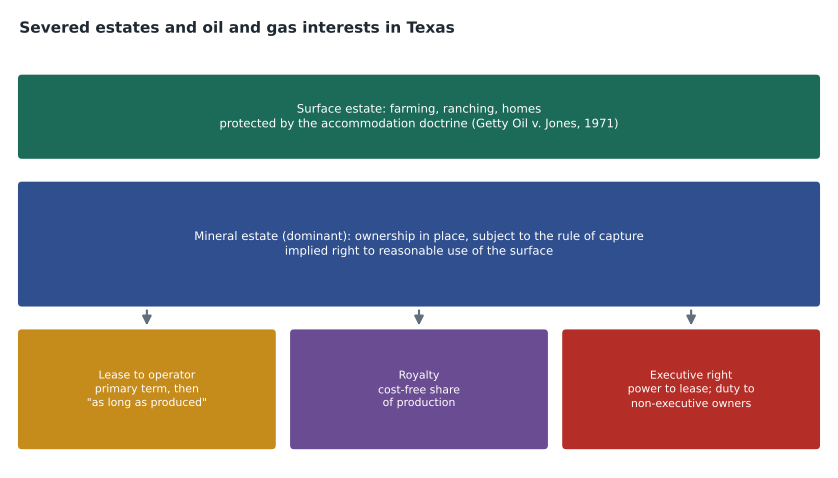
Texas real property law has many distinctive features, but oil and gas law is the one that most clearly sets Texas apart, and it is now part of the graded component. Texas follows the ownership-in-place theory: the owner of the mineral estate owns the oil and gas in place beneath the land, subject to the rule of capture. Under the rule of capture, a landowner who produces oil or gas from a well on its own land is not liable to neighbors for draining oil or gas from beneath their land, as long as the well is lawfully drilled. The neighbors' remedy is to drill their own wells, and the Railroad Commission of Texas regulates spacing and production to prevent waste and protect correlative rights.
The mineral estate can be severed from the surface estate, and once severed it is the dominant estate. The mineral owner has an implied right to use as much of the surface as is reasonably necessary to develop the minerals. That right is limited by the accommodation doctrine, recognized by the Supreme Court of Texas in Getty Oil Co. v. Jones (1971): where the surface owner has an existing use that would be precluded or substantially impaired, and reasonable alternative methods are available to the mineral owner on the premises under usual industry practices, the mineral owner may be required to use the alternative.
Hydraulic fracturing produced one of the leading modern cases. In Coastal Oil & Gas Corp. v. Garza Energy Trust (2008), the Supreme Court of Texas held that the rule of capture barred recovery of damages for drainage caused by fractures that extended beneath a neighbor's land, so the neighbor could not recover the value of gas drained in that way.
Most production happens under oil and gas leases. A typical lease grants the lessee the right to explore and produce for a primary term and for as long thereafter as oil or gas is produced. In Texas, the lease is generally treated as a fee simple determinable in the lessee, so if production ceases after the primary term and no savings clause applies, the lease can terminate automatically. Royalty, the lessor's cost-free share of production, is a frequent source of litigation over how it is calculated. The executive right, the power to sign leases on behalf of a mineral interest, may be held by someone other than the owner of the royalty, and the Supreme Court of Texas has recognized that the executive owes a duty to the non-executive owners in exercising that power.
Worked problem
Applying the accommodation doctrine
Kaylee Oberholtzer, a hypothetical surface owner in the Permian Basin, uses center-pivot irrigation across her field. A lessee of the severed mineral estate plans to drill two wells in the middle of the field, which would stop the irrigation system from turning. An alternative location at the field's edge is feasible with directional drilling, a method commonly used in the area. Can Kaylee require the lessee to use the edge location?
Show solution
- The mineral estate is dominant and carries an implied right to reasonable surface use.
- Kaylee has an existing surface use, irrigated farming, that the planned wells would substantially impair.
- A reasonable alternative is available on the premises under usual industry practices: directional drilling from the field's edge.
- Under Getty Oil v. Jones, the accommodation doctrine can require the lessee to use the alternative.
Answer: Kaylee has a strong accommodation doctrine argument. She bears the burden of proving the existing use, the substantial impairment and the reasonable alternative, so she should document each one.
Why this preview matters now
Dana will not be tested on any of this in February 2027. But her firm handles probate and guardianship matters, a steady flow of family law cases and occasional real estate closings in which mineral reservations matter. 'The Texas Law Course will give you the outline,' Marchetti said. 'Your first year of practice will fill it in. The graded component in 2028 is the State saying these are the subjects no Texas lawyer can skip.'
Common mistakes
MistakeLeaving the Texas Law Course until after results
InsteadLicensure cannot happen until the course is complete; finish it before results arrive.
MistakeTreating the Texas Law Course as an exam with a passing score
InsteadToday the requirement is completion of the course, including its hurdle questions.
MistakeAssuming a Texas trust is irrevocable unless stated otherwise
InsteadTexas trusts are revocable unless made irrevocable by express terms.
MistakeApplying the federal exclusionary rule's exceptions to Article 38.23
InsteadArticle 38.23 reaches state-law violations, and its statutory good-faith exception is limited to reliance on a warrant.
MistakeTreating the mineral estate's surface rights as unlimited
InsteadThe accommodation doctrine can require a mineral owner to use reasonable alternatives that protect an existing surface use.
The Railroad Commission
Despite its name, the Railroad Commission of Texas no longer regulates railroads. It is the state agency that regulates oil and gas exploration and production, pipelines and related activities. It issues drilling permits, sets well spacing and density rules, regulates production to prevent waste, oversees plugging of abandoned wells and enforces environmental rules for oil field operations. Its three commissioners are elected statewide. Lawyers in oil and gas practice appear before it regularly, and its rules shape the practical limits of the rule of capture.
Pooling and unitization
Because the rule of capture can encourage wasteful competitive drilling, Texas law allows owners to combine their interests. Most pooling in Texas is voluntary, under pooling clauses in leases and pooling agreements. Texas has a limited compulsory pooling statute, the Mineral Interest Pooling Act, which is used less often than compulsory pooling laws in some other producing states. Pooled units share production according to the terms of the pooling agreement, usually in proportion to acreage.
Summary and key terms
- The Texas Law Component is satisfied today by completing the online Texas Law Course through TexasBarCLE, with hurdle questions after each segment.
- The Board allows completion up to one year before the exam and up to five years after passing; licensure waits for completion.
- Transfer, admission without examination and military temporary license applicants must also meet the requirement.
- From July 2028 a graded component will test six subjects, including trusts and guardianship and real property including oil and gas.
- Texas criminal law features felony grades from state jail to capital, a statutory exclusionary rule in Article 38.23 and jury sentencing on election.
- Texas oil and gas law follows ownership in place, the rule of capture (Garza, 2008) and the accommodation doctrine (Getty Oil v. Jones, 1971).
- 0
- Texas Law Course
- 1
- hurdle questions
- 2
- TexasBarCLE
- 3
- Texas Trust Code
- 4
- less restrictive alternatives
- 5
- Article 38.23
- 6
- jury sentencing
- 7
- ownership in place
- 8
- rule of capture
- 9
- accommodation doctrine
- 10
- executive right
Practice problems
Work each problem on paper first, then reveal the answer to check.
How is the Texas Law Component satisfied for a February 2027 examinee?
Show answer
By completing the Texas Law Course through TexasBarCLE.
What is the default rule on revocability of a Texas trust?
Show answer
It is revocable unless made irrevocable by its express terms.
Which court has final appellate jurisdiction in Texas criminal cases?
Show answer
The Court of Criminal Appeals.
What did Coastal Oil & Gas v. Garza Energy Trust hold?
Show answer
The rule of capture barred damages for drainage caused by hydraulic fractures extending beneath a neighbor's land.
State the accommodation doctrine.
Show answer
Where an existing surface use would be precluded or substantially impaired and a reasonable alternative is available on the premises under usual industry practices, the mineral owner may be required to use the alternative.
Lesson quiz · 5 questions
Score 60% or more to complete this lesson.
Create a free account to save your progress, take quizzes and earn a certificate.