
BAR-244 · Lesson 8 of 12 · 21 min
Texas torts: proportionate responsibility, the Tort Claims Act and health care liability claims
▶ Video coming soon A video version of this lesson is on the way.
Tejeda & Marwick represents injured people in a steady stream of car crash, premises and medical cases, and Dana's first months at the firm have been a crash course in how Texas tort law differs from the general principles she is studying for the MBE. The MBE tests comparative negligence in general terms and the common law of torts. A Texas tort case is shaped by three statutory systems: proportionate responsibility under Chapter 33 of the Civil Practice and Remedies Code, the Texas Tort Claims Act in Chapter 101 for claims against government, and the health care liability provisions of Chapter 74. This lesson covers all three, plus the Texas limits on exemplary damages.
Marchetti framed it in exam terms. 'On the MBE, know the general rules,' she said. 'For Texas practice, know the statutes. They decide whether your client recovers anything, how much and from whom. And they come with deadlines that end cases.'
Proportionate responsibility: the 51 percent bar
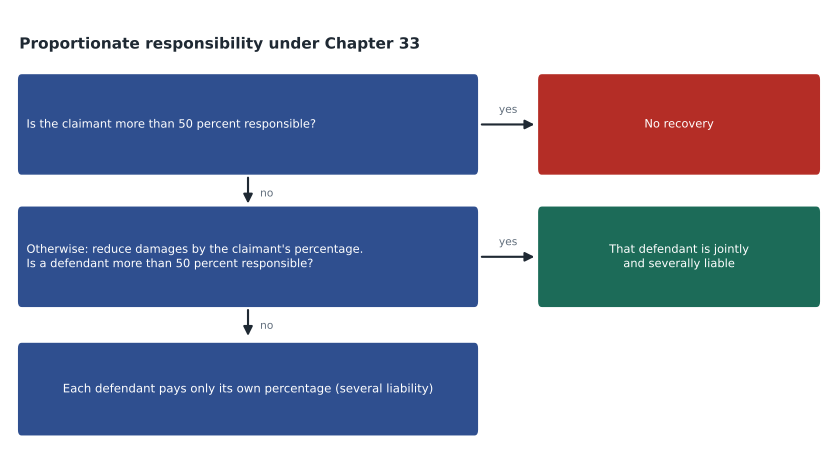
Texas follows a modified comparative responsibility system. Under Chapter 33, the jury determines the percentage of responsibility of each claimant, each defendant, each settling person and each designated responsible third party. A claimant whose percentage of responsibility is greater than 50 percent recovers nothing. A claimant whose percentage is 50 percent or less recovers damages reduced by that percentage. This is often called the 51 percent bar, because a claimant must be found at least 51 percent responsible to be barred entirely.
Chapter 33 applies broadly: to tort claims and to claims under the Deceptive Trade Practices Act, among others, with certain exclusions. It replaced the older common law contributory negligence and joint and several liability rules in most cases.
Several liability and the greater-than-50-percent rule
The general rule in Texas is several liability. Each liable defendant pays only its own percentage share of the damages. A defendant is jointly and severally liable, meaning liable for all of the damages recoverable by the claimant, only if its percentage of responsibility is greater than 50 percent. The statute also imposes joint and several liability on a defendant who, with the specific intent to do harm, committed certain listed serious crimes, a narrow category.
For a plaintiff, the practical effect is significant. If one defendant is found 40 percent responsible and another 60 percent, and the 60 percent defendant is insolvent, the plaintiff can collect all recoverable damages from the 60 percent defendant only; the 40 percent defendant pays its 40 percent share and no more. Several liability shifts the risk of an insolvent defendant to the plaintiff.
Responsible third parties and settlement credits
A defendant may move to designate a responsible third party, a person who is alleged to have caused or contributed to the harm, even if that person is not a party and could not be sued by the plaintiff. If the court grants the motion, the jury may assign a percentage of responsibility to that person. A designation does not impose liability on the responsible third party; its purpose is to reduce the percentages assigned to the defendants. The motion generally must be filed on or before the 60th day before the trial date, and the statute restricts designations after limitations has run on the third party where the defendant did not timely disclose the person in discovery.
Settlements also matter. If the claimant has settled with some persons, the court reduces the claimant's recovery by the dollar amount of the settlements, a dollar-for-dollar credit, and the jury may also assign a percentage of responsibility to a settling person. Lawyers on both sides model these effects before mediation.
| Scenario | Claimant's recovery under Chapter 33 |
|---|---|
| Claimant 20 percent, Defendant A 80 percent; damages 100,000 dollars | 80,000 dollars; A is jointly and severally liable (over 50 percent) |
| Claimant 50 percent, Defendant 50 percent; damages 100,000 dollars | 50,000 dollars; claimant is not barred at exactly 50 percent |
| Claimant 51 percent, Defendant 49 percent | Nothing; claimant is more than 50 percent responsible |
| Claimant 10 percent, A 45 percent, B 45 percent; damages 100,000 dollars | A pays 45,000 dollars and B pays 45,000 dollars; neither is jointly liable |
The Texas Tort Claims Act
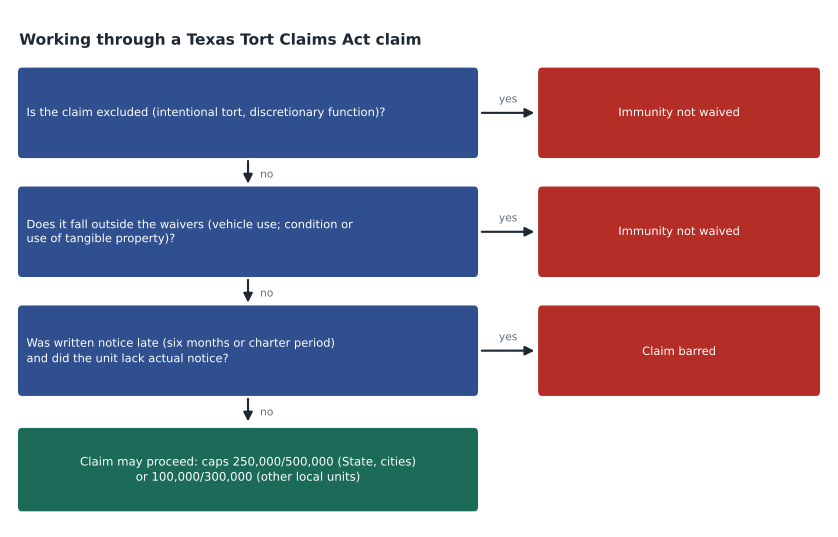
Governmental entities in Texas have sovereign or governmental immunity from suit and from liability unless the Legislature has clearly waived it. The Texas Tort Claims Act, Chapter 101 of the Civil Practice and Remedies Code, is the main waiver for tort claims. Because immunity from suit deprives the court of subject matter jurisdiction, government defendants raise it by a plea to the jurisdiction, and an order granting or denying that plea can generally be appealed immediately.
The Act waives immunity in limited categories. The two main categories are injuries arising from the operation or use of a motor-driven vehicle or motor-driven equipment by a government employee acting within the scope of employment, if the employee would be personally liable under Texas law; and personal injury and death caused by a condition or use of tangible personal or real property, if the government would be liable as a private person. Premises defect claims receive special treatment: the government generally owes the claimant only the duty a private person owes a licensee, unless the claimant pays for the use of the premises, with different rules for special defects and certain road conditions.
The Act also lists claims it does not waive, including claims based on discretionary decisions and claims arising out of intentional torts such as assault and battery. These exclusions defeat many claims that look like ordinary negligence at first glance.
Damages caps and the notice requirement
The Act caps damages. For the State, liability is limited to 250,000 dollars for each person and 500,000 dollars for each single occurrence for bodily injury or death, and 100,000 dollars for each single occurrence for injury to or destruction of property. Municipalities have the same caps as the State. Other units of local government, such as counties and school districts, are capped at 100,000 dollars for each person and 300,000 dollars for each occurrence for bodily injury or death, and 100,000 dollars for property damage. Emergency service organizations have the lower local government caps.
| Defendant | Each person (injury or death) | Each occurrence (injury or death) | Property damage per occurrence |
|---|---|---|---|
| State government | 250,000 dollars | 500,000 dollars | 100,000 dollars |
| Municipality | 250,000 dollars | 500,000 dollars | 100,000 dollars |
| Other unit of local government (county, school district) | 100,000 dollars | 300,000 dollars | 100,000 dollars |
| Emergency service organization | 100,000 dollars | 300,000 dollars | 100,000 dollars |
The Act also requires notice. A claimant must give the governmental unit written notice of the claim not later than six months after the incident, reasonably describing the damage or injury, the time and place of the incident and the incident itself. Formal notice is not required if the governmental unit has actual notice of the death, the injury or the property damage and of its own alleged fault. City charters may set their own notice provisions, and some require notice much sooner than six months, so a lawyer with a claim against a city must check the charter immediately.
Finally, the Act contains an election-of-remedies provision that strongly encourages suing the governmental unit rather than the individual employee. Filing suit against both, or against the employee for conduct within the scope of employment, can lead to dismissal of the employee, and choosing wrongly can cost the claimant the claim. This provision is technical, and its consequences are severe.
Health care liability claims under Chapter 74
In 2003 Texas enacted major reforms to medical liability law, and Texas voters approved a constitutional amendment authorizing the Legislature to limit noneconomic damages in such cases. The resulting provisions, in Chapter 74 of the Civil Practice and Remedies Code, apply to health care liability claims, a term the courts have read broadly to cover many claims against physicians, health care providers and health care institutions arising from treatment or from departures from accepted standards of health care or safety.
The most important procedural rule is the expert report requirement. Within 120 days after each defendant physician or health care provider files its original answer, the claimant must serve that defendant with one or more expert reports, with the experts' curricula vitae, summarizing the applicable standards of care, the manner in which the defendant failed to meet them and the causal relationship between that failure and the injury. A defendant must object to the sufficiency of a report within 21 days after it is served or 21 days after the defendant's answer is filed, whichever is later, or the objections are waived. If a report is not served on time, the court, on the defendant's motion, must dismiss the claim against that defendant with prejudice and award the defendant reasonable attorney fees and court costs. If a timely report is deficient, the court may grant one 30-day extension to cure it.
Chapter 74 caps noneconomic damages. In a final judgment against physicians or health care providers other than institutions, noneconomic damages are limited to 250,000 dollars for each claimant, regardless of the number of defendant physicians or providers. Against a single health care institution, noneconomic damages are limited to 250,000 dollars for each claimant; against two or more institutions, each is limited to 250,000 dollars and the total for all institutions is limited to 500,000 dollars. Economic damages, such as medical expenses and lost earnings, are not capped by these provisions, although Chapter 74 also contains a separate inflation-adjusted cap on total damages in wrongful death and survival actions.
Health care liability claims have their own limitations period: generally two years from the breach or tort or from the completion of the treatment, with a 10-year statute of repose. Claimants must also give pre-suit notice and an authorization for release of medical records, which can toll limitations for 75 days.
| Chapter 74 rule | Requirement |
|---|---|
| Expert report | Within 120 days after each defendant's original answer |
| Objections to report | Within 21 days after service of the report or the answer, whichever is later |
| Missing report | Dismissal with prejudice and attorney fees on motion |
| Deficient report | One 30-day extension may be granted to cure |
| Noneconomic cap, physicians and providers | 250,000 dollars per claimant |
| Noneconomic cap, institutions | 250,000 dollars each; 500,000 dollars total per claimant |
| Limitations | Generally two years, with a 10-year repose period |
Exemplary damages
Chapter 41 of the Civil Practice and Remedies Code governs exemplary damages, the Texas term for punitive damages. A claimant must prove by clear and convincing evidence that the harm resulted from fraud, malice or gross negligence, and the jury's finding on liability for and the amount of exemplary damages must be unanimous. Exemplary damages are capped at the greater of two times economic damages plus noneconomic damages found by the jury, up to 750,000 dollars of noneconomic damages, or 200,000 dollars. The cap does not apply when the claim is based on certain listed felonies committed knowingly or intentionally.
Worked problem
Working a crash case against a city
On June 2, 2026, a hypothetical claimant, Kip Tillotson, was injured when a city garbage truck backed into his parked car while he was loading groceries. His medical bills and lost wages total 90,000 dollars, and he claims 200,000 dollars in pain and suffering. The city's charter requires notice of claims within 90 days. He came to the firm on November 2, 2026. What should the firm analyze first?
Show solution
- Waiver: injury from the operation of a motor-driven vehicle by a city employee in the scope of employment fits the Tort Claims Act's vehicle waiver, if the driver would be personally liable.
- Timing of notice: the charter's 90-day period expired on August 31, 2026, and the statutory six months would expire on December 2, 2026. The firm must find out whether the city had actual notice of the injury and its fault, such as a police report or an incident report by the driver, and must give written notice at once.
- Defendant: sue the city, not the driver individually, because of the election-of-remedies provision.
- Caps: as a municipality, the city's liability is capped at 250,000 dollars per person for bodily injury. Total claimed damages of 290,000 dollars exceed the cap.
- Comparative responsibility: Chapter 33 applies; any percentage assigned to Kip reduces his recovery.
Answer: The notice problem comes first. If the city had no actual notice and the charter's 90-day period controls, the claim may be barred. If notice is satisfied, the most Kip can recover from the city is 250,000 dollars, reduced by any percentage of responsibility assigned to him.
Common mistakes
MistakeTreating Texas as a pure comparative fault state
InsteadA Texas claimant more than 50 percent responsible recovers nothing.
MistakeAssuming every defendant is jointly and severally liable
InsteadJoint and several liability applies only to a defendant more than 50 percent responsible, or in narrow criminal-act cases.
MistakeWaiting to give notice to a city
InsteadStatutory notice is due within six months, and city charters may require notice sooner; actual notice is the only fallback.
MistakeSuing a government employee instead of the governmental unit
InsteadThe election-of-remedies provision can lead to dismissal; sue the unit for conduct within the scope of employment.
MistakeMissing the 120-day expert report deadline
InsteadFailure to serve the report leads to dismissal with prejudice and an award of attorney fees.
Summary and key terms
- Chapter 33 bars a claimant who is more than 50 percent responsible and reduces recovery by the claimant's percentage otherwise.
- Liability is several unless a defendant is more than 50 percent responsible; responsible third parties and settlement credits reduce defendants' shares.
- The Tort Claims Act waives immunity mainly for motor vehicle use and condition or use of tangible property, with exclusions such as intentional torts and discretionary functions.
- Caps: 250,000 and 500,000 dollars for the State and municipalities; 100,000 and 300,000 dollars for other local units; 100,000 dollars for property; notice within six months or the city charter period.
- Chapter 74 requires an expert report within 120 days after each defendant's answer and caps noneconomic damages at 250,000 dollars per claimant for physicians and up to 500,000 dollars for institutions.
- Exemplary damages require clear and convincing evidence and a unanimous jury, and are capped under Chapter 41.
- 0
- proportionate responsibility
- 1
- responsible third party
- 2
- several liability
- 3
- joint and several liability
- 4
- governmental immunity
- 5
- plea to the jurisdiction
- 6
- Texas Tort Claims Act
- 7
- actual notice
- 8
- election of remedies
- 9
- health care liability claim
- 10
- expert report
- 11
- exemplary damages
Practice problems
Work each problem on paper first, then reveal the answer to check.
A claimant is found 50 percent responsible. Is recovery barred?
Show answer
No. The bar applies only when the claimant's percentage is greater than 50 percent; recovery is reduced by half.
When is a Texas defendant jointly and severally liable?
Show answer
When its percentage of responsibility is greater than 50 percent, or in narrow cases involving listed crimes committed with specific intent.
What are the Tort Claims Act caps for a county?
Show answer
100,000 dollars per person and 300,000 dollars per occurrence for bodily injury or death, and 100,000 dollars for property damage.
When is a Chapter 74 expert report due?
Show answer
Within 120 days after each defendant files its original answer.
What standard of proof applies to exemplary damages?
Show answer
Clear and convincing evidence, with a unanimous jury.
Lesson quiz · 5 questions
Score 60% or more to complete this lesson.
Create a free account to save your progress, take quizzes and earn a certificate.