
BAR-244 · Lesson 12 of 12 · 20 min
Capstone: Texas practice questions and an exam-day plan
▶ Video coming soon A video version of this lesson is on the way.
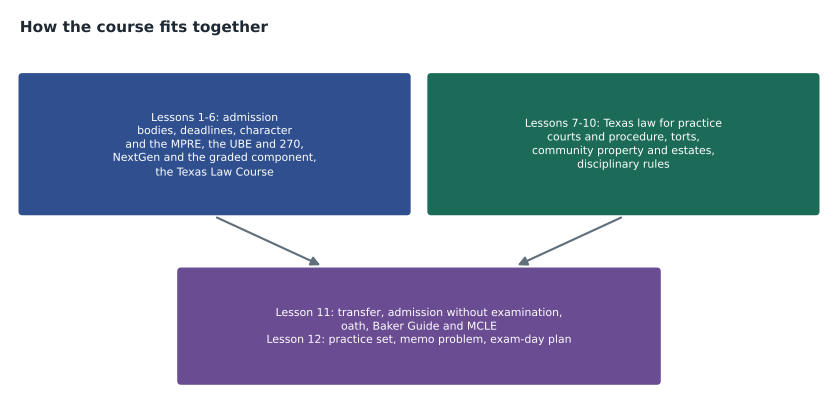
This final lesson brings the course together in three parts. First, a set of ten short practice questions on Texas admission rules and Texas law, with answers and explanations. Second, an original Texas practice problem, written in the style of a law office assignment, answered in memo form using the IRAC method. Third, an exam-day plan for the February 2027 Texas UBE, built from the logistics and scoring rules in Lessons 2 and 4. None of the questions are released bar exam questions; all are original, and every person and business in them is fictional.
Dana and Marchetti worked through the set on an undated Tuesday call in November, after the group's regular session. 'The exam in February will not ask you any of the Texas questions,' Marchetti said. 'Do them anyway. The admission questions decide whether you get licensed on time, and the Texas law questions are the first things your partners will ask you.'
Part 1: Ten short practice questions
Question 1. A Texas law student who entered law school in the fall of 2024 filed a Declaration of Intention on November 15, 2024. What consequences follow? Answer: The deadline for a fall entrant was October 1 of the first semester, so the Declaration was late and a late fee applied under the Board's fee schedule. The student could still file before or with the in-state application, but the Board's investigation started later than it otherwise would have.
Question 2. A February 2027 examinee files the application on November 20, 2026. Which fees apply for an in-state law student who will type? Answer: 450 dollars for the application, a 300 dollar late fee because the filing falls in the final period ending December 1, and the 150 dollar software fee, for a total of 900 dollars payable to the Board.
Question 3. An examinee's scaled MBE score is 141 and her scaled written score is 127. Does she pass in Texas? Answer: Her total is 268, two points below 270, so she does not pass in Texas. She may request formal review of her written answers, which does not extend to the MBE, and she may reapply within 30 days after results.
Question 4. A candidate passes the February 2027 exam and has completed everything except the Texas Law Course. Can he be licensed in April? Answer: No. Licensure requires completion of the Texas Law Component. He should complete the Texas Law Course immediately; he becomes eligible once it is complete and all other requirements are met.
Question 5. A client in a premises case is found 50 percent responsible; the defendant store is found 50 percent responsible; damages are 120,000 dollars. What is the recovery? Answer: 60,000 dollars. Under Chapter 33 a claimant is barred only if more than 50 percent responsible; recovery is reduced by the claimant's 50 percent.
Question 6. A school district bus rear-ends a car, injuring two passengers, each with 150,000 dollars in damages. What is the most the district can be required to pay? Answer: A school district is a unit of local government other than a municipality, so the Tort Claims Act caps its liability at 100,000 dollars per person and 300,000 dollars per occurrence for bodily injury. Each passenger can recover at most 100,000 dollars, for a total of 200,000 dollars.
Question 7. A husband owned a rental duplex before marriage and collected 30,000 dollars in rent during the marriage, which he deposited in an account in his own name. At divorce, how are the duplex and the rent classified? Answer: The duplex is his separate property. The rent is community property, because income from separate property is community in Texas absent a valid agreement, even though it sits in an account in his name.
Question 8. A will is typed and signed by the testator and by one witness. Is it valid in Texas? Answer: Not as an attested will, because Texas requires two or more credible witnesses over 14. It is not holographic, because it is not wholly in the testator's handwriting. As drafted it would not be admitted to probate as a valid will.
Question 9. A client tells a Texas lawyer that he plans to set fire to an occupied apartment building tonight to collect insurance, and gives details. What must the lawyer do? Answer: Under Texas Rule 1.05, when confidential information clearly establishes that a client is likely to commit a criminal or fraudulent act likely to result in death or substantial bodily harm, the lawyer must reveal the information to the extent reasonably necessary to prevent the act.
Question 10. A lawyer licensed in Colorado earned a 272 UBE score in July 2021 and has practiced there since. In December 2026, can she transfer the score to Texas? Answer: No. The score is more than five years old by December 2026. But she has practiced for more than five of the last seven years, so admission without examination is available, along with the MPRE, Texas Law Component and character and fitness requirements.
Part 2: The practice problem
The assignment below is written as a memo from a supervising lawyer. Read it once for the overall picture, a second time to mark the issues, then write the answer in IRAC form: issue, rule, application and conclusion for each issue. The model answer follows.
To: Dana Whitfield, law clerk. From: supervising partner. Re: Saldivar matter, intake on November 16, 2026. Please give me a short memo on the issues I list at the end.
Facts. Our prospective client, Marisela Saldivar, lives in Bastrop County. She married Hector Saldivar in 2009. Hector died on October 3, 2026, without a will. They had two children together, now 14 and 11. Hector also had an adult son, Leandro, from an earlier relationship. The couple lived on a 40-acre rural tract that Hector bought in 2007, before the marriage, and that has been their home since 2009. During the marriage, the couple paid off the mortgage on the tract with Hector's salary. They also own a checking account with about 60,000 dollars, funded with both spouses' paychecks, and a pickup truck bought in 2022.
On August 12, 2026, a little under two months before Hector died, he was injured when a City of Bastrop maintenance truck backed into him while he was walking in a city parking lot. The driver was on duty. Hector was hospitalized and incurred 85,000 dollars in medical bills. His death on October 3 was from unrelated causes. Marisela gave no written notice to the city. The police report of the parking lot accident was prepared by city police and lists the truck driver as having been backing without a spotter.
Marisela also tells us that a local lawyer has offered to handle the estate and the accident claim for a 45 percent contingent fee, agreed by handshake.
Issues. One: How does Hector's property pass? Two: Can Marisela stay in the home? Three: What are the problems with the claim against the city, and what is the most that could be recovered? Four: Any concerns about the other lawyer's fee arrangement?
Model answer
Issue 1: Distribution of Hector's property. Rule: Property acquired during marriage is presumed community; separate property includes property owned before marriage. If a married intestate decedent leaves a child or descendant who is not also the surviving spouse's, the decedent's half of the community passes to the decedent's children and descendants. The surviving spouse takes one-third of the decedent's separate personal property and a life estate in one-third of the decedent's separate real property; the children take the rest. Application: The 40-acre tract was bought in 2007, before the marriage, so it is Hector's separate real property. The checking account and the 2022 truck were acquired during marriage and are community. Because Leandro is Hector's child but not Marisela's, Hector's half of the community, half of the account and half of the truck, passes to his three children in equal shares. Marisela keeps her own half of the community. For the separate tract, Marisela takes a life estate in one-third, and Hector's three children take the remainder of that third and the other two-thirds. The community estate may also have a reimbursement claim against Hector's separate estate, because community salary paid off the mortgage on his separate tract. Conclusion: Marisela keeps her half of the community and a life estate in one-third of the tract; Hector's three children share his half of the community and the rest of the tract, subject to any community reimbursement claim.
Issue 2: Occupancy of the home. Rule: The Texas Constitution gives a surviving spouse the right to occupy the homestead for life, or as long as the spouse elects to use or occupy it, regardless of who inherits title. A rural family homestead may be up to 200 acres. Application: The 40-acre tract has been the family home since 2009 and is well within the rural limit. Even though Leandro and the younger children inherit most of the title, Marisela may continue to occupy it. Conclusion: Marisela may stay in the home for as long as she uses it as her homestead; the co-owners cannot force a partition while her homestead right continues.
Issue 3: The claim against the City of Bastrop. Rule: The Tort Claims Act waives immunity for injuries arising from the operation or use of a motor-driven vehicle by an employee within the scope of employment if the employee would be personally liable. Written notice must be given within six months after the incident, or within any shorter period in the city charter; formal notice is excused if the city had actual notice of the injury and of its own alleged fault. Municipal liability is capped at 250,000 dollars per person for bodily injury. Claims for a decedent's injuries before death survive and may be brought by the estate's representative. Application: Backing a maintenance truck is operation of a motor-driven vehicle, and the driver was on duty, so the waiver likely applies. Six months from August 12, 2026 runs to February 12, 2027, but the firm must immediately check the Bastrop city charter for a shorter notice period. Because city police prepared a report noting the driver backed without a spotter, there is an argument that the city had actual notice of both the injury and its fault, but that argument is fact-dependent. The safest course is to give written notice at once. The claim belongs to Hector's estate as a survival claim, so someone must be appointed to represent the estate. Recoverable damages include the 85,000 dollars in medical bills and pain and suffering before death, reduced by any percentage of responsibility assigned to Hector, and capped at 250,000 dollars. Conclusion: The claim is viable if notice is satisfied; give written notice immediately, check the charter, open an estate administration, and expect a maximum recovery of 250,000 dollars.
Issue 4: The other lawyer's fee arrangement. Rule: Under Texas Rule 1.04, a contingent fee agreement must be in writing and state the method by which the fee is determined, and a lawyer may not charge an unconscionable fee. Application: A handshake contingent fee does not satisfy the writing requirement. A 45 percent fee on a modest capped claim may raise reasonableness questions depending on the work required. Conclusion: Marisela should not rely on the oral arrangement; any lawyer she hires, including our firm, should give her a written fee agreement.
Part 3: The exam-day plan
The second half of the capstone is a plan for February 23 and 24, 2027. Marchetti builds it backward from the exam.
| When | Task |
|---|---|
| Early December 2026 | Complete the Texas Law Course; confirm the MPRE score report in ATLAS |
| January 2027 | Register the laptop and install the exam software by the Board's deadline |
| Late January 2027 | Admission ticket arrives about four weeks before the exam; confirm site and seat |
| February 1, 2027 | Deadline for religious-accommodation requests for February 2027, if needed |
| February 21 and 22, 2027 | Light review only; pack the permitted items; check into a hotel near the site |
| February 23, 2027 | Morning: two MPT tasks (90 minutes each). Afternoon: six MEE questions (30 minutes each) |
| February 24, 2027 | Morning and afternoon: 100 MBE questions each, three hours per session |
| Mid-April 2027 | Results in ATLAS; take the oath once eligible |
Marchetti's final checklist for the morning of each exam day is short. Photo identification and admission ticket. Laptop, power cord and any permitted items. Car keys and a plan for where the phone goes into the Yondr pouch. Leave the watch behind, since the Board provides no storage, and rely on the room clocks. Breakfast. Arrive early, because security lines at a large site move slowly.
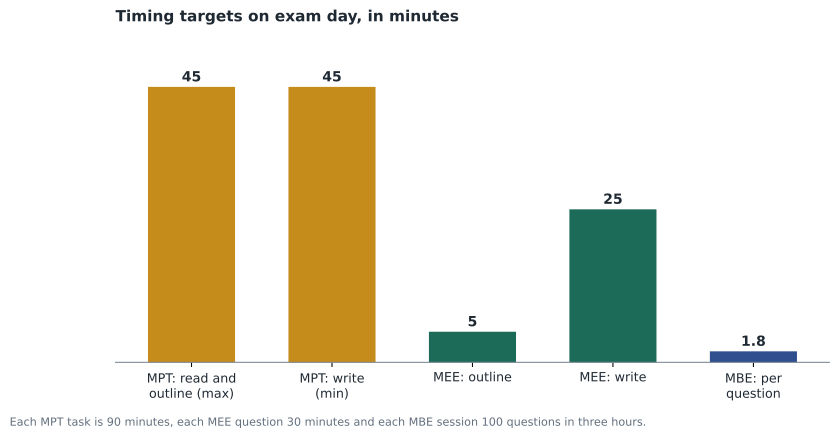
During the MPT, she reminds Dana of the timing rule: no more than 40 to 45 minutes reading and outlining each task. During the MEE, five minutes of reading and outlining per question, then write, and move on at 30 minutes even if the answer feels incomplete. During the MBE, about 1.8 minutes per question, marking hard questions and returning only if time allows.
After the exam
The weeks after the exam are a good time to finish anything left on the licensing list and to start learning Texas practice in earnest. Marchetti suggests that every February examinee use March to work through the six graded Texas Law Component subjects at an introductory level, not because the exam will test them, but because they are the substance of a first year in Texas practice. Dana plans to start with the firm's probate files.
'Passing is the gate,' Marchetti said at the end of the call. 'The four requirements get you licensed. The Texas law gets you through your first year. You have both now.'
Common mistakes
MistakeSkipping the Texas questions because the exam does not test them
InsteadAdmission rules decide licensing timing, and Texas law is what new lawyers use first.
MistakeAnswering a property question without classifying each asset first
InsteadClassify every asset as separate or community before applying intestacy or division rules.
MistakeRelying on actual notice without giving written notice
InsteadGive written notice to the governmental unit immediately; actual notice is fact-dependent.
MistakeAccepting an oral contingent fee
InsteadTexas Rule 1.04 requires contingent fee agreements to be in writing.
MistakeSpending too long reading the MPT File
InsteadCap reading and outlining at 40 to 45 minutes per task.
Summary and key terms
- Admission questions turn on deadlines, fees, scores and the four shared requirements: character and fitness, the 85 MPRE, the Texas Law Component and the oath.
- A 268 does not pass in Texas; formal review covers written answers only; re-applicants may file within 30 days after results.
- Texas law questions turn on classification (community or separate), statutory thresholds (51 percent bar, Tort Claims Act caps) and formalities (two witnesses, written contingent fees).
- In the practice problem, a child from a prior relationship changes the community result, the homestead right protects the surviving spouse and the Tort Claims Act notice issue comes first.
- The exam-day plan works backward from February 23 and 24, 2027, with fixed timing targets for the MPT, MEE and MBE.
- 0
- IRAC
- 1
- survival claim
- 2
- reimbursement claim
- 3
- probate homestead
- 4
- actual notice
- 5
- exam-day plan
- 6
- error log
- 7
- formal review
Practice problems
Work each problem on paper first, then reveal the answer to check.
What is the first issue to analyze in a claim against a Texas city for a vehicle accident?
Show answer
The notice question: whether written notice was given within six months or the city charter's period, or the city had actual notice.
In the Saldivar problem, why does Hector's half of the community not go to Marisela?
Show answer
Because Hector had a child, Leandro, who is not Marisela's child, so his half of the community passes to his children.
What protects Marisela's right to stay in the home?
Show answer
The surviving spouse's constitutional homestead right to occupy for life.
How long should an examinee spend reading and outlining each MPT task?
Show answer
No more than 40 to 45 minutes.
When are February 2027 results expected?
Show answer
Mid-April 2027.
Lesson quiz · 5 questions
Score 60% or more to complete this lesson.
Create a free account to save your progress, take quizzes and earn a certificate.