
BAR-244 · Lesson 4 of 12 · 20 min
The Texas bar exam today: the UBE and the 270 passing score
▶ Video coming soon A video version of this lesson is on the way.
The February 2027 Texas bar exam is the Uniform Bar Examination. It is the same exam given in every UBE jurisdiction on the same days, written by NCBE, graded in Texas and scored on the common 400-point UBE scale. Texas requires a total scaled score of 270 to pass. This lesson explains the format, the subjects, the scoring and what the 270 means, so that Dana and every other February candidate know exactly what they are preparing for.
Dana came to the session with her error logs from the Saturday MBE drills and the Wednesday essay series. 'I know the components,' she said. 'What I do not have a feel for is how they add up. If my MBE is weak, how much do the essays have to carry? And what happens if I miss by two points?' Marchetti promised to answer both questions with numbers.
The two days
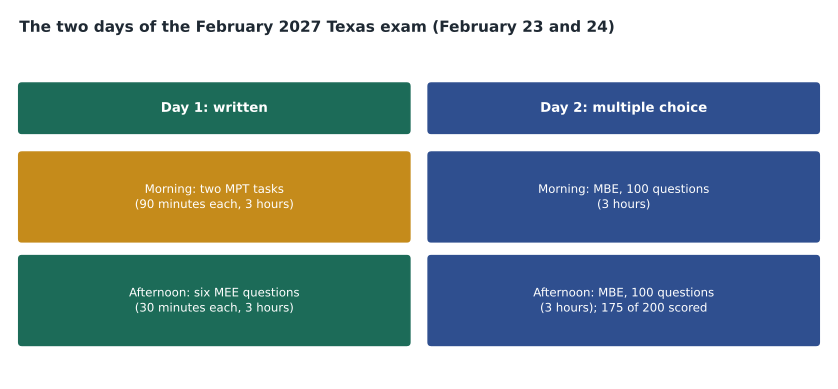
The Texas UBE is given over two consecutive days. On the first day, the morning session has two Multistate Performance Test tasks, each 90 minutes, and the afternoon session has six Multistate Essay Examination questions, each 30 minutes. On the second day, examinees answer the 200 questions of the Multistate Bar Examination, 100 in a three-hour morning session and 100 in a three-hour afternoon session. For February 2027 those days are Tuesday, February 23 and Wednesday, February 24.
The Multistate Bar Examination
The MBE is a 200-question multiple-choice exam covering seven subjects: civil procedure, constitutional law, contracts, criminal law and procedure, evidence, real property and torts. Of the 200 questions, 175 are scored and 25 are unscored pretest questions that look exactly like the others. Raw scores are converted to a scaled score through a statistical process called equating, which adjusts for small differences in difficulty between exams, so that a scaled score means the same thing from one administration to the next.
The MBE tests general principles of law and, for some subjects, specific federal rules: the Federal Rules of Civil Procedure and the Federal Rules of Evidence. It does not test Texas law. A Texas candidate who answers an evidence question using a Texas Rule of Evidence that differs from its federal counterpart will get it wrong.
The Multistate Essay Examination
The MEE consists of six 30-minute essay questions. Starting with the July 2026 administration, NCBE removed four subjects from the MEE: conflict of laws, family law, trusts and estates, and secured transactions. That change aligns the MEE with the subjects of the coming NextGen exam. The MEE now tests business associations (agency and partnership, and corporations and limited liability companies), civil procedure, constitutional law, contracts including Article 2 of the Uniform Commercial Code, criminal law and procedure, evidence, real property and torts.
The change is significant for Texas candidates studying from older materials. Many older Texas outlines and practice sets were built around the full MEE list, and some still include essays on trusts, wills, family law or secured transactions. Those essays are no longer on the February 2027 exam. Marchetti told Dana to skip them in practice sets and spend the time on business associations, which remain on the MEE and often appear in combination with other subjects.
MEE answers are graded by jurisdiction graders, in Texas by graders working for the Board, using NCBE's grading materials and a common calibration process. The grading is relative: answers are compared with other answers to the same question, and the strongest answers earn the highest grades. That is why a well-organized answer that identifies the issues and applies the rules to the facts can score well even if it misses a detail.
The Multistate Performance Test
Each MPT task gives the examinee a File, containing the facts in documents such as memos, letters and transcripts, and a Library, containing the law in cases, statutes or rules, which may be real or fictional. The task is to complete a lawyering assignment, such as an objective memo, a persuasive brief, a client letter or a set of discovery requests, using only the materials provided. The MPT tests skills: organizing, reading critically, separating relevant from irrelevant facts, following instructions and writing clearly under time pressure. No outside law is needed, and using outside law can hurt an answer.
How the parts are weighted
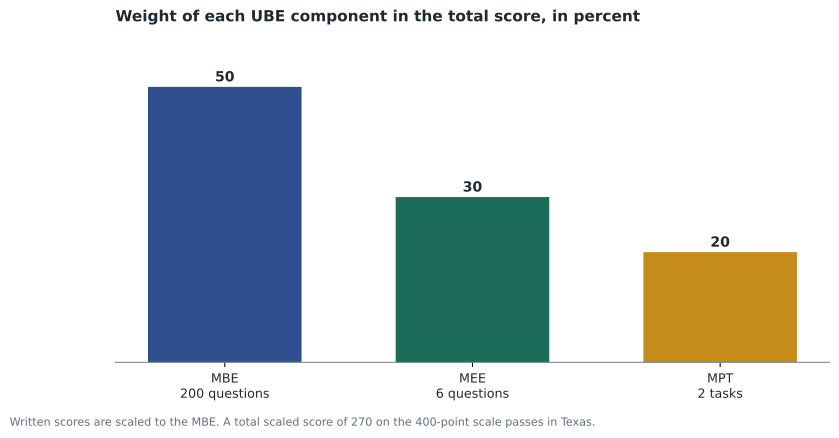
On the UBE, the MBE counts for 50 percent of the total score, the MEE for 30 percent and the MPT for 20 percent. The written components, the MEE and the MPT together, are scaled to the MBE. In practice this means that the raw essay and performance test grades are converted to the same scale as the MBE, so that strength on the written portion and strength on the MBE are measured in the same units.
The total UBE score is reported on a 400-point scale. A simple way to understand it is that the scaled MBE score and the scaled written score, each on a 200-point scale, are added together. A candidate with a scaled MBE score of 136 and a scaled written score of 134 has a total of 270 and passes in Texas. A candidate with 145 on the MBE and 125 on the written portion also has 270 and also passes.
| Scaled MBE | Scaled written (MEE and MPT) | Total UBE | Texas result |
|---|---|---|---|
| 136 | 134 | 270 | Pass |
| 145 | 125 | 270 | Pass |
| 128 | 140 | 268 | Does not pass |
| 150 | 118 | 268 | Does not pass |
| 138 | 136 | 274 | Pass |
The 270 passing score
The Texas passing score of 270 is on the higher end among UBE jurisdictions. Some jurisdictions require 260 or 266; a few require 280. When Texas adopted the UBE, the Board explained that a UBE score of 270 was roughly equivalent to the 675 required on the old Texas exam. The September 2026 order restates the passing scores by era: 675 for exams before February 2021, 270 for the UBE from February 2021 through February 2028, and a score to be set by the Court for the NextGen exam from July 2028.
A 270 also has value beyond Texas. A candidate who earns 270 or more in Texas has a score that meets the passing standard of most UBE jurisdictions, which matters if the candidate later wants to transfer the score. Lesson 11 covers transfers.
Results and what happens if you do not pass
The Board releases February results in mid-April and July results in mid-October. Results appear in ATLAS. Passing examinees who have met every other requirement become eligible for licensure; those still missing a requirement, such as the Texas Law Course or character and fitness approval, become eligible when the requirement is met.
An examinee who does not pass may request formal review of the written answers under the Board's rules. The September 2026 amendments clarify that formal review covers the written answers and does not extend to the MBE. Re-applicants may file for the next exam within 30 days after receiving results. There is also a limit on attempts: under the amended rules, an applicant who has failed after five combined exams may not take the exam again or transfer a score unless the Board grants a waiver.
Worked problem
Reading a near miss
Itzel Saucedo, a hypothetical February 2026 examinee, received a scaled MBE score of 131 and a scaled written score of 137, for a total of 268. What does her score tell her about July 2026 preparation?
Show solution
- Total: 131 plus 137 equals 268, two points short of 270.
- Her written score is above the 135 midpoint that would pair with a 135 MBE, so her essays and MPT were relatively strong.
- Her MBE score is below 135, so the MBE is where the points are most available.
- Because the MBE is 50 percent of the score, a gain of four scaled MBE points, about five or six more correct answers, would have produced a pass with the same written score.
Answer: Itzel should keep her writing practice steady and spend most of her new hours on MBE questions, using an error log to target her weakest subjects.
Planning around the scoring
Marchetti uses the scoring structure to set priorities. Because the MBE is half of the score and is equated, steady improvement in MBE accuracy pays off reliably. Because the MEE is graded relatively, organization and issue-spotting matter more than perfect recall. Because the MPT is 20 percent of the score and tests skills rather than memory, a few timed practice tasks deliver large gains, and Dana's records show she still runs out of time when she reads the File too slowly.
Dana's plan for the last weeks before February is to keep 60 percent of her study time on MBE questions, 25 percent on timed MEE answers and 15 percent on MPT practice. 'That is close to the weights,' Marchetti said, 'with a little extra on the MBE because that is where your error log says the points are.'
Common mistakes
MistakeStudying trusts, wills, family law or secured transactions essays for February 2027
InsteadNCBE removed those four subjects from the MEE starting in July 2026.
MistakeAnswering MBE evidence questions with Texas rules
InsteadThe MBE tests the Federal Rules of Evidence and general principles, not Texas law.
MistakeThinking a strong MBE alone will carry the exam
InsteadThe written portion is half of the total score; a weak written score can sink a strong MBE.
MistakeExpecting formal review to cover the MBE
InsteadFormal review covers the written answers; the September 2026 amendments exclude the MBE.
MistakeBringing outside law into the MPT
InsteadThe MPT is closed universe: use only the File and the Library.
Test-day logistics in Austin
The Board gives the Texas exam in Austin. The main site is large, and some examinees with accommodations test at a second Austin site, as Lesson 2 explained. Admission tickets arrive about four weeks before the exam and confirm each examinee's site and seat. Examinees should read the ticket and the Board's instructions closely, because they list exactly what may be brought into the room, what identification is required and when doors open.
Phones go into a Yondr pouch, a locking fabric pouch that the examinee keeps but cannot open until staff unlock it at the end of the session. The Board does not provide storage, so bags, watches, wallets and study materials must stay in a car or hotel room. Laptop users must have registered and installed the exam software in advance and must bring the laptop and power cord. Handwriters need the permitted pens.
The two-day rhythm
Most examinees find the first day harder. The morning MPT session demands three hours of reading and writing, and the afternoon MEE session demands six fast, organized essays. The second day's MBE is long, but it is familiar. Marchetti's advice is to treat the evening between the two days as recovery time: a short walk, a normal dinner, no new material and an early night.
Time management on day one is the most common problem. On the MPT, Marchetti's rule is to spend no more than 40 to 45 minutes reading and outlining each task, leaving at least 45 minutes to write. On the MEE, each question gets 30 minutes: five to read and outline, 25 to write. An unfinished essay usually costs more than a short one, because graders can reward only what is on the page.
Reading the score report
Texas releases results through ATLAS. An examinee who does not pass receives score information that shows the scaled MBE score, the scaled written score and the total. That breakdown is the starting point for a retake plan, as the example above showed. The examinee should also review the written answers and, if the rules allow, request formal review promptly.
Practice materials that match the exam
Because the February 2027 exam is the legacy UBE, the best practice materials are NCBE's own released MEE and MPT questions and licensed MBE practice questions, plus commercial materials built for the legacy UBE. Candidates should check every practice essay against the July 2026 subject list and skip essays on the four removed subjects. They should also avoid NextGen-style integrated question sets for now: they are useful for later candidates, but they test a different format. Dana's rule, borrowed from Marchetti, is simple: if a practice item would not appear on the February 2027 exam, it does not go into her week.
The psychology of a 270
Because 270 is above many jurisdictions' passing scores, Texas candidates sometimes believe they must be exceptional. Marchetti puts the number in perspective: 270 is an average of 135 on each half of the exam, which is roughly the national mean MBE score in many recent administrations. 'You do not need to be brilliant,' she told Dana. 'You need to be solid on both days.'
Dana's MBE drills have been running in the high 60s percent correct, and her self-graded essays have been near the middle of the grading scale. Marchetti's verdict is that she is on track for February if she keeps her timing under control on the MPT, where her error log shows she still spends too long reading the File.
Summary and key terms
- Texas gives the UBE over two days: two MPT tasks and six MEE questions on day one, 200 MBE questions on day two.
- Since July 2026 the MEE omits conflict of laws, family law, trusts and estates and secured transactions.
- The MBE is 50 percent, the MEE 30 percent and the MPT 20 percent; the written portion is scaled to the MBE.
- Texas requires a total scaled UBE score of 270 on the 400-point scale.
- Results come in mid-April (February exam) and mid-October (July exam); formal review covers written answers only.
- An applicant who fails after five combined exams may not test again or transfer a score without a Board waiver.
- 0
- Uniform Bar Examination
- 1
- Multistate Bar Examination
- 2
- Multistate Essay Examination
- 3
- Multistate Performance Test
- 4
- scaled score
- 5
- equating
- 6
- relative grading
- 7
- formal review
- 8
- pretest questions
Practice problems
Work each problem on paper first, then reveal the answer to check.
What are the weights of the UBE components?
Show answer
MBE 50 percent, MEE 30 percent, MPT 20 percent.
Which four subjects left the MEE in July 2026?
Show answer
Conflict of laws, family law, trusts and estates, and secured transactions.
A candidate scores 133 on the MBE and 137 on the written portion. Does she pass in Texas?
Show answer
Yes. The total is 270, which meets the Texas passing score.
Does formal review cover MBE answers?
Show answer
No. It covers written answers only.
When are February results released?
Show answer
In mid-April.
Lesson quiz · 5 questions
Score 60% or more to complete this lesson.
Create a free account to save your progress, take quizzes and earn a certificate.