
BAR-244 · Lesson 2 of 12 · 21 min
Eligibility, education, deadlines and fees
▶ Video coming soon A video version of this lesson is on the way.
Texas is a jurisdiction where the paperwork starts early. A student at a Texas law school begins the admission process in the first semester of law school by filing a Declaration of Intention to Study Law, years before the bar exam. Dana filed hers in the fall of her first year, as most of her classmates did, and her character and fitness investigation started then. This lesson covers who is eligible to sit for the Texas exam, the education requirement, the Declaration, the application deadlines and the fees, and the practical steps of getting a seat at the exam in Austin.
Marchetti opened the session with a warning she gives every Texas candidate. 'Texas publishes its deadlines and fees, and it means them,' she said. 'The late fees are real, the final filing date is final, and the Board's website is the only source you should trust for a date. Use this lesson to understand the system. Use the Board's deadlines page to set your calendar.'
The education requirement
The default rule is that an applicant must hold a J.D. from an approved law school, which in practice means a law school approved by the American Bar Association. The Texas rules also contain exceptions, mainly for lawyers licensed in other jurisdictions and for foreign-trained lawyers, under which an applicant without an ABA-approved J.D. may qualify after meeting additional conditions. These exceptions are technical, and an applicant who needs one should read the current rules carefully and contact the Board before filing.
A Texas law student may sit for the bar exam before the J.D. is conferred if the student is within four semester hours, or six quarter hours, of completing the degree requirements. The law school must certify that status to the Board. A student who sits early still cannot be licensed until the degree is conferred and the law school sends the final certification. Dana did not need this option, because her J.D. was conferred in May 2026, but several of her classmates who finished in December used it to sit in February.
The Declaration of Intention to Study Law
First-year students at Texas law schools file a Declaration of Intention to Study Law with the Board. The Declaration is a detailed character and fitness questionnaire: residence and employment history, education, criminal and civil matters, financial responsibility and other topics. Filing it early lets the Board begin investigating during law school, so that by the time the student applies to take the bar exam, much of the character and fitness work is finished.
The Board's current fee for a timely Declaration is 190 dollars. The deadlines depend on when the student started law school. A student who enters in the fall files by October 1 of the first semester. A regular spring entrant files by May 1. A spring entrant at a quarter-hour school, such as Baylor, files by June 1. A summer entrant files by September 15. A student who transfers to a Texas law school from an out-of-state school files within 60 days of matriculating at the Texas school.
A student who misses the deadline may still file, with a late fee under the Board's fee schedule, at any time before or together with the in-state application to take the exam. The cost of filing late is not only the fee: the investigation starts later, so there is less time to resolve questions before the exam.
| When the student entered law school | Declaration deadline |
|---|---|
| Fall semester | October 1 of the first semester |
| Spring semester (regular) | May 1 |
| Spring entrant at a quarter-hour school (such as Baylor) | June 1 |
| Summer term | September 15 |
| Transfer from an out-of-state law school | Within 60 days of matriculating at the Texas school |
Applying to take the exam
After the Declaration, the next filing is the application to take a specific bar exam. A Texas law student who filed a Declaration files the in-state law student application, which updates the Declaration. Students at out-of-state law schools, lawyers licensed elsewhere and foreign-trained applicants file their own application types. Everyone files through ATLAS.
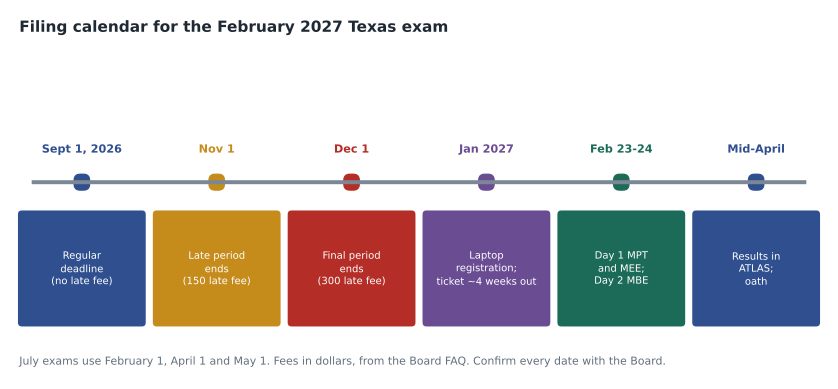
Texas uses a three-stage filing calendar for each exam: a regular deadline, a late deadline with a fee and a final deadline with a larger fee. For the February exam, the regular deadline is September 1 of the prior year, the late period ends November 1 and the final period ends December 1. For the July exam, the regular deadline is February 1, the late period ends April 1 and the final period ends May 1. The Board's FAQ lists the late fee as 150 dollars for an application filed in the first late period and 300 dollars for an application filed in the final period.
A re-applicant, meaning someone who took a Texas exam and did not pass, follows a different timetable under the September 2026 amendments. Instead of facing fixed December 1 and June 1 deadlines, a re-applicant may apply within 30 days after the Board delivers the results of the prior exam. That change matters to February takers who learn their results in mid-April and want to sit again in July.
The fees
The Board's fee schedule is set out in the admission rules, and the Board's FAQ lists the current bar exam application fees by applicant type. A Texas law student pays 450 dollars. A student at an out-of-state law school pays 640 dollars. A lawyer licensed in another jurisdiction pays 1,190 dollars. A foreign-trained applicant pays 1,290 dollars. A re-applicant pays 545 dollars. An applicant who wants a courtesy seat, explained below, pays 450 dollars.
Two other charges are common. The September 2026 order replaced the old laptop examination software fee with a 150 dollar software fee for applicants who type their answers. And the MPRE, which is administered and charged by NCBE rather than the Board, has its own registration fee. The Texas Law Course itself does not add a Board fee; the Board's FAQ describes it as free through TexasBarCLE, although a candidate must register as a TexasBarCLE user to take it.
| Applicant type | Bar exam application fee |
|---|---|
| Texas law student (in-state) | 450 dollars |
| Out-of-state law student | 640 dollars |
| Attorney licensed in another jurisdiction | 1,190 dollars |
| Foreign-trained applicant | 1,290 dollars |
| Re-applicant | 545 dollars |
| Courtesy seat | 450 dollars |
| Late fee (first late period) | 150 dollars |
| Late fee (final period) | 300 dollars |
| Software fee for typing the exam | 150 dollars |
Courtesy seats
Texas offers courtesy seats to people who want to take the UBE in Texas but seek admission somewhere else. A courtesy seat applicant takes the exam in Austin with everyone else, and the score is then transferred to the other UBE jurisdiction. Courtesy seats are only for applicants seeking admission outside Texas, and late fees apply to them as they do to other applicants. A courtesy seat is not a back door into Texas practice: the applicant still has to apply for admission in the jurisdiction where the score will be used.
Accommodations
An applicant with a disability may request testing accommodations through ATLAS, with supporting documentation. Requests take time to review, so the Board's deadlines for accommodation requests come well before the exam. Applicants who need religious accommodations, such as a different testing day or prayer time, also request them in ATLAS; for the February 2027 exam, the Board set February 1, 2027 as the deadline to upload a religious-accommodation request.
Some examinees with accommodations are assigned to a second testing site in Austin. The Board notifies them through ATLAS in early 2027. Every examinee's site is confirmed only when the admission ticket arrives, about four weeks before the exam, and the Board may move an examinee to a different site if needed.
Exam-day rules to plan for now
The February 2027 exam will be given in Austin on Tuesday and Wednesday, February 23 and 24. Phones must be locked in a Yondr pouch, and the Board does not provide lockers or other storage for bags, watches, wallets or study materials. Candidates traveling from outside Austin should plan where those items will stay, which in practice means a hotel room or a car. Marchetti tells candidates to book a hotel within walking distance of the site as soon as they file, because rooms near the main site fill quickly.
Laptop registration is separate from the application. The Board sends instructions by email a few weeks before the exam. A candidate who misses the laptop registration deadline must handwrite the written portions, which is slower and harder to read. Dana put the expected window on her calendar the day she filed.
Worked problem
Calculating a candidate's costs
Lorena Zertuche is a hypothetical third-year student at a Texas law school who filed a timely Declaration in her first semester. She plans to file for the February 2027 exam on October 15, 2026, and to type her answers. What will she pay the Board for the exam, and what could she have saved?
Show solution
- Her applicant type is in-state law student: 450 dollars.
- October 15 is after the September 1 regular deadline and before the November 1 late deadline, so the first late fee applies: 150 dollars.
- Typing requires the software fee: 150 dollars.
- Total Board charges: 450 plus 150 plus 150 equals 750 dollars, plus the separate MPRE fee charged by NCBE if she has not already taken it.
Answer: Lorena will pay 750 dollars to the Board. Filing by September 1 would have saved the 150 dollar late fee and given the Board six more weeks to process her file.
Building a filing calendar
Marchetti asks every Texas candidate to build a one-page calendar with six dates on it: the regular filing deadline, the accommodation request deadline, the laptop registration window, the expected admission ticket date, the exam dates and the expected results date. For Dana's February 2027 exam, the regular filing deadline was September 1, 2026; she filed in August. Her other dates are the religious-accommodation upload deadline of February 1, 2027 for anyone who needs it, laptop registration in January, admission tickets about four weeks before the exam, the exam on February 23 and 24, and results in mid-April 2027.
She also adds two personal dates: a reminder to finish the Texas Law Course in December, and a reminder to confirm in ATLAS that her MPRE score report has reached the Board. 'Most licensing delays I see are not about the exam at all,' Marchetti said. 'They are about one missing document.'
Common mistakes
MistakeWaiting until the third year to file the Declaration
InsteadFirst-year students at Texas law schools file the Declaration in the first semester (October 1 for fall entrants), so the investigation can start early.
MistakeAssuming the final filing date is a soft deadline
InsteadTexas uses a regular deadline, a late deadline and a final deadline; after the final deadline the applicant waits for the next exam.
MistakeForgetting the software fee or laptop registration
InsteadTyping the exam requires the 150 dollar software fee and timely laptop registration; otherwise the candidate handwrites.
MistakeUsing a courtesy seat to get into Texas practice
InsteadCourtesy seats are only for applicants seeking admission outside Texas.
MistakeThinking a re-applicant must wait for the December 1 or June 1 deadline
InsteadUnder the September 2026 amendments, a re-applicant may apply within 30 days after the Board delivers the prior results.
Out-of-state students and lawyers licensed elsewhere
Students at law schools outside Texas did not file a Declaration of Intention, so their character and fitness investigation starts with the application itself. They should file as early as possible in the regular period, because the Board has less information about them and the investigation has further to go. The same is true of lawyers licensed in other jurisdictions who choose to take the Texas exam rather than transfer a score or seek admission without examination: the Board will ask for certificates of good standing and disciplinary history from every jurisdiction where they are admitted, and gathering those documents takes time.
Foreign-trained applicants face the longest timelines. Their education must be evaluated under the rules for foreign-educated applicants, and their character and fitness investigations may take up to 270 days. A foreign-trained lawyer who hopes to sit in a particular February should begin the process a year or more ahead.
Keeping the file current
Filing is not the end of the paperwork. An applicant has a continuing duty to keep the application accurate. A new address, a new job, a traffic ticket, a lawsuit or any other change that affects an answer must be reported through ATLAS. The Board's eligibility letters are sent through ATLAS, and an applicant who misses a request for a document can lose weeks.
Dana keeps a running list of every change since her application: she moved apartments in July and started at the firm in June, and both are already reported. 'If it changes an answer, it goes in ATLAS that week,' Marchetti said. 'Not after the exam.'
Summary and key terms
- The default education requirement is a J.D. from an ABA-approved law school; exceptions exist mainly for lawyers licensed elsewhere and foreign-trained lawyers.
- A Texas law student may sit before graduation if within four semester hours (six quarter hours) of the degree, certified by the school.
- First-year students file a Declaration of Intention to Study Law (190 dollars), due October 1 for fall entrants.
- Each exam has a regular, late and final deadline: September 1, November 1 and December 1 for February; February 1, April 1 and May 1 for July.
- Application fees range from 450 dollars (in-state law student) to 1,290 dollars (foreign-trained), with 150 and 300 dollar late fees and a 150 dollar software fee.
- The February 2027 exam is in Austin on February 23 and 24; phones go in Yondr pouches and no storage is provided.
- 0
- Declaration of Intention to Study Law
- 1
- in-state law student application
- 2
- late filing period
- 3
- final filing period
- 4
- re-applicant
- 5
- courtesy seat
- 6
- software fee
- 7
- testing accommodations
- 8
- Yondr pouch
Practice problems
Work each problem on paper first, then reveal the answer to check.
When must a fall-entering first-year student at a Texas law school file the Declaration?
Show answer
By October 1 of the first semester.
What are the three filing deadlines for the February exam?
Show answer
September 1 (regular), November 1 (late) and December 1 (final).
What does a Texas law student pay to apply for the bar exam on time?
Show answer
450 dollars, plus the 150 dollar software fee if typing.
Who may use a courtesy seat?
Show answer
Only applicants seeking admission in a jurisdiction other than Texas.
Can a student sit for the exam before graduating?
Show answer
Yes, if within four semester hours (six quarter hours) of the degree and the law school certifies it, but licensure waits for the degree.
Lesson quiz · 5 questions
Score 60% or more to complete this lesson.
Create a free account to save your progress, take quizzes and earn a certificate.