
BAR-248 · Lesson 1 of 12 · 21 min
Becoming a lawyer in Washington
▶ Video coming soon A video version of this lesson is on the way.
Tessa Halvorsen has been part of Hollis Marchetti's online study group since the NextGen sessions in the fall. She finishes law school in December 2026 and is registered for Washington's February 23-24, 2027 NextGen bar exam, where she needs a scaled score of 610. On her first one-on-one call about Washington itself, she admitted that the last few months had left her unsure what the rules even were. 'Every time I open the bar's website something has changed,' she said. 'The passing score moved twice in two years. The July exam in Yakima was canceled for most people. Some of the people I know were admitted without taking it at all. And everyone keeps telling me there will soon be a way to become a lawyer without a bar exam. I want one clear map of what applies to me in February.'
Marchetti had a second Washington candidate on the call, Gerrit Huxley, who had agreed to join because his own path through the summer illustrated most of what Tessa was asking about. Gerrit grew up in Ellensburg, finished law school at an ABA-approved Washington law school in May 2026 and has worked in Yakima at Ferro & Quintanilla, a small firm that handles car accidents, orchard and farm contracts, family law and estates. He registered for the July 2026 exam and checked in at the Yakima Convention Center, where a technology failure at the venue stopped the exam for most of the room. He chose the exam waiver the Supreme Court offered in its August 6, 2026 order and was admitted by court order with the fall admissions. He is now registered to sit the February 2027 exam anyway, as a courtesy seat, so that he can earn a NextGen score he can carry to another state.
'Between the two of you,' Marchetti said, 'you cover almost every moving part. Tessa, your path is the ordinary one: pass the NextGen exam with 610 or better, pass the Washington Law Component, have an MPRE score of 85 inside the window, clear character and fitness and take the oath. Gerrit's path shows what the Court can do when something goes wrong, and why a Washington candidate reads the Court's orders and the bar's notices, not last year's advice.'
This lesson lays out the whole Washington system: who controls admission, which bodies do the work, the routes into practice and the order of events for a first-time applicant. Later lessons take each step in detail and then turn to the Washington law that a new lawyer meets in early practice in Seattle, Spokane, Tacoma, Vancouver, Yakima or a small county seat.
The Supreme Court of Washington controls admission
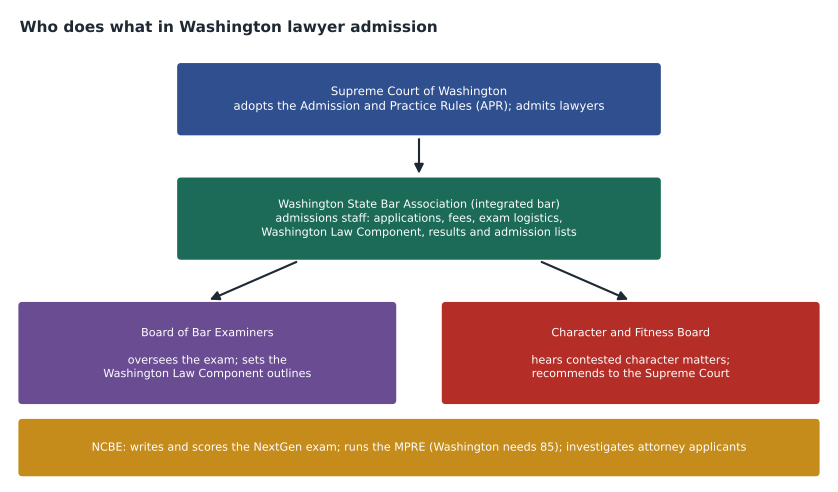
Admission to the practice of law in Washington is a function of the Supreme Court of Washington. The Court regulates the practice of law through court rules, and the rules for lawyer admission are in the Admission and Practice Rules, usually cited as APR. APR 3 sets out who may apply and the routes to admission, APR 4 covers the examination and its passing score, APR 5 covers the oath and the requirements that must be completed before admission, APR 6 governs the Law Clerk Program, APR 9 covers licensed legal interns and APR 11 governs continuing legal education. The Court changes those rules by order, and in the last three years it has done so repeatedly.
The Court's recent orders are the reason Tessa feels the ground moving. In March 2024 it lowered the passing score on the Uniform Bar Examination from 270 to 266, applied that change back to February 2023, and adopted in concept a set of alternatives to the bar exam. In December 2025, in Order No. 25700-B-747, it set the NextGen passing score at 610 starting in July 2026, set 260 as the passing score for the final legacy UBE in February 2026, and applied the 260 score back to July 2020. In August 2026 it responded to the failed July exam with a waiver and a make-up exam. Lesson 5 tells that story in detail. The practical lesson is simple: the rule that governs a candidate is the rule in force for the exam that candidate sits, and the Court's orders say what that is.
The Washington State Bar Association does the work
Washington's bar is an integrated, or unified, bar. Every lawyer who practices in Washington must be a member of the Washington State Bar Association, usually called the WSBA, and must pay license fees to it. The WSBA acts under the Supreme Court's delegated authority. For a candidate, the WSBA is the office that matters: its admissions staff receive applications, collect fees, check eligibility, run the exam with NCBE, administer the Washington Law Component, process character and fitness files and publish results and admission lists. The WSBA's admissions department is in Seattle and is reached through the online admissions portal and the admissions email address listed on the bar's website.
Within the WSBA structure, two bodies appointed under the APR handle the core admissions decisions. The Board of Bar Examiners oversees the examination, including the Washington Law Component, whose content and materials it sets. The Character and Fitness Board hears matters in which an applicant's character and fitness are in question and makes recommendations to the Supreme Court. Lesson 3 covers that process.
NCBE and the national pieces
The National Conference of Bar Examiners writes and scores the multiple-choice and integrated parts of the NextGen exam, supplies the grading materials for the written work, and runs the Multistate Professional Responsibility Examination. NCBE also runs the character and fitness investigation for attorney applicants, which is why attorneys pay a separate investigation fee and why Washington applicants have paid sales tax on that service since October 1, 2025. What NCBE does not do is decide who is admitted in Washington. The Supreme Court and the WSBA make those decisions under the APR; NCBE provides the exam and certain services.
Washington's exam today: NextGen, plus the Washington Law Component
Washington was one of the first jurisdictions to adopt the Uniform Bar Examination, beginning in July 2013, and one of the first to adopt NCBE's NextGen bar exam. The final legacy UBE in Washington was given in February 2026. The July 2026 exam was the first NextGen administration in the state, and February 2027 is the second. NextGen replaces the three legacy parts (the MBE, MEE and MPT) with a single integrated exam scored on a scale from 500 to 750. Washington's passing score is 610.
Washington has always added its own requirement on top of the national exam. Every applicant for lawyer admission, whether by exam, by transferred score or by motion, must pass the Washington Law Component, an online, open-book, multiple-choice test on Washington-specific law based on outlines the Board of Bar Examiners publishes. It is not part of the two-day exam and is not taken on exam day. Lesson 6 covers it in detail.
| Requirement | What Washington requires |
|---|---|
| Admitting authority | Supreme Court of Washington, through the Admission and Practice Rules |
| Who runs admissions | The Washington State Bar Association, an integrated bar |
| Exam | NextGen bar exam since July 2026 (legacy UBE from July 2013 through February 2026) |
| Passing score | 610 on the NextGen scale; 260 for the last legacy UBE |
| State component | The Washington Law Component: online, open book, 60 questions, 80 percent to pass |
| MPRE | Scaled score of 85, earned within the window in the rules |
| Character and fitness | Required for every applicant; reviewed by WSBA staff and, if needed, the Character and Fitness Board |
Four routes into Washington practice
There are four ways to become a Washington lawyer. The first is admission by examination: sit and pass the NextGen exam in Washington, then complete the other requirements. The second is admission by transferred UBE score: a candidate who earned a qualifying score in another jurisdiction within the time limit in the rules (260 on the legacy UBE or 610 on NextGen, within 40 months) can apply to Washington on that score. The third is admission by motion under APR 3(c), open to lawyers admitted elsewhere in the United States who have practiced actively for at least one of the three years before applying. The fourth is the route Gerrit took, which exists only because of an emergency: admission by order of the Supreme Court without the exam, under the August 2026 waiver. No future candidate should plan on that route. It was a one-time remedy for a specific failure, offered only to first-time applicants who could not test in July.
Two other routes lead to limited forms of practice. A lawyer licensed elsewhere may appear in a particular case pro hac vice, by association with Washington counsel. Students and recent graduates can practice in supervised settings as licensed legal interns under APR 9, which is how Gerrit worked at his firm before admission. Washington also licenses limited practice officers to prepare certain real estate closing documents. Washington once licensed limited license legal technicians, a separate category of nonlawyer practitioners in family law, but the Supreme Court decided in 2020 to end new admissions to that program; existing technicians may continue to practice.
Where the bar-exam alternatives stand
Tessa's friends are right that Washington has said it will create paths to licensure that do not require a bar exam, and wrong about the timing. In March 2024 the Supreme Court adopted in concept recommendations from its Bar Licensure Task Force: apprenticeship-style routes for law graduates, an experiential route for law students and a route for APR 6 law clerks, each built on supervised practice and a portfolio of work. The Court then directed the WSBA to convene a steering committee to write the rules. As of November 2026, the WSBA describes the result as admission by portfolio evaluation and states that it has not yet been adopted. The steering committee approved suggested amendments to the APR on April 1, 2026, and the Court plans to publish proposed rules for comment beginning in January 2027, with comments due April 30, 2027. Nobody can use those routes for the February 2027 exam, and the final rules may differ from the concept.
The order of events for a first-time applicant
Most first-time applicants follow the same sequence. They finish an ABA-approved J.D. or another qualifying education under APR 3. They file the online application by the deadline for their exam and pay the fee. They complete the character and fitness questionnaire and supply references and records. They pass the MPRE within the time window. They take and pass the Washington Law Component online after filing. They sit the NextGen exam in late February or late July. When results are released and the WSBA confirms that every requirement is met, they are placed on an admission list, take the oath under APR 5 and become active members of the WSBA.
Admission brings duties at once: a license fee and annual licensing forms, trust account rules if the lawyer holds client money, a duty to keep contact information current and the MCLE requirement of 45 credits every three years. Lesson 11 covers those duties.
Worked problem
Mapping two candidates' next six months
Tessa graduates in December 2026 and sits the February 23-24, 2027 NextGen exam. Gerrit was admitted by court order under the August 2026 waiver and is registered for a February 2027 courtesy seat. Build a checklist for each through the spring of 2027.
Show solution
- Tessa: confirm that the application, filed before the October 5, 2026 first deadline, is complete, and answer any request from admissions staff quickly.
- Tessa: confirm her MPRE score of 85 or higher falls in the window (no earlier than three years before the exam she passes and no later than 40 months after it).
- Tessa: take the Washington Law Component online after filing, aiming to finish before full-time study for the NextGen exam begins.
- Tessa: sit the NextGen exam in February and, after results, complete the oath and licensing steps.
- Gerrit: he is already a Washington lawyer, so his duties are licensing, his license fee and MCLE. The February 2027 courtesy seat is optional; its only purpose is a portable NextGen score.
Answer: Tessa's critical path runs through the NextGen exam and the Washington Law Component. Gerrit's admission is complete; whether he sits in February depends on whether he wants a score that another state will accept.
How this course is organized
Lessons 2 through 6 cover the admission process: eligibility, deadlines and fees; character and fitness and the MPRE; the NextGen exam and its scoring; the reforms and disruptions of 2024 to 2026 and the pathways project; and the Washington Law Component. Lessons 7 through 10 cover the Washington law a new lawyer needs in practice and that the Washington Law Component tests in some form: courts and civil procedure; torts and claims against government; community property, family law and estates; and lawyer regulation under the WSBA and the Washington Rules of Professional Conduct. Lesson 11 covers score transfer, admission by motion, the Law Clerk Program and life after admission. Lesson 12 is a capstone with original practice questions and an exam-day plan.
Marchetti finished the call with the rule she gives every Washington candidate. 'Keep a source column in your notes,' she said. 'Court order, APR, WSBA notice or statute. If you can't fill in that column, you don't know the rule yet. In Washington, the rule this year may not be the rule last year.'
Common mistakes
MistakeWashington still gives the legacy UBE with the MBE, MEE and MPT.
InsteadThe final legacy UBE in Washington was February 2026. Washington has given the NextGen exam since July 2026.
MistakeThe Washington passing score is 270 (or 266).
InsteadOrder No. 25700-B-747 set the NextGen passing score at 610 and the final legacy UBE passing score at 260.
MistakeWashington has already replaced the bar exam with apprenticeships.
InsteadThe Court adopted alternatives in concept in 2024, but admission by portfolio evaluation has not been adopted. Proposed rules are expected to be published for comment in 2027.
MistakeThe August 2026 waiver is a new permanent route.
InsteadIt was a one-time remedy for first-time applicants who could not test in Yakima in July 2026.
MistakeThe Washington Law Component is a section of the two-day exam.
InsteadIt is a separate online, open-book test taken through the admissions portal after filing.
MistakeMembership in the WSBA is optional.
InsteadWashington has an integrated bar. Every practicing Washington lawyer must be a member and pay license fees.
Summary and key terms
- The Supreme Court of Washington controls admission through the Admission and Practice Rules and changes them by order.
- The WSBA, an integrated bar, runs admissions under the Court's authority, with the Board of Bar Examiners and the Character and Fitness Board.
- Washington gives the NextGen exam (since July 2026) with a passing score of 610, plus the Washington Law Component and an MPRE score of 85.
- Routes in are examination, transferred UBE score within 40 months, and motion after one of the last three years of practice; the August 2026 waiver was a one-time remedy.
- Admission by portfolio evaluation is still a proposal; proposed rules are expected to go out for comment in 2027.
- 0
- Admission and Practice Rules
- 1
- integrated bar
- 2
- Washington State Bar Association
- 3
- Board of Bar Examiners
- 4
- Character and Fitness Board
- 5
- Washington Law Component
- 6
- admission by motion
- 7
- licensed legal intern
- 8
- admission by portfolio evaluation
Practice problems
Work each problem on paper first, then reveal the answer to check.
Which body admits lawyers in Washington?
Show answer
The Supreme Court of Washington, under the Admission and Practice Rules.
What is the WSBA's role in admission?
Show answer
It runs admissions under the Court's authority: applications, fees, the exam with NCBE, the Washington Law Component, character and fitness files and results.
What passing score applies on the NextGen exam in Washington?
Show answer
610, set by Order No. 25700-B-747 in December 2025.
Can a February 2027 candidate use admission by portfolio evaluation?
Show answer
No. The pathway has not been adopted; proposed rules are expected to be published for comment beginning in January 2027.
Lesson quiz · 5 questions
Score 60% or more to complete this lesson.
Create a free account to save your progress, take quizzes and earn a certificate.