
BAR-248 · Lesson 4 of 12 · 19 min
The Washington bar exam: NextGen format, scoring and the 610 passing score
▶ Video coming soon A video version of this lesson is on the way.
By mid-November, Tessa had worked through the NextGen sessions with the study group and knew the outline of the new exam. What she wanted from Marchetti was the Washington version: what exactly she would sit on February 23 and 24, how it would be scored, what 610 meant and what she should take from the July and September 2026 results. Gerrit joined the call because he was registered for the same February sitting as a courtesy seat, and he wanted to understand how his score, which would not affect his license, would be reported.
'The exam is national,' Marchetti said. 'Washington's choices are the passing score, the site, the logistics and what it does with your score. Everything else, from the content to the question types to the scaling, comes from NCBE.'
This lesson covers the structure of the NextGen exam as given in Washington, the content it tests, how it is scored, the 610 passing score and how Washington reports results.
Two days, three sessions
The NextGen exam is given over a day and a half. Day one, a Tuesday, has a morning session and an afternoon session. Day two, a Wednesday, has a morning session only. Each session lasts three hours. NCBE's blueprint puts the same mix of work in each session: 40 multiple-choice questions, two integrated question sets and one performance task. Within a session, the candidate may work in any order. For the February 2027 administration the dates are February 23 and 24, 2027; the July 2027 exam is scheduled for July 27 and 28.
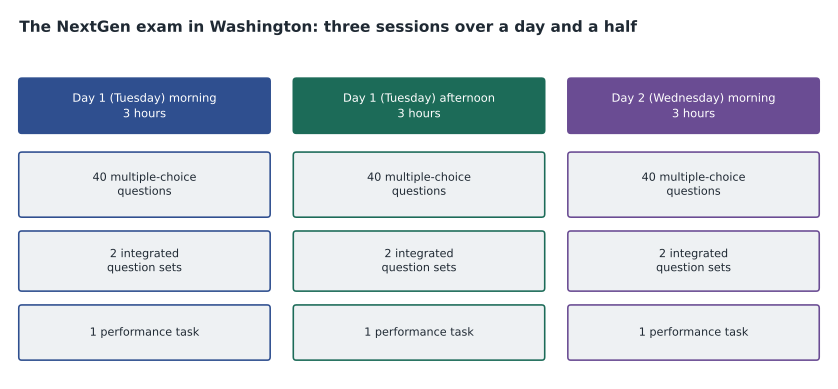
Each session also includes a small number of unscored pretest items that NCBE is trying out for future exams. The candidate cannot tell which items are pretest items and should treat every question as scored.
The question types
NextGen uses three main kinds of tasks. Stand-alone multiple-choice questions look most like the old MBE. Most ask the candidate to choose one answer, but some ask the candidate to select two correct options, with partial credit available. Integrated question sets are built around a single client matter, with a short fact pattern and sometimes legal materials, followed by several questions of different types: multiple choice, short written answers and drafting tasks. Performance tasks give the candidate a file and a library of law and ask for a written product, such as a memo or a client letter. Some performance tasks are research tasks, in which the candidate must find the controlling law in a larger library before applying it.
What the exam tests
NextGen tests eight foundational subject areas through the February 2028 exam: civil procedure, contracts (including sales of goods under Article 2 of the UCC), evidence, torts, business associations, constitutional law, criminal law and procedure, and real property. Family law and trusts and estates appear in performance tasks and, for family law, possibly in integrated sets, always with the necessary law supplied. Family law becomes a full foundational subject beginning in July 2028. The exam also tests seven foundational skills: legal research, legal writing, issue spotting and analysis, investigation and evaluation, client counseling and advising, negotiation and dispute resolution, and client relationship and management, including a defined set of professional responsibility rules.
The law tested is general law and federal law, not Washington law. A candidate who answers a torts question by applying Washington's pure comparative fault statute or its rule against punitive damages, both covered in Lesson 8, will often reach the wrong answer. Marchetti tells Washington candidates to keep two sets of notes: one for the exam and one for the Washington Law Component and practice.
How the exam is scored
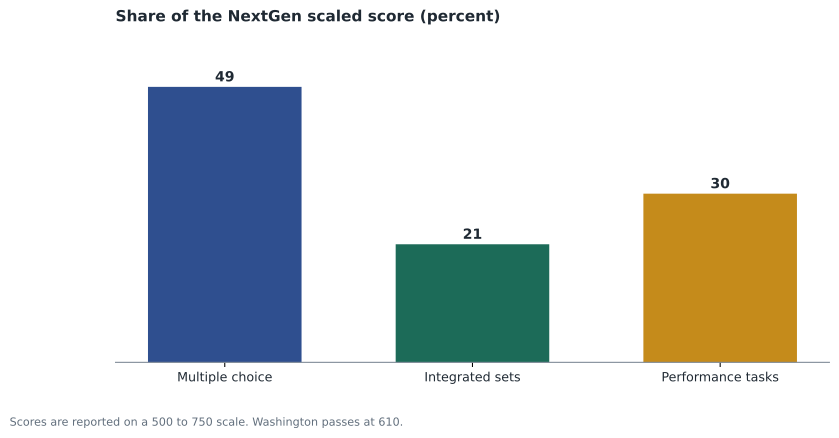
NCBE combines every scored item into a single scaled score on a range from 500 to 750. The weights are fixed by NCBE's blueprint: stand-alone multiple-choice questions count for 49 percent of the score, integrated question sets for 21 percent and performance tasks for 30 percent. The multiple-choice items are scored by NCBE; the written answers are graded by graders in the jurisdiction using NCBE's grading materials and are then scaled so that a score means the same thing from one administration to the next. The score is not curved against other examinees in the room.
The 610 passing score
In Order No. 25700-B-747, dated December 8, 2025, the Supreme Court set Washington's minimum passing score on the NextGen exam at 610, beginning with the July 2026 exam and continuing until further order. The Court described 610 as equivalent to a score of 260 on the legacy UBE, which it adopted as the passing score for the final legacy exam in February 2026. NCBE recommended that jurisdictions set passing scores between 610 and 620, and most did. Washington chose the low end of that range, along with a handful of other states.
The 610 figure applies to Washington admission. Another state deciding whether to accept a Washington score applies its own minimum. A candidate who scores 615 passes in Washington, but that score would fall short in a state that requires 620. That matters for Gerrit: he wants a score he can carry to Oregon, which requires 620 on NextGen for exams after July 2026. He needs to aim well above 610.
| Score | Washington result | What it means elsewhere |
|---|---|---|
| 605 | Fails | Below every NextGen passing score |
| 612 | Passes | Passes in 610 states; fails in 616 and 620 states |
| 622 | Passes | Above the minimum in most NextGen jurisdictions |
What July and September 2026 tell candidates
The first NextGen results were released nationally in late September 2026. NCBE reported that 2,630 candidates had tested across ten jurisdictions, with a mean score of about 640.6 and an overall pass rate of about 72.7 percent, higher for first-time takers and lower for repeat takers. Washington's July results came out alongside the results of the September 1-2 make-up exam in Tacoma, which 172 candidates sat and 171 completed. The WSBA publishes Washington's own statistics on its admissions pages. Marchetti's point to Tessa was not the numbers but the lesson: first-time takers who prepared steadily did well on the new exam, and the scoring held up across two sittings months apart.
Exam-day logistics in Washington
NextGen is given on the candidate's own laptop running NCBE's secure software, in a proctored room. The candidate must register the laptop, install the software, and complete any readiness checks NCBE requires before exam week. After July 2026, Washington's choice of site has received more attention than usual. The WSBA announces the site, the check-in times and the permitted items in its notices for each exam. Tessa will read the February 2027 notice when it arrives and plan her travel from it.
Marchetti's logistics checklist for Washington: confirm the site in the WSBA's notice; register and test the laptop, charger and software early; know the identification rules; book lodging near the site for both nights; arrive early for check-in on both days; and pack only the items the notice allows. 'After Yakima, have a plan for delays,' she added. 'Bring food you can eat quickly, and don't let a late start rattle you. The candidates who did best in the make-up were the ones who treated the disruption as noise.'
How Washington reports results
The WSBA releases results through the admissions portal on the date it announces, and publishes a list of successful applicants. For the July and September 2026 exams, the Supreme Court directed that admission by waiver take effect on the same date as admission for exam takers, and that the WSBA's admission list, published on or after October 12, 2026, not show how anyone was admitted. A candidate who passes still must have completed the Washington Law Component, the MPRE and character and fitness before admission.
Worked problem
Reading a score report
Tessa scores 628 in February 2027. Gerrit, sitting as a courtesy seat, scores 617. Tessa wants to know whether she passed and whether her score would work in Idaho, which requires 616. Gerrit wants to know whether his score helps him in Oregon.
Show solution
- Tessa: 628 is at or above 610, so she passes in Washington, subject to her other requirements. It is also above Idaho's 616, so it would meet Idaho's minimum if Idaho accepts the transfer within its time limit.
- Gerrit: his score does not affect his Washington license, which he already holds by court order.
- Gerrit and Oregon: 617 is below Oregon's 620, so it would not support transfer to Oregon.
- Each state's rules on transfer, including time limits and other requirements, control in that state.
Answer: Tessa passes and has a score that travels; Gerrit's 617 falls short of Oregon's minimum.
Common mistakes
MistakeThe NextGen exam has separate MBE, MEE and MPT sections.
InsteadIt has three three-hour sessions, each mixing multiple-choice questions, integrated question sets and a performance task.
MistakeNextGen tests Washington law.
InsteadIt tests general and federal law. Washington law is tested on the Washington Law Component.
MistakeThe score is curved against the room.
InsteadScores are scaled and equated, not curved.
MistakeA passing Washington score passes everywhere.
InsteadEach state sets its own minimum; 610 is at the low end of NextGen passing scores.
MistakeFamily law is a full tested subject on the February 2027 exam.
InsteadThrough February 2028, family law appears only in performance tasks and possibly integrated sets, with law supplied.
Time management inside a session
Each three-hour session holds 40 multiple-choice questions, two integrated question sets and one performance task, and the candidate may work in any order. NCBE's blueprint gives a rough budget: about 1.8 minutes for each multiple-choice question, about 24 minutes for each integrated question set and about 60 minutes for the performance task. Those figures add up to roughly the three hours available, so a candidate who overspends on one part must make it up elsewhere.
Marchetti teaches a simple session plan. Start with the part that sets the candidate's rhythm; for most people that is the multiple-choice block, worked in one pass with hard questions flagged. Then do the performance task while energy is high, because it carries the most points in a single task and rewards organized writing. Finish with the two integrated sets, watching the clock for each. Leave a few minutes to return to flagged questions. A candidate who prefers another order should practice it on full timed sessions and stick with it.
Writing for the graders
The written answers on NextGen, the short responses in integrated sets and the performance task, are graded against NCBE's grading materials by graders in the jurisdiction. Graders reward answers that answer the question asked, use the facts and the law supplied, and are organized so the analysis is easy to follow. Headings that track the task's instructions, short paragraphs that state a conclusion and then the reasons, and accurate use of the library or legal materials help. Long restatements of the facts, general background law and arguments that ignore the materials supplied do not.
Using the materials supplied
Because family law and trusts and estates appear on the February 2027 exam with the law supplied, and because research performance tasks require finding the controlling authority in a library, the exam rewards careful reading of legal sources. A candidate should practice reading a statute closely, noting definitions and exceptions, and reading a case for its holding and reasoning, under time pressure. Tessa, who did not take a wills and trusts course in law school, practiced two performance tasks on trusts and estates in her first month of study so that the format would not surprise her.
How Tessa will use the score
Tessa does not plan to practice outside Washington soon, but Marchetti told her to aim well above 610 anyway. A score in the 620s keeps open almost every NextGen jurisdiction that accepts transfers, and nobody knows at the start of a career where it will lead. A higher target also gives a margin for a bad session. Candidates who aim exactly at the passing score often fall just short of it.
A practice routine for the weeks before the exam
Marchetti's routine for NextGen candidates is built around the three task types. Every weekday, a timed block of multiple-choice questions, reviewed the same day, with every miss logged by subject and by reason: did not know the rule, misread the facts, or ran out of time. Twice a week, a timed integrated question set, with the written answers compared against a model. Once a week, a full performance task under time limits, followed by a careful comparison with the grading points. Once before the exam, a full simulation of all three sessions, on the same laptop and software settings. The routine matters more than any single resource, because NextGen rewards steady practice of skills, not last-minute memorization.
Summary and key terms
- NextGen in Washington: three three-hour sessions over Tuesday and Wednesday morning, each with 40 multiple-choice questions, two integrated sets and one performance task.
- Scores run from 500 to 750; weights are 49 percent multiple choice, 21 percent integrated sets and 30 percent performance tasks.
- Washington's passing score is 610 under Order No. 25700-B-747, equivalent to 260 on the legacy UBE.
- The exam tests general and federal law in eight subjects and seven skills; family law becomes a full subject in July 2028.
- Other states apply their own passing scores to a Washington score.
- 0
- NextGen bar exam
- 1
- integrated question set
- 2
- performance task
- 3
- scaled score
- 4
- pretest item
- 5
- foundational concepts
- 6
- foundational skills
- 7
- passing score
Practice problems
Work each problem on paper first, then reveal the answer to check.
How many sessions does the NextGen exam have, and how long is each?
Show answer
Three sessions of three hours each, two on day one and one on the morning of day two.
What weights does NCBE give the three kinds of tasks?
Show answer
Multiple choice 49 percent, integrated question sets 21 percent, performance tasks 30 percent.
What legacy score did the Court treat as equivalent to 610?
Show answer
260 on the legacy UBE.
Does a 612 in Washington meet a 620 state's minimum?
Show answer
No. Each state applies its own minimum.
Lesson quiz · 5 questions
Score 60% or more to complete this lesson.
Create a free account to save your progress, take quizzes and earn a certificate.