
BAR-248 · Lesson 10 of 12 · 19 min
Washington lawyer regulation: the WSBA, the RPCs and trust accounts
▶ Video coming soon A video version of this lesson is on the way.
Gerrit's first trust account deposit at Ferro & Quintanilla came three days after admission. A new client paid a 5,000-dollar advance fee for an estate matter, and the firm's office manager handed Gerrit the check with a deposit slip for the trust account. Ingvild Ferro stopped him on the way to the bank. 'Before you deposit anything,' she said, 'tell me what kind of fee this is, whose money it is today, and what the rules say about when it becomes ours. Then tell me what records you'll keep. In Washington, the trust account is where good lawyers get disciplined.'
Tessa will meet the same questions after admission, and the Washington Law Component tests them. They are also where Washington's rules differ most from the ABA Model Rules that the MPRE tests.
This lesson covers the structure of lawyer regulation in Washington, the discipline system under the Rules for Enforcement of Lawyer Conduct, the Washington Rules of Professional Conduct that most often differ from the Model Rules, the trust account rules in RPC 1.15A and 1.15B, and the other licensed legal professionals a new lawyer will work with.
An integrated bar under the Supreme Court
As Lesson 1 explained, the WSBA is an integrated bar: every lawyer who practices in Washington must be a member and pay license fees. The Supreme Court has ultimate authority over the practice of law and delegates functions to the WSBA, including admissions, licensing, continuing legal education, discipline and the Client Protection Fund. The WSBA is governed by a Board of Governors. Because membership is compulsory, the use of license fees is subject to constitutional limits on compelled support of speech, recognized by the U.S. Supreme Court in Keller v. State Bar of California in 1990, and the WSBA's activities are organized with those limits in mind. Over the past decade the Washington Supreme Court has reviewed the bar's structure and kept the integrated model.
For a new lawyer, the practical consequences are licensing duties. Each year the lawyer must pay the license fee and complete the annual licensing form, which includes trust account and professional liability insurance disclosures. The lawyer must keep a current address and email on file with the WSBA. Failure to license on time leads to late fees and, eventually, administrative suspension.
Discipline under the ELC
Lawyer discipline in Washington is governed by the Rules for Enforcement of Lawyer Conduct, cited as ELC. A grievance against a lawyer goes to the WSBA's Office of Disciplinary Counsel, which reviews and investigates it. Many grievances are dismissed after review. If disciplinary counsel finds that a matter warrants formal action, it may be referred for a hearing before a hearing officer, who makes findings and a recommendation. The Disciplinary Board reviews hearing officer decisions, and the Supreme Court decides cases involving suspension or disbarment and reviews other matters on appeal. Sanctions range from admonitions and reprimands to suspension and disbarment, and may include restitution and conditions.
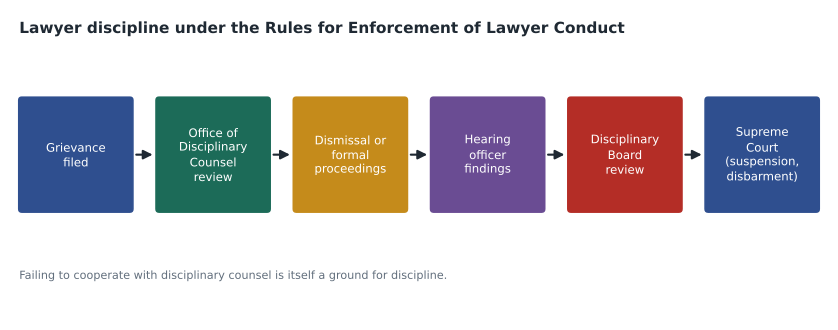
Washington's ELC also provide for interim suspension in urgent cases, such as when a lawyer has been convicted of a serious crime or poses a substantial threat of serious harm to the public, and for transfer to disability inactive status when a lawyer is unable to practice because of a mental or physical condition. A lawyer's duty to cooperate with a disciplinary investigation is itself enforceable: failing to respond to disciplinary counsel can lead to discipline even if the underlying grievance had no merit.
The Washington RPCs: same numbers, different details
Washington adopted the Rules of Professional Conduct based on the ABA Model Rules and generally uses the same numbering. The Washington rules include additional comments marked as Washington comments, and some rules have Washington-specific provisions. A Washington lawyer must follow the Washington text. The MPRE, by contrast, tests the Model Rules, so a candidate must keep the two apart.
Some of the differences a new lawyer meets most often:
Fees and flat fees. Washington's RPC 1.5 addresses the treatment of advance fees and flat fees in more detail than the Model Rule. Under the Washington rule, a lawyer may treat a flat fee as earned on receipt and deposit it in the operating account only if the client agrees in a writing signed by the client that explains, in the terms the rule requires, that the fee is the lawyer's property on receipt, that the client may discharge the lawyer at any time and that the client may be entitled to a refund of part of the fee if the representation is not completed. Without such an agreement, an advance fee belongs to the client until earned and goes into trust. A lawyer drafting a flat-fee agreement should use the precise language required by RPC 1.5(f).
Trust accounts. Washington replaces Model Rule 1.15 with two rules. RPC 1.15A governs safeguarding property, and RPC 1.15B sets out required trust account records. Together they are more detailed than the Model Rule, as the next section explains.
Confidentiality. Washington's RPC 1.6 follows the Model Rule's general duty but its list of situations in which a lawyer may reveal information differs in places from the Model Rule. A lawyer considering a permissive disclosure must read the Washington text and comments, not the Model Rule.
Discrimination. Washington's RPC 8.4 contains Washington-specific provisions, including one that treats certain discriminatory conduct in connection with the practice of law as professional misconduct. Its wording differs from Model Rule 8.4(g), and a lawyer should read Washington's text rather than assume the Model Rule applies.
Trust accounts under RPC 1.15A and 1.15B
The core rule is the same as everywhere: client and third-party money must be kept separate from the lawyer's own money, in a trust account, and must be accounted for. Washington's rules add structure. A lawyer must keep property of clients and third persons separate from the lawyer's own, must deposit client funds in a trust account, must promptly notify clients of receipt of funds and promptly deliver funds to which a client is entitled, and must not use one client's money for another client's purposes. A lawyer may not deposit the lawyer's own funds in the trust account except as the rule allows, such as a small amount to cover bank charges. Disputed funds must be held in trust until the dispute is resolved.
Washington trust accounts are generally interest on lawyers' trust accounts, known as IOLTA accounts, when the funds are nominal in amount or held for a short time. The interest goes to the Legal Foundation of Washington, which funds civil legal aid. When funds are large enough, or will be held long enough, to earn net interest for the client, the lawyer must place them in a separate interest-bearing trust account for the client's benefit.
RPC 1.15B lists the records a lawyer must keep, including a check register or equivalent for each trust account, an individual client ledger for each client, copies of fee agreements and accountings, bank statements and, critically, a monthly reconciliation of the check register, the client ledgers and the bank statement. Records must be kept for a period set by the rule after the events they record. Monthly three-way reconciliation is the habit that catches errors before they become grievances.
| Trust account duty | Washington rule |
|---|---|
| Keep client funds separate | RPC 1.15A |
| Advance fees | Held in trust until earned, unless a written flat-fee agreement under RPC 1.5(f) applies |
| Nominal or short-term funds | IOLTA account; interest to the Legal Foundation of Washington |
| Larger or longer-held funds | Separate interest-bearing account for the client |
| Records | Check register, client ledgers, bank statements, monthly reconciliation (RPC 1.15B) |
| Disputed funds | Held in trust until the dispute is resolved |
Other licensed legal professionals
Washington licenses more than one kind of legal professional, and a new lawyer will work with all of them. Limited practice officers, admitted under APR 12, may select, prepare and complete legal documents for real and personal property transactions, such as deeds and deeds of trust, for use by lenders, title companies, escrow companies and others in closings. Licensed legal interns under APR 9 are law students and recent graduates who may practice under a supervising lawyer. Washington also created the limited license legal technician program, which allowed trained nonlawyers to give advice and prepare documents in family law. In 2020 the Supreme Court decided to sunset that program, stopping new admissions after a transition period, but technicians who had been licensed may continue to practice within their license. Lawyers who supervise or work with these professionals must understand what each may and may not do.
The Client Protection Fund
The WSBA's Client Protection Fund, established under the APR and funded through lawyers' license fees, reimburses clients who lose money or property because of a Washington lawyer's dishonest conduct, within limits set by the fund's rules. It is not insurance against malpractice, which Washington does not require lawyers to carry, although lawyers must disclose on their licensing forms whether they have professional liability insurance.
Worked problem
Gerrit's deposit
The estate client paid Ferro & Quintanilla a 5,000-dollar advance fee by check. The firm's engagement letter describes it as a retainer against hourly fees and has no flat-fee language. Two weeks later, Gerrit has billed 1,800 dollars of work. The client then disputes 500 dollars of that bill. What should Gerrit do?
Show solution
- Characterize: the 5,000 dollars is an advance fee against hourly work, not a flat fee earned on receipt, because the agreement lacks the RPC 1.5(f) written terms. It belongs to the client until earned.
- Deposit the full check into the firm's trust account, likely the IOLTA account because the funds are modest and short-term, and record it on the client ledger.
- When the 1,800 dollars is billed and the client is notified, the firm may withdraw the undisputed 1,300 dollars as earned.
- The disputed 500 dollars stays in trust until the dispute is resolved, and the remaining 3,200 dollars stays in trust for future work or refund.
- Reconcile the check register, the client ledger and the bank statement at month end, as RPC 1.15B requires.
Answer: Trust first, withdraw only what is earned and undisputed, hold the disputed amount and reconcile monthly.
Common mistakes
MistakeWashington uses Model Rule 1.15 for trust accounts.
InsteadWashington uses RPC 1.15A (safeguarding property) and RPC 1.15B (required records).
MistakeAny flat fee can go straight into the operating account.
InsteadOnly if the client signs a written agreement with the terms RPC 1.5(f) requires; otherwise it goes into trust.
MistakeDiscipline in Washington is handled by the courts alone.
InsteadGrievances go to the WSBA's Office of Disciplinary Counsel under the ELC; the Supreme Court decides suspension and disbarment.
MistakeWashington still admits new limited license legal technicians.
InsteadThe Court sunset the program in 2020; existing technicians may continue to practice.
MistakeThe MPRE tests Washington's RPCs.
InsteadIt tests the ABA Model Rules; follow Washington's text in practice.
Habits that prevent grievances
Most grievances against new lawyers do not involve dishonesty. They involve neglect, poor communication or sloppy money handling. Marchetti gives every new lawyer the same five habits. Answer every client message within a business day, even if only to say when a full answer will come. Put every fee agreement in writing, using the exact language the rules require for flat fees. Reconcile the trust account every month, without exception. Keep a calendar with every deadline and a backup reminder. And when a mistake happens, tell the client promptly and get advice on what the rules require next.
Gerrit added a sixth from his first month: ask. Ferro & Quintanilla's partners expected him to ask before handling client money, signing a fee agreement or making a disclosure decision. The WSBA also offers an ethics line where lawyers can ask questions about the Washington RPCs, and advisory opinions on many recurring questions. A new lawyer who asks early rarely needs to explain later.
The MPRE and Washington rules, side by side
Tessa's notes kept the two systems apart. For the MPRE, which she had already passed, the answer is always the Model Rules. For the Washington Law Component and practice, the answer is the Washington RPCs: RPC 1.15A and 1.15B for trust accounts, RPC 1.5(f) for flat fees, and the Washington text of RPC 1.6 and RPC 8.4. On the NextGen exam, professional responsibility appears within the skills questions and follows a defined set of Model Rules, so the Model Rules govern there too.
Where to find the rules
The Washington RPCs, the APR, the ELC and the Supreme Court's orders amending them are published on the Washington courts' website, and the WSBA publishes guidance, advisory opinions and the trust account manual on its own site. A new lawyer should bookmark both and should read the current text, with its Washington comments, before relying on any rule. Rules change by order, sometimes with short notice.
Summary and key terms
- The WSBA is an integrated bar exercising authority delegated by the Supreme Court, including discipline and licensing.
- Discipline runs under the ELC: Office of Disciplinary Counsel, hearing officer, Disciplinary Board and Supreme Court.
- Washington's RPCs follow the Model Rules' numbering, with Washington-specific provisions on fees, trust accounts, confidentiality and discrimination.
- RPC 1.15A and 1.15B require separation of funds, IOLTA or interest-bearing accounts, detailed records and monthly reconciliation.
- Limited practice officers and licensed legal interns practice within limits; the LLLT program was sunset in 2020.
- 0
- Rules for Enforcement of Lawyer Conduct
- 1
- Office of Disciplinary Counsel
- 2
- Disciplinary Board
- 3
- RPC 1.15A
- 4
- RPC 1.15B
- 5
- IOLTA
- 6
- flat fee
- 7
- limited practice officer
- 8
- Client Protection Fund
Practice problems
Work each problem on paper first, then reveal the answer to check.
Which Washington rules govern trust accounts?
Show answer
RPC 1.15A on safeguarding property and RPC 1.15B on required records.
When may a Washington lawyer treat a flat fee as earned on receipt?
Show answer
Only with a written agreement signed by the client containing the terms RPC 1.5(f) requires.
Where does a grievance against a Washington lawyer go first?
Show answer
To the WSBA's Office of Disciplinary Counsel, under the ELC.
Who receives the interest on IOLTA accounts in Washington?
Show answer
The Legal Foundation of Washington, which funds civil legal aid.
Lesson quiz · 5 questions
Score 60% or more to complete this lesson.
Create a free account to save your progress, take quizzes and earn a certificate.