
BAR-248 · Lesson 9 of 12 · 20 min
Washington community property, family law and estates
▶ Video coming soon A video version of this lesson is on the way.
Ferro & Quintanilla's family law practice gave Gerrit his first Washington property problem within a month of admission. A couple who had married in 2012 were divorcing. The husband had owned a small orchard parcel near Wapato before the marriage, the couple had paid down its mortgage with wages during the marriage and planted new trees on it, and the wife's paycheck had gone into a retirement account in her name. The husband believed the orchard was his and the retirement account was hers. The wife believed everything should be divided equally. Ingvild Ferro asked Gerrit to write a two-page memo on how a Washington court would approach the property, and to be clear about what Washington did not do.
'Washington is a community property state,' Ferro said, 'but people get two things wrong. They think community property means everything is split fifty-fifty in a divorce. And they think separate property stays out of the divorce. Neither is true here.'
This lesson covers Washington's community property system, how property is divided at dissolution, committed intimate relationships, spousal maintenance and parenting plans, and the Washington rules on wills, intestacy, community property agreements and probate.
Washington is a community property state
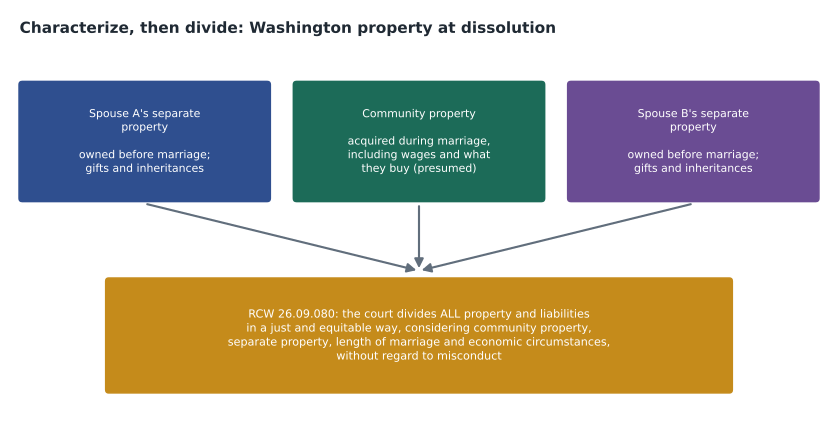
Washington is one of nine community property states. Under chapter 26.16 RCW, property that a spouse or registered domestic partner owned before the marriage or partnership, or acquired afterward by gift, bequest, devise, descent or inheritance, together with its rents, issues and profits, is that spouse's separate property. Property acquired after marriage or domestic partnership by either spouse or partner, or both, is community property, with the exceptions in the statute. The most important consequence is that wages earned during the marriage are community property, and so is property bought with them.
Washington starts from a presumption that property acquired during the marriage is community property. A spouse who claims that an asset acquired during the marriage is separate must trace it to a separate source with clear and convincing evidence. Separate property keeps its character as long as it can be traced, even if it changes form, such as when separately owned stock is sold and the proceeds used to buy land. But commingling separate and community funds so thoroughly that the separate portion can no longer be traced can turn the whole fund into community property. A spouse who wants to keep property separate must keep records.
When community funds or labor improve or pay down a separate asset, the asset keeps its separate character, but the community may have a right of reimbursement for its contributions, and courts take those contributions into account at dissolution. That was the issue with the orchard parcel: the parcel was the husband's separate property, but the community paid down the mortgage and planted trees with community wages and labor.
Management and liability during the marriage
Either spouse acting alone generally may manage and control community property, with important exceptions. Under RCW 26.16.030, neither spouse may give community property away without the express or implied consent of the other, and both spouses must join in selling, conveying or encumbering community real property and in some transactions involving a community business. A community debt can be satisfied from community property, and a spouse's separate debts generally cannot be satisfied from the other spouse's separate property. These rules come up constantly in real estate closings, in collection work and in estate planning.
Dissolution: just and equitable, not fifty-fifty
Washington is a no-fault state. Under chapter 26.09 RCW, a court may dissolve a marriage if it finds the marriage irretrievably broken. A decree may not be entered until at least 90 days have passed after the petition was filed and served, or the respondent joined. That waiting period applies even when both spouses agree on every term.
The key rule for property is RCW 26.09.080. The court must make a disposition of the property and the liabilities of the parties, both community and separate, that appears just and equitable after considering all relevant factors. The statute lists four factors in particular: the nature and extent of the community property, the nature and extent of the separate property, the duration of the marriage or domestic partnership, and the economic circumstances of each spouse at the time the division is to become effective, including the desirability of awarding the family home or the right to live in it for reasonable periods to the spouse with primary residential care of the children. The court must make the division without regard to misconduct.
Two consequences follow. First, Washington does not require an equal division of community property. Equal division is common, and many courts start there, but the statute requires a just and equitable result, which may be unequal. Second, separate property is before the court. Courts usually confirm separate property to the spouse who owns it, but they may award separate property of one spouse to the other when a just and equitable result requires it, for example after a long marriage when one spouse has little community property and limited earning prospects. Characterization still matters, because it guides the court's view of fairness, but it does not decide the outcome.
| Question | Washington rule |
|---|---|
| Ground for dissolution | The marriage is irretrievably broken (no fault) |
| Waiting period | At least 90 days after filing and service or joinder |
| Property before the court | All property, community and separate, and all liabilities |
| Standard | Just and equitable, considering the RCW 26.09.080 factors |
| Misconduct | The division is made without regard to misconduct |
Spousal maintenance
A court may order maintenance, Washington's term for spousal support, in such amounts and for such periods as the court deems just, without regard to misconduct, after considering the factors in RCW 26.09.090. Those include the financial resources of the party seeking maintenance, the time needed to obtain education or training, the standard of living during the marriage, the duration of the marriage, the age, condition and obligations of the spouse seeking maintenance, and the ability of the other spouse to pay. Washington has no statutory formula for maintenance. Courts often treat the property division and maintenance together, because an award of more property can reduce the need for maintenance.
Parenting plans and child support
Washington does not use the terms custody and visitation in its dissolution statute. Instead, a court enters a parenting plan that allocates residential time and decision-making between the parents and sets a dispute resolution process. The court's objective is the best interests of the child, and the statute lists factors for residential provisions. RCW 26.09.191 requires the court to limit a parent's residential time or decision-making in specified circumstances, such as a history of domestic violence or abuse, and permits limits in others. Child support is calculated under the Washington State Child Support Schedule in chapter 26.19 RCW, which uses both parents' incomes and an economic table, with deviations available in specified circumstances.
Committed intimate relationships
Washington also recognizes a doctrine that applies to unmarried couples who live together in a stable, marriage-like relationship. In Connell v. Francisco, decided in 1995, the Supreme Court of Washington held that when such a relationship ends, property acquired during the relationship that would have been community property had the couple been married is subject to a just and equitable distribution. Courts decide whether a committed intimate relationship existed by considering factors such as continuous cohabitation, the duration of the relationship, its purpose, the pooling of resources and services for joint projects, and the intent of the parties. Unlike in a dissolution, only property that would have been community property is subject to distribution; the parties' separate property is not before the court. The doctrine is a frequent source of litigation and a frequent subject of client questions from couples who never married.
Wills and intestacy
A Washington will must be in writing, signed by the testator or by another person at the testator's direction in the testator's presence, and attested by two or more competent witnesses who sign in the testator's presence or by the testator's direction, under RCW 11.12.020. Washington generally does not recognize unwitnessed handwritten wills, so an informal note in the testator's handwriting that would be a valid holographic will in some states usually fails in Washington. Washington law also provides for self-proving affidavits that make probate easier, and more recent legislation allows electronic wills under specified conditions.
If a person dies without a will, chapter 11.04 RCW governs intestate succession. A surviving spouse or domestic partner takes all of the decedent's share of the net community estate, because the survivor already owns half and receives the decedent's half. The surviving spouse's share of the decedent's separate property depends on who else survives: a portion if the decedent left children or other issue, a larger portion if there are no issue but there are parents or their issue, and all of it if none of those relatives survive.
Community property agreements and nonintervention probate
Two Washington tools appear in almost every estate practice. A community property agreement under RCW 26.16.120 allows spouses to agree on the status of their property, including an agreement that all property is community property and that it will pass to the surviving spouse at the first death, without probate. Such agreements are common among long-married couples, but they can have unintended effects, such as overriding later wills, and they are generally revoked by a dissolution proceeding or by agreement.
Washington's probate system is also unusually flexible. Under chapter 11.68 RCW, a personal representative may be granted nonintervention powers, which allow the estate to be administered and closed without further court orders once the powers are granted, provided the estate is solvent and other conditions are met. Disputes about trusts and estates are resolved under the Trust and Estate Dispute Resolution Act, chapter 11.96A RCW, which encourages binding agreements among interested parties and provides a framework for resolving disputes without full litigation. Washington also imposes its own state estate tax on larger estates, with an exclusion amount set by statute that the Legislature has changed in recent years, so estate planners must check the current figure.
Worked problem
Gerrit's orchard memo
The husband owned the orchard parcel before the 2012 marriage, subject to a mortgage. During the marriage, the couple paid the mortgage from both spouses' wages and planted new trees with their labor. The wife contributed her wages to a retirement account in her own name. How should Gerrit's memo frame the issues under Washington law?
Show solution
- Characterize: the orchard parcel is the husband's separate property because he owned it before the marriage; the mortgage payments and labor came from the community.
- The community may have a claim for its contributions to the separate orchard; the court considers those contributions in making its division.
- The retirement account was funded with wages earned during the marriage, so it is community property despite being in the wife's name.
- Divide: under RCW 26.09.080 the court has all property before it, community and separate, and must make a just and equitable division considering the four statutory factors, without regard to misconduct. An unequal division is possible, and the court could, in an appropriate case, award part of the separate orchard to the wife.
Answer: Both spouses are partly wrong. The orchard is separate but subject to the community's contributions, the retirement account is community despite the title, and the court's task is a just and equitable division of everything, not an automatic fifty-fifty split.
Common mistakes
MistakeCommunity property is always divided equally at dissolution.
InsteadRCW 26.09.080 requires a just and equitable division, which may be unequal.
MistakeSeparate property is not part of the divorce.
InsteadAll property, community and separate, is before the court.
MistakeA paycheck deposited in one spouse's name is that spouse's separate property.
InsteadWages earned during the marriage are community property regardless of title.
MistakeUnmarried partners have no property rights when they split.
InsteadUnder Connell v. Francisco (1995), community-like property from a committed intimate relationship is subject to just and equitable distribution.
MistakeA handwritten, unwitnessed will is valid in Washington.
InsteadRCW 11.12.020 requires two attesting witnesses; Washington generally does not recognize holographic wills.
Advising clients before trouble starts
Many Washington property disputes could have been avoided with planning. Spouses who want certain property to stay separate can sign a prenuptial or postnuptial agreement, which Washington courts generally enforce if it is fair and entered into with full disclosure and an opportunity for independent advice. Spouses who want everything to pass to the survivor without probate can use a community property agreement, understanding its effect on later wills. Unmarried partners who share a home can record their intentions in writing, which helps a court applying Connell decide what the parties meant. A new lawyer who explains these options at the first meeting often saves a client years of litigation.
Reading the case law
Community property and dissolution are areas where Washington appellate decisions are frequent and fact-specific. A new lawyer should read the recent decisions of the Court of Appeals on characterization, reimbursement and maintenance before advising a client, and should check whether a statute has been amended. The principles in this lesson are stable, but their application changes with every set of facts.
Summary and key terms
- Property acquired during marriage is presumed community; separate property must be traced.
- Dissolution requires irretrievable breakdown and at least 90 days after filing and service.
- RCW 26.09.080 puts all property before the court for a just and equitable division without regard to misconduct.
- Committed intimate relationships (Connell v. Francisco) allow division of community-like property between unmarried partners.
- Wills need two witnesses; community property agreements and nonintervention powers shape Washington estate practice.
- 0
- community property
- 1
- separate property
- 2
- tracing
- 3
- commingling
- 4
- just and equitable distribution
- 5
- maintenance
- 6
- parenting plan
- 7
- committed intimate relationship
- 8
- community property agreement
- 9
- nonintervention powers
Practice problems
Work each problem on paper first, then reveal the answer to check.
Is a retirement account funded with one spouse's wages during the marriage community or separate property?
Show answer
Community property, because wages earned during the marriage are community property.
Must a Washington court divide community property equally?
Show answer
No. It must make a just and equitable division of all property under RCW 26.09.080.
What did Connell v. Francisco hold?
Show answer
When a committed intimate relationship ends, property that would have been community property is subject to just and equitable distribution.
How many witnesses does a Washington will require?
Show answer
Two or more competent witnesses, under RCW 11.12.020.
Lesson quiz · 5 questions
Score 60% or more to complete this lesson.
Create a free account to save your progress, take quizzes and earn a certificate.