
BAR-248 · Lesson 3 of 12 · 20 min
Character and fitness and the MPRE
▶ Video coming soon A video version of this lesson is on the way.
Tessa had one item on her application that worried her. In her second year of college she had been cited for being a minor in possession of alcohol at a party near campus. She paid a fine, completed a short class and the case was dismissed. She disclosed it on her Washington application, but she wanted to know how much it would matter. Marchetti also had a second example ready, about a former student of hers she called Ilsa Tennant, whose file had been far more complicated: unpaid student loans in default, a civil judgment from a failed small business, and an application that had left the judgment out.
'Tessa's citation is the kind of thing that almost never keeps anyone out,' Marchetti said. 'Ilsa's file is the kind that gets a hearing. The difference is not just what happened. It is how recent it was, whether there is a pattern, what the person did about it, and above all whether the application told the truth.'
This lesson covers what Washington's character and fitness review is for, how a file moves from disclosure to decision, the factors that matter, and the MPRE requirement that sits alongside it.
Why character and fitness review exists
The Supreme Court admits only applicants who show good moral character and fitness to practice law. The purpose is protective. A lawyer holds client money, keeps client confidences, makes statements to courts that the courts rely on and acts for people who often cannot check what the lawyer does. The review asks whether the applicant's past conduct gives reason to doubt that the applicant will do those things honestly and competently. It is not a test of whether the applicant has made mistakes. Almost everyone has.
In Washington the applicant carries the burden of showing good moral character and fitness. That allocation matters in practice. An applicant who leaves a gap or gives an evasive answer is not given the benefit of the doubt. The way to carry the burden is a complete, candid application with documents that support it.
How a file moves
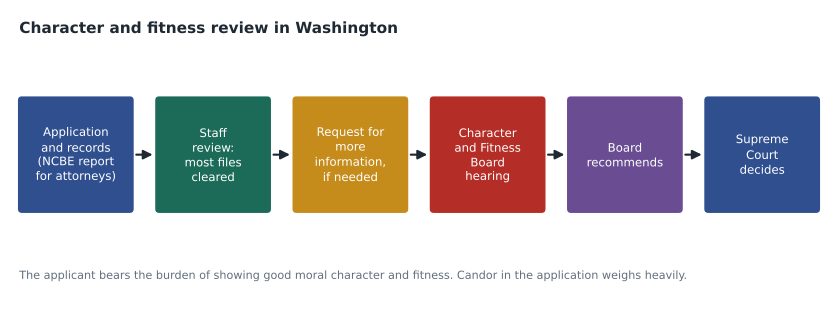
Every application goes through an initial review by WSBA admissions staff. For attorney applicants, NCBE also conducts a character and fitness investigation and sends a report, which is why attorneys pay a separate investigation fee. Staff check the answers against records, references and reports. Most files end there, and the applicant is cleared. If staff find something that raises a concern, they may ask the applicant for more information, documents or an explanation. If concerns remain, the matter can be referred to the Character and Fitness Board, which may hold a hearing at which the applicant may appear, present evidence and be represented by counsel. The Board then makes a recommendation, and the Supreme Court makes the final decision.
What reviewers look at
The issues that most often lead to further inquiry fall into familiar groups: criminal conduct, academic misconduct, dishonesty in employment, financial irresponsibility such as unpaid debts or judgments, neglect of legal obligations such as child support or taxes, conduct in prior litigation, substance use that has affected conduct, and, most important, lack of candor in the application itself. A history of discipline in another profession, or as a lawyer elsewhere, is also central for attorney applicants.
Reviewers then weigh the conduct. The factors used across most jurisdictions, and reflected in the questions Washington's Board asks, include the applicant's age at the time; how recent the conduct was; how serious it was; the factors underlying it; the cumulative effect of several incidents; evidence of rehabilitation; positive social contributions since; candor in the admissions process; and how relevant the conduct is to the duties of a lawyer. Conduct involving dishonesty, fraud or deceit weighs more heavily than most other conduct because honesty is at the center of a lawyer's work.
| Factor | Tessa (minor in possession at 19) | Ilsa (defaulted loans, omitted judgment) |
|---|---|---|
| Age at the time | Young; years ago | Adult; recent |
| Seriousness | Minor offense, dismissed | Financial irresponsibility plus an omission |
| Pattern | Single incident | Several related problems |
| Rehabilitation | Class completed, nothing since | Payment plan started only after inquiry |
| Candor | Fully disclosed | Judgment left off the application |
Candor is the decisive factor
Marchetti told Tessa that the single most common way applicants turn a small problem into a large one is by leaving it off the application. A dismissed citation from college, fully disclosed, is usually cleared at staff review. The same citation, left off and discovered in a background check, raises a different question: whether the applicant will tell the truth when it is inconvenient. That question goes to the heart of fitness to practice. Courts and admissions boards across the country have repeatedly treated false or misleading answers in the application as more serious than the conduct the applicant tried to hide.
The duty of candor continues after filing. If an applicant is charged with an offense, sued, has a judgment entered, changes jobs or has any other change that affects an answer, the applicant must update the application. The duty ends only at admission, and an admission obtained through a false or incomplete application can be revisited later through discipline.
Ilsa's file
Ilsa had borrowed heavily for law school and for a small catering business she ran with a friend before law school. The business failed, a supplier obtained a civil judgment against her, and she stopped paying her student loans during her third year. Her application disclosed the loans but not the judgment, because she believed, wrongly, that a judgment against a business she co-owned was not a judgment against her. Admissions staff found the judgment in a records check and asked about it. Marchetti helped her prepare a response: an explanation of the business and its failure, a copy of the judgment, a payment agreement with the supplier, proof that the loans had been moved into an income-based repayment plan and an amended application that corrected the omission and explained it plainly.
Her file went to a hearing. The Board heard from Ilsa, from her former business partner and from a lawyer for whom she had worked as an intern. The question was not whether she had debts, which many applicants have, but whether she had handled them responsibly once she understood them and whether the omission was a misunderstanding or an attempt to conceal. Her case shows the pattern Marchetti sees most often: debt alone rarely blocks admission, while a pattern of ignoring obligations, combined with an incomplete application, can.
Worked problem
Deciding what to disclose
Tessa's friend Tolbert Harkness asks Marchetti four questions while preparing his application: (1) Must he disclose a speeding ticket from four years ago that he paid? (2) Must he disclose a juvenile matter that was sealed? (3) Must he disclose that he was placed on academic probation in his first semester of college? (4) Must he disclose a lawsuit in which he was a witness but not a party?
Show solution
- The rule of thumb: answer the question that is asked, read the question literally and broadly, and when in doubt disclose with an explanation.
- Traffic matters: many applications ask about traffic violations above a minimum amount or of certain kinds; read the question and disclose what it covers.
- Sealed or expunged matters: applications often ask about them expressly; if the question covers them, disclosure is required despite sealing. If the wording is unclear, ask the WSBA in writing.
- Academic probation and lawsuits: answer exactly what the questions ask about academic discipline and about cases in which he was a party; a witness role is usually outside a question about being a party, but read the wording.
Answer: The safe course is to read each question carefully, disclose what it asks for with a short explanation, and get written guidance from the WSBA where the wording is genuinely unclear.
The MPRE requirement
Alongside character and fitness, every applicant for admission by examination must pass the Multistate Professional Responsibility Examination. Washington requires a scaled score of 85. The MPRE is a two-hour, 60-question multiple-choice test on the ABA Model Rules of Professional Conduct and related law, given several times a year at testing centers.
Washington also sets a time window. According to the WSBA's guidance as summarized by bar preparation providers and Washington law schools, an applicant must take the MPRE no earlier than three years before, and no later than 40 months after, the administration of the bar exam the applicant passes. A score earned in law school is therefore usually valid for a candidate who sits soon after graduating. A candidate who took the MPRE early in law school and then delays the bar exam for several years should check the date. Admission on motion has no comparable time limit for the MPRE, according to NCBE's guide.
Tessa took the MPRE in March 2026 and scored 98, well above 85 and inside the window for her February 2027 exam. Gerrit took it in August 2025 and scored 94. Both scores were already on file, so neither needed to sit again.
Washington ethics law is not the same as the Model Rules
The MPRE tests the ABA Model Rules, not the Washington Rules of Professional Conduct. Washington's rules follow the Model Rules closely but differ in places, including trust account rules, fees and some confidentiality exceptions. For the MPRE, the candidate answers under the Model Rules. For practice, the candidate follows Washington's rules. Lesson 10 covers the main Washington differences.
Common mistakes
MistakeAny criminal record keeps an applicant out.
InsteadThe review weighs conduct, age, recency, pattern and rehabilitation. Minor, isolated, disclosed incidents are usually cleared.
MistakeLeaving off a minor matter is harmless.
InsteadLack of candor is often treated as more serious than the underlying conduct and can lead to a hearing or denial.
MistakeThe duty to disclose ends when the application is filed.
InsteadThe applicant must update the application until admission.
MistakeWashington accepts an MPRE score of 75 or 80.
InsteadWashington requires 85.
MistakeAn MPRE score is valid forever.
InsteadFor exam applicants Washington sets a window: no earlier than three years before and no later than 40 months after the exam the applicant passes.
MistakeThe MPRE tests the Washington RPCs.
InsteadIt tests the ABA Model Rules; Washington's rules differ in places.
Writing an explanation that helps
When an application discloses something that may raise a question, the explanation matters almost as much as the facts. Marchetti teaches a simple structure. First, state what happened in plain, neutral words, with dates. Second, state the outcome: the charge, the disposition, the amount owed or paid, the current status. Third, state what the applicant has done since, such as completing a class, paying a judgment or entering a repayment plan, with documents. Fourth, if it is true and relevant, state what the applicant learned. The explanation should not argue, minimize or blame others. Reviewers read many explanations, and the ones that work are short, specific and supported.
Tessa's explanation of her citation was four sentences long. It gave the date and place, said that she paid a fine and completed an alcohol education class, said that the case was dismissed, and attached the court's dismissal order. Her file was cleared at staff review without any further question.
Mental health and substance use
Applicants often worry that seeking treatment for a mental health condition or for substance use will count against them. Bar admission authorities across the country, including through national guidance, have moved away from broad questions about diagnosis and treatment and toward questions focused on conduct: whether the applicant has engaged in conduct that raises concerns about the ability to practice competently and ethically. Applicants should answer the questions Washington's application actually asks, read literally, and should not avoid treatment out of fear of the admissions process. An applicant with a specific concern can ask the WSBA, or a lawyers' assistance program, in confidence how the process works.
Conditional admission and timing
Some jurisdictions allow conditional admission, in which an applicant with a recent problem, such as a period of substance use followed by recovery, is admitted subject to monitoring and conditions. An applicant whose file raises such questions should ask whether Washington's rules allow conditions in a particular case and what they would involve. More generally, an applicant with a complicated history should file early. A hearing before the Character and Fitness Board takes time to schedule, and the applicant cannot be admitted until the matter is resolved, even after passing the exam.
Marchetti's last word on the subject was the same one she gives every candidate. 'The review is not looking for perfect people. It is looking for honest ones who handle their problems. Show them that, on paper, and you will almost always be fine.'
What a hearing looks like
A hearing before the Character and Fitness Board is a formal proceeding, but it is not a trial. The applicant may testify, call witnesses, offer documents and be represented by a lawyer. Board members ask questions directly. The questions usually focus on what happened, why, what the applicant has done since and why the application said what it did. Applicants who prepare a short chronology, bring documents that prove rehabilitation and answer questions directly do best. Ilsa's hearing lasted about two hours.
Summary and key terms
- The applicant must show good moral character and fitness; the burden is on the applicant.
- Files go from staff review to requests for information and, if needed, a Character and Fitness Board hearing; the Supreme Court decides.
- Reviewers weigh age, recency, seriousness, pattern, rehabilitation and candor; dishonesty weighs most.
- The duty to update the application lasts until admission.
- Washington requires an MPRE scaled score of 85, earned within the time window for exam applicants.
- 0
- character and fitness
- 1
- burden of proof
- 2
- Character and Fitness Board
- 3
- candor
- 4
- rehabilitation
- 5
- MPRE
- 6
- scaled score
- 7
- duty to update
Practice problems
Work each problem on paper first, then reveal the answer to check.
Who bears the burden in a Washington character and fitness review?
Show answer
The applicant, who must show good moral character and fitness to practice.
What MPRE score does Washington require?
Show answer
A scaled score of 85.
What is the most common way applicants make a small problem worse?
Show answer
By leaving it off the application, which raises a candor issue.
Who makes the final decision after a Character and Fitness Board hearing?
Show answer
The Supreme Court of Washington.
Lesson quiz · 5 questions
Score 60% or more to complete this lesson.
Create a free account to save your progress, take quizzes and earn a certificate.