
BAR-248 · Lesson 7 of 12 · 19 min
Washington courts and civil procedure
▶ Video coming soon A video version of this lesson is on the way.
Gerrit's first week as an admitted lawyer at Ferro & Quintanilla included a task that every new Washington litigator meets early: a client's car accident case was about to run out of time. The client, whom the firm called Mrs. Thorvald in its file, had been rear-ended on Interstate 82 near Union Gap almost three years earlier. The complaint was ready. The partner, Ingvild Ferro, asked Gerrit to explain to her, before she signed it, exactly when the action would be commenced under Washington law, when the defendant had to be served and what would happen if service was late.
'Every state has a statute of limitations,' Ferro told him. 'Washington has a twist about when you've beaten it. If you only remember the federal rule, you can lose a case you thought you'd filed in time.'
This lesson covers the structure of the Washington courts, the Civil Rules and the pleading standard, commencement and service, key limitations periods, mandatory arbitration and Washington's anti-SLAPP statute. Each is a place where Washington practice departs from what the national exam teaches.
The structure of the Washington courts
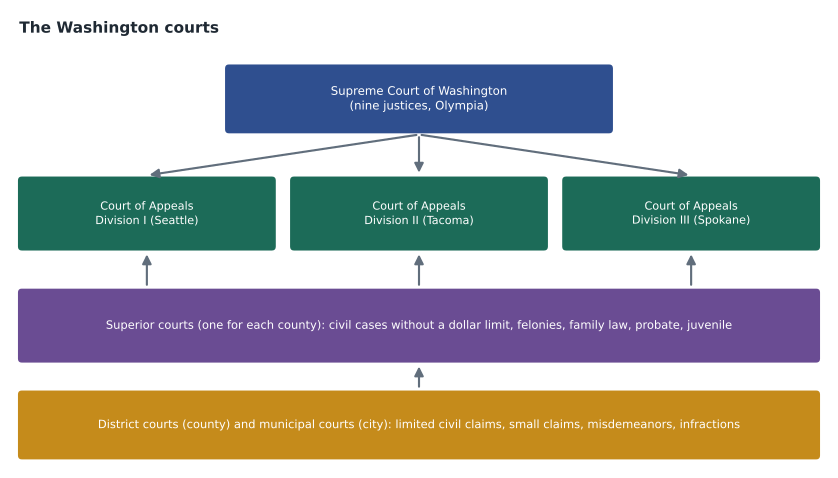
Washington has a four-level court system. At the top is the Supreme Court of Washington, with nine justices, which sits in Olympia, hears appeals it accepts for review and certain direct appeals, and regulates the practice of law. Below it is the Court of Appeals, which is divided into three divisions: Division I, based in Seattle, Division II, based in Tacoma, and Division III, based in Spokane. Each division hears appeals from the superior courts in its region.
The superior courts are the general jurisdiction trial courts. Each county has a superior court, though some smaller counties share judges. Superior courts hear civil cases without a dollar limit, felony criminal cases, family law, probate, juvenile matters and appeals from the courts of limited jurisdiction. The courts of limited jurisdiction are the district courts, organized by county, and the municipal courts, organized by city. District courts hear civil cases up to a statutory dollar limit, small claims, misdemeanors, gross misdemeanors and traffic infractions. Washington's judges at every level are elected in nonpartisan elections, with vacancies filled by appointment until the next election.
The Civil Rules and notice pleading
Civil practice in superior court is governed by the Superior Court Civil Rules, cited as CR, which are modeled on the Federal Rules of Civil Procedure and generally follow their numbering. Courts of limited jurisdiction have their own civil rules, cited as CRLJ. County courts adopt local rules that supplement the statewide rules, and a new lawyer must read the local rules of the county where the case is filed.
The most important difference in pleading is the standard for a motion to dismiss. In federal court, after Bell Atlantic Corp. v. Twombly and Ashcroft v. Iqbal, a complaint must state a plausible claim. In McCurry v. Chevy Chase Bank, FSB, decided in 2010, the Supreme Court of Washington declined to adopt that plausibility standard for CR 12(b)(6). Washington keeps its traditional notice pleading standard: a complaint should be dismissed only if it appears beyond doubt that the plaintiff can prove no set of facts, consistent with the complaint, that would justify recovery, and the court may consider hypothetical facts in making that decision. A Washington complaint that would not survive a federal plausibility challenge may well survive in superior court.
For the national exam, the candidate applies the federal standard. For practice, the candidate files in state court knowing that the threshold is lower, and that defendants who want to test a claim early often do so by summary judgment under CR 56 after some discovery, not by a motion to dismiss.
Commencement and service: the 90-day rule
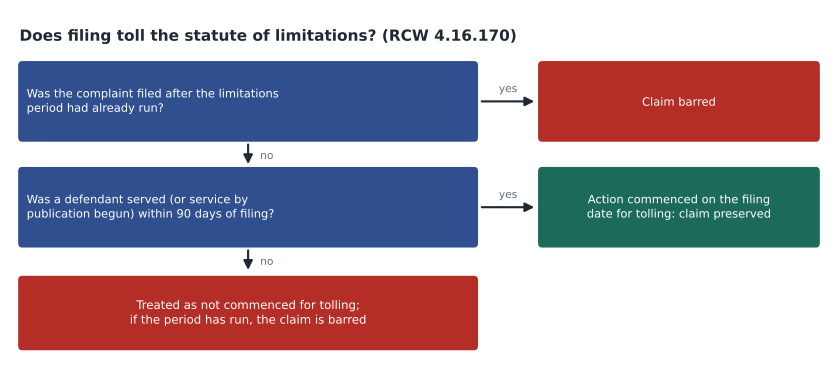
The answer Gerrit gave Ferro turns on RCW 4.16.170, one of the most important statutes in Washington civil practice. Under that statute, an action is deemed commenced for purposes of tolling the statute of limitations when the complaint is filed or the summons is served, whichever occurs first. But commencement by filing is conditional. If the plaintiff files first, the plaintiff must serve one or more defendants personally, or begin service by publication, within 90 days after filing. If service is not made within the 90 days, the action is treated as not commenced for purposes of tolling, and if the limitations period has run in the meantime, the claim is barred.
That rule rewards early action. Ferro's practice, which Gerrit adopted, is to hand a summons and complaint to a process server the same day the complaint is filed, and to calendar the 90-day date in red. A plaintiff can also serve the summons and complaint first and file later, which commences the action on the date of service for tolling purposes, though the rules then require filing within a set time on the defendant's demand.
Key limitations periods
Washington's general limitations statutes are in chapter 4.16 RCW. The periods a new lawyer uses most often are three years for most personal injury actions and for injury to property, three years for actions on an oral contract or on an account, and six years for actions on a written contract. Medical negligence claims have their own statute, generally three years from the act or omission or one year from discovery, whichever is later, subject to further rules. Claims against government entities also require a pre-suit claim and a waiting period, covered in Lesson 8. Discovery rules, tolling for minority and other special rules can change the date, so each case needs its own calculation.
| Claim | General Washington period |
|---|---|
| Personal injury (negligence) | Three years |
| Injury to property | Three years |
| Oral contract or account | Three years |
| Written contract | Six years |
| Medical negligence | Generally three years from the act, or one year from discovery if later, with further rules |
Mandatory arbitration
Washington has a system of mandatory arbitration for civil cases in superior court in which the only relief sought is a money judgment below a statutory threshold, in counties that have adopted it, under chapter 7.06 RCW and the Superior Court Civil Arbitration Rules. The arbitrator's award is not binding if a party requests a trial de novo within the time allowed, but a party who requests a trial de novo and fails to improve its position at trial must pay the other side's attorney fees and costs incurred after the request. The fee-shifting rule is the reason mandatory arbitration resolves many smaller cases: a defendant who loses in arbitration must think hard about whether a jury will do better.
The Uniform Public Expression Protection Act
Washington's first anti-SLAPP statute, enacted in 2010, allowed defendants sued over public speech to bring an early special motion to strike. In Davis v. Cox, decided in 2015, the Supreme Court of Washington held that statute unconstitutional because its procedure required judges to weigh evidence and decide factual questions before trial, violating the right to a jury trial. In 2021 the Legislature adopted the Uniform Public Expression Protection Act, now chapter 4.105 RCW, which uses a different procedure modeled on the uniform act. A defendant sued over protected expression on a matter of public concern can bring an expedited motion to dismiss; the motion generally stays discovery, the court decides it quickly, and a prevailing moving party generally recovers costs and attorney fees.
Appeals
An appeal from a final superior court judgment is taken by filing a notice of appeal within 30 days after entry of the decision, under the Rules of Appellate Procedure. The appeal goes to the division of the Court of Appeals that covers the county. A party who loses in the Court of Appeals may petition the Supreme Court for review, which the Court grants only on limited grounds, such as a conflict among decisions or a significant constitutional question or issue of substantial public interest. Some cases go directly to the Supreme Court. Discretionary review of interlocutory orders is also available on narrow grounds.
Worked problem
Will the Thorvald claim be timely?
Mrs. Thorvald was injured on November 30, 2023. Ferro & Quintanilla files her negligence complaint in Yakima County Superior Court on November 20, 2026. The defendant lives in Kennewick. When must the firm serve him, and what happens if service is made on March 1, 2027?
Show solution
- Limitations: a three-year period from November 30, 2023 runs to November 30, 2026.
- Filing on November 20, 2026 commences the action for tolling, but only if the defendant is served within 90 days after filing.
- Ninety days after November 20, 2026 is February 18, 2027. Service by that date preserves the claim.
- Service on March 1, 2027 is outside the 90 days. The action is treated as not commenced for tolling, and because the limitations period ran on November 30, 2026, the claim is barred.
Answer: The firm must serve by February 18, 2027. Service on March 1 would lose the claim, which is why Ferro sends the papers to a process server the day she files.
Common mistakes
MistakeWashington uses the federal plausibility standard for motions to dismiss.
InsteadMcCurry v. Chevy Chase Bank (2010) kept Washington's notice pleading standard under CR 12(b)(6).
MistakeFiling the complaint always stops the statute of limitations.
InsteadUnder RCW 4.16.170, filing tolls the statute only if a defendant is served within 90 days.
MistakeThe Court of Appeals is one statewide court with one location.
InsteadIt has three divisions, based in Seattle, Tacoma and Spokane.
MistakeWashington still uses its 2010 anti-SLAPP procedure.
InsteadDavis v. Cox (2015) struck that statute; the Uniform Public Expression Protection Act (2021) now applies.
MistakeMandatory arbitration awards are final.
InsteadA party may request a trial de novo, but risks paying fees if it does not improve its position.
Local rules and practice habits
Every Washington superior court has local rules, and many have local practices that do not appear in any rule. Yakima County, King County, Spokane County and Pierce County, for example, each set their own procedures for scheduling motions, for case schedules and for filing working copies with the judge. A new lawyer should read the local rules of each county before filing anything there and should ask a court clerk or an experienced colleague about practices that the rules do not cover. Missing a local requirement rarely loses a case, but it can delay a hearing and embarrass a client.
Ferro taught Gerrit three habits in his first month. Calendar every deadline the day it arises, with a reminder a week ahead. Read the judge's own instructions, which many superior court judges post, before every hearing. And check the case schedule order, which in many counties sets the dates for discovery cutoffs, witness disclosures and trial, the moment it issues.
State and federal procedure side by side
Washington lawyers often practice in both the superior courts and the federal district courts for the Western and Eastern Districts of Washington. The two systems look alike because the Civil Rules follow the federal rules, but the differences matter. The pleading standard differs after McCurry. Commencement and tolling of the statute of limitations in state law claims are governed by RCW 4.16.170 in state court. Discovery limits, motion practice and local rules differ. Juries in civil cases in superior court may be smaller than twelve if the parties so agree or the rules provide. A lawyer who moves between the two systems should keep a short checklist of the differences that matter in each case.
Why the national exam cares about none of this
On the NextGen exam, civil procedure is federal civil procedure. A question about whether a complaint survives a motion to dismiss is answered under Twombly and Iqbal, and a question about when an action is commenced is answered under the federal rules. Tessa wrote a line at the top of her civil procedure notes for the exam: federal rules only, no RCW 4.16.170, no McCurry. She wrote the opposite line at the top of her Washington Law Component notes. The two notes look alike, which is exactly why she labeled them.
Personal jurisdiction and service outside Washington
When a defendant lives outside Washington, the lawyer must consider both personal jurisdiction and the method of service. Washington's long-arm statute, RCW 4.28.185, allows jurisdiction over a person who, among other things, transacts business in the state or commits a tortious act in the state, and Washington courts generally read it to reach as far as due process allows. Service outside the state follows the statutes and the Civil Rules. A defendant who lives in Oregon or Idaho and caused a collision in Washington can usually be sued in Washington, but the 90-day service rule still applies, and out-of-state service often takes longer.
Summary and key terms
- Washington courts: the Supreme Court; the Court of Appeals in three divisions; superior courts; district and municipal courts.
- The Civil Rules track the federal rules, but McCurry (2010) kept notice pleading for CR 12(b)(6).
- Under RCW 4.16.170, filing tolls the statute of limitations only if service follows within 90 days.
- Common periods: three years for personal injury and oral contracts, six years for written contracts.
- Mandatory arbitration shifts fees against a party that requests a trial de novo and does not improve its position; UPEPA governs anti-SLAPP motions.
- 0
- superior court
- 1
- Court of Appeals
- 2
- Civil Rules
- 3
- notice pleading
- 4
- RCW 4.16.170
- 5
- tolling
- 6
- mandatory arbitration
- 7
- trial de novo
- 8
- Uniform Public Expression Protection Act
Practice problems
Work each problem on paper first, then reveal the answer to check.
What pleading standard applies to a CR 12(b)(6) motion in Washington?
Show answer
The notice pleading standard reaffirmed in McCurry v. Chevy Chase Bank (2010), not the federal plausibility standard.
Under RCW 4.16.170, when does filing a complaint toll the statute of limitations?
Show answer
When a defendant is served personally, or service by publication begins, within 90 days after filing.
How many divisions does the Court of Appeals have?
Show answer
Three, based in Seattle, Tacoma and Spokane.
Why did Davis v. Cox strike Washington's 2010 anti-SLAPP statute?
Show answer
Its procedure required judges to weigh evidence before trial, violating the right to a jury trial.
Lesson quiz · 5 questions
Score 60% or more to complete this lesson.
Create a free account to save your progress, take quizzes and earn a certificate.