
BAR-248 · Lesson 12 of 12 · 17 min
Capstone: Washington practice questions and an exam-day plan
▶ Video coming soon A video version of this lesson is on the way.
In the last of their one-on-one sessions before the holidays, Marchetti gave Tessa a three-part capstone. Part one was ten short questions on Washington admission and Washington law, of the kind the Washington Law Component asks, to be answered in twenty minutes without notes and then checked against the lessons. Part two was an original practice file to be answered as a short memo in the IRAC form she would use in her first year of practice. Part three was a written plan for the weeks before February 23, 2027, covering the Washington Law Component, the NextGen exam and the logistics of exam week. Gerrit, who would sit beside her in February as a courtesy seat, agreed to grade her memo the way Ingvild Ferro graded his.
'The capstone has one job,' Marchetti said. 'It tells you whether you can keep two sets of rules in your head: Washington's for the component and for practice, and the general rules for the national exam. If you can switch cleanly between them, you're ready.'
Part one: ten Washington questions
Answer each question in a sentence or two, then compare your answer with the explanation that follows it.
Question 1. Tessa passes the February 2027 NextGen exam with a 618 but has not yet taken the Washington Law Component. Can she be admitted?
Answer: Not yet. Passing the Washington Law Component is a prerequisite for admission on every route. As an exam applicant she has up to 40 months after passing the exam to pass it, but admission waits until she does.
Question 2. What score must Tessa achieve on the NextGen exam to pass in Washington, and what order set it?
Answer: 610, set by Order No. 25700-B-747 of December 8, 2025.
Question 3. A lawyer admitted in Arizona practiced there from 2015 to 2022, then left practice, and has not practiced since. Can she be admitted on motion in Washington in 2026?
Answer: Not on her current record. APR 3(c)(1) requires active legal experience in at least one of the three years immediately preceding the filing of the application. Her experience ended in 2022, outside the window.
Question 4. A Washington client's complaint is filed on the last day of the three-year limitations period and served 95 days later. Is the claim timely?
Answer: No. Under RCW 4.16.170, filing tolls the statute only if a defendant is served within 90 days after filing. Late service means the action is treated as not commenced for tolling, and the period has run.
Question 5. A plaintiff in a Washington negligence case is found 65 percent at fault. What does she recover?
Answer: Thirty-five percent of her damages, because Washington applies pure comparative fault under RCW 4.22.005.
Question 6. A jury finds two defendants 60 and 40 percent at fault for injuries to a plaintiff who was not at fault. One defendant is insolvent. Can the plaintiff collect the whole judgment from the other?
Answer: Yes. Under RCW 4.22.070(1)(b), when the claimant is fault-free, the defendants against whom judgment is entered are jointly and severally liable for the sum of their proportionate shares.
Question 7. Can a Washington jury award punitive damages against a driver who caused a crash while intoxicated?
Answer: Not under Washington law unless a statute authorizes them. Washington bars punitive damages absent express statutory authorization, a rule reaffirmed in Dailey v. North Coast Life Insurance Co. (1996).
Question 8. A spouse receives an inheritance during the marriage and deposits it in a separate account in her own name. Is it community property?
Answer: No. Property acquired by inheritance is separate property under chapter 26.16 RCW, and it keeps that character if it can be traced. At dissolution, however, the court may still consider it in making a just and equitable division of all property.
Question 9. A lawyer receives a 3,000-dollar advance fee under an hourly engagement letter. May the lawyer deposit it in the operating account?
Answer: No. Without a signed written agreement containing the flat-fee terms required by RPC 1.5(f), the advance fee belongs to the client until earned and must be deposited in trust under RPC 1.15A.
Question 10. A Washington lawyer earned 47 MCLE credits in her reporting period, including 7 ethics credits, one of them an equity credit. Is she compliant, and can she carry anything forward?
Answer: Yes. She met the 45-credit total and the six-credit ethics minimum with an equity credit, assuming at least 15 credits were in law and legal procedure. She may carry forward the two excess credits, and the rule allows up to two ethics credits to carry forward.
Part two: the Wenatchee orchard problem
Read the file below and write a memo of about one page in IRAC form, addressed to a supervising lawyer. The facts and names are invented.
Facts. Vesna Dellacort owns an apple orchard near Wenatchee. In September 2024 a pickup driven by Stellan Ruark, an employee of Columbia Pallet Supply, rear-ended Vesna's farm truck at a county intersection. Vesna was driving slightly over the speed limit. The intersection's stop sign facing Stellan had been knocked down weeks earlier, and Chelan County had received two reports about it but had not replaced it. Vesna suffered a back injury and lost part of her harvest. A jury could find her 10 percent at fault, Stellan 60 percent and the county 30 percent. Vesna's damages are 300,000 dollars. Vesna and her husband, Ruairi, bought the orchard together in 2015 with savings from both their salaries. Vesna wants to sue, wants punitive damages against Columbia Pallet because Stellan was texting, and asks whether a recovery will belong to her or to the marriage.
Issues. (1) What procedural steps must Vesna take before suing Chelan County, and what is the deadline? (2) How will fault and liability be allocated among Stellan, Columbia Pallet and the county? (3) Are punitive damages available? (4) Is the orchard, and any recovery for lost harvest, community or separate property?
Model memo, issue 1: pre-suit claim and timing. Rule: claims against a local government require presenting a claim on the standard form to the entity's designated agent and waiting 60 calendar days before suit, under chapter 4.96 RCW; the limitations period is tolled during the waiting period. The general period for personal injury and injury to property is three years under chapter 4.16 RCW, and filing tolls it only if service follows within 90 days under RCW 4.16.170. Application: the collision occurred in September 2024, so the three-year period runs to September 2027. Vesna should present her claim to Chelan County's designated agent promptly, wait 60 days and then file, serving every defendant within 90 days of filing. Conclusion: present the claim now; do not file against the county until the 60 days have passed.
Model memo, issue 2: allocation. Rule: Washington applies pure comparative fault under RCW 4.22.005, so Vesna's recovery is reduced by her own share. Under RCW 4.22.070, each defendant is severally liable for its own share unless an exception applies; an employer is responsible for its servant's share, and joint and several liability for a fault-free claimant does not apply because Vesna was at fault. The county is liable as a private party would be under RCW 4.96.010, subject to the public duty doctrine, which should not bar a claim based on failure to maintain a traffic sign after notice. Application: Vesna recovers 90 percent of 300,000 dollars, or 270,000 dollars. Columbia Pallet is responsible for Stellan's 60 percent share as his employer, so it owes 180,000 dollars; the county owes its 30 percent share, 90,000 dollars. Because Vesna was at fault, she cannot collect the county's share from Columbia Pallet if the county does not pay. Conclusion: 180,000 dollars from Stellan and Columbia Pallet and 90,000 dollars from the county, each severally.
Model memo, issue 3: punitive damages. Rule: Washington does not allow punitive damages unless a statute expressly authorizes them. Application: no statute authorizes punitive damages for negligent or distracted driving, and the texting does not change that under Washington law. The facts suggest no basis for applying another state's law. Conclusion: punitive damages are not available; the texting is relevant to fault and to the jury's view of the case.
Model memo, issue 4: characterization. Rule: property acquired during marriage is presumed community, and wages earned during marriage are community property. Recoveries for personal injury raise separate questions: Washington cases generally treat compensation for the injured spouse's pain and suffering as that spouse's separate property, and compensation for lost community earnings or damage to community property as community property. Application: the orchard was bought during the marriage with both spouses' savings, so it is community property. The recovery for lost harvest compensates for loss to a community asset and is likely community property; the portion for Vesna's pain and suffering is likely her separate property. Conclusion: the orchard and the lost-harvest damages are community property; the pain-and-suffering portion is likely Vesna's separate property, a point to confirm in the current case law before advising her.
Gerrit graded Tessa's draft with Ferro's checklist: Did she state the claim process before the merits? Did she get the arithmetic right and explain why Columbia Pallet answers for Stellan? Did she say no to punitive damages clearly? Did she flag the characterization issue as one to confirm rather than overstate it? Tessa missed the employer's responsibility for Stellan's share on her first draft and fixed it on the second.
Part three: an exam-day plan
The plan has three tracks: the Washington Law Component, the NextGen exam and the logistics of exam week.
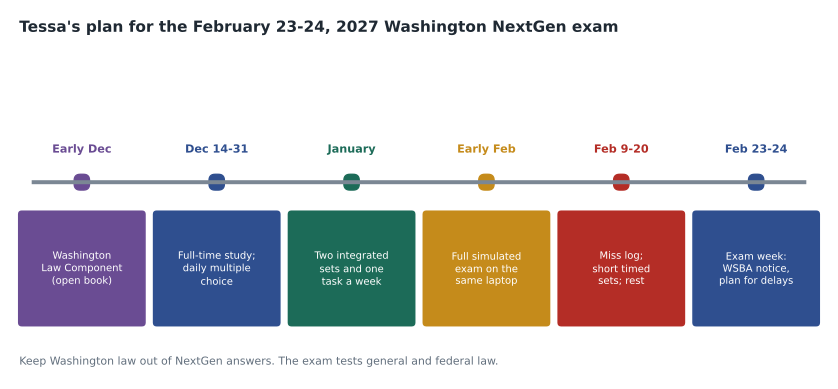
Track one, the Washington Law Component. Tessa takes it in early December, before full-time study begins on December 14. She prepares by reading all 15 outlines once for structure, building a one-page index for each, learning the Washington rules that differ most from the national rules, and practicing the timing of 60 questions in four hours.
Track two, the NextGen exam. From December 14 through the end of January, she studies the foundational subjects on a weekly cycle: daily timed multiple-choice sets, two integrated question sets a week and one timed performance task a week, keeping a log of every miss and the reason for it. In early February she takes a full simulated exam under timed conditions, three three-hour sessions over a day and a half, using the same laptop and software settings she will use on exam day. The final two weeks are for review of her miss log, short timed sets and rest.
Track three, logistics. She reads the WSBA's notice for the February exam as soon as it is issued and confirms the site, check-in times and permitted items. She registers and tests her laptop and the exam software early. She books lodging near the site for both nights. She plans meals that are quick to eat. And, after Yakima, she plans for delays: if the start is late, she will stay calm, eat something and treat lost time as everyone's problem, not hers alone.
Marchetti added two lines to the plan. First, during exam week, Washington law stays out of the answers: no pure comparative fault, no rule against punitive damages, no community property unless the question supplies it. Second, after the exam, check the portal, confirm that the component, MPRE and character file are complete, and get ready for the oath.
Common mistakes
MistakeThe component can wait until after the oath.
InsteadAdmission waits for the Washington Law Component; take it early.
MistakeAn employer answers only for its own fault.
InsteadUnder RCW 4.22.070(1)(a), a party is responsible for the fault of its agent or servant.
MistakeA partly at-fault plaintiff can collect any defendant's share from another.
InsteadJoint and several liability applies to a fault-free claimant; otherwise each defendant is severally liable.
MistakeAny recovery by a married plaintiff is community property.
InsteadCharacterization depends on what the recovery compensates; confirm the case law for pain and suffering.
After the capstone
Tessa scored eight of ten on part one. She missed Question 3, because she counted the Arizona lawyer's earlier years toward the motion rule, and Question 10, because she forgot that up to two ethics credits may carry forward. Both misses went into her log. Her memo improved between drafts, and Gerrit's comments focused on structure: start each issue with the rule, apply it to the facts in order, and end with a one-sentence conclusion that a busy partner can read alone.
Marchetti closed the session with the same reminder she had given at the start of the course. Keep a source for every rule. Know which rules are Washington's and which are the exam's. Read every WSBA notice the day it arrives. And remember that the goal is not only to pass, but to start practice ready to serve clients under the rules that actually govern them.
A final checklist for exam week
Tessa's last page lists six items: the WSBA's notice printed, with the site, times and permitted items highlighted; the laptop charged, updated and tested with the exam software; identification in the bag; lodging confirmed for both nights; meals and water planned; and a note to herself that reads, in capital letters, general law only.
Summary and key terms
- The capstone tests switching between Washington rules and the general rules on the national exam.
- Before suing a county: present a claim, wait 60 days, file within the limitations period and serve within 90 days.
- Washington allocates fault under pure comparative fault and several liability, with employer responsibility for servants.
- No punitive damages without statutory authorization; characterize recoveries by what they compensate.
- Take the component early, practice NextGen on the laptop, simulate the full exam, and plan for delays.
- 0
- IRAC
- 1
- capstone
- 2
- claim presentation
- 3
- several liability
- 4
- respondeat superior
- 5
- characterization
- 6
- miss log
- 7
- simulated exam
Practice problems
Work each problem on paper first, then reveal the answer to check.
In the orchard problem, how much does Vesna recover in total?
Show answer
Ninety percent of 300,000 dollars, or 270,000 dollars.
Why does Columbia Pallet owe Stellan's share?
Show answer
Under RCW 4.22.070(1)(a), a party is responsible for the fault of its agent or servant.
Why can't Vesna collect the county's share from Columbia Pallet?
Show answer
She was partly at fault, so the fault-free claimant exception does not apply.
What should Tessa do first after February results?
Show answer
Confirm in the portal that the component, MPRE and character file are complete, and prepare for the oath.
Lesson quiz · 5 questions
Score 60% or more to complete this lesson.
Create a free account to save your progress, take quizzes and earn a certificate.