
BAR-249 · Lesson 1 of 12 · 21 min
Becoming a lawyer in West Virginia
▶ Video coming soon A video version of this lesson is on the way.
The Tuesday evening study group had a new face in November. Lonnie Rexroad grew up near Elkins, in Randolph County, finished his JD in May 2026 at an ABA-approved law school outside the state, and came home to work as a law clerk at Varner & Dotson, a four-lawyer firm in Clarksburg that handles injury cases, business disputes and some municipal defense work. He filed his application for the February 2027 West Virginia bar exam in October 2026. 'I know the MBE is the same everywhere,' he told Hollis Marchetti on his first call. 'What I do not know is who actually decides whether I get a law license in West Virginia, and what they want from me before they decide.'
Hollis said that was the right first question. Every jurisdiction in the United States regulates its own lawyers, and the people who make the decisions differ from state to state. A candidate who understands the structure knows where to send each document, whom to ask when a rule is unclear and what happens if something goes wrong. This lesson maps that structure for West Virginia and sets out the whole path from law school to the oath.
The Supreme Court of Appeals
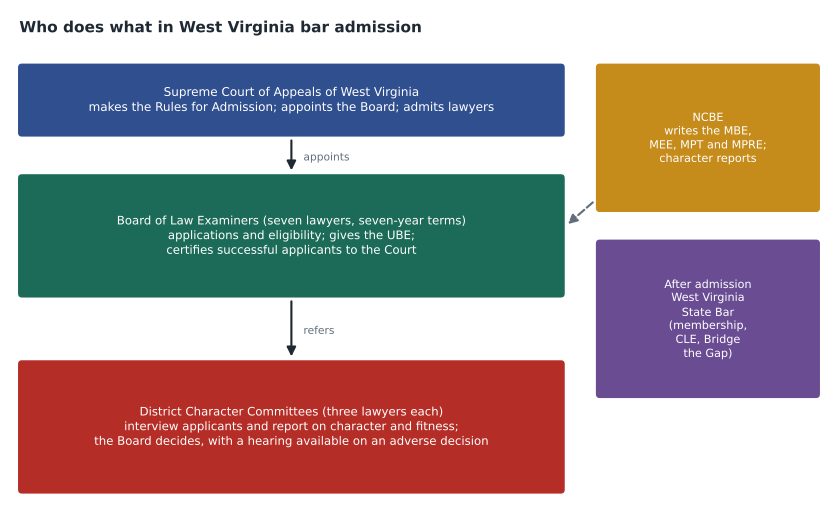
In West Virginia, the power to regulate the practice of law belongs to the Supreme Court of Appeals of West Virginia, the state's highest court. The Court adopts the Rules for Admission to the Practice of Law, appoints the members of the Board of Law Examiners and, at the end of the process, admits each successful applicant. The Court also controls the rest of a lawyer's professional life: it adopts the West Virginia Rules of Professional Conduct, oversees the integrated State Bar and decides lawyer discipline cases.
Because the Court makes the rules, it also changes them. Rule changes usually come by order after a period of public comment. A recent example matters to every candidate: on June 26, 2026, in docket number 25-810, the Court amended Rule 3.2 and Rule 4.4 to extend the time within which an applicant's MPRE score must be earned from 25 months to 36 months. No comments were received during the comment period. Lesson 3 covers the MPRE rule in detail. The lesson for now is that the rules are living documents, and a candidate should read the current version on the Court's website rather than relying on a classmate's memory or an old guide.
The Board of Law Examiners
The West Virginia Board of Law Examiners does the day-to-day work of admission. The Board has seven members, all members of the West Virginia State Bar, appointed by the Supreme Court of Appeals to seven-year terms, and members may be reappointed. Under the Rules for Admission, the Board evaluates each applicant's education, credentials, character and fitness, and competence. It receives applications, decides eligibility, administers the bar examination, coordinates character investigations and, when an applicant has met every requirement, certifies that applicant to the Clerk of the Supreme Court for admission.
The Board has a small professional staff in Charleston, in the Judicial Tower on MacCorkle Avenue. The staff maintain application records, coordinate character and fitness investigations, administer the exam twice a year and coordinate the swearing-in ceremonies. When an applicant has a question about a filing, a fee or a deadline, the staff are the people to ask, and a written question with a written answer is better than a phone call that nobody remembers later.
District Character Committees
Character and fitness review in West Virginia has a local element. The rules provide for District Character Committees in each bar district, each made up of three lawyers appointed by the Supreme Court of Appeals. After an applicant files, the National Conference of Bar Examiners prepares a character report, and the applicant's file goes to a committee, which may interview the applicant and look into any matter that needs explanation. The committee reports to the Board, and the Board decides. An applicant who receives an adverse decision may ask for a hearing under the rules, and at a hearing the applicant carries the burden of proving qualifications by clear and convincing evidence.
Lonnie asked whether the interview was something to fear. Hollis said that for most applicants it is a short conversation with lawyers from their own part of the state, and that the best preparation is an application that is complete and honest. 'The committee is not looking for perfect people,' she said. 'It is looking for people who tell the truth, take responsibility and can be trusted with a client's money and secrets.'
NCBE and the exams
The National Conference of Bar Examiners is a private nonprofit organization, not a government body. It writes the Multistate Bar Examination, the Multistate Essay Examination, the Multistate Performance Test and the Multistate Professional Responsibility Examination, and it scales and reports scores. West Virginia gives the Uniform Bar Examination, which combines the MBE, the MEE and the MPT under uniform rules, so a score earned in West Virginia can be transferred to other UBE jurisdictions and a score earned elsewhere can be transferred into West Virginia. NCBE also prepares the character reports that the Board relies on.
NCBE does not decide who is admitted. It supplies tests and information; the Board and the Court make the decisions. Candidates sometimes call NCBE about a West Virginia rule, and NCBE's own pages tell them to check with the Board, because jurisdictions change their rules and NCBE's summaries can lag behind.
The State Bar
After admission, a West Virginia lawyer must be an active member of the West Virginia State Bar, which is an integrated bar: membership is a condition of practice. The State Bar collects dues, keeps the membership roll, runs the mandatory continuing legal education system and sponsors the Bridge the Gap program that new admittees must complete. The West Virginia Bar Association, by contrast, is a voluntary professional association. New lawyers sometimes confuse the two. Only one of them is required.
The routes into practice
The Court's bar admissions page lists the ways a person can become a member of the West Virginia bar. The main route for a new graduate is admission by examination under Rule 3.0. Other routes include admission by transferred UBE score under Rule 3.5, admission without examination for experienced lawyers under Rule 4.0, special provisions for resident professors of law, temporary admission for military spouse attorneys, admission for military legal assistance and limited permission for lawyers working for indigent legal services or public defender programs. Lesson 11 compares the routes.
The steps in order
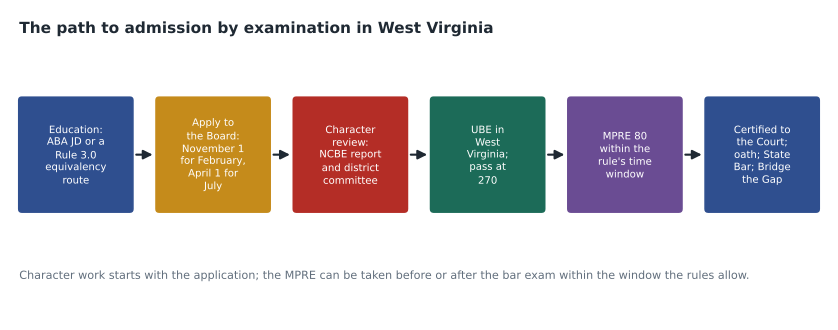
For a JD graduate like Lonnie, the path has six steps, though several run in parallel. First, the applicant must satisfy the education rules: an undergraduate degree and a law degree from an ABA-approved law school, or one of the equivalency routes that Rule 3.0 allows. Second, the applicant files an application with the Board by the filing deadline, with the fees. Third, character and fitness review begins as soon as the application is filed. Fourth, the applicant sits the UBE in West Virginia and must earn a combined scaled score of at least 270. Fifth, the applicant needs an MPRE scaled score of at least 80, earned within the time the rules allow. Sixth, once everything is complete, the Board certifies the applicant to the Court, the applicant takes the oath, joins the State Bar and, within the time allowed, completes Bridge the Gap.
Hollis stressed that the steps are not strictly sequential. 'Character work takes months, so it starts the day you file,' she said. 'The MPRE can be taken before the bar exam, and most people take it in law school. The only step you cannot rush is the exam itself, which happens twice a year.'
| Step | What it requires | Who handles it |
|---|---|---|
| Education | Undergraduate degree; ABA JD or a Rule 3.0 equivalency route | Board |
| Application | Online application and fees by the filing deadline | Board |
| Character and fitness | NCBE report; district committee review; Board decision | NCBE, committee, Board |
| Examination | UBE in West Virginia; 270 or higher | Board (exam written by NCBE) |
| MPRE | Scaled score of 80 within the rule's time window | NCBE, Board |
| Admission | Certification, oath, State Bar membership, Bridge the Gap | Court, State Bar |
What a candidate controls
Lonnie said the structure made him feel better because so much of it was predictable. Hollis agreed and gave the group a list of the things a candidate controls. The first is timing: file early, because an application filed on the first deadline avoids late fees and gives the character review more time. The second is completeness: an application with every address, job and court matter listed, with documents attached, moves faster than one that draws follow-up letters. The third is candor: anything that might be found later should be disclosed now. The fourth is preparation for the exam itself, which is the subject of most of this course.
She also told the group about the things a candidate does not control, so that they would not waste worry on them: the exam questions, the scaling, the speed of other people's responses to the Board's character inquiries and the date results are released. 'Spend your energy where it changes the outcome,' she said.
A short history
West Virginia joined the Uniform Bar Examination system in the 2010s and began accepting transferred UBE scores under Rule 3.5 on or after July 1, 2017. Before that, the state gave its own bar exam with West Virginia essay questions. The move to the UBE was part of a national trend; today most jurisdictions give it. The next change is NextGen, NCBE's new bar exam, which West Virginia will first give in July 2028, as Lesson 5 explains. A February 2027 candidate like Lonnie sits the current UBE, and nothing about NextGen changes his exam.
Keeping a file
Hollis asked every new member of the group to keep a single admission file, paper or electronic, from the day of filing. Lonnie's file has seven sections: a copy of the submitted application and every attachment; the fee receipts; correspondence with the Board, each item dated; the MPRE score report; transcripts and the dean's certification; character documents such as court records and employment letters; and a page of deadlines. 'When the Board writes asking for something, you should be able to answer the same day,' Hollis said. 'And if a question about your history comes up a year from now, the answer you gave the first time is in the file, word for word.'
The file matters for another reason. The application asks for information that later documents repeat: addresses, employers, dates of attendance. An applicant who gives one date on the application and a different date in an interview creates a problem even when neither date was meant to mislead. Consistency comes from working off the same record every time. Lonnie said he had already found one inconsistency of his own, an employment start date he had misremembered, and he wrote to the Board to correct it before anyone asked. Hollis said that was exactly what the committee hopes to see.
Where West Virginia fits nationally
West Virginia is one of a large group of jurisdictions that give the UBE, accept transferred scores and use NCBE's character reports. That makes much of the process familiar to anyone who has looked at another UBE state. The differences lie in the details: the 270 passing score, which is higher than in some UBE states and the same as in others; the MPRE score of 80; the filing deadlines of November 1 and April 1; the District Character Committees; the State Bar's Bridge the Gap requirement; and the rules for admission without examination, which depend on reciprocity. The rest of this course works through each of them.
Worked problem
Who handles which question?
Over one week, Lonnie had four questions: whether his online application had been received; whether a 2019 speeding ticket had to be disclosed; whether his MPRE score from March 2025 would still count; and whether he had to join the West Virginia Bar Association after admission.
Show solution
- Receipt of the application is a Board staff question, best asked in writing.
- Disclosure depends on the application's own wording, which the Board writes; when in doubt, disclose.
- The MPRE timing rule is in Rule 3.2(d) as amended in June 2026; the Board applies it.
- Membership in the State Bar is mandatory; membership in the voluntary West Virginia Bar Association is not.
Answer: Each question has a home: the Board for filing, disclosure and MPRE timing, and the State Bar rules for membership.
Common mistakes
MistakeNCBE decides who is admitted in West Virginia.
InsteadNCBE writes the exams and prepares character reports; the Board and the Supreme Court of Appeals decide.
MistakeThe Board of Law Examiners admits lawyers.
InsteadThe Board certifies applicants; the Supreme Court of Appeals admits them.
MistakeCharacter review starts after the exam.
InsteadIt starts when the application is filed and runs alongside exam preparation.
MistakeJoining the West Virginia Bar Association is required.
InsteadMembership in the integrated West Virginia State Bar is required; the Bar Association is voluntary.
MistakeThe admission rules never change.
InsteadThe Court amends them by order, as it did on June 26, 2026 for the MPRE time window.
Practice problems
Work each problem on paper first, then reveal the answer to check.
Which body adopts the Rules for Admission to the Practice of Law?
Show answer
The Supreme Court of Appeals of West Virginia.
How many members does the Board of Law Examiners have, and how long are their terms?
Show answer
Seven members, each serving a seven-year term.
Who interviews applicants about character and fitness?
Show answer
A District Character Committee of three lawyers.
What passing score applies to the UBE in West Virginia?
Show answer
A combined scaled score of 270.
Which organization must every West Virginia lawyer join?
Show answer
The West Virginia State Bar, an integrated bar.
Summary and key terms
- The Supreme Court of Appeals regulates the practice of law, adopts the admission rules and admits lawyers.
- The seven-member Board of Law Examiners handles applications, eligibility, the exam and certification.
- District Character Committees review character with an NCBE report; the Board decides.
- NCBE writes the exams and reports scores but does not decide admission.
- Membership in the integrated West Virginia State Bar is mandatory after admission.
- The path: education, application, character review, the UBE at 270, the MPRE at 80, certification and oath.
- Supreme Court of Appeals
- West Virginia's highest court, which regulates admission and practice.
- Board of Law Examiners
- The seven-member body that administers admission and the bar exam.
- District Character Committee
- A three-lawyer committee that reviews an applicant's character and fitness.
- integrated bar
- A bar association whose membership is required in order to practice law.
- certification
- The Board's report to the Court that an applicant has met every requirement.
Lesson quiz · 5 questions
Score 60% or more to complete this lesson.
Create a free account to save your progress, take quizzes and earn a certificate.