
BAR-249 · Lesson 3 of 12 · 23 min
Character and fitness and the MPRE score of 80
▶ Video coming soon A video version of this lesson is on the way.
Lonnie's application had one item he worried about. In his second year of college he was cited for underage possession of alcohol at a football game, paid a fine and heard nothing more. On the application, he found a question that asked about every citation, charge and arrest, not just convictions, and he wondered whether a nine-year-old fine for a misdemeanor-level offense could cost him his license. Hollis said it almost certainly could not, provided he disclosed it. 'The thing that sinks applicants is not the old citation,' she said. 'It is leaving it off and having it found.' This lesson covers the character and fitness review and the MPRE, the two requirements that sit beside the exam.
What the review is for
West Virginia, like every jurisdiction, admits only applicants who have the good moral character and fitness to practice law. The purpose is protective, not punitive. The Board asks whether the applicant can be trusted to deal honestly with clients, courts and opponents, to handle client money and confidences, to meet deadlines and to obey the law and the rules of the profession. Past conduct matters because it predicts future conduct, but the review looks at the whole person: what happened, how long ago, what the applicant did about it and how the applicant describes it now.
Rule 2.0 states that convictions for false swearing, perjury or any felony are considered, along with the applicant's prior and subsequent conduct. That language tells applicants something useful: the rule does not make any conviction an automatic bar, but it directs serious attention to offenses involving dishonesty under oath and to felonies, and it invites evidence of rehabilitation.
The process
After an applicant files, NCBE prepares a character report from the application, the authorizations the applicant signs and its own inquiries to schools, employers, courts and others. The file then goes to a District Character Committee, made up of three lawyers appointed by the Supreme Court of Appeals, in the applicant's bar district. The committee may interview the applicant and may investigate further. The applicant carries the burden of proving good moral character, and the rules require the applicant to report changes in the information given, such as a new job, a new address or a new legal matter, while the application is pending.
The committee reports to the Board. If the Board decides that an applicant has not shown the required character and fitness, the applicant receives written notice and may ask for a hearing under Rule 6.0 within the short time the rule allows. At the hearing, the applicant must prove qualifications by clear and convincing evidence. The Board then decides, and the applicant may take exceptions to an adverse decision to the Supreme Court of Appeals. Most applicants never come near this process; it exists for the small number of files that raise real concerns.
What the questions cover
The application asks about many subjects, and applicants should answer each question as worded. The common areas are criminal matters, including arrests, charges and citations, whether or not they led to a conviction and whether or not they were expunged or sealed, unless the application expressly says otherwise; civil litigation in which the applicant was a party; academic discipline in college or law school; employment problems, such as being fired or asked to resign; financial matters, such as defaulted loans, judgments, tax liens and bankruptcy; professional licenses and their discipline; and driving records. Some applications also ask about conduct or conditions that currently impair the ability to practice.
Questions that ask whether a matter was 'ever' the subject of a charge reach back to childhood unless the question sets a limit. An applicant who is unsure whether a matter is covered should disclose it and explain. Over-disclosure costs a paragraph; under-disclosure can cost the license.
Candor and rehabilitation
The most important single factor in most files is candor. The Board and committees see many applicants with old mistakes and very few who are refused because of them. Refusals and delays tend to come from false or incomplete answers, from attempts to minimize what happened, and from patterns of recent misconduct. An applicant who discloses fully, explains plainly and shows what has changed is in a strong position.
Rehabilitation evidence includes time passed without further problems, restitution or repayment, completed treatment where relevant, steady employment, community service and letters from people who know the applicant well. For financial issues, a payment plan that the applicant has kept is more persuasive than a promise to start one. For an alcohol-related matter, the question is whether there is a current problem; a single college citation with nothing since rarely suggests one.
| Issue | What the committee looks for | What helps |
|---|---|---|
| Old minor citation | Disclosure; no pattern | A short factual explanation |
| Student loan default | Responsibility for debts | A rehabilitation agreement kept for months |
| Academic discipline | Honesty and insight | The school's record and the applicant's account, consistent |
| Firing from a job | Reliability | An honest account and a later good reference |
| Omitted matter discovered | Candor | Immediate correction before anyone asks |
The MPRE requirement
The Multistate Professional Responsibility Examination is a 60-question multiple-choice test of the law governing lawyers: the ABA Model Rules of Professional Conduct, the Model Code of Judicial Conduct and the general law of lawyering, such as malpractice and the attorney-client privilege. NCBE writes and scores it, and it is given at testing centers several times a year. Scores are reported on a scaled range of 50 to 150. Each jurisdiction sets its own passing score.
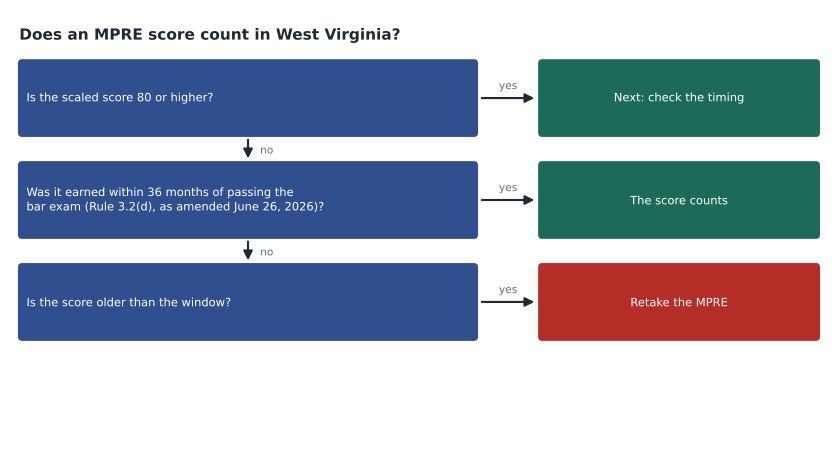
West Virginia's passing score is a scaled 80. That figure is confirmed in NCBE's chart and in the Court's June 26, 2026 order, which noted that the passing score remained at least 80 while changing the timing rule. Passing scores in other jurisdictions range from 75 to 86, so a candidate who may also seek admission elsewhere should check that jurisdiction's figure as well.
Timing: the 36-month window
The MPRE score must be earned within a set period. Until 2026, Rule 3.2(d) required the scaled score to be achieved within 25 months of successfully completing the bar exam. In docket number 25-810, the Supreme Court of Appeals published amendments for comment and, by order entered June 26, 2026, extended the window to 36 months. The same order amended Rule 4.4, which governs MPRE scores for applicants seeking admission on motion, so that the Board may accept a score from another jurisdiction or a prior exam taken within 36 months of the application.
In practice, the window works in both directions. A candidate may take the MPRE before the bar exam, as most do during law school, or after it. What matters is that the passing MPRE score and the passing bar exam score fall within 36 months of each other under the rule's terms. A candidate whose MPRE score is old should check the dates carefully against the current rule and, if in doubt, write to the Board.
Applying the rule
Lonnie took the MPRE in March 2025 during his second year of law school and scored 96, well above the West Virginia requirement. He sits the bar exam in February 2027. The gap between the two is about 23 months, which would have fit even under the old 25-month rule and fits easily under the new 36-month rule. Another member of the group, studying for a different state, had taken the MPRE in November 2023 and would sit in February 2027, a gap of about 39 months. In West Virginia, that score would fall outside the window and would have to be retaken.
What the MPRE tests
Because the MPRE is a separate requirement, candidates sometimes treat it as an afterthought. Hollis did not. The exam tests the regulation of the legal profession, the client-lawyer relationship, client confidentiality, conflicts of interest, competence and malpractice, litigation and other forms of advocacy, transactions and communications with persons other than clients, the different roles of the lawyer, safekeeping funds and other property, communications about legal services, lawyers' duties to the public and the legal system, and judicial conduct. Conflicts of interest and confidentiality together make up a large share of the questions.
The MPRE tests the ABA Model Rules, not West Virginia's own rules, so a candidate should learn the Model Rule answer. West Virginia's rules follow the Model Rules closely but not completely, and Lesson 10 covers the differences a new West Virginia lawyer should know. On the MPRE, though, the right answer is the Model Rule answer unless the question says otherwise.
Preparing for the MPRE
Most candidates prepare for two to four weeks, using a professional responsibility course from law school, an outline and practice questions. NCBE sells official practice exams with past questions, which give the best sense of how questions are framed. Hollis suggested a simple method: learn the rules subject by subject, then do timed sets of questions and keep a log of every missed question with the rule that answers it. A candidate who reviews the log before the exam finds that the same few rules account for most errors.
The MPRE is given at testing centers on several dates each year, and registration closes well before each date. A candidate who needs the score for a particular bar exam should register early enough that a retake is possible if the first attempt falls short. Scores are usually released several weeks after the test, and NCBE sends them to the jurisdictions the candidate designates.
Preparing for the interview
Not every applicant is interviewed, but every applicant should be ready to be. Hollis's advice was practical. Reread the application before the interview, because the committee will have it in front of them and will ask about it. Bring copies of any documents that explain a disclosed matter. Answer questions directly and briefly, and do not volunteer arguments about why a rule is unfair. If a question touches something the applicant does not remember, say so and offer to find out. Dress as for a job interview with lawyers, because that is what it is.
Questions about health and conduct
Bar applications across the country have narrowed their questions about mental health in recent years, focusing on current conduct and current impairment rather than diagnosis or treatment history. Applicants should read West Virginia's current questions carefully and answer exactly what they ask. Seeking counseling or treatment is not misconduct, and applicants should not avoid help because they fear the application. Where a question does call for information, a short, factual answer with supporting documentation from a treating professional is the usual approach.
Financial responsibility
Debts are a common source of questions, because a lawyer who handles client money must show financial responsibility. Debt itself is not disqualifying; most new lawyers have student loans. What concerns committees is neglect: loans in default with no plan, judgments ignored, taxes unpaid. An applicant with a financial problem should take concrete steps before filing, such as entering a repayment or rehabilitation agreement, and should document every payment made under it. Six months of payments on a plan speak louder than any explanation.
Reporting changes
The duty to keep the application current continues until admission. A new traffic citation, a new lawsuit, a change of job or address, or anything else that would change an answer must be reported promptly. An applicant who moves, changes employers or is involved in an accident while the application is pending should tell the Board in writing and keep a copy. Lonnie said that duty made sense, since the application is only accurate on the day it is signed. Hollis said the committees treat a prompt update as a sign of exactly the reliability they are looking for.
Worked problem
Will the score count?
A hypothetical applicant, Junia Yokum, scored 82 on the MPRE in August 2024 and plans to sit the West Virginia exam in July 2027, with results expected in the fall of 2027.
Show solution
- The score of 82 meets the scaled passing score of 80.
- From August 2024 to July 2027 is about 35 months, inside the 36-month window under amended Rule 3.2(d).
- Had the old 25-month rule still applied, the score would have been too old.
- If she failed in July 2027 and sat again in February 2028, the gap would exceed 36 months and she would need a new score.
Answer: Junia's score counts for July 2027 under the amended rule, but only just; a later sitting would require a new MPRE.
Worked problem
Disclosing the citation
Lonnie must answer a question asking whether he has ever been cited, charged or arrested for any offense.
Show solution
- The 2017 underage possession citation is within the question's plain words, so it must be disclosed.
- He should state the date, the court, the offense, the fine and that nothing further occurred.
- He should attach the court record if one can be obtained, or explain the effort made to get it.
- A short statement of what he learned is appropriate; excuses are not.
Answer: Full disclosure of a single old citation with nothing since is very unlikely to affect admission; omission could.
Common mistakes
MistakeExpunged matters never need disclosure.
InsteadAnswer the question as written; many applications ask about matters regardless of expungement unless they say otherwise.
MistakeThe committee decides admission.
InsteadThe committee reports; the Board decides, with review available in the Court.
MistakeWest Virginia accepts an MPRE score of 75.
InsteadThe passing score is a scaled 80.
MistakeThe MPRE must be passed within 25 months of the bar exam.
InsteadThe window became 36 months by order entered June 26, 2026.
MistakeOld mistakes are the main cause of refusals.
InsteadLack of candor and recent patterns of misconduct cause most problems.
Practice problems
Work each problem on paper first, then reveal the answer to check.
Who carries the burden of proving good moral character?
Show answer
The applicant.
What standard applies at a character hearing?
Show answer
Clear and convincing evidence.
What MPRE scaled score does West Virginia require?
Show answer
80.
What did the June 26, 2026 order change?
Show answer
It extended the MPRE window from 25 to 36 months in Rules 3.2(d) and 4.4.
Name two kinds of rehabilitation evidence.
Show answer
Time without further problems and repayment or restitution; also treatment, steady work and references.
Summary and key terms
- Character review protects the public; it asks whether the applicant can be trusted with clients, courts and money.
- NCBE prepares a report; a District Character Committee reviews and may interview; the Board decides.
- Rule 2.0 directs attention to convictions for false swearing, perjury and felonies, with prior and later conduct.
- Candor is the key factor: disclose fully, explain plainly and show rehabilitation.
- The MPRE passing score is a scaled 80.
- Since June 26, 2026, the MPRE score must fall within 36 months of passing the bar exam.
- character and fitness
- The qualities of honesty, reliability and judgment required for admission.
- MPRE
- NCBE's professional responsibility exam, scored 50 to 150.
- rehabilitation
- Evidence that an applicant has addressed past misconduct and changed.
- clear and convincing evidence
- Proof that makes a fact highly probable; the applicant's burden at a hearing.
- Rule 6.0
- The rule governing hearings on adverse admission decisions.
Lesson quiz · 5 questions
Score 60% or more to complete this lesson.
Create a free account to save your progress, take quizzes and earn a certificate.