
BAR-249 · Lesson 8 of 12 · 22 min
West Virginia torts: modified comparative fault and the 2015 reforms
▶ Video coming soon A video version of this lesson is on the way.
Most of Varner & Dotson's injury cases involve more than one possible defendant. In one of Lonnie's files, a delivery driver was hurt when a forklift operated by a warehouse employee struck him in a loading area with poor lighting, and the driver himself had walked into the lane while looking at his phone. 'Who pays, and how much?' Verna asked him. Lonnie said that on the MBE he would have answered with joint and several liability and a comparative negligence reduction. Verna said that in West Virginia, since 2015, the answer starts somewhere else entirely. This lesson covers West Virginia's comparative fault statute and the other 2015 tort reforms that shape injury practice.
From Bradley to 2015
West Virginia abandoned the traditional rule of contributory negligence, under which any negligence by the plaintiff barred recovery, in Bradley v. Appalachian Power Co. (1979). The Supreme Court of Appeals adopted a form of modified comparative negligence: a plaintiff could recover as long as the plaintiff's negligence was less than the combined negligence of the other parties, with damages reduced in proportion to the plaintiff's fault. Defendants remained jointly and severally liable in most cases, so a plaintiff could collect the whole judgment from any defendant, who could then seek contribution from the others.
In 2015, the Legislature replaced much of that judge-made structure with a statute. House Bill 2002, codified at sections 55-7-13a through 55-7-13d of the West Virginia Code, adopted modified comparative fault with several liability for most defendants. The law took effect 90 days after passage on February 24, 2015, and applies to causes of action arising or accruing on or after that effective date, in late May 2015. Older causes of action are governed by the earlier law, which still matters in a few long-running cases.
The plaintiff's fault
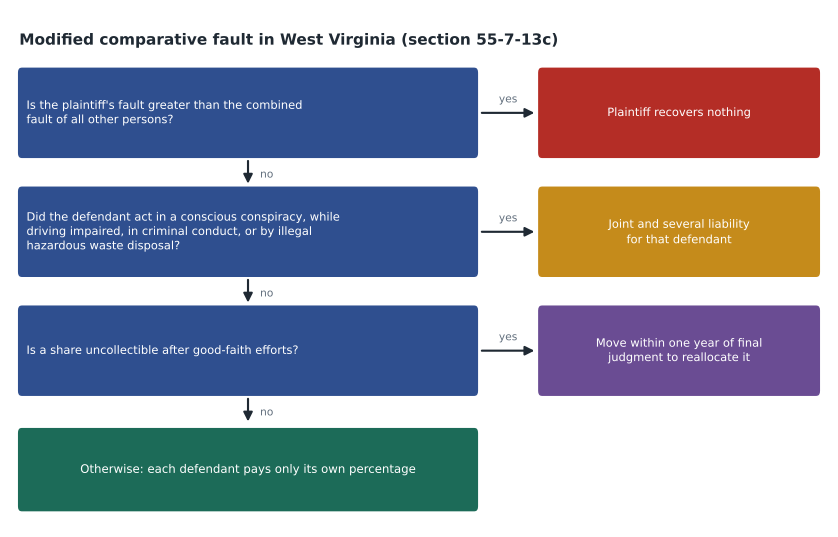
Under section 55-7-13c(c), the plaintiff's fault bars recovery only if it is greater than the combined fault of all other persons whose fault is considered. A plaintiff whose fault is exactly equal to the combined fault of the others is not barred. Below that line, the plaintiff's recovery is reduced in proportion to the plaintiff's own percentage of fault. In practice, a plaintiff found 50 percent at fault recovers half of the damages, and a plaintiff found 51 percent at fault recovers nothing.
This is a 'greater than' bar, sometimes called a 51 percent bar, and it differs from the 'equal to or greater than' bar used in some other states, under which a plaintiff at exactly 50 percent recovers nothing. On the MBE, a question will either state the rule or test a general approach; in a West Virginia case, the statute's wording controls.
Several liability
The central change in 2015 was the move to several liability. Under section 55-7-13c(a), each defendant is generally liable only for the compensatory damages allocated to it in proportion to its percentage of fault, and the court enters a separate judgment against each defendant for its share. Under subsection (b), a defendant's maximum liability equals the total recoverable damages multiplied by its percentage of fault, subject to the reallocation rule discussed below.
The practical effect is large. Before 2015, a plaintiff could collect an entire judgment from a defendant who was 20 percent at fault if the other defendants could not pay. After 2015, that defendant generally pays only 20 percent of the damages. The risk that a defendant cannot pay shifts, in large part, from the solvent defendants to the plaintiff.
Exceptions: when joint liability survives
The statute keeps joint and several liability in specific situations. Defendants who consciously conspire and deliberately pursue a common plan or design to commit a tortious act are jointly liable, and those defendants may seek contribution among themselves. In addition, under subsection (h), a defendant is jointly and severally liable if its conduct was a proximate cause of the plaintiff's harm and involved driving under the influence of alcohol, a controlled substance or another drug, criminal conduct, or the illegal disposal of hazardous waste.
Reallocation of uncollectible shares
The statute softens several liability with a reallocation procedure. Under section 55-7-13c(d), if a plaintiff makes good-faith efforts but cannot collect a liable defendant's share, the plaintiff may move, within one year after the judgment becomes final, for reallocation. The court then reallocates the uncollectible amount among the other parties found at fault, including a plaintiff who was at fault, in proportion to their percentages of fault. Two limits apply: no defendant can be reallocated more than its own percentage of fault multiplied by the uncollectible amount, and no reallocation may be made to a defendant whose fault is equal to or less than the plaintiff's. The parties may take discovery on collectibility before the hearing, and reallocated parties keep their rights of contribution.
Immune and capped defendants
Subsection (g) provides that fault assigned to a defendant who is immune from liability, or whose liability is limited by law, cannot be shifted to other defendants. If a political subdivision with statutory protections, for example, is assigned a share of fault but is immune or capped, the other defendants do not absorb the difference. Subsection (i) lists statutory articles and chapters to which the section does not apply; claims under the Medical Professional Liability Act, for example, are handled under that Act's own provisions rather than this section.
Nonparty fault
Section 55-7-13d allows the fact-finder to consider the fault of persons who are not parties to the case, such as a settling defendant or a person the plaintiff chose not to sue, when the defendant gives notice that it intends to assert nonparty fault within the time the statute requires. Allocating fault to a nonparty reduces the shares of the parties who remain, but it does not create liability for the nonparty in that case. Defense lawyers therefore investigate early to identify every person whose fault might be considered, and plaintiffs' lawyers think carefully about whom to sue.
| Situation | Result under the 2015 statute |
|---|---|
| Plaintiff 50 percent at fault | Recovers half of the damages |
| Plaintiff 51 percent at fault | Recovers nothing |
| Defendant 20 percent at fault, others insolvent | Generally pays 20 percent, subject to reallocation |
| Defendant driving drunk and a proximate cause | Jointly and severally liable |
| Immune defendant assigned fault | Its share is not shifted to the others |
| Settling nonparty with notice given | Fault can be allocated, reducing the parties' shares |
Punitive damages
Senate Bill 421, also enacted in 2015 and codified at section 55-7-29, governs punitive damages. The plaintiff must prove by clear and convincing evidence that the damages resulted from conduct carried out with actual malice toward the plaintiff or with a conscious, reckless and outrageous indifference to the health, safety and welfare of others. Punitive damages may not exceed the greater of four times the amount of compensatory damages or 500,000 dollars. On a defendant's request, the trial may be bifurcated, so that the jury decides liability and compensatory damages before it hears evidence relevant only to punitive damages.
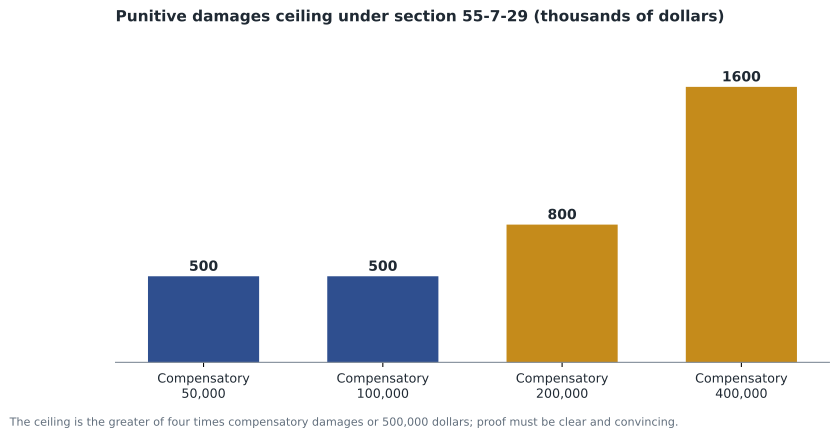
The ceiling works differently at different levels of compensatory damages. When compensatory damages are 125,000 dollars or less, four times compensatory is 500,000 dollars or less, so the 500,000-dollar figure is the ceiling. Above 125,000 dollars, four times compensatory is the larger figure. The statute operates alongside the federal constitutional limits on punitive damages, which can make an award within the statutory ceiling still too large in a particular case.
The open and obvious statute
Section 55-7-28, also enacted in 2015, addresses premises liability. A possessor of real property, including an owner, lessee or other lawful occupant, owes no duty of care to protect others against dangers that are open, obvious, reasonably apparent or as well known to the person injured as they are to the owner or occupant, and is not liable for injuries from them. The Legislature stated its intent to reinstate and codify the open and obvious doctrine as it existed before the Supreme Court of Appeals decided Hersh v. E-T Enterprises in 2013, and it directed courts to apply the doctrine as a matter of law, considering the nature and severity of any related statutory violations. The statute does not create any cause of action.
For a premises case like the hardware store fall Lonnie researched, the statute often decides the case: if the danger was open and obvious, the possessor owed no duty, and comparative fault never comes into play. The facts that matter are lighting, visibility, warnings and what the injured person knew.
Deliberate intent
West Virginia's workers' compensation system generally gives employers immunity from negligence suits by injured employees. The main exception is the deliberate intent action under section 23-4-2(d)(2), which allows an employee to sue an employer that acted with deliberate intention, including under a statutory test built around an employer's actual knowledge of a specific unsafe working condition that violated a safety standard and presented a high degree of risk of serious injury. House Bill 2011, effective for injuries on or after July 1, 2015, tightened the test: actual knowledge must be specifically proven and cannot be presumed, the safety standard must be specifically applicable to the work, the injury must meet a defined level of seriousness, and the complaint must be accompanied by a verified statement from a qualified expert.
Product liability and choice of law
Another 2015 statute addressed product liability claims by nonresidents. It provides that the law of the place of injury governs such claims, extending an earlier rule for pharmaceutical failure-to-warn claims to products generally, for civil actions commenced on or after July 1, 2015. The rule matters because West Virginia's product liability law has historically been regarded as favorable to plaintiffs, and the statute limits the use of West Virginia courts and law for injuries suffered elsewhere.
Worked problem
The forklift case
In Lonnie's file, a jury finds total damages of 400,000 dollars and allocates fault as follows: the delivery driver 30 percent, the warehouse company (through its forklift operator) 50 percent and the building owner (for poor lighting) 20 percent. The building owner is insolvent.
Show solution
- The driver's 30 percent is not greater than the others' combined 70 percent, so he recovers, reduced by 30 percent.
- Several liability applies: the warehouse company owes 50 percent of 400,000 dollars, or 200,000; the owner owes 80,000.
- No exception applies on these facts, so the warehouse company is not liable for the owner's share outright.
- Within one year of final judgment, the driver may move to reallocate the owner's 80,000. Reallocation to the warehouse company is allowed because its fault (50 percent) exceeds the driver's (30 percent).
- In proportion, the warehouse company's share of the 80,000 would be 50,000, but the statute limits it to its own percentage of fault times the uncollectible amount: 50 percent of 80,000, or 40,000. The driver bears the rest.
Answer: The driver collects 200,000 dollars from the warehouse company and may obtain a further 40,000 by reallocation, bearing 40,000 of the uncollectible share himself.
Worked problem
A punitive damages ceiling
A jury awards a hypothetical plaintiff, Waneta Keener, 90,000 dollars in compensatory damages and 700,000 dollars in punitive damages against a trucking company whose driver was found to have acted with conscious, reckless and outrageous indifference.
Show solution
- Four times compensatory damages is 360,000 dollars.
- The greater of 360,000 and 500,000 is 500,000 dollars.
- The 700,000-dollar punitive award exceeds the ceiling.
- The court reduces the punitive award to 500,000 dollars, subject to any further constitutional review.
Answer: Punitive damages are capped at 500,000 dollars on these facts.
Common mistakes
MistakeWest Virginia defendants are jointly and severally liable for all damages.
InsteadSince 2015, most defendants are severally liable for their own share only.
MistakeA plaintiff at exactly 50 percent fault recovers nothing.
InsteadThe bar applies only if the plaintiff's fault is greater than the others' combined fault.
MistakePunitive damages are capped at four times compensatory in every case.
InsteadThe cap is the greater of four times compensatory or 500,000 dollars.
MistakeAn immune defendant's share is spread among the others.
InsteadSection 55-7-13c(g) prevents shifting it.
MistakeThe open and obvious doctrine is only a comparative fault factor in West Virginia.
InsteadSection 55-7-28 makes it a no-duty rule applied as a matter of law.
Practice problems
Work each problem on paper first, then reveal the answer to check.
Which case adopted comparative negligence in West Virginia?
Show answer
Bradley v. Appalachian Power Co. (1979).
What is the plaintiff's bar under section 55-7-13c?
Show answer
The plaintiff recovers nothing if the plaintiff's fault is greater than the combined fault of all others.
Name the four situations that keep joint and several liability.
Show answer
Conscious conspiracy; driving under the influence; criminal conduct; illegal hazardous waste disposal.
Within what time must a reallocation motion be filed?
Show answer
Within one year after the judgment becomes final.
What is the punitive damages ceiling under section 55-7-29?
Show answer
The greater of four times compensatory damages or 500,000 dollars.
Summary and key terms
- Bradley (1979) adopted comparative negligence; HB 2002 (2015) codified modified comparative fault at sections 55-7-13a to 13d.
- A plaintiff is barred only if the plaintiff's fault exceeds the others' combined fault; otherwise damages are reduced.
- Most defendants are severally liable; joint liability survives for conspiracy, impaired driving, criminal conduct and illegal waste disposal.
- Uncollectible shares may be reallocated on a motion within one year of final judgment, with limits.
- Punitive damages need clear and convincing proof and are capped at the greater of four times compensatory or 500,000 dollars.
- Section 55-7-28 restores the pre-Hersh open and obvious no-duty rule; deliberate intent claims were tightened in 2015.
- several liability
- Liability limited to a defendant's own share of fault.
- joint and several liability
- Liability under which any responsible defendant can be made to pay the whole judgment.
- reallocation
- Redistributing an uncollectible share among the other parties at fault.
- nonparty fault
- Fault of a person not in the case that the fact-finder may consider after notice.
- deliberate intent
- The exception to employer immunity in section 23-4-2(d)(2).
Lesson quiz · 5 questions
Score 60% or more to complete this lesson.
Create a free account to save your progress, take quizzes and earn a certificate.