
BAR-249 · Lesson 5 of 12 · 20 min
Exam changes: NextGen in July 2028
▶ Video coming soon A video version of this lesson is on the way.
Marcus Bell, the group's Missouri member, took the first NextGen bar exam in July 2026 and passed. When Lonnie joined the group, Marcus was the first person to ask him which exam he was taking. 'The old one,' Lonnie said. 'I think.' Hollis said that 'I think' was not good enough for a bar candidate and that West Virginia's NextGen dates had in fact changed once already. This lesson sets out what NextGen is, when West Virginia moves to it, what happens to scores during the transition and why none of it changes the February 2027 exam.
What NextGen is
NextGen is NCBE's new bar examination. It was developed after a multi-year study of what newly licensed lawyers do in practice, and it is designed to test foundational legal knowledge together with lawyering skills in an integrated way, rather than testing knowledge mainly through multiple choice and skills mainly through the MPT. NCBE first administered it in July 2026 in a group of early jurisdictions, and more jurisdictions are adopting it on staggered dates. The current UBE, now often called the legacy UBE, will be given for the last time in February 2028.
NextGen is a nine-hour exam given over a day and a half: six hours on the first day and three on the second, in three sessions of three hours each. Each session mixes question types: stand-alone multiple-choice questions, integrated question sets built around a common fact pattern that combine multiple-choice and short written answers, and performance tasks that ask the candidate to do lawyering work with supplied materials. Scores are reported as a single scaled score on a range of 500 to 750, and each jurisdiction sets its own passing score on that scale.
What it tests
NextGen tests eight foundational concepts and principles: business associations, civil procedure, constitutional law, contract law, criminal law, evidence, real property and torts. NCBE has announced that family law will be added beginning with the July 2028 exam, and some trusts and estates material may appear in connection with legal resources supplied in the questions. It also tests seven foundational skills: legal research, legal writing, issue spotting and analysis, investigation and evaluation, client counseling and advising, negotiation and dispute resolution, and client relationship and management. The professional responsibility rules can appear within the skills questions, though the MPRE remains a separate requirement.
Compared with the legacy UBE, NextGen covers fewer subjects in depth and places more weight on applying law to realistic tasks. NCBE's materials describe the content scope in detail, with some topics marked as tested in greater depth. A candidate preparing for NextGen should start with NCBE's content scope and sample questions, not with a legacy outline.
| Feature | Legacy UBE | NextGen |
|---|---|---|
| Length | Two full days (12 hours) | Nine hours over a day and a half |
| Question types | MBE multiple choice, MEE essays, MPT tasks | Multiple choice, integrated question sets, performance tasks |
| Score scale | 400-point scale; West Virginia passes at 270 | 500 to 750; West Virginia score to be announced |
| Subjects | Seven MBE subjects plus MEE subjects | Eight foundational concepts; family law added July 2028 |
| Last or first in West Virginia | Last given February 2028 | First given July 2028 |
West Virginia's dates
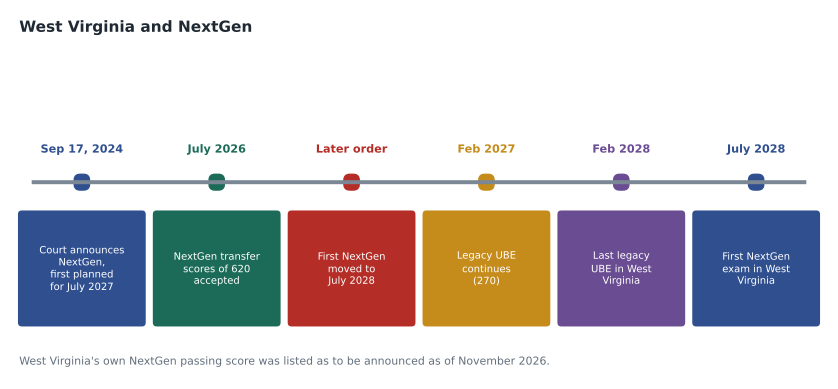
On September 17, 2024, NCBE announced that West Virginia and North Dakota had adopted NextGen. The announcement quoted Chief Justice Tim Armstead and said West Virginia would begin administering NextGen in July 2027. The Supreme Court of Appeals later changed that date. The Court's bar admissions page now states that the Court approved July 2028 as the first NextGen administration in West Virginia, replacing the previously announced July 2027 date, and that the current UBE will be given through February 2028.
Some secondary sources, and parts of NCBE's own jurisdiction page, still showed the July 2027 date in late 2026, while other parts of the same page showed July 2028. Hollis said this is a common problem during a transition and that the rule for resolving it is simple: the Court's own announcement controls. A candidate who sees conflicting dates should rely on the Court and the Board and, if anything remains unclear, ask the Board in writing.
The passing score
As of November 2026, West Virginia had not announced the passing score it will use for NextGen examinations given in West Virginia. NCBE's chart lists it as to be announced. For transferred scores, though, the Court has acted, as the next section explains. Candidates who expect to sit in July 2028 or later should watch for the Court's announcement of the in-state passing score.
Transferring NextGen scores in
The Court approved NCBE's NextGen score conversion chart for portability purposes. Under it, a NextGen UBE score of 620 is treated as equivalent to a legacy UBE score of 270 for transferring a score into West Virginia. During the transition, an applicant may seek admission by transferred score with either a legacy UBE score of 270 or higher or a NextGen UBE score of 620 or higher. NCBE's chart records that West Virginia began accepting NextGen transfer scores starting with the July 2026 exam. The usual transfer conditions in Rule 3.5 still apply, including the three-year limit on the age of the score, as Lesson 11 explains.
Marcus asked what that meant for him. His July 2026 NextGen score of 648 exceeds 620, so if he wanted West Virginia admission by transferred score within the time allowed, the score itself would qualify; he would still need character and fitness clearance and an MPRE score meeting West Virginia's requirement. He said he had no plans to move to West Virginia but liked knowing the option existed.
What the transition means for different candidates
For a February 2027 candidate like Lonnie, nothing changes. He sits the legacy UBE, needs 270 and should prepare with legacy materials. The four MEE subjects removed in July 2026 will not appear on his exam. For a candidate who sits in July 2027 or February 2028, the same is true: those are legacy UBE exams in West Virginia. For a candidate who first sits in July 2028 or later, the exam is NextGen.
The hardest position is the candidate who sits the legacy exam in February 2028, the last legacy sitting, and does not pass. That candidate's next attempt in West Virginia would be on NextGen in July 2028, a different exam with different question types and a different score scale. Hollis said candidates in that window should prepare with special care for February 2028 and, if they fail, should plan a new study program for NextGen rather than repeating legacy materials.
| First sitting in West Virginia | Exam | Passing score |
|---|---|---|
| February 2027 | Legacy UBE | 270 |
| July 2027 | Legacy UBE | 270 |
| February 2028 | Legacy UBE (last) | 270 |
| July 2028 and later | NextGen UBE | To be announced (620 accepted for transfers in) |
Choosing study materials
Commercial bar courses began shifting toward NextGen in 2026, and some practice materials now blend the two exams. Hollis told Lonnie to make sure every practice set he uses is designed for the legacy UBE. A NextGen practice question may use a format that does not appear on the legacy exam. An older MEE practice set has the opposite problem: it may include essays on conflict of laws, family law, trusts and estates or secured transactions, which left the MEE in July 2026. Lonnie should skip those essays and spend the time on the eight current MEE subjects.
The question types in more detail
Marcus described the NextGen question types from his own experience in Missouri. The stand-alone multiple-choice questions look familiar to anyone who has done MBE practice, though some ask the candidate to select two correct answers rather than one, with partial credit available. The integrated question sets begin with a fact pattern and a few documents, then ask a series of questions about it, some multiple choice and some requiring a short written answer, such as a paragraph explaining what a client should do next or drafting a contract clause. The performance tasks resemble the MPT: the candidate receives a file and a library and produces a piece of written work.
NCBE also includes longer research-focused performance tasks, in which the candidate works through a larger set of materials over a longer period and answers questions that test research judgment, as well as drafting. Marcus said the hardest adjustment was pacing, because the sessions mix question types and the candidate must decide how long to spend on each, within the section's overall time. 'You cannot do it the MBE way,' he said, 'where every question gets the same minute and a half.'
If you will sit in July 2028 or later
A law student who expects to sit in West Virginia in July 2028 or later should plan for NextGen from the start. Hollis suggested four steps. First, read NCBE's content scope for NextGen and note the topics marked for greater depth. Second, take NCBE's sample questions and tutorial early, in law school, to become familiar with the formats and the testing software. Third, choose law school courses with the skills in mind: legal research and writing, clinics, negotiation, client counseling and drafting all build the abilities the performance tasks and short-answer questions test. Fourth, choose a commercial course designed for NextGen, not an adapted legacy course.
Students should also remember that family law joins the tested concepts in July 2028, which is exactly when West Virginia begins giving NextGen. A West Virginia candidate in the first NextGen group should therefore expect family law content that earlier NextGen takers in other states did not face. Courses and materials prepared for July 2026 or July 2027 candidates elsewhere may not include it.
Why the change matters after admission
NextGen's emphasis on skills reflects a broader view of what new lawyers need: the ability to research, write, counsel and negotiate, not just to recall rules. West Virginia's Bridge the Gap program and continuing legal education requirements aim at the same goal from the other side, after admission. Hollis said that whichever exam a candidate takes, the skills the MPT tests today and NextGen will test tomorrow are the skills a client pays for.
How other jurisdictions are moving
West Virginia is one of many jurisdictions on the move. Some gave NextGen for the first time in July 2026, others plan to begin in July 2027 or July 2028, and a few have announced that they will not adopt it or will use their own exams. During the transition, each jurisdiction decides whether to accept NextGen scores, legacy UBE scores or both for transfers, and from what date. A candidate who wants a portable score should check the receiving jurisdiction's rule as well as West Virginia's. Lonnie, for example, has thought about practicing across the river in Ohio or Pennsylvania one day. His legacy UBE score from February 2027 will be portable to UBE jurisdictions that accept legacy scores within their time limits, but he would need to check each state's own rule, since not every neighbor uses the UBE in the same way.
Keeping up with announcements
Because the dates have already moved once, Hollis asked the group's West Virginia members to check the Court's bar admissions page at least monthly until their exam and to read any new order on the admission rules. The Court publishes proposed amendments for comment before adopting them, so most changes can be seen coming. NCBE's jurisdiction pages are useful summaries but sometimes lag behind the Court's own announcements.
Worked problem
Which exam and which score?
A hypothetical candidate, Rhoda Romine, graduates in May 2028 and plans to sit in July 2028 in West Virginia. Her friend Elden Spurlock passed the NextGen exam in another state in July 2027 with a score of 626 and wants to transfer it to West Virginia in 2028.
Show solution
- Rhoda's July 2028 exam in West Virginia is NextGen; she needs West Virginia's announced NextGen passing score and should prepare with NextGen materials.
- Elden's score of 626 exceeds the 620 the Court treats as equivalent to 270 for transfers in.
- Elden must apply within the three-year age limit for transferred scores, so by July 2030 at the latest under Rule 3.5.
- Both still need character and fitness clearance and a qualifying MPRE score.
Answer: Rhoda sits NextGen; Elden can transfer his 626, subject to the usual Rule 3.5 conditions.
Common mistakes
MistakeWest Virginia's first NextGen exam is July 2027.
InsteadThe Court moved it to July 2028; the legacy UBE runs through February 2028.
MistakeA February 2027 candidate should study NextGen materials.
InsteadFebruary 2027 is a legacy UBE sitting; use legacy materials.
MistakeWest Virginia's NextGen passing score is 620.
InsteadThe in-state score was to be announced; 620 is the transfer equivalence for scores coming in.
MistakeNCBE's summary always controls over the Court's page.
InsteadThe Court's own announcement controls; NCBE advises checking with the Board.
MistakeNextGen removes the MPRE requirement.
InsteadThe MPRE remains a separate requirement.
Practice problems
Work each problem on paper first, then reveal the answer to check.
When is West Virginia's first NextGen exam?
Show answer
July 2028.
When is the last legacy UBE in West Virginia?
Show answer
February 2028.
What NextGen score does West Virginia treat as equivalent to 270 for transfers?
Show answer
620.
On what scale are NextGen scores reported?
Show answer
500 to 750.
Which subject does NCBE add to NextGen in July 2028?
Show answer
Family law.
Summary and key terms
- NextGen is NCBE's new integrated exam: nine hours, three sessions, a single score from 500 to 750.
- It tests eight foundational concepts and seven skills; family law is added in July 2028.
- Announced on September 17, 2024 for July 2027, West Virginia's first NextGen exam was moved to July 2028.
- The legacy UBE continues in West Virginia through February 2028 at a passing score of 270.
- For transfers in, the Court treats a NextGen 620 as equal to a legacy 270; the in-state NextGen score was to be announced.
- February 2027 candidates should use legacy materials and skip the four subjects that left the MEE.
- NextGen
- NCBE's new bar exam, first given in July 2026.
- legacy UBE
- The current UBE, given for the last time in February 2028.
- integrated question set
- A NextGen item combining questions about one fact pattern.
- score conversion chart
- NCBE's table relating NextGen scores to legacy UBE scores.
- foundational skills
- The seven lawyering skills NextGen tests.
Lesson quiz · 5 questions
Score 60% or more to complete this lesson.
Create a free account to save your progress, take quizzes and earn a certificate.