
BAR-249 · Lesson 12 of 12 · 20 min
Capstone: West Virginia practice questions and an exam-day plan
▶ Video coming soon A video version of this lesson is on the way.
The last session before the holidays was Lonnie's capstone. Hollis set three tasks: ten short questions on admission and on the West Virginia law from this course, an original memo problem drawn from the kind of file Varner & Dotson sees every month, and a written plan for the exam days and the months after. 'The short questions check that you know the rules,' she said. 'The memo checks that you can use them. The plan checks that you will actually get to the exam rested and ready.' This lesson works through all three. Every question and fact pattern here is original and hypothetical.
Part one: ten short questions
Try each question before reading the answer.
Question 1. An applicant filed for the February exam on November 20. What happens? Answer: The application is after the November 1 first deadline but before the December 1 late deadline, so it is accepted with the late fee. Filing after December 1 would mean waiting for July.
Question 2. An applicant scored 79 on the MPRE in 2025. Can the score be used in West Virginia? Answer: No. West Virginia requires a scaled score of 80. The applicant must retake the MPRE and earn 80 or higher within the 36-month window set by amended Rule 3.2(d).
Question 3. A candidate's practice exams show a scaled MBE of 131. Is that enough to pass with average written scores? Answer: Not reliably. West Virginia requires a combined 270, so a 131 MBE needs a scaled written score of about 139. The candidate should strengthen both components rather than rely on the written portion to carry the total.
Question 4. A candidate passed the NextGen exam in another state in July 2026 with 622. Can the score transfer to West Virginia? Answer: Yes, if the other requirements are met. The Court treats a NextGen score of 620 as equivalent to a legacy 270 for transfers, and West Virginia began accepting NextGen transfer scores with the July 2026 exam. The score must be from an exam within three years before the application.
Question 5. A client's car is struck by a city snowplow driven negligently on a clear road in April. Is the city immune? Answer: Probably not on that basis. Negligent operation of a vehicle by an employee within the scope of employment is a liability category under section 29-12A-4(c). The snow and ice immunity concerns conditions on public ways caused by snow or ice, not negligent driving. The lawyer must still check every immunity in section 29-12A-5(a) against the facts.
Question 6. A jury finds a plaintiff 50 percent at fault and a single defendant 50 percent at fault. What does the plaintiff recover? Answer: Half of the damages. Under section 55-7-13c(c), the plaintiff is barred only if the plaintiff's fault is greater than the combined fault of all others; equal fault does not bar recovery.
Question 7. A defendant found 15 percent at fault was driving under the influence when the collision occurred, and its conduct was a proximate cause of the harm. Is it severally liable for only 15 percent? Answer: No. Section 55-7-13c(h) makes a defendant whose impaired driving was a proximate cause jointly and severally liable.
Question 8. Compensatory damages are 110,000 dollars and the jury awards 900,000 dollars in punitive damages. What is the maximum punitive award? Answer: 500,000 dollars. Four times compensatory is 440,000 dollars, and the greater of that or 500,000 dollars is 500,000.
Question 9. A family plans to sue a private hospital for a death caused by alleged negligent care. What must they do before filing? Answer: Serve each provider with a notice of claim and a screening certificate of merit by certified mail at least 30 days before filing, under section 55-7B-6, unless a statutory alternative applies.
Question 10. A circuit court enters final judgment in a contract case. Where does the appeal go? Answer: To the Intermediate Court of Appeals, which hears appeals from final civil judgments under section 51-11-4. Further review in the Supreme Court of Appeals may follow.
Part two: the memo problem
Facts. On August 14, 2026, Delmer Cordell, a 58-year-old electrician, was walking across the parking lot of a county-owned recreation center near Weston after a youth league game. A large pothole near the entrance, about two feet across and eight inches deep, had been reported to the county parks office twice in July. The lot lights near the entrance were out, and it was dusk. Delmer was carrying a cooler and looking at his phone. He stepped into the pothole, fell and broke his ankle. While he was on the ground, a private contractor's pickup truck, driven by an employee who had been drinking and whose blood alcohol level was later measured above the legal limit, swerved around another car and clipped Delmer's outstretched leg, causing a second fracture. Delmer's medical bills and lost wages total 85,000 dollars, and his doctors expect lasting pain. He consults Varner & Dotson on November 2, 2026.
Task. Write a memo to Verna Dotson analyzing Delmer's potential claims against the county and the contractor, the effect of his own conduct and the deadlines and damages limits that apply.
Issue 1: Can Delmer recover from the county? Rule: A county is a political subdivision governed by the Governmental Tort Claims and Insurance Reform Act. It is liable only if a claim fits a category in section 29-12A-4(c) and no immunity in section 29-12A-5(a) applies. Liability categories include the negligence of employees within or on the grounds of buildings used in connection with governmental functions, and the negligent failure to keep public roads and ways in repair. Application: The pothole was in the parking lot of a county recreation center and had been reported twice; the lights were out. Delmer can argue that the county's employees negligently failed to repair a known hazard on the grounds of a building used in connection with a governmental function. The county will argue that an immunity applies and that a parking lot is not within the road category. The open and obvious statute, section 55-7-28, is also a defense theme: the county will argue the pothole was open and obvious. Delmer will answer that at dusk, with the lights out, it was not reasonably apparent, and that the county knew of it from the reports. Conclusion: Delmer has a viable claim against the county if the facts fit a liability category and no immunity applies, with the open and obvious statute as the county's main defense on duty.
Issue 2: Can Delmer recover from the contractor, and for how much? Rule: The contractor is liable for its employee's negligent driving within the scope of employment under ordinary respondeat superior principles. Under section 55-7-13c, defendants are generally severally liable only for their own share of fault, but subsection (h) makes a defendant jointly and severally liable when its conduct was a proximate cause of the harm and involved driving under the influence. Application: The driver's blood alcohol level was above the legal limit, and his driving caused the second fracture. If the jury finds that impaired driving was a proximate cause of Delmer's harm, the contractor is jointly and severally liable, so Delmer can collect the full damages attributable to that harm from the contractor regardless of the county's share. Punitive damages may be available if Delmer proves by clear and convincing evidence conscious, reckless and outrageous indifference to safety, subject to the section 55-7-29 ceiling of the greater of four times compensatory damages or 500,000 dollars. Conclusion: The contractor is likely liable and, because of the impaired driving, jointly and severally liable for the harm it caused; punitive damages are possible within the statutory ceiling.
Issue 3: What is the effect of Delmer's own conduct? Rule: Under section 55-7-13c(c), Delmer is barred only if his fault is greater than the combined fault of all others; otherwise his damages are reduced in proportion to his fault. Application: Delmer was looking at his phone while carrying a cooler at dusk. A jury could assign him some fault for the first fall, but it is unlikely to find his fault greater than the combined fault of the county, which knew of the hazard, and the impaired driver. For the second injury, his fault is minimal; he was on the ground. Conclusion: Delmer's recovery is likely reduced but not barred.
Issue 4: Deadlines and damages limits. Rule: Claims against political subdivisions must be brought within two years under section 29-12A-6, noneconomic damages against a political subdivision are capped at 500,000 dollars per person and punitive damages against it are prohibited under section 29-12A-7. Claims against the private contractor are subject to the general two-year personal injury period, and to the punitive damages ceiling in section 55-7-29. Application: The injury occurred on August 14, 2026, so suit against both defendants should be filed before August 14, 2028. Delmer's economic losses of 85,000 dollars are not capped against the county; his noneconomic damages from the county cannot exceed 500,000 dollars; no punitive damages are available against the county. Conclusion: File before August 14, 2028; plan the damages case around the county's cap and the contractor's joint liability.
Recommendation. The firm should preserve evidence at once, including photographs of the lot, the July reports to the parks office, maintenance records, the police report and the driver's test results; send preservation letters to the county and the contractor; investigate any immunity the county may raise; and calendar August 14, 2028 as the outside filing date, aiming to file well before it.
Part three: the exam-day plan
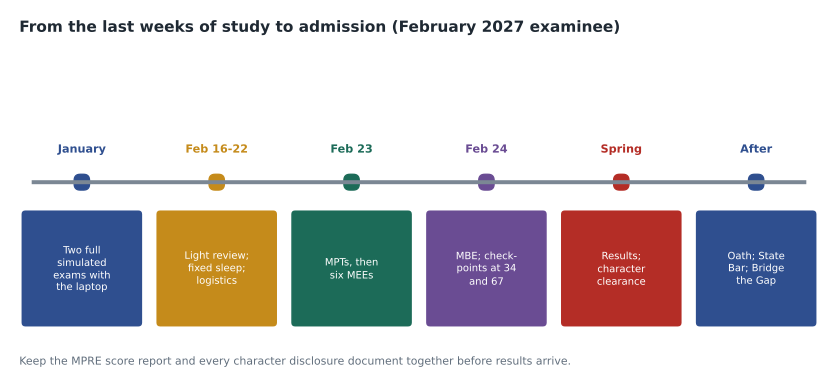
Lonnie's plan, written in the session and checked by Hollis, has five parts. The first is the study calendar: subject review through mid-January, then mixed MBE sets, timed MEE answers and full MPTs, with two complete simulated exams in late January on the laptop. The second is the week before: light review only, fixed sleep and wake times, the drive from Clarksburg to the exam site rehearsed and the admission materials, identification and permitted items packed in a clear bag by Sunday night.
The third part is exam day one, Tuesday, February 23, 2027: arrive early; in the morning, split the three hours evenly between the two MPT tasks and read each task memo twice; in the afternoon, give each MEE question 30 minutes, opening each answer with a conclusion and organizing by the calls of the question. The fourth is day two, Wednesday, February 24, 2027: write the checkpoints of question 34 at one hour and question 67 at two hours on scratch paper, answer every question and flag only questions worth revisiting. The fifth is after the exam: keep the admission file current, report any change to the Board, register for Bridge the Gap once results are in and plan the oath ceremony with his family.
Hollis's last word
At the end of the session, Hollis asked Lonnie what he would remember most from the course. He said it was the difference between the two kinds of law: the general law he would write on February 23 and 24, and the West Virginia law he would use on Monday morning at the firm. Hollis said that was exactly right, and that the habits from both, reading the rule carefully, applying it to the facts and checking the deadline, are the same habits that make a good lawyer anywhere.
Worked problem
Grading the memo
Hollis graded Lonnie's memo against a short checklist.
Show solution
- Did it identify the county as a political subdivision and apply the section 29-12A-4 categories and section 29-12A-5 immunities?
- Did it address the open and obvious statute and the facts that cut against it?
- Did it apply section 55-7-13c, including the impaired driving exception to several liability?
- Did it state the two-year deadlines, the 500,000-dollar noneconomic cap against the county, the bar on punitive damages against the county and the section 55-7-29 ceiling for the contractor?
Answer: A memo that covers all four points, applies each rule to the specific facts and ends with practical steps would earn full credit.
Common mistakes
MistakeApplying West Virginia statutes on the MBE.
InsteadUse the general rule on the exam unless the question supplies a different one.
MistakeTreating a plaintiff at 50 percent fault as barred in West Virginia.
InsteadOnly fault greater than the others' combined fault bars recovery.
MistakeForgetting the impaired driving exception to several liability.
InsteadSection 55-7-13c(h) restores joint liability for impaired driving that is a proximate cause.
MistakeSeeking punitive damages from a county.
InsteadSection 29-12A-7 prohibits punitive damages against political subdivisions.
MistakeLeaving the exam plan until exam week.
InsteadWrite it in advance, including checkpoints and logistics.
Practice problems
Work each problem on paper first, then reveal the answer to check.
What is the late filing deadline for the February exam?
Show answer
December 1.
What NextGen score transfers as equivalent to 270?
Show answer
620.
What makes the contractor jointly and severally liable in the memo problem?
Show answer
Its employee's impaired driving was a proximate cause of the harm.
By what date must Delmer sue the county?
Show answer
Before August 14, 2028, two years after the injury.
What are the MBE checkpoints in each three-hour session?
Show answer
Question 34 at one hour and question 67 at two hours.
Summary and key terms
- Short questions tested deadlines, the MPRE score, the 270 passing score, NextGen transfers and the West Virginia tort statutes.
- The memo applied the Governmental Tort Claims Act, the open and obvious statute and section 55-7-13c to one set of facts.
- Impaired driving that is a proximate cause restores joint and several liability.
- Claims against political subdivisions: two years, a 500,000-dollar noneconomic cap and no punitive damages.
- The exam-day plan covers the study calendar, the final week, both exam days and the steps after the exam.
- On exam day, apply the general rule; in practice, apply West Virginia law.
- capstone
- A final exercise that combines the course's material.
- IRAC
- Issue, rule, application and conclusion, the standard structure for legal analysis.
- respondeat superior
- The doctrine making an employer liable for an employee's torts within the scope of employment.
- preservation letter
- A letter asking a party to keep evidence relevant to a claim.
- checkpoint
- A planned time check during a timed exam session.
Lesson quiz · 5 questions
Score 60% or more to complete this lesson.
Create a free account to save your progress, take quizzes and earn a certificate.