
BAR-249 · Lesson 4 of 12 · 23 min
The West Virginia bar exam: the UBE, scoring and the 270 passing score
▶ Video coming soon A video version of this lesson is on the way.
At the session after his application was accepted, Lonnie asked Hollis a question that sounded simple. 'What score do I need, and how do they get that score from my answers?' Hollis said that the first half was easy, 270, and that the second half was the most misunderstood part of the bar exam. Candidates who understand scaling stop trying to calculate raw percentages and start using their time on the parts of the exam that move the total. This lesson explains the format of the Uniform Bar Examination as West Virginia gives it, how the parts are weighted and scaled, and what the 270 passing score means.
The two days
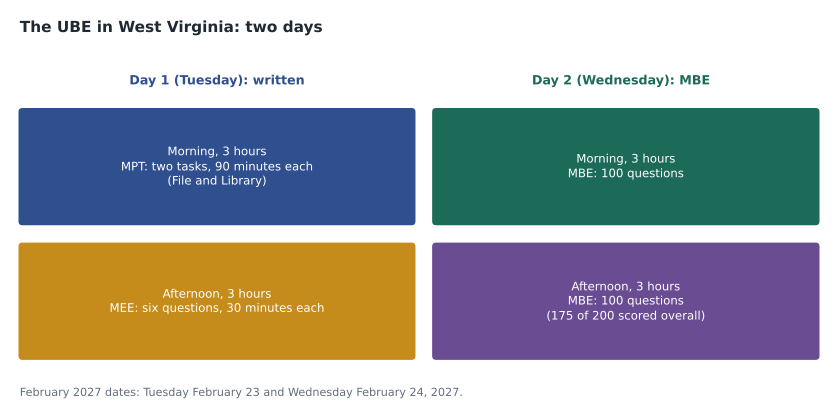
West Virginia gives the UBE twice a year, on the last Tuesday and Wednesday of February and July. The February 2027 exam falls on Tuesday, February 23 and Wednesday, February 24, 2027. The first day is the written day. In the morning, candidates have three hours for the Multistate Performance Test, which consists of two 90-minute tasks. In the afternoon, they have three hours for the Multistate Essay Examination, six questions with about 30 minutes for each. The second day is the Multistate Bar Examination: 200 multiple-choice questions, 100 in a three-hour morning session and 100 in a three-hour afternoon session. Of the 200 questions, 175 are scored and 25 are unscored pretest questions that look exactly like the others.
The Multistate Performance Test
Each MPT task gives the candidate a File, containing the facts in the form of documents such as interview notes, letters and memos, and a Library, containing the law, such as cases, statutes and regulations, some of them from fictional jurisdictions. A task memo from a supervising lawyer tells the candidate what to write: an objective memo, a persuasive brief, a client letter, a demand letter, a contract provision or a plan for discovery, for example. The MPT tests lawyering skills, not memorized law. Everything needed is in the packet, and the instructions say to use only the Library's law.
Candidates lose points on the MPT mostly by failing to follow the task memo: writing an objective memo when the partner asked for a persuasive one, ignoring a format instruction, or running out of time on the second task. Hollis's rule is to split the three hours evenly and to read the task memo twice, once at the start and once before writing.
The Multistate Essay Examination
The MEE has six questions, each about 30 minutes, drawn from a defined list of subjects. Starting with the July 2026 exam, NCBE removed conflict of laws, family law, trusts and estates and secured transactions from the MEE, aligning it with the subjects of the new NextGen exam. For a February 2027 candidate, the MEE subjects are business associations (agency and partnership, corporations and limited liability companies), civil procedure, constitutional law, contracts including Article 2 of the Uniform Commercial Code, criminal law and procedure, evidence, real property and torts. A question may combine subjects.
MEE answers are graded by the jurisdiction, not by NCBE. NCBE supplies the questions, analyses and a grading workshop, and graders in each jurisdiction grade the answers, usually on a relative scale that compares answers to one another. The best preparation is practice: write full answers to released questions under time, then compare them with NCBE's analyses, looking for issues missed and rules stated imprecisely.
The Multistate Bar Examination
The MBE covers seven subjects: civil procedure, constitutional law, contracts, criminal law and procedure, evidence, real property and torts. Questions present a short fact pattern and ask for the best answer among four choices. Each session is three hours for 100 questions, an average of about one minute and 48 seconds per question. There is no penalty for a wrong answer, so every question should be answered.
Weighting
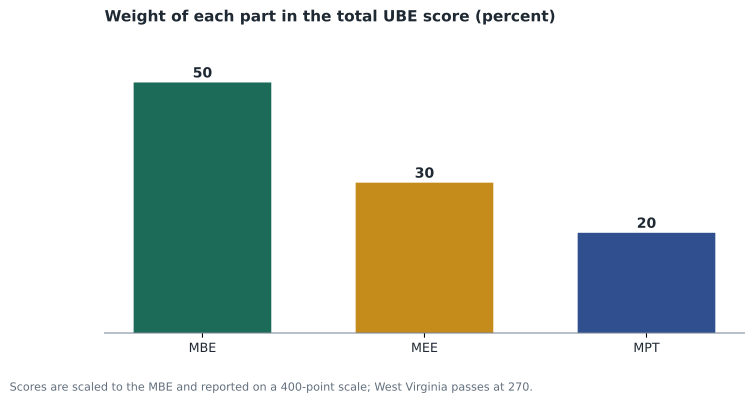
On the UBE, the MBE counts for 50 percent of the total score, the MEE for 30 percent and the MPT for 20 percent. Together, the written portion, MEE and MPT, counts for half. Candidates who neglect the MPT because it seems easy are giving away a fifth of the score, and candidates who neglect the MEE because they prefer multiple choice are giving away nearly a third.
Scaling
Raw scores are not added together. NCBE equates the MBE so that a scaled MBE score means the same thing from one exam to the next, regardless of whether a particular set of questions was harder or easier. The written scores are then scaled to the MBE: the jurisdiction's raw written scores are converted so that they have the same mean and spread as the MBE scores of the same group of candidates. The scaled MBE and scaled written scores are combined in the 50-50 proportion and expressed on a 400-point scale.
Two practical lessons follow. First, there is no fixed percentage of questions a candidate must answer correctly. The scaled score depends on how the candidate performs compared with the scale, not on a raw percentage. Second, because written scores are scaled to the MBE performance of the whole group, the written score reflects how a candidate's answers rank among the other candidates' answers. A solid, organized answer that addresses every issue tends to rank well even if it is not brilliant.
| Part | Format | Weight | Graded by |
|---|---|---|---|
| MPT | Two 90-minute tasks | 20 percent | West Virginia graders |
| MEE | Six 30-minute essays | 30 percent | West Virginia graders |
| MBE | 200 questions, 175 scored | 50 percent | NCBE (machine scored, equated) |
The 270 passing score
West Virginia requires a combined scaled UBE score of at least 270, confirmed in NCBE's chart. UBE jurisdictions set passing scores between 260 and 270, so West Virginia sits at the top of the range, together with a number of other jurisdictions. That has two consequences. A candidate needs to prepare to a level comfortably above 270, because performance on the day varies by several points. And a West Virginia passing score transfers to every UBE jurisdiction, because no jurisdiction requires more than 270, as long as the score is within the receiving jurisdiction's time limit.
The score is combined, not part by part. A strong MBE can make up for a weaker written score, and the reverse. A candidate with a scaled MBE of 140 needs a written performance that, when scaled and combined, brings the total to 270; a candidate with a scaled MBE of 130 needs a stronger written performance. Candidates sometimes ask what MBE score guarantees a pass. None does by itself, but a scaled MBE well above 135 makes the written performance needed much more forgiving.
Recent results
The Board posted unofficial results for the July 2026 exam listing 117 seats, of which 72 passed and 45 failed, a pass rate of about 62 percent for all takers combined. First-time takers from ABA-approved law schools usually pass at higher rates than repeat takers, so the combined figure understates a typical first-time candidate's chances. Official score notices are mailed to each examinee at the address on file with the Board, and the Board asks candidates to read the official letter before contacting its office.
If the result is a fail
Hollis talked about failing openly, because more than a third of the July 2026 takers in West Virginia failed and many of them will pass next time. A candidate who fails should read the official score notice closely, separate the scaled MBE and written components and compare them with practice results. The usual causes are clear once the numbers are laid out: an MBE score held back by two or three weak subjects, written answers that missed issues or ran out of time, or an MPT that did not follow the task memo. The next study plan should target those causes rather than repeating the whole course in the same way. The candidate should also check the next filing deadline at once, because the February exam's deadlines fall soon after July results.
Exam day
The Board's instructions, sent before the exam, give the site, the check-in times and the list of items allowed in the room. Candidates bring government-issued photo identification and the admission materials the Board requires. Phones and other electronic devices, apart from a registered laptop, are generally not allowed at the desk. Laptop users install the required exam software in advance and run its practice mode. Hollis's advice is to arrive early on both days, to eat and sleep normally between the days and to write MBE time checkpoints on scratch paper before starting: question 34 at the end of the first hour, question 67 at the end of the second.
Preparing for each part
For the MBE, the core method is volume with review. Candidates work through thousands of practice questions over the study period, but the questions are only half the value; the other half is reading every explanation, including for questions answered correctly by luck, and keeping a log of missed rules. Hollis likes subject blocks early, mixed sets later and two full simulated sessions of 100 questions in the final month. Released NCBE questions are the most reliable practice because they show exactly how the real exam frames issues.
For the MEE, candidates should build short outlines of the eight subjects with rule statements that can be written quickly and accurately. A good MEE answer opens with a direct conclusion, states the governing rule, applies it to the specific facts and closes with the conclusion again. Headings for each call of the question help the grader find each point. Writing out full answers to at least two released questions per subject, under time, is the best single exercise.
For the MPT, practice is everything. Candidates should complete several full tasks under the 90-minute limit, using the first 35 to 45 minutes to read and organize and the rest to write. Reading the task memo, then the Library, then the File in a deliberate order, and building an outline before writing, keeps the answer focused on what the supervising lawyer asked for. A candidate who has done six or eight timed MPTs is rarely surprised on exam day.
A twelve-week shape
Most commercial courses run about ten to twelve weeks for a February exam, starting in early December. A typical shape: the first six weeks cover the subjects one at a time with lectures, outlines and practice questions; weeks seven to ten add mixed MBE sets, timed essays and MPTs; and the last two weeks are review and full simulations. Candidates who work, like Lonnie, often stretch the schedule to start in November and study fewer hours each week. Hollis said either shape works if the candidate does the practice, and that the most common failure is spending too long watching lectures and too little time answering questions.
Lonnie's firm agreed to reduce his hours from mid-January. He planned to study about 15 hours a week through December, rising to 40 hours a week in the final five weeks. Hollis said that was a sensible plan for a working candidate and suggested he take one full day off each week to avoid burning out before the exam.
Why 270 is not a target
Hollis warned the group against treating 270 as the goal. 'If your practice scores sit at 270, you have about even odds,' she said. 'A hard essay set, a slow MPT or a bad night's sleep moves you a few points either way.' The real target is a practice level comfortably above the line. For many candidates, that means a scaled MBE in the high 130s or above on practice exams and written answers that consistently address every issue with a correct rule statement.
Worked problem
Reading a score report
A hypothetical examinee, Floyd Imboden, received a scaled MBE score of 134 and a scaled written score of 139 on a West Virginia UBE.
Show solution
- The total score combines the two scaled components equally on the 400-point scale.
- Each component is on the MBE's scale of roughly 0 to 200, so the total is about 134 plus 139, or 273.
- West Virginia requires 270, so Floyd passes.
- His score also transfers to every UBE jurisdiction, since none requires more than 270, subject to each one's time limit.
Answer: Floyd's combined scaled score of about 273 passes in West Virginia and is portable.
Worked problem
Planning study time by weight
Lonnie has about 400 hours to prepare and is tempted to spend 300 of them on MBE questions.
Show solution
- The MBE is 50 percent of the score, so it deserves the largest share, but not three quarters.
- The MEE at 30 percent and the MPT at 20 percent together equal the MBE's weight.
- A balanced plan might give about 200 hours to the MBE, 120 to the MEE and 80 to the MPT, adjusted for his weaknesses.
- Full timed practice of all three parts belongs in the final weeks.
Answer: Lonnie should divide time roughly in proportion to the weights, adjusting for his diagnostic results.
Common mistakes
MistakeCandidates need to answer 70 percent of questions correctly to pass.
InsteadScores are scaled; there is no fixed raw percentage.
MistakeEach part of the UBE must be passed separately.
InsteadWest Virginia uses a combined scaled score of 270.
MistakeThe MEE still tests family law and trusts and estates.
InsteadThose subjects, with conflict of laws and secured transactions, left the MEE in July 2026.
MistakeThe MPT tests memorized law.
InsteadIt tests skills; the Library supplies the law.
MistakeA wrong MBE answer costs points.
InsteadThere is no penalty for guessing; answer every question.
Practice problems
Work each problem on paper first, then reveal the answer to check.
What are the dates of the February 2027 exam?
Show answer
Tuesday, February 23 and Wednesday, February 24, 2027.
How is the UBE weighted?
Show answer
MBE 50 percent, MEE 30 percent, MPT 20 percent.
What passing score does West Virginia require?
Show answer
A combined scaled score of 270.
How many MBE questions are scored?
Show answer
175 of the 200.
Who grades the MEE and MPT answers?
Show answer
Graders in the jurisdiction, using NCBE's materials.
Summary and key terms
- Day 1: the MPT (two 90-minute tasks) and the MEE (six 30-minute essays); day 2: the 200-question MBE.
- Weights: MBE 50 percent, MEE 30 percent, MPT 20 percent.
- Written scores are scaled to the MBE; there is no fixed raw percentage to pass.
- West Virginia passes at a combined scaled 270, the top of the UBE range, so its scores transfer everywhere.
- The MEE dropped four subjects in July 2026.
- July 2026 unofficial results: 72 of 117 listed seats passed.
- UBE
- The Uniform Bar Examination, made up of the MBE, MEE and MPT.
- scaling
- Converting raw written scores to the MBE scale so that scores are comparable.
- equating
- Adjusting MBE scores so they mean the same thing across administrations.
- pretest question
- An unscored MBE question being tried out for future use.
- combined scaled score
- The total UBE score on a 400-point scale.
Lesson quiz · 5 questions
Score 60% or more to complete this lesson.
Create a free account to save your progress, take quizzes and earn a certificate.