
BAR-249 · Lesson 2 of 12 · 23 min
Eligibility, education, filing deadlines and fees
▶ Video coming soon A video version of this lesson is on the way.
Lonnie filed his application in October 2026, ahead of the first deadline for the February 2027 exam. At the next session, another member of the group asked how he knew he was eligible in the first place. 'I went to an ABA-approved school,' he said. 'I assumed that settled it.' Hollis said that for most applicants it does, but that the eligibility rules have more parts than people expect, and that a candidate who does not fit the standard pattern needs to know the rules well before the deadline. This lesson covers who may sit the West Virginia exam, when to file and what it costs.
The general requirements
Rule 2.0 of the Rules for Admission sets the general requirements that every applicant must meet, whatever the route. The applicant must be at least 18 years old and of good moral character and fitness. The applicant must hold an undergraduate degree, such as a bachelor of arts or bachelor of science or a higher degree, from an approved institution, or its equivalent. The applicant must hold a law degree, a JD or LLB, from an approved law school, or qualify under the equivalency provisions. The applicant must pass the West Virginia bar exam, which today is the UBE, or transfer a qualifying UBE score, or qualify for admission without examination. And the applicant must earn a passing MPRE score within the time the rules allow.
The undergraduate degree requirement surprises some applicants, because many states do not state it separately; the law school's admission standards usually take care of it. It matters for applicants who entered law school through an unusual route, such as some foreign-educated lawyers, and for anyone whose undergraduate degree came from an institution the Board may need to evaluate.
Legal education: the ABA route
Rule 3.0 requires an applicant for admission by examination to have completed a full course of study at a law school accredited by the American Bar Association, or its equivalency. For the great majority of applicants, the ABA route is the whole story. The law school certifies that the applicant has received the degree, usually through a dean's certificate that the Board's application process requests. An applicant who has not yet graduated when filing should check the Board's instructions for when proof of graduation is due, because a missing certificate can hold up an otherwise complete file.
Equivalency routes
The rules recognize that some applicants studied law in other ways, and they set out equivalency routes that the Board evaluates case by case. Over the years, the rule has included routes for graduates of non-ABA law schools who were admitted in another jurisdiction after passing its bar exam, for graduates of non-ABA schools whose graduates may sit the bar exam in the state where the school is located combined with substantial supervised legal work, for graduates of schools the Board finds substantially equivalent, and for certain graduates of foreign law schools in common-law countries who complete additional basic courses at an ABA-approved school within a set period. NCBE's chart for West Virginia confirms that an ABA JD is not the only route and that foreign law graduates may be eligible for admission by examination, while also noting that an LLM from an ABA-approved school does not by itself make a foreign graduate eligible.
The rules also exclude some kinds of study. Graduates of correspondence law schools, and of schools that deliver most of their instruction online, have been ineligible under the rule. Applicants in any of these categories bear the burden of proving equivalency and the cost of the Board's review, and adverse decisions can be challenged through the hearing procedure in Rule 6.0. Because the details matter and the rule has been amended over time, an applicant outside the ABA route should read the current Rule 3.0 and write to the Board early, before paying for a semester of additional coursework that may or may not satisfy it.
| Applicant | Likely route | First step |
|---|---|---|
| Graduate of an ABA-approved law school | Rule 3.0 ABA route | File with a dean's certificate |
| Non-ABA graduate admitted elsewhere after a bar exam | Rule 3.0 equivalency | Ask the Board to evaluate equivalency early |
| Foreign common-law graduate | Rule 3.0 foreign route with added ABA coursework | Confirm the coursework plan with the Board before enrolling |
| Graduate of a mostly online or correspondence school | Generally ineligible by examination | Read the current rule; consider other routes |
| Lawyer with five of the last seven years in practice | Rule 4.0, without examination | Check reciprocity (Lesson 11) |
Filing deadlines
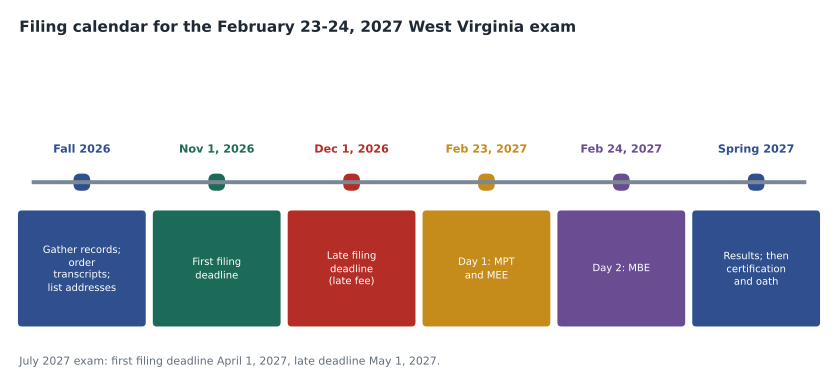
West Virginia uses two filing deadlines for each exam: a first deadline and a later late-filing deadline with an additional fee. For the February exam, the first filing deadline is November 1 and the late deadline is December 1 of the preceding year. For the July exam, the first deadline is April 1 and the late deadline is May 1. NCBE's chart for West Virginia lists exactly these dates for the July 2026 and February 2027 exams. There is no filing after the late deadline: an applicant who misses it waits for the next exam.
Lonnie filed in October 2026, so his application was in before November 1 and he paid no late fee. Hollis pointed out a second reason to file on the first deadline. Character investigations take time, and an applicant who files on December 1 leaves less room before the February exam for the Board to finish its review. An applicant who passes the exam but whose character review is incomplete cannot be admitted until it is complete.
Fees
NCBE's 2026 chart lists the West Virginia fees for the bar exam, each charged in addition to the character and fitness fee. First-time applicants who are not already lawyers pay 500 dollars. Applicants who are already admitted in another jurisdiction pay 800 dollars. Repeat applicants pay the same amounts as first-time applicants in their category. Applicants who are permitted to type the written portions on a laptop pay a further 125 dollars. A late filing adds a late fee. The Board's own fee schedule controls, so the figures should be checked against the schedule on the Court's website before paying.
The character and fitness fee covers the cost of the NCBE investigation, and its amount depends on the type of application. Applicants who are already lawyers elsewhere usually pay more, because their investigation covers years of practice. Fees for other routes, such as admission by transferred UBE score and admission without examination, are higher and are covered in Lesson 11.
| Fee (NCBE chart, 2026) | Amount |
|---|---|
| Bar exam, first-time applicant who is not a lawyer | 500 dollars |
| Bar exam, applicant admitted elsewhere | 800 dollars |
| Repeat applicant | 500 or 800 dollars, by category |
| Laptop, if permitted | 125 dollars |
| Character and fitness | Separate fee set by the Board's schedule |
The application itself
The application asks for a detailed personal history: every residence and employer for a set period, schools attended, military service, court proceedings of any kind, traffic matters, financial problems such as defaults and judgments, bar admissions and discipline elsewhere, and other matters bearing on character and fitness. It asks the applicant to sign authorizations so that the Board and NCBE can check the answers. Lesson 3 covers how to answer the hard questions. Here, the practical point is that the application takes far longer to complete than applicants expect, often several evenings, because it requires dates, addresses and documents that most people do not have at hand.
Hollis suggested starting with the documents that take longest to obtain: certified court records for any case, letters from former employers who must be tracked down, and credit information. 'Order the records first,' she said. 'Write the narrative answers while you wait for them.'
Attempts
NCBE's chart reports that West Virginia allows four attempts to earn a passing UBE score. An applicant who has failed the exam several times should count prior attempts carefully and read the current rule on how attempts are counted and whether further attempts can be allowed. Lonnie is a first-time taker, so the limit does not affect him, but Hollis said that every candidate should know it exists, because it changes how seriously a third or fourth attempt has to be prepared.
Accommodations
Applicants with a disability may ask for testing accommodations. The request is separate from the main application and needs supporting documentation from a qualified professional, so it should be prepared early. Applicants who received accommodations on the MPRE or in law school should not assume the same accommodations will be granted automatically; the Board decides each request on its own record. The request deadline is tied to the filing deadline, and late requests may not be decided in time for the exam.
Laptops and exam logistics
Applicants who want to type the MPT and MEE answers register for the laptop option and pay the laptop fee. The Board tells laptop users which exam software to install and when; the software usually has a practice mode, and a candidate should run it more than once before exam week. Applicants who prefer to handwrite may do so. The exam site and the list of permitted items come in the Board's instructions closer to the exam, and they should be read in full rather than skimmed, because a prohibited item can cause a candidate to be removed from the room.
Common filing problems
Hollis keeps a list of the problems she has seen hold up applications in UBE jurisdictions, and she went through it with the group. The first is a missing or late law school certification, often because the applicant assumed the school would send it automatically. The second is an incomplete address or employment history, with gaps of a few months that the applicant did not think mattered. The third is an unexplained court matter, such as a dismissed charge from college, which the applicant left off because it was dismissed; the application usually asks about charges and arrests, not only convictions. The fourth is a fee paid in the wrong amount or by the wrong method. The fifth is a change of address after filing that the applicant never reported, so the Board's letters went unanswered.
Each of these problems is avoidable, and each has the same cure: read every instruction, answer every question as asked, attach the documents the question calls for and keep the Board informed. Lonnie said he had checked his application against the instructions twice. Hollis suggested a third check by someone else, because a reader who did not write the answers notices gaps the writer cannot see.
Withdrawing or deferring
Plans change. An applicant who decides not to sit an exam after filing should read the Board's rules on withdrawal and on whether any part of the fee can be refunded or applied to a later exam, and should notify the Board in writing. An applicant who simply does not appear has missed the exam and may lose the fee, and the Board's rules decide whether the missed sitting has any other effect. Hollis said she had seen candidates assume that staying home was the same as withdrawing. It is not, and the safer course is always a written notice before the exam.
Worked problem
Is Lonnie on time?
Lonnie graduated from an ABA-approved law school in May 2026, filed his online application on October 12, 2026 for the February 2027 exam, registered to use a laptop and paid the fees.
Show solution
- He meets the education requirement through the ABA route; the dean's certificate completes the file.
- His application was filed before the November 1 first deadline, so no late fee applies.
- His fees are the first-time non-lawyer exam fee of 500 dollars, the 125-dollar laptop fee and the character and fitness fee.
- He is a first-time taker, so the four-attempt limit is not an issue.
Answer: Lonnie is eligible and on time; his remaining tasks are character documents, the MPRE and the exam itself.
Worked problem
A foreign-trained applicant
A hypothetical applicant, Faye Talbott, earned a law degree in a common-law country, practiced there for three years and moved to Morgantown. She asks whether she can sit the July 2027 West Virginia exam.
Show solution
- She is not an ABA graduate, so she must qualify under a Rule 3.0 equivalency route.
- The foreign-graduate route has required additional basic courses at an ABA-approved law school within a set period; an LLM alone does not establish eligibility.
- She should write to the Board now, describe her education and ask which courses would satisfy the rule before enrolling.
- She must file by April 1, 2027 for July, or by May 1, 2027 with a late fee, but only once she is eligible.
Answer: Faye should seek a written eligibility evaluation before investing in coursework, then file for the first exam she can qualify for.
Common mistakes
MistakeAny law degree is enough to sit the West Virginia exam.
InsteadAn ABA JD, or a Rule 3.0 equivalency route evaluated by the Board, is required.
MistakeAn LLM from an ABA school qualifies a foreign graduate automatically.
InsteadNCBE's chart notes that an LLM alone does not make a foreign graduate eligible.
MistakeThe February exam can be filed for in January.
InsteadThe first deadline is November 1 and the late deadline December 1.
MistakeThe exam fee covers character review.
InsteadThe character and fitness fee is separate.
MistakeAccommodations carry over from the MPRE automatically.
InsteadEach request is decided by the Board on its own documentation.
Practice problems
Work each problem on paper first, then reveal the answer to check.
What are the filing deadlines for the July exam?
Show answer
April 1, with a late deadline of May 1.
What does Rule 2.0 require besides a law degree?
Show answer
Age 18, good moral character and fitness, an undergraduate degree, passing the exam or another route, and a timely MPRE score.
What is the exam fee for a first-time applicant who is not a lawyer?
Show answer
500 dollars, plus the character and fitness fee.
How many attempts does NCBE report West Virginia allows to pass the UBE?
Show answer
Four.
Who bears the burden of proving educational equivalency?
Show answer
The applicant.
Summary and key terms
- Rule 2.0 requires age 18, good character, an undergraduate degree, a law degree, a passing exam or other route, and a timely MPRE score.
- Rule 3.0 requires an ABA JD or a Board-approved equivalency; mostly online and correspondence study has been excluded.
- February exam: file by November 1, or by December 1 with a late fee; July exam: April 1 or May 1.
- NCBE's chart lists 500 dollars for first-time non-lawyers, 800 for lawyers and 125 for a laptop, plus the character fee.
- NCBE reports a limit of four attempts to pass the UBE.
- File early: character review takes months and must be complete before admission.
- equivalency
- A Board finding that non-ABA legal education satisfies Rule 3.0.
- first filing deadline
- The regular deadline: November 1 for February and April 1 for July.
- late filing deadline
- The final deadline, with a late fee: December 1 for February and May 1 for July.
- dean's certificate
- The law school's certification that an applicant has received the degree.
- testing accommodation
- A change in exam conditions granted for a documented disability.
Lesson quiz · 5 questions
Score 60% or more to complete this lesson.
Create a free account to save your progress, take quizzes and earn a certificate.