
BAR-250 · Lesson 1 of 12 · 21 min
Becoming a lawyer in Wisconsin: the Supreme Court, the Board of Bar Examiners and four routes
▶ Video coming soon A video version of this lesson is on the way.
Hollis Marchetti began the Wisconsin session with a map of the upper Midwest on her screen and a new face in the corner of the call. Selby Tollefson grew up in Eau Claire, went to law school across the river in Minnesota, graduated in May 2026 and came home to work as a law clerk for Priscilla Heidemann, who runs a four-lawyer general practice in Eau Claire. Selby is registered for the February 23-24, 2027 Wisconsin bar exam. 'Everyone I grew up with who went to Madison or Marquette is already sworn in,' she said. 'They never took a bar exam. I have to take one, and it is not even the exam Wisconsin gave last year.'
'That is the Wisconsin story in two sentences,' Hollis said. 'Wisconsin is the only state that still admits graduates of its own law schools without a bar exam. And in 2026 it replaced its own exam with the Uniform Bar Examination. If you understand those two facts and who makes the rules, the rest of this course falls into place.'
This lesson maps the Wisconsin admission system: the bodies that run it, the rules that govern it and the routes into the profession. Later lessons take each step in detail.
Why Wisconsin is different
Most states admit lawyers in one main way: a law graduate passes the state's bar exam, satisfies the character and fitness review and takes the oath. Wisconsin has always been an exception. For well over a century it has admitted graduates of the University of Wisconsin Law School and Marquette University Law School on their diplomas, provided they complete a prescribed set of courses and satisfy the Board of Bar Examiners on character and fitness. This is the diploma privilege, now found in Supreme Court Rule 40.03. Other states once had similar rules and abandoned them; Wisconsin kept its version, and it is the only state with a permanent diploma privilege for its own law schools.
The diploma privilege means that most new Wisconsin lawyers each year never sit a bar exam. The exam in Wisconsin has historically been taken by a relatively small group: graduates of law schools in other states, foreign-educated lawyers with qualifying credentials, and Wisconsin residents like Selby who studied elsewhere. For decades, that group took a Wisconsin-drafted exam. Wisconsin was not part of the Uniform Bar Examination, so a score earned in Wisconsin could not travel, and a UBE score earned elsewhere could not be used in Wisconsin.
That changed in 2026. On March 24, 2026, the Supreme Court of Wisconsin granted a petition from the Board of Bar Examiners and ordered that Wisconsin would administer the Uniform Bar Examination beginning with the July 2026 exam. The first Wisconsin UBE was given on July 28 and 29, 2026, in Middleton, just outside Madison, with 122 applicants registered. NCBE described Wisconsin as the 42nd jurisdiction in the UBE. Chief Justice Jill Karofsky explained the change in terms of access to lawyers: Wisconsin is facing real challenges in recruiting and retaining attorneys, especially outside the larger cities, and it borders four UBE states, Illinois, Iowa, Michigan and Minnesota.
The diploma privilege was not touched by the 2026 change. Court and NCBE announcements both state that eligible graduates of the two Wisconsin law schools remain eligible for admission without an exam.
The bodies that run admission
The Supreme Court of Wisconsin regulates the practice of law in the state. It writes the rules for admission, continuing legal education and lawyer conduct, and they appear as chapters of the Supreme Court Rules, cited as SCR. Chapter 40 governs admission to the bar. Chapter 31 governs continuing legal education. Chapter 20 contains the Rules of Professional Conduct for Attorneys. Chapter 10 creates the State Bar of Wisconsin and makes membership mandatory for practicing lawyers. When the court changes admission requirements, it does so by order after a rule petition, a period for public comment and, usually, a public hearing. The UBE change followed that path: the Board filed petition 25-04 on December 17, 2025, the court received written comments from the State Bar, the State Public Defender, a legislator and others, held a public hearing on March 12, 2026, wrote to the deans of the two law schools and received their responses, and issued its order on March 24, 2026.
The Board of Bar Examiners, usually called the BBE, is an office of the Supreme Court. It administers the bar exam in Wisconsin, decides whether applicants meet the eligibility requirements, investigates and certifies character and fitness for every route of admission (including diploma privilege), and runs the continuing legal education reporting system for lawyers already admitted. Its staff sit in Madison, and its filing instructions for each exam, known by form numbers such as BE-170 for the bar exam, BE-270 for diploma privilege and BE-370 for proof of practice, are the most important documents an applicant will read.
NCBE, the National Conference of Bar Examiners, writes the three parts of the UBE: the Multistate Bar Examination, the Multistate Essay Examination and the Multistate Performance Test. NCBE scores the MBE, provides grading materials for the written parts and certifies UBE scores for transfer. NCBE does not decide who is admitted in Wisconsin. NCBE also writes the Multistate Professional Responsibility Examination, the MPRE, but Wisconsin, unusually, does not require it for any route of admission.
The State Bar of Wisconsin is the integrated, mandatory bar association. A lawyer admitted by the Supreme Court must become a member and pay dues to practice. The State Bar is not the admitting authority, and applicants do not send admission materials to it, but newly admitted lawyers deal with it immediately for membership, dues and the trust account certification that comes with the annual dues statement.
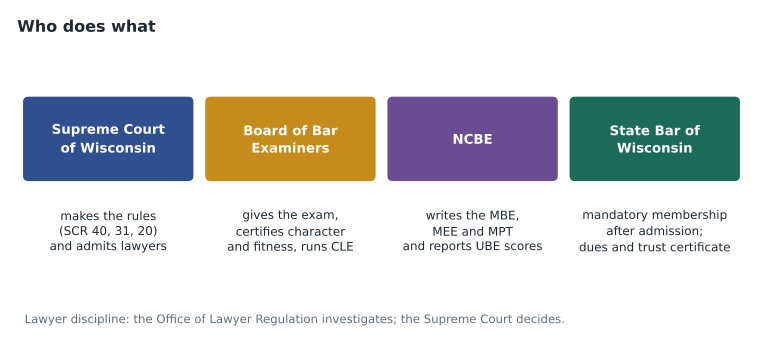
Lawyer discipline sits with a separate office. The Office of Lawyer Regulation investigates grievances and prosecutes misconduct, referees hear contested cases, and the Supreme Court decides on discipline. Lesson 10 covers that system and the Wisconsin rules of conduct.
The four routes into the profession
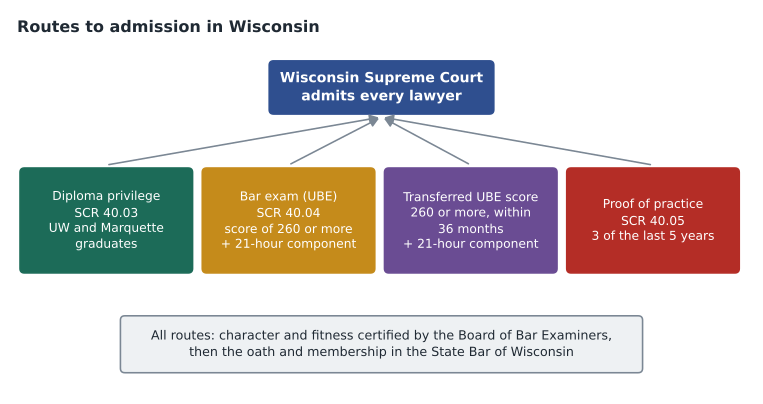
The first route is the diploma privilege. A graduate of the University of Wisconsin Law School in Madison or Marquette University Law School in Milwaukee who has completed the coursework that SCR 40.03 requires can be admitted without an exam once the Board certifies character and fitness. The school certifies the legal competence part; the Board certifies the character part. Graduates of other law schools, even schools a few miles over the state line, cannot use this route.
The second route is the bar exam. Since July 2026, the Wisconsin bar exam is the UBE, and a candidate passes with a scaled score of 260 or more. A candidate who passes in Wisconsin must also complete a 21-hour Wisconsin law and practice educational component within 12 months of being notified of the passing score. Lesson 6 explains the component.
The third route is a transferred UBE score. A lawyer or graduate who earned a UBE score of 260 or more in any UBE jurisdiction can apply for admission in Wisconsin on that score, as long as the score is certified by NCBE and the complete application arrives within 36 months of the exam that produced it. This route also requires the 21-hour component, completed within 12 months of filing the transfer application.
The fourth route is admission on proof of practice under SCR 40.05, often called admission on motion in other states. An experienced lawyer licensed elsewhere who was substantially engaged in the practice of law for three of the five years before filing can be admitted without an exam. Wisconsin does not require reciprocity, so a lawyer from any US jurisdiction can use this route. Lesson 11 covers transfer and proof of practice.
| Route | Rule | Who uses it | Exam? | Wisconsin component? |
|---|---|---|---|---|
| Diploma privilege | SCR 40.03 | UW and Marquette graduates who complete the required courses | No | No; the required courses do that work |
| Bar exam (UBE) | SCR 40.04 | Graduates of other law schools; some foreign-educated lawyers | Yes, 260 to pass | Yes, 21 hours within 12 months |
| Transferred UBE score | SCR 40.04 as amended in 2026 | Candidates with a UBE score of 260 or more from another jurisdiction | Already taken | Yes, 21 hours within 12 months |
| Proof of practice | SCR 40.05 | Lawyers with three of the last five years in practice | No | No |
Every route has two requirements in common. The first is character and fitness: the Board must be satisfied that the applicant has the honesty, diligence and reliability required of a lawyer. The second is the oath and enrollment in the State Bar. A person is not a Wisconsin lawyer until the oath has been taken and the court has entered the admission.
Where Selby fits
Selby's position is the most common one for a Wisconsin exam taker. She has a JD from an ABA-approved law school outside Wisconsin, so the diploma privilege is not available. She has never practiced, so proof of practice is not available. She has never taken a UBE, so there is no score to transfer. Her only route is the exam, followed by the component.
Hollis drew a short checklist on the screen. 'For you the sequence is: file by the deadline, satisfy the Board on eligibility and character, pass the UBE with 260, complete the 21 hours, take the oath, join the State Bar. The exam is the hardest step but not the last one.'
Selby asked whether she should have tried to transfer into a Wisconsin law school for her final year to get the diploma privilege. 'Ask the schools,' Hollis said, 'but the privilege depends on the degree and the required coursework, and each school controls how transfer credits count. It is not something to plan around once you have graduated. You have graduated. Your route is the exam.'
The UBE changes what a Wisconsin score is worth
Before July 2026, a candidate who passed the Wisconsin exam earned a license in Wisconsin and nothing more. Now a Wisconsin UBE score is portable. If Selby scores 270, for example, that score could be transferred to Minnesota, where her law school is, as long as she meets Minnesota's own requirements and its passing score and time limits. A UBE score from Minnesota, Illinois, Iowa or Michigan can likewise be brought into Wisconsin. Wisconsin's passing score of 260 is one of the lower UBE passing scores, which makes it easier for candidates with scores from other UBE jurisdictions to meet. Lesson 4 explains how the score is built.
Portability matters in a border practice. Priscilla Heidemann's firm in Eau Claire regularly sees clients from the Minnesota side of the Twin Cities metropolitan area, and Selby already knows she will want a Minnesota license as well. Hollis noted that the 2026 order was aimed partly at exactly that kind of practice.
The NextGen exam is coming
The UBE that Wisconsin adopted in 2026 is the legacy UBE, the version in place since 2011. NCBE is replacing it with the NextGen bar exam, first given in July 2026 in a small group of jurisdictions. NCBE lists February 2028 as Wisconsin's final legacy UBE and July 2028 as Wisconsin's first NextGen exam. Wisconsin's NextGen passing score, its approach to transferred NextGen scores and whether it will keep a jurisdiction-specific requirement under NextGen were all listed as to be announced in November 2026. Selby's February 2027 exam is a legacy UBE, and everything in this course is aimed at that exam. Lesson 5 covers the transition.
Worked problem
Choosing the route
A hypothetical lawyer, Kurt Thornquist, was admitted in Iowa in 2023 after taking the UBE there in July 2022 and scoring 274. Since admission he has practiced full-time at an Iowa firm. In January 2027 he wants to join a firm in La Crosse, Wisconsin. Which routes are available to him?
Show solution
- Diploma privilege: not available; he did not graduate from UW or Marquette.
- Transferred UBE score: his score of 274 is above 260, but the score was earned in July 2022. More than 36 months have passed, so it is too old to transfer.
- Proof of practice: he was admitted in 2023, so by January 2027 he has at most about three and a half years of practice. Three of the last five years of substantial practice would satisfy SCR 40.05 if his practice qualifies.
- Exam: always available, but unnecessary if proof of practice works.
Answer: Proof of practice under SCR 40.05 is his best route. Transfer is closed because the score is more than 36 months old.
Common mistakes
MistakeThe State Bar of Wisconsin admits lawyers.
InsteadThe Supreme Court admits lawyers; the Board of Bar Examiners runs the exam and certifies character and fitness. The State Bar is the mandatory membership organization after admission.
MistakeThe diploma privilege ended when Wisconsin adopted the UBE.
InsteadThe diploma privilege for UW and Marquette graduates continues unchanged.
MistakeAny Wisconsin resident can use the diploma privilege.
InsteadOnly graduates of the two Wisconsin law schools who complete the required courses qualify; residence does not matter.
MistakeWisconsin still gives its own bar exam.
InsteadSince July 2026 the Wisconsin bar exam is the UBE.
MistakeLike most states, Wisconsin requires the MPRE.
InsteadWisconsin does not require the MPRE for any route of admission.
Practice problems
Work each problem on paper first, then reveal the answer to check.
When did Wisconsin first give the UBE?
Show answer
July 28-29, 2026, in Middleton.
Which rule contains the diploma privilege?
Show answer
SCR 40.03.
What is the minimum UBE score for admission in Wisconsin?
Show answer
260.
Which body certifies character and fitness for diploma-privilege applicants?
Show answer
The Board of Bar Examiners.
What must an exam taker complete after passing, and by when?
Show answer
The 21-hour Wisconsin law and practice component, within 12 months of notice of the passing score.
Summary and key terms
- The Supreme Court of Wisconsin makes the admission rules (SCR chapter 40) and admits lawyers; the Board of Bar Examiners runs the exam and certifies character and fitness.
- Wisconsin has four routes: diploma privilege, the UBE, a transferred UBE score and proof of practice.
- The court ordered the switch to the UBE on March 24, 2026; the first Wisconsin UBE was July 28-29, 2026.
- The passing and transfer score is 260; transferred scores must be used within 36 months.
- Exam and transfer applicants must complete a 21-hour Wisconsin component within 12 months.
- Wisconsin does not require the MPRE; the State Bar of Wisconsin is mandatory after admission.
- diploma privilege
- Admission without a bar exam for graduates of the UW and Marquette law schools who complete the courses required by SCR 40.03.
- Board of Bar Examiners
- The Supreme Court office that administers the bar exam, certifies character and fitness and runs CLE reporting.
- SCR
- Supreme Court Rules, the court-made rules governing Wisconsin lawyers.
- integrated bar
- A bar association in which membership is required to practice law; the State Bar of Wisconsin is one.
- proof of practice
- Admission without exam under SCR 40.05 based on three of the last five years of law practice.
Lesson quiz · 5 questions
Score 60% or more to complete this lesson.
Create a free account to save your progress, take quizzes and earn a certificate.