
BAR-250 · Lesson 9 of 12 · 20 min
Wisconsin marital property, divorce and estates
▶ Video coming soon A video version of this lesson is on the way.
In October a couple came to Priscilla Heidemann's office to update their wills. The husband, a hypothetical retired paper-mill supervisor named Lazlo Mertz, had inherited a cabin on a lake near Hayward from his mother in 2001. The couple had used money from their joint savings to put a new roof on it and had rented it out for years, putting the rent into their joint account. 'Is the cabin his or ours?' the wife asked. Priscilla turned to Selby. 'In Minnesota, how would you answer that?' Selby gave a careful answer about separate and marital property. 'Good,' Priscilla said. 'Now forget most of it. Wisconsin is a marital property state.'
This lesson covers the Wisconsin Marital Property Act in chapter 766, property division and support at divorce under chapter 767, and the basics of wills, intestacy and probate. Family law and trusts and estates are no longer tested on the MEE, but they are core subjects of the Wisconsin component and daily work in general practice.
Wisconsin is a marital property state
Most US states follow a common-law system of property between spouses: each spouse owns what is titled in his or her name during the marriage, and courts divide property equitably at divorce. A group of mostly western and southwestern states follow community property, under which property acquired during the marriage belongs to both spouses equally. Wisconsin is the one state that adopted the Uniform Marital Property Act, which took effect in Wisconsin on January 1, 1986. Its system works like community property, and Wisconsin is usually counted among the nine traditional community property states, but it has its own vocabulary and rules.
The basic rule is a presumption. All property of spouses is presumed to be marital property, owned one-half by each spouse, regardless of whose name is on the title. A spouse claiming that property is individual property has the burden of proving it. The key date is the determination date, which is generally the latest of the date of marriage, the date both spouses became domiciled in Wisconsin, and January 1, 1986. Property a spouse owned before the determination date is not marital property, and property acquired by one spouse during the marriage by gift from a third party or by inheritance is individual property. Wages and other earnings of either spouse during the marriage are marital property.
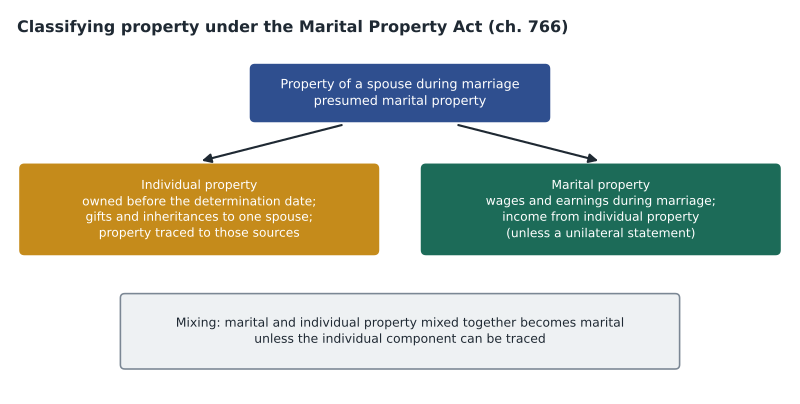
Two rules produce many of the hard cases. The first concerns income. Income earned from individual property, such as rent, interest or dividends, is marital property, unless the owning spouse signs and delivers a unilateral statement classifying that income as individual property. Many people never do. The second concerns mixing. When marital property and individual property are mixed together, the mixed property becomes marital property unless the individual component can be traced. Spending marital funds to improve individual property can also give the marital estate a claim.
Applied to the Mertz cabin, the analysis goes like this. The cabin itself was inherited by Lazlo, so it began as his individual property. The rent was income from individual property, so it was marital property unless he had signed a unilateral statement, which he had not. The roof was paid for with marital funds, which may give the marital estate a claim to the value added. And if the cabin had been sold and the proceeds mixed with joint savings without records, tracing could have become impossible. Priscilla told the couple the cabin was probably still Lazlo's individual property, with a marital component, and suggested a marital property agreement to settle the question.
Spouses can change the default rules by a marital property agreement, signed by both spouses, before or during marriage. Wisconsin lawyers use these agreements for second marriages, family farms and businesses, and estate planning. There are also special forms of ownership, such as survivorship marital property, which passes automatically to the surviving spouse at death.
Divorce in Wisconsin
Wisconsin is a no-fault divorce state. The court grants a divorce on finding that the marriage is irretrievably broken. A party must meet a residence requirement in the state and the county before filing, and there is a waiting period after service before the final hearing. Marital misconduct does not determine whether a divorce is granted, and, importantly, it is not a factor in dividing property.
Property division is governed by section 767.61. The court first identifies the property of both spouses. It then excludes certain property: property acquired by either party by gift from a person other than the other spouse, by reason of another person's death (such as inheritance, survivorship, life insurance and payable-on-death arrangements) and property paid for with funds from those sources. Excluded property stays with the spouse who received it, unless refusing to divide it would create a hardship for the other party or the children, in which case the court may divide it in a fair and equitable manner.
All other property is presumed to be divided equally. The court may depart from equal division, without regard to marital misconduct, only after considering factors listed in the statute. They include the length of the marriage, the property each party brought to it, whether a party has substantial assets not subject to division, each party's contributions, including homemaking and child care, the parties' ages and health, contributions by one party to the other's education or earning power, each party's earning capacity, the desirability of awarding the family home to the parent with more physical placement, the relationship to maintenance and support orders, other economic circumstances such as pensions, tax consequences, and any written agreement between the parties about property. A written agreement binds the court unless it is inequitable to either party, and it is presumed equitable.
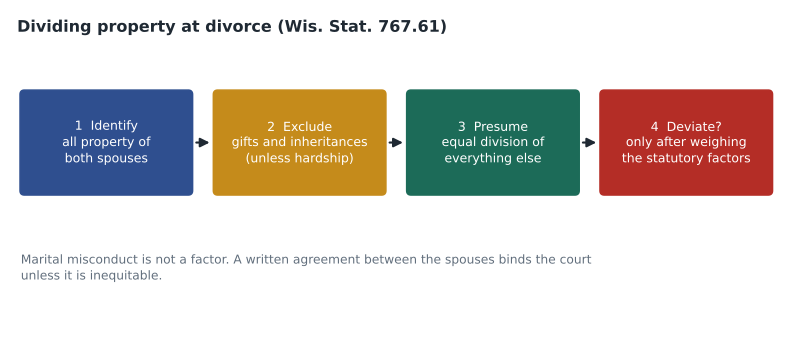
Note the interplay between the two chapters. Chapter 766 classifies property during the marriage and at death. At divorce, section 767.61 controls, with its own exclusion for gifts and inheritances and its own presumption of equal division. A Wisconsin divorce lawyer works with both.
| Question | Wisconsin rule | Where |
|---|---|---|
| Ground for divorce | Marriage irretrievably broken (no-fault) | Ch. 767 |
| Property excluded from division | Gifts from third parties, inheritances and similar transfers at death, and their traceable proceeds | Wis. Stat. 767.61(2) |
| Starting point for everything else | Presumption of equal division | Wis. Stat. 767.61(3) |
| Is misconduct a factor? | No | Wis. Stat. 767.61(3) |
| Effect of a written agreement | Binding unless inequitable; presumed equitable | Wis. Stat. 767.61(3)(L) |
| Spousal support | Maintenance, based on statutory factors | Ch. 767 |
| Child support | Percentage-of-income standard in agency rules | Ch. 767 and DCF rules |
Support, custody and placement
Wisconsin calls spousal support maintenance. A court may award maintenance for a limited or indefinite period after considering statutory factors such as the length of the marriage, the parties' ages and health, the property division, education and earning capacity, and the standard of living during the marriage, with the twin goals of support and fairness. Child support is set using a percentage-of-income standard in rules issued by the Department of Children and Families, with adjustments for shared placement, serial families and high or low incomes.
Wisconsin separates legal custody, meaning the right to make major decisions about a child, from physical placement, meaning the schedule of when the child is with each parent. The law generally favors joint legal custody, and placement is decided under the best interests of the child, with a goal of maximizing the time a child spends with each parent where that is consistent with the child's welfare. Guardians ad litem are commonly appointed in contested cases. These terms differ from those used in many other states, and getting the vocabulary right matters in Wisconsin pleadings.
Wills
A Wisconsin will generally must be in writing, signed by the testator or by someone else at the testator's direction and in his or her presence, and signed by two witnesses. Wisconsin does not recognize unwitnessed handwritten wills, so a holographic will valid in another state may be valid in Wisconsin only if it meets another state's law under the statute that recognizes wills validly executed elsewhere. A will can be made self-proved with the appropriate affidavit, which simplifies probate.
Because Wisconsin is a marital property state, a spouse's will controls only that spouse's own property: his or her individual property and his or her one-half interest in marital property. A husband cannot leave the whole of a marital-property brokerage account to his children from a first marriage; half of it already belongs to his wife. Estate planning in Wisconsin always starts with classification.
Death of a spouse and the deferred marital property election
At death, the surviving spouse keeps his or her own one-half interest in marital property. The deceased spouse's half passes under the will or by intestacy. Wisconsin also protects spouses who moved from common-law states. Property acquired during the marriage while the couple lived elsewhere, which would have been marital property had they lived in Wisconsin, is called deferred marital property. A surviving spouse may elect to take a share of the deceased spouse's deferred marital property, up to one-half, under the elective share statute in chapter 861. Selby noted that this rule would matter for retirees who move to Wisconsin from Illinois or Minnesota to be near their grandchildren.
Intestacy and probate
When a Wisconsin resident dies without a will, chapter 852 decides who inherits. As a general rule, if all of the decedent's children are also children of the surviving spouse, the surviving spouse takes the entire net estate. If the decedent has children who are not children of the surviving spouse, the spouse takes a smaller share and the children take the rest. If there is no spouse, the estate passes to children and their descendants, then to parents, siblings and more remote relatives under the statutory order.
Wisconsin offers several ways to settle an estate. Formal administration takes place under court supervision. Informal administration, handled by the probate registrar with much less court involvement, is common for estates without disputes. Small estates may qualify for summary procedures or for transfer by affidavit, without any probate proceeding, if the value is below the statutory limit. Many assets pass outside probate entirely, such as jointly held and survivorship marital property, accounts with payable-on-death or transfer-on-death designations, life insurance and retirement accounts with named beneficiaries.
Worked problem
Classifying an account at divorce
A hypothetical couple, Rune and Ragna Hanneman, married in Wisconsin in 2010. Rune inherited 80,000 dollars from his father in 2015 and put it into a new brokerage account in his name. He never added marital funds. The account is now worth 120,000 dollars, all from market growth and reinvested dividends. Ragna files for divorce. How is the account treated?
Show solution
- Under section 767.61(2), property acquired by reason of another person's death, and property traceable to it, is excluded from division.
- The inherited principal and its growth in value remain traceable to the inheritance because nothing else was mixed in.
- Reinvested dividends raise a classification question: under chapter 766 income from individual property is marital property unless a unilateral statement was signed. Courts look closely at whether the inherited character survived; a lawyer would trace each component.
- Absent hardship, the inherited portion stays with Rune; any portion found to be divisible joins the property presumed to be divided equally.
Answer: Most of the account is likely excluded as inherited property, but the dividend component needs careful tracing and could be divisible.
Common mistakes
MistakeWisconsin is a common-law equitable distribution state.
InsteadWisconsin is a marital property state under the Uniform Marital Property Act.
MistakeRent from a spouse's inherited cabin is that spouse's individual property.
InsteadIncome from individual property is marital property unless a unilateral statement is signed.
MistakeA court may give one spouse more property because the other had an affair.
InsteadSection 767.61 excludes marital misconduct from the factors.
MistakeA handwritten, unwitnessed will is valid in Wisconsin.
InsteadWisconsin requires two witnesses and does not recognize holographic wills as such.
MistakeA spouse can leave all marital property by will.
InsteadA will controls only the testator's individual property and one-half interest in marital property.
Practice problems
Work each problem on paper first, then reveal the answer to check.
When did Wisconsin's Marital Property Act take effect?
Show answer
January 1, 1986.
What is presumed about property of spouses?
Show answer
That it is marital property, owned one-half by each.
What property is excluded from division at divorce?
Show answer
Gifts from third parties, inheritances and similar transfers at death, and their traceable proceeds.
What is the starting presumption for dividing other property?
Show answer
Equal division.
What does Wisconsin call spousal support?
Show answer
Maintenance.
Planning with marital property in mind
For estate planners, the marital property system creates both problems and tools. Because each spouse owns half of marital property, a couple's estate plan must address both halves, and a plan drafted in a common-law state may not work as intended after the couple moves to Wisconsin. Marital property agreements can classify property clearly, add survivorship features or keep a family business individual property, which reduces disputes at death or divorce.
Summary and key terms
- Wisconsin is the only state to adopt the Uniform Marital Property Act; property of spouses is presumed marital and owned half by each.
- Gifts, inheritances and property owned before the determination date are individual property; income from individual property is marital unless a unilateral statement is signed.
- At divorce, section 767.61 excludes gifts and inheritances, presumes equal division of the rest and ignores misconduct.
- Wisconsin separates legal custody from physical placement; child support uses a percentage-of-income standard.
- Wills need two witnesses; a will controls only the testator's own property, including half of marital property.
- Surviving spouses may elect against deferred marital property; small estates may avoid probate.
- marital property
- Property owned one-half by each spouse under chapter 766, including earnings during marriage.
- individual property
- Property owned by one spouse alone, such as property owned before the determination date or received by gift or inheritance.
- determination date
- The latest of the date of marriage, the date both spouses were domiciled in Wisconsin and January 1, 1986.
- unilateral statement
- A signed statement that makes income from a spouse's individual property individual property.
- deferred marital property
- Property acquired during marriage while domiciled elsewhere that would have been marital property in Wisconsin.
Lesson quiz · 5 questions
Score 60% or more to complete this lesson.
Create a free account to save your progress, take quizzes and earn a certificate.