
BAR-250 · Lesson 2 of 12 · 21 min
Eligibility, education, filing deadlines and fees
▶ Video coming soon A video version of this lesson is on the way.
Selby opened the second session with a screenshot of the Board's online admissions site. 'I have an eCourts account, a half-finished questionnaire and a list of documents I have never heard of,' she said. 'And the deadline on the instructions is December 1. Is that the date I mail it, or the date it has to arrive?'
'Neither,' Hollis said. 'Wisconsin files online, and it has a very specific idea of what filed means. Let us go through it in order: whether you can sit, what you must send, when, and what it costs.'
This lesson covers who is eligible to take the Wisconsin bar exam, the education rules for US and foreign-educated applicants, the filing system and deadlines for the February and July exams, and the fees. Everything here comes from SCR chapter 40, the Board's filing instructions and NCBE's Wisconsin chart, and the instructions for the specific exam are what control. Read them for your own administration.
Who may sit the exam
A Wisconsin exam applicant needs a qualifying legal education. The standard qualification is a JD from a law school approved by the American Bar Association. Selby has one, from an ABA-approved school in Minnesota, so the education question is easy for her. Graduates of the two Wisconsin law schools may also sit the exam if they wish, for example if they lack a course required for diploma privilege or want a portable UBE score, but most use the privilege.
NCBE's Wisconsin chart records several other eligibility rules. Wisconsin does not limit the exam to graduates of ABA-approved schools. A graduate of a law school that is not ABA-approved, outside Wisconsin, may sit if he or she has also been admitted to the bar in another state. Foreign-educated lawyers can qualify by showing legal education in the English common law, additional education at an ABA-approved law school, practice in a foreign jurisdiction and a determination by the Board that the education is equivalent. NCBE also lists an LLM or other graduate law degree from an ABA-approved law school as sufficient on its own for eligibility, subject to the Board's rules on what the degree must contain. These paths have detailed documentary requirements, and a foreign-educated applicant should ask the Board for an eligibility determination well before the filing deadline.
The Board must also receive proof that the degree was conferred. For a recent graduate, the law school sends a Dean's Certificate directly to the Board, and official transcripts are required from every law school attended, from the undergraduate institution if a degree was conferred, and from other schools attended after high school. A transcript that does not show the JD conferred will not establish eligibility to sit.
Wisconsin places no limit on the number of attempts to earn a passing UBE score. A candidate who fails may file again for the next exam.
How filing works
Applications are filed through the Board's online admissions site, which requires an eCourts account. The Board treats an application as filed only when it has received three things: the online application itself, the Authorization and Release form and the filing fee. Missing any one of the three means the application has not been filed, whatever the applicant has submitted otherwise.
The online application includes the Applicant Questionnaire, a long form covering identity, residence history, education, employment, bar admissions elsewhere, military service, financial obligations, criminal and traffic history, civil litigation and anything else relevant to character and fitness. The applicant signs it electronically as an affidavit using two-factor authentication. The Authorization and Release form allows the Board to obtain records about the applicant. It must be notarized, and it must be new for each exam; a form signed for an earlier exam is not accepted.
The Board's July 2026 instructions also required an NCBE number in the questionnaire. The NCBE number links the applicant to NCBE's records, which is how the MBE score and the UBE score are recorded and later certified. Without it, the instructions said, an applicant could not sit for the UBE. Selby already has one because she registered with NCBE for the MPRE.
| Item | Who sends it | Notes |
|---|---|---|
| Online application and Applicant Questionnaire | Applicant | Signed electronically as an affidavit |
| Authorization and Release | Applicant | Notarized; new form for each exam |
| Filing fee | Applicant | Amount depends on the filing deadline met |
| Dean's Certificate | Law school | Sent directly to the Board |
| Official transcripts | Each school | Law school transcript must show the JD conferred |
| Character references | Applicant supplies names and emails | Known the applicant at least two years; not relatives or partners |
| Employment verifications | Applicant supplies employer emails | Explain any employer that cannot be reached |
| Court, driving or military records | The issuing agency | Sent directly by the source when required |
Deadlines
Wisconsin uses two filing deadlines for each exam. NCBE lists the first filing deadline for the February 2027 exam as December 1 and the late filing deadline as January 1. For the July exam, the deadlines are May 1 and June 1. The Board's July 2026 instructions show how the system worked in practice: the application, the release and the fee were due by May 1, 2026; an applicant who met that date paid the initial fee, and an applicant who filed by the final June 1 deadline paid a higher fee. Testing accommodation requests and their documentation were due by the first deadline. A recent photo upload, final eligibility documents and any written withdrawal request for a partial refund were due on July 1. The instructions said plainly that all deadlines are firm and will not be extended.
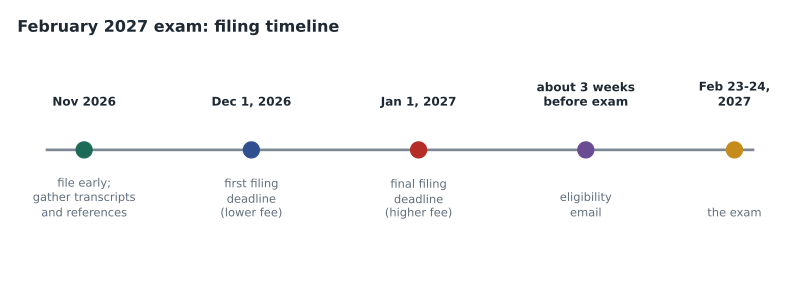
For Selby, the practical rule is simple. Treat December 1 as the real deadline, because it is the cheaper one and because accommodation requests are tied to it. Treat January 1 as an emergency backstop. Hollis asked her to set a personal deadline of November 20 for the three filing items, leaving time for a notary appointment and for the fee payment to process.
Eligibility notices come late in the process. Under the July 2026 instructions, applicants who had completed the initial filing, whose final transcripts or Dean's Certificates had arrived and who had uploaded a photo received an eligibility email about three weeks before the exam. An applicant who has not heard anything by then should contact the Board at once.
Registration for the exam is also part of the schedule. The July 2026 exam required in-person registration on the Monday before the exam, at an assigned time, and an applicant who missed registration should not expect to sit. Registration is where the Board checks government photo identification and issues the identification badge needed to enter the exam room. Lesson 4 covers exam day itself.
Fees
Fees change, and the instructions for each exam control. For the July 2026 exam, the Board's instructions listed a filing fee of 450 dollars for an applicant who completed the initial filing by May 1, a fee of 650 dollars for an application filed by the final June 1 deadline, and a 200 dollar late fee for an applicant who had not submitted all three initial items by the first deadline. NCBE's chart, updated in late 2026, lists a bar exam fee of 450 dollars and a higher figure of 850 dollars without explaining which applicants pay which, and a repeater fee of 450 dollars. The safest reading is that the base fee for a timely application is 450 dollars and that later filing costs more; Selby should confirm the February 2027 amounts in the current instructions.
Laptop software is a separate cost. Applicants ordinarily type the written portion on their own laptops using exam software from an outside vendor, and the vendor charges its fee directly. NCBE's chart lists a laptop fee of 163 dollars. Other small fees appear in the instructions, such as fees for copies of an application.
Wisconsin offers one notable fee waiver. Qualified veterans may receive a waiver of bar admission and exam fees through the Wisconsin Department of Veterans Affairs; the applicant uploads the email containing the eligibility code to the online application.
| Item | Source | Amount noted |
|---|---|---|
| Exam filing fee, initial deadline | Board instructions for July 2026 | 450 dollars |
| Exam filing fee, final deadline | Board instructions for July 2026 | 650 dollars |
| Late fee if initial items incomplete | Board instructions for July 2026 | 200 dollars |
| Repeater exam fee | NCBE Wisconsin chart | 450 dollars |
| Laptop software | NCBE Wisconsin chart; paid to the vendor | 163 dollars |
| UBE transfer application | NCBE Wisconsin chart | 450 dollars |
| Proof of practice application | NCBE Wisconsin chart | 850 dollars |
Withdrawals, refunds and no-shows
An applicant who decides not to sit must withdraw in writing and state the reasons. Under the July 2026 instructions, a withdrawal received by July 1 qualified for a partial refund. An applicant who simply does not appear, without withdrawing, is recorded as a no-show and receives no refund. A withdrawal does not end the character and fitness file, and an applicant who files for a later exam must submit a new Authorization and Release.
Keeping the file current
Filing is not a single event. Under SCR 40.12 applications are confidential, but the applicant has a continuing duty to keep the information current. A new job, a change of address, a traffic citation or a new lawsuit after filing must be reported by amending the application. A change of name requires an Amendment to Application with supporting documents. The Board communicates by email, and the instructions warn applicants to make sure that spam filters do not block messages from addresses ending in wicourts.gov.
There is also a clock after the exam. The July 2026 instructions said that files not completed within six months after passing the bar exam are closed. A candidate who passes but leaves a reference or a record outstanding can lose the benefit of the pass, at least until the file is reopened.
Selby's filing plan
Hollis and Selby built a plan on the call. By November 10, request transcripts from her undergraduate college and law school, and ask the law school to send the Dean's Certificate. By November 13, line up three character references who have known her for at least two years and who are not relatives, and confirm their email addresses. By November 16, finish the questionnaire, including the summer job at a Chippewa Falls landscaping company where the owner has since retired, which needs an explanation instead of a working email. By November 18, have the Authorization and Release notarized at her bank. By November 20, submit everything and pay the fee.
Selby finished on November 16, four days early. 'The landscaping job took the longest,' she said. 'I had to explain that the owner retired to Arizona and the company no longer exists. The instructions tell you exactly what to do, but you have to read them.'
Worked problem
Was the application filed?
A hypothetical applicant, Augie Larsgaard, submits the online application and pays the fee on November 28 for the February exam. His notary appointment is on December 3, and the Board receives his notarized Authorization and Release on December 4. Did he meet the first filing deadline?
Show solution
- An application is filed only when the Board has the application, the Authorization and Release and the fee.
- The release arrived on December 4, after the December 1 first deadline.
- His application was therefore not filed by the first deadline, even though the application and fee were in on time.
- He can still complete the filing by the final January 1 deadline, but he will pay the higher fee or late fee that the instructions set.
Answer: No. The filing was incomplete on December 1 because the release was missing; he falls into the later deadline and its higher cost.
Common mistakes
MistakeThe application is filed when the online form is submitted.
InsteadIt is filed only when the Board has the application, the notarized Authorization and Release and the fee.
MistakeA release signed for the July exam can be reused in February.
InsteadA new Authorization and Release is required for each exam.
MistakeThe late deadline costs the same as the first deadline.
InsteadFiling after the first deadline costs more; read the instructions for the amounts.
MistakeAccommodation requests can be filed after the late deadline.
InsteadAccommodation forms and documentation are due by the first filing deadline.
MistakeWisconsin limits candidates to a few attempts.
InsteadNCBE lists no limit on attempts in Wisconsin.
Practice problems
Work each problem on paper first, then reveal the answer to check.
What three items make an application filed?
Show answer
The online application, the notarized Authorization and Release and the filing fee.
What are the filing deadlines for the February 2027 exam?
Show answer
December 1 (first) and January 1 (late), per NCBE.
Who sends the Dean's Certificate?
Show answer
The law school, directly to the Board.
What fee did the Board list for timely July 2026 filing?
Show answer
450 dollars.
What happens to an applicant who does not appear and did not withdraw?
Show answer
Recorded as a no-show; no refund.
A note on timing and support
Two practical points round out the filing process. First, applicants who need testing accommodations should begin gathering documentation from their providers well before the first filing deadline, because recent, detailed evaluations are often required and providers can take weeks to respond. Second, applicants should not submit accommodation forms before the application itself is on file; the July 2026 instructions said so expressly, and the forms were not accepted by fax or email.
Summary and key terms
- A JD from an ABA-approved school is the standard qualification; Wisconsin also has routes for some non-ABA and foreign-educated applicants.
- An application is filed only when the Board has the application, the notarized release and the fee.
- February deadlines are December 1 and January 1; July deadlines are May 1 and June 1. Deadlines are firm.
- The July 2026 fee was 450 dollars by the first deadline and more after it; laptop software is paid to the vendor.
- Accommodation requests are due by the first deadline; withdrawals must be written to earn a partial refund.
- Applicants must keep their file current; incomplete files are closed six months after passing.
- Authorization and Release
- A notarized form allowing the Board to obtain records about the applicant; required for each exam.
- Dean's Certificate
- A law school's certification, sent directly to the Board, that the applicant graduated.
- first filing deadline
- The earlier, cheaper deadline for an exam: December 1 for February and May 1 for July.
- NCBE number
- The identifier linking an applicant to NCBE records, needed for UBE score reporting.
- no-show
- An applicant who neither sits nor withdraws in writing; no refund is due.
Lesson quiz · 5 questions
Score 60% or more to complete this lesson.
Create a free account to save your progress, take quizzes and earn a certificate.