
BAR-250 · Lesson 8 of 12 · 20 min
Wisconsin torts: comparative negligence, the safe-place statute and damages caps
▶ Video coming soon A video version of this lesson is on the way.
The Highway 53 file grew more complicated over the autumn. The client, a hypothetical delivery driver named Hedwig Wojcik, had been rear-ended by a pickup truck while stopped at an intersection. The pickup's driver blamed a ridge of snow left by a county plow that hid the stop sign. The county blamed the pickup driver. And the pickup driver's insurer pointed out that Ms. Wojcik had been looking at her phone. 'Three parties, three theories of fault,' Priscilla told Selby. 'Wisconsin has very specific rules for sorting that out, and a cap that changes the whole case if the county is in it.'
This lesson covers the Wisconsin tort rules that matter most in early practice: comparative negligence and joint and several liability under section 895.045, the safe-place statute, the limits on claims against governments, the medical malpractice cap upheld in Mayo, and the punitive damages statute. Torts on the UBE are national torts; these are the Wisconsin rules that decide real cases.
Comparative negligence
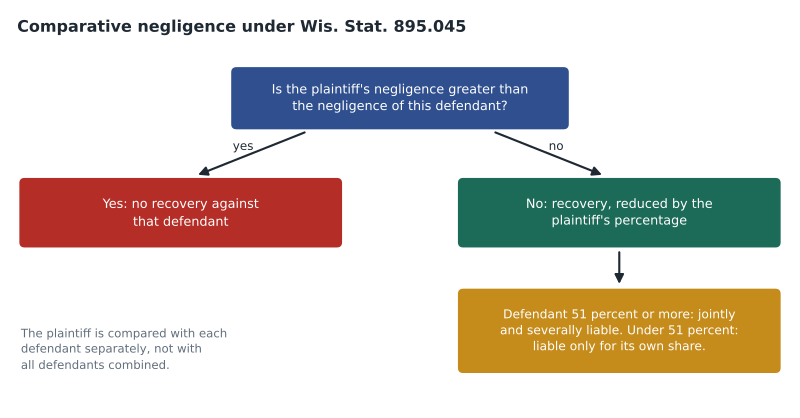
Wisconsin was one of the first states to adopt comparative negligence by statute, early in the twentieth century, and its version has a distinctive feature. Under section 895.045(1), a plaintiff's contributory negligence does not bar recovery if it was not greater than the negligence of the person against whom recovery is sought. Damages are reduced in proportion to the plaintiff's share of the negligence. A plaintiff who is 50 percent at fault against a defendant who is 50 percent at fault recovers half; a plaintiff who is 51 percent at fault recovers nothing from that defendant. This is the modified comparative negligence rule known as the 51 percent bar.
The distinctive feature is the comparison. The statute says that the plaintiff's negligence is measured separately against the negligence of each person found to be causally negligent. The plaintiff is not compared with all defendants combined. That can produce results that surprise lawyers from other states. If a plaintiff is 30 percent at fault, defendant A is 50 percent and defendant B is 20 percent, the plaintiff recovers from A, whose share is larger than the plaintiff's, but not from B, whose share is smaller.
Joint and several liability
Section 895.045 also limits joint and several liability. A defendant found 51 percent or more causally negligent is jointly and severally liable for the damages allowed, meaning the plaintiff can collect the whole judgment from that defendant, who must then seek contribution from others. A defendant found less than 51 percent negligent is liable only for its own percentage of the total causal negligence. There is an exception for persons who act in accordance with a common scheme or plan: they are jointly and severally liable for all damages resulting from that action, subject to a further exception in the punitive damages statute.
| Fault: Plaintiff / A / B | Recovery against A | Recovery against B | Joint and several? |
|---|---|---|---|
| 10 / 60 / 30 | Yes, damages reduced by 10 percent | Yes | A is jointly and severally liable (60 percent); B owes only its 30 percent share |
| 30 / 50 / 20 | Yes | No: plaintiff's 30 exceeds B's 20 | Neither reaches 51; A owes its 50 percent share |
| 40 / 40 / 20 | Yes: 40 is not greater than 40 | No | A owes its 40 percent share |
| 55 / 45 / 0 | No: 55 exceeds 45 | Not a party at fault | No recovery |
Hollis walked Selby through the Wojcik case using these rules. If a jury found Ms. Wojcik 15 percent negligent for the phone, the pickup driver 60 percent and the county 25 percent, she would recover from both defendants, reduced by 15 percent. The pickup driver, at 60 percent, would be jointly and severally liable for the whole reduced award. The county, at 25 percent, would owe only its 25 percent share, and that share would be subject to a statutory cap.
The safe-place statute
Wisconsin has a statute that sets a higher standard of care than ordinary negligence for certain premises. The safe-place statute, section 101.11, requires employers and owners of places of employment and public buildings to construct, repair and maintain them as safe as the nature of the place will reasonably permit. The duty is heavier than the ordinary duty of reasonable care, and safe-place claims are a staple of Wisconsin premises litigation, from slip-and-fall cases in stores to falls in apartment common areas.
The statute has limits that courts have developed over many years. It applies to unsafe conditions associated with the structure, not to every negligent act that occurs on the premises. Liability for a structural defect generally does not depend on notice, while liability for an unsafe condition associated with the structure usually requires that the owner had actual or constructive notice of the condition. Comparative negligence still applies, so a plaintiff who was careless can have damages reduced or barred under section 895.045. A new lawyer handling a premises case should always ask whether the safe-place statute applies in addition to ordinary negligence.
Limits on claims against governments
Wisconsin abolished broad governmental immunity by judicial decision in the early 1960s, and the legislature responded with the statute now found in section 893.80. It allows tort claims against local governmental bodies but places three important limits on them. First, the notice requirements described in lesson 7: written notice within 120 days and an itemized claim that must be disallowed before suit. Second, a cap: recovery against a governmental body, or its officers and employees acting in their official capacity or within the scope of their employment, may not exceed 50,000 dollars in any action. The cap is 25,000 dollars for volunteer fire companies, and punitive damages are not recoverable. Third, immunity: no suit may be brought for acts done in the exercise of legislative, quasi-legislative, judicial or quasi-judicial functions, which Wisconsin courts treat as discretionary acts, nor for the intentional torts of employees.
Courts have recognized exceptions to the discretionary-act immunity. It does not protect the performance of ministerial duties, meaning duties so clearly defined that nothing is left to judgment. It does not protect against a known and compelling danger that gives rise to a ministerial duty to act. It does not apply to medical discretion, and it does not protect malicious, willful and intentional conduct. Much Wisconsin litigation against municipalities turns on whether a duty was discretionary or ministerial.
Claims against state officers and employees are governed by a separate statute, section 893.82, which has its own notice requirement to the attorney general and its own, higher damages limit. The state itself is protected by sovereign immunity except where the legislature has consented to suit.
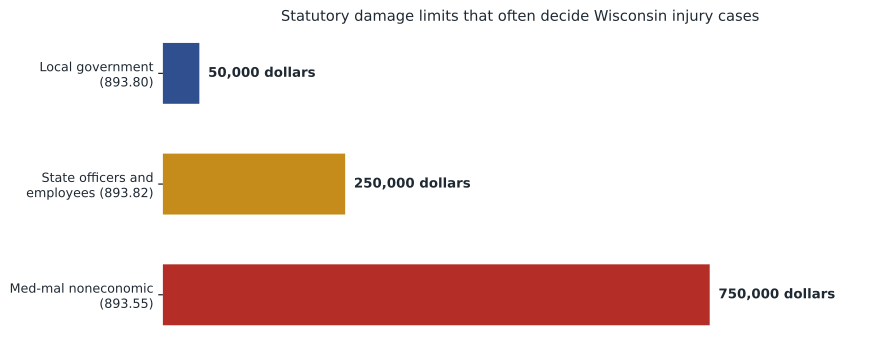
In the Wojcik case, the cap changed everything about the county. Even if the jury awarded 400,000 dollars and found the county 25 percent at fault, the county's share would be 100,000 dollars before the reduction for Ms. Wojcik's negligence, and the cap would limit recovery against the county to 50,000 dollars. And if the county could show that its snow-removal decisions were discretionary, it might owe nothing. Priscilla's strategy was to focus on the pickup driver, who was more than 51 percent at fault on any plausible view and carried insurance.
Medical malpractice and the Mayo decision
Wisconsin caps noneconomic damages in medical malpractice cases at 750,000 dollars under section 893.55. The cap has a history. An earlier cap of 350,000 dollars was struck down by the Supreme Court of Wisconsin in 2005 in Ferdon v. Wisconsin Patients Compensation Fund, under the state constitution's equal protection guarantee. The legislature then enacted the 750,000 dollar cap.
That cap was challenged in Mayo v. Wisconsin Injured Patients and Families Compensation Fund. Ascaris Mayo lost all four limbs after a severe infection that a Milwaukee hospital did not initially detect. A jury awarded her about 25 million dollars, including 15 million in noneconomic damages. The Court of Appeals held the cap unconstitutional in 2017. On June 27, 2018, the Supreme Court reversed by a vote of five to two, in an opinion by Chief Justice Patience Roggensack, holding the cap constitutional both on its face and as applied, and overruling Ferdon. Justice Ann Walsh Bradley wrote in dissent. The decision means that noneconomic damages in Wisconsin medical malpractice cases are limited to 750,000 dollars, while economic damages such as medical expenses and lost earnings are not capped. Wisconsin also has a state Injured Patients and Families Compensation Fund that pays the part of a malpractice judgment above the health care provider's required insurance.
Punitive damages
Punitive damages in Wisconsin are governed by section 895.043. A plaintiff must show that the defendant acted maliciously toward the plaintiff or in an intentional disregard of the plaintiff's rights. The Supreme Court of Wisconsin explained in Strenke v. Hogner in 2005 that intentional disregard requires a deliberate act or course of conduct with awareness that it is practically certain to result in a disregard of the plaintiff's rights, though it does not require intent to cause injury. The statute also caps punitive damages, generally at the greater of twice the compensatory damages or 200,000 dollars, with an exception for certain intoxicated-driving cases. As noted above, punitive damages are not available at all against local governmental bodies under section 893.80.
Other Wisconsin rules worth knowing
A few more Wisconsin statutes appear often in practice. The recreational immunity statute, section 895.52, protects landowners from liability to people who enter their land for recreational activities, with exceptions; it is frequently litigated in a state with so much outdoor recreation. Section 125.035 gives sellers and servers of alcohol broad immunity for injuries caused by intoxicated adult customers, with exceptions for service to underage persons in some circumstances. Wrongful death actions are governed by section 895.04, which includes statutory limits on damages for loss of society and companionship. Each of these deserves a careful reading of the current statute before it is relied on.
Worked problem
Applying the comparison
A hypothetical shopper, Tilde Delwiche, slips on spilled detergent in a grocery store aisle in Green Bay while looking at her phone. A jury finds her 35 percent negligent, the store 45 percent negligent under the safe-place statute, and a cleaning contractor 20 percent negligent. Damages are 100,000 dollars.
Show solution
- Compare the plaintiff with each defendant separately. Against the store: 35 is not greater than 45, so she recovers. Against the contractor: 35 is greater than 20, so she recovers nothing from the contractor.
- Reduce the award by her own 35 percent: 65,000 dollars is the reduced award.
- The store, at 45 percent, is under 51 percent, so it is liable only for its own percentage of the total causal negligence: 45 percent of 100,000, or 45,000 dollars.
- The contractor owes nothing because her negligence exceeds its negligence.
Answer: She recovers 45,000 dollars from the store and nothing from the contractor. A lawyer from a state that combines defendants would have expected more.
Common mistakes
MistakeWisconsin compares the plaintiff with all defendants combined.
InsteadSection 895.045 compares the plaintiff separately with each defendant.
MistakeA defendant 40 percent at fault is jointly and severally liable.
InsteadOnly a defendant 51 percent or more at fault is jointly and severally liable.
MistakeThe safe-place statute imposes ordinary negligence.
InsteadIt requires premises to be as safe as the nature of the place will reasonably permit, a higher standard.
MistakePunitive damages are available against a city if the conduct was egregious.
InsteadSection 893.80 bars punitive damages against local governmental bodies.
MistakeThe 750,000 dollar cap was struck down in Mayo.
InsteadMayo (2018) upheld the cap and overruled Ferdon.
Practice problems
Work each problem on paper first, then reveal the answer to check.
When does a plaintiff's negligence bar recovery in Wisconsin?
Show answer
When it is greater than the negligence of the defendant in question.
At what percentage is a defendant jointly and severally liable?
Show answer
51 percent or more.
What is the cap on claims against local governments?
Show answer
50,000 dollars, with no punitive damages.
What did Mayo hold?
Show answer
The 750,000 dollar noneconomic damages cap in medical malpractice is constitutional.
What standard does the safe-place statute impose?
Show answer
As safe as the nature of the place will reasonably permit.
Insurance and practical value
In practice, most Wisconsin injury cases are resolved by insurers. Wisconsin is a direct-action state in many circumstances, meaning an injured person may sue a liability insurer directly along with its insured, which affects how complaints are drafted and how cases are tried. Combined with the comparative negligence rules and the statutory caps, the direct-action rules mean that a plaintiff's lawyer must identify every potentially responsible party and every policy early, and a defense lawyer must evaluate each party's percentage exposure separately.
Summary and key terms
- Section 895.045: recovery barred only if the plaintiff's negligence is greater than that of the defendant in question; compared with each defendant separately.
- Defendants 51 percent or more at fault are jointly and severally liable; others pay their own share.
- The safe-place statute, section 101.11, imposes a heightened duty for workplaces and public buildings.
- Section 893.80: 120-day notice, a 50,000 dollar cap, no punitive damages and immunity for discretionary acts.
- Mayo (2018) upheld the 750,000 dollar noneconomic cap in medical malpractice cases, overruling Ferdon.
- Punitive damages require malice or intentional disregard of rights and are capped by section 895.043.
- modified comparative negligence
- A rule allowing a negligent plaintiff to recover reduced damages unless his or her fault exceeds a threshold.
- joint and several liability
- Liability under which one defendant may be made to pay the whole judgment.
- safe-place statute
- Wis. Stat. 101.11, requiring workplaces and public buildings to be as safe as their nature reasonably permits.
- ministerial duty
- A duty so clearly defined that nothing is left to discretion; not protected by governmental immunity.
- noneconomic damages
- Damages for pain, suffering and similar losses, as distinct from medical bills and lost wages.
Lesson quiz · 5 questions
Score 60% or more to complete this lesson.
Create a free account to save your progress, take quizzes and earn a certificate.