
BAR-250 · Lesson 4 of 12 · 20 min
The Wisconsin UBE: format, scoring and the 260 passing score
▶ Video coming soon A video version of this lesson is on the way.
Hollis put two numbers on the screen: 260 and 270. 'The first is what you need in Wisconsin,' she told Selby. 'The second is what you need in several of the UBE states around you. I want you aiming above 270, not because Wisconsin requires it, but because a margin is what gets you through a bad essay, and because a higher score travels further.'
Selby asked the question every candidate asks. 'How is the score actually built? I see 260 out of 400, but the MBE has 200 questions and the essays are graded one to six.'
This lesson explains the structure of the UBE, how its parts are scored and combined, what Wisconsin's passing score of 260 means, and what exam day looks like in Wisconsin. The exam is the same UBE given across the compact; what is distinctive about Wisconsin is the passing score, the logistics and what comes after the exam.
The structure of the UBE
The UBE has three parts, all written by NCBE. The Multistate Performance Test, the MPT, consists of two 90-minute tasks. Each task gives the examinee a File, which holds the facts in the form of memos, letters, transcripts and similar documents, and a Library, which holds the legal authorities: cases, statutes and regulations, sometimes from a fictional jurisdiction. The examinee must produce a piece of legal writing, such as an objective memo, a persuasive brief, a client letter, a demand letter or a set of contract provisions. All the law needed is in the Library. The MPT tests lawyering: following the task memo exactly, separating relevant facts from irrelevant ones, extracting rules from cases and writing something a supervising lawyer could use.
The Multistate Essay Examination, the MEE, consists of six 30-minute essay questions. Since July 2026, NCBE has drawn MEE questions from a narrower list: business associations (agency and partnership, and corporations and limited liability companies), civil procedure, constitutional law, contracts including Article 2 of the Uniform Commercial Code, criminal law and procedure, evidence, real property and torts. Conflict of laws, family law, trusts and estates and secured transactions were removed from the MEE for the remaining legacy administrations. The MEE tests general principles of law as they apply across the country, not Wisconsin law.
The Multistate Bar Examination, the MBE, consists of 200 multiple-choice questions over two three-hour sessions of 100 questions each. Of the 200, 175 are scored and 25 are unscored pretest questions that look exactly like the scored ones. The MBE covers civil procedure, constitutional law, contracts, criminal law and procedure, evidence, real property and torts.
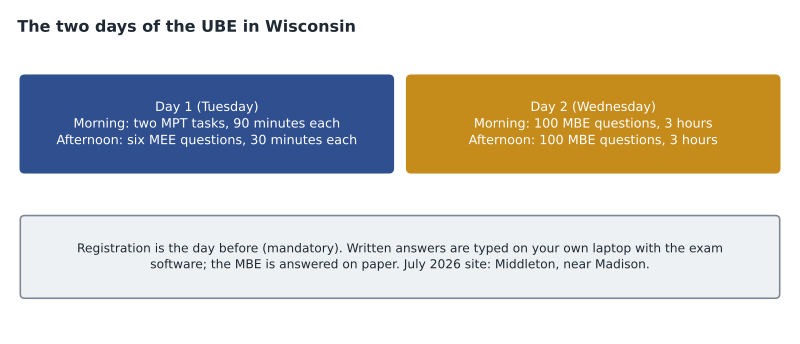
The Wisconsin July 2026 schedule followed the national pattern. Registration was on Monday, July 27, at assigned times. The written portion, meaning the MEE and the two MPT tasks, ran on Tuesday, July 28, from 9:00 a.m. to 4:30 p.m. The MBE ran on Wednesday, July 29, at the same times. The exam site was a hotel conference center in Middleton, on the west side of Madison. The February 2027 exam is on February 23 and 24, 2027, the national UBE dates; the Board's instructions for that exam give the site and registration details.
How the parts are weighted
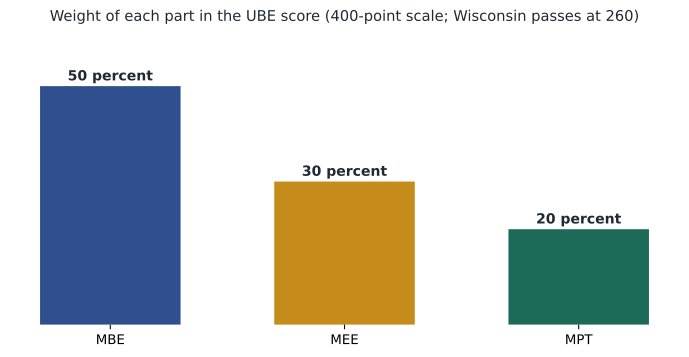
Each part is scaled, and the three are combined into a single UBE score on a 400-point scale. The weights are the same in every UBE jurisdiction: the MBE counts for 50 percent of the total, the MEE for 30 percent and the MPT for 20 percent. Half the score comes from multiple choice and half from writing, and within the writing half the six essays count for more than the two performance tests.
Scaling is what makes UBE scores portable. NCBE equates the MBE across administrations, so that a given scaled MBE score represents the same level of performance from one exam to the next, whatever small differences there are in the difficulty of the questions. The written scores are then scaled to the MBE: the raw MEE and MPT grades awarded in a jurisdiction at a given administration are mapped onto the MBE scale for that group of examinees. Graders grade written answers relative to one another, using NCBE's grading materials, and scaling puts those grades on the same footing as the grades in every other UBE jurisdiction.
Two consequences follow. First, the UBE is compensatory. There is no separate passing score for the MBE or the written parts; a strong MBE can carry weaker essays and the reverse. Second, the written grades are relative. A grader asks which answers in the pile are better than others, so a clear, organized answer that spots the main issues and applies the rule to the facts will usually do well even if it misses a minor point.
| Part | Format | Time | Weight |
|---|---|---|---|
| MPT | Two performance tasks using a File and a Library | 90 minutes each, 3 hours total | 20 percent |
| MEE | Six essay questions | 30 minutes each, 3 hours total | 30 percent |
| MBE | 200 multiple-choice questions, 175 scored | Two 3-hour sessions | 50 percent |
What 260 means
Wisconsin's passing score is a scaled UBE score of 260. It is also the minimum score Wisconsin accepts for transfer from another jurisdiction. Among UBE jurisdictions, passing scores run from 260 to 270, so Wisconsin sits at the lower end, alongside other jurisdictions with 260 such as Minnesota and New Mexico. Many of the states with the largest numbers of UBE takers use 266 or 270.
A lower passing score does not make the exam easier to take; it makes the threshold lower. The exam, the scaling and the grading are the same as everywhere else. What changes is how much of the national distribution of scores falls above the line. Practically, a candidate aiming at 260 has a few more points of margin than one aiming at 270.
Selby's question about the arithmetic is worth answering roughly. A scaled MBE score is reported on a scale of about 0 to 200. The written score is reported on the same scale. The UBE score is, in effect, the scaled MBE score plus the scaled written score, where the written score combines the MEE at three-fifths and the MPT at two-fifths. A candidate with a scaled MBE score of 132 and a scaled written score of 130 has a total of 262 and passes in Wisconsin. A candidate with 140 on the MBE and 125 on the written portion has 265 and also passes. Hollis uses these examples to make a single point: neither half has to be excellent, but neither can collapse.
Exam day in Wisconsin
The July 2026 instructions give a clear picture of the day, and the February instructions follow the same pattern. Registration is mandatory and takes place the day before the exam at an assigned time. At registration, applicants must show a current, unexpired driver's license, government-issued photo identification or passport bearing a signature, a photograph and the name used on the application. They receive an identification badge, which they must wear to enter the exam room. The instructions recommend being in Madison no later than the morning of registration, which for applicants from the northern part of the state means planning travel carefully in February.
Applicants ordinarily type the written portion on their own laptops using Exam4 software from Extegrity. The software saves the answer automatically every few seconds and keeps backups, and the instructions say that if the software or laptop fails and cannot be restored, the director may grant a reasonable extension to finish by hand. Applicants must install and register the software by the vendor's deadline and should run its practice exam several times before the real one. The MBE is answered on a paper answer sheet with a pencil.
The Board publishes rules on what may be brought into the room. In general, phones and other electronic devices other than the registered laptop are not allowed at the desk, study materials are prohibited, and food and drink are restricted. Read the current list rather than relying on what a friend was allowed at another exam.
There is no official bar review course in Wisconsin, and the Board does not endorse any course. Candidates choose their own preparation.
Pacing
Pacing is the skill that matters most on the day. On the morning of day one, the two MPT tasks share three hours, and the clock does not divide itself. A candidate who spends 110 minutes on the first task has 70 left for the second. Hollis teaches a simple rule: start the second task at 90 minutes, whatever state the first one is in. On the afternoon of day one, the six essays share three hours. A candidate who spends 45 minutes on the first essay is already in trouble. The hard stop at 30 minutes is the most important rule of the afternoon, because a short answer to the sixth question earns more than polishing the second.
On day two, the MBE allows about 1.8 minutes per question. Candidates should mark and move on from questions that are not yielding, return if time permits, and never leave a bubble blank, since there is no penalty for guessing. The unscored pretest questions are indistinguishable from the scored ones, so a question that seems strange should be answered and forgotten.
After the exam
Results are released by email notification to the applicant's online account. The July 2026 instructions listed the release date as to be determined. A passing candidate is not yet a lawyer: the character and fitness file must be complete, and the 21-hour Wisconsin component must be finished within 12 months of the notice of passing. A failing candidate can file for the next exam; Wisconsin does not limit attempts. Because UBE scores are portable, a passing Wisconsin candidate can also use the score elsewhere, subject to each jurisdiction's rules.
Selby wrote down the numbers she needed and taped them above her desk: 260, 30 minutes, 90 minutes, 1.8 minutes. 'Four numbers,' Hollis said. 'If you respect all four, the score takes care of itself.'
Worked problem
Reading a score report
A hypothetical examinee, Coralie Vandenhoek, receives her February score report: scaled MBE 128.5, scaled written score 129.0, total UBE score 258. She asks whether she passed in Wisconsin and whether she can use the score in Minnesota.
Show solution
- Wisconsin requires 260. Her total is 258, so she did not pass.
- The UBE is compensatory; there is no way to combine her written score with a better MBE from another sitting in Wisconsin.
- A score of 258 is also below Minnesota's 260, so it cannot be transferred there.
- She can file for the next Wisconsin exam. A gain of two points in either half would have been enough.
Answer: She did not pass and has no transferable score. Her next attempt should focus on whichever half is easier to raise by a few points.
Common mistakes
MistakeWisconsin requires 266 on the UBE.
InsteadWisconsin's passing score is 260.
MistakeThe MEE and MPT each count for a third.
InsteadThe MBE counts 50 percent, the MEE 30 percent and the MPT 20 percent.
MistakeThere is a separate passing score for each part.
InsteadThe UBE is compensatory; only the total matters.
MistakeThe MEE tests Wisconsin law.
InsteadThe MEE tests general principles; Wisconsin law is covered by the 21-hour component.
MistakeFamily law and trusts are still MEE subjects.
InsteadFrom July 2026 they were removed from the MEE, along with conflict of laws and secured transactions.
Practice problems
Work each problem on paper first, then reveal the answer to check.
What are the three parts of the UBE and their weights?
Show answer
MBE 50 percent, MEE 30 percent, MPT 20 percent.
How many MBE questions are scored?
Show answer
175 of 200.
What is Wisconsin's passing score?
Show answer
260.
What happens if the exam software fails on a laptop?
Show answer
The director may allow a reasonable extension to finish by hand.
What must a passing exam taker complete before admission?
Show answer
The 21-hour Wisconsin component and the character and fitness review.
The week before
Hollis's last advice on the exam was about the week before it. Stop learning new law three or four days out and switch to review of the rules you already know. Do one short MBE set each day to keep the rhythm. Run the exam software practice test one final time. Lay out identification, admission materials and clothing the night before registration. And sleep: a candidate who arrives rested makes better timing decisions than one who stayed up reviewing evidence rules. For a February exam in Madison, check the weather forecast and leave room for winter driving.
Summary and key terms
- The UBE has the MPT (two 90-minute tasks), the MEE (six 30-minute essays) and the MBE (200 questions, 175 scored).
- Weights are MBE 50, MEE 30, MPT 20 percent; written scores are scaled to the MBE and the exam is compensatory.
- Wisconsin passes at 260, at the low end of the UBE range.
- In-person registration the day before is mandatory; written answers are typed with Exam4 software; the MBE is on paper.
- Since July 2026 the MEE omits conflict of laws, family law, trusts and estates and secured transactions.
- Pacing rules: 90 minutes per MPT, 30 per essay, about 1.8 per MBE question.
- UBE
- The Uniform Bar Examination, NCBE's portable bar exam made up of the MBE, MEE and MPT.
- compensatory scoring
- Scoring in which a strong performance on one part can make up for a weaker one; only the total matters.
- scaling
- Placing written scores on the MBE scale so that UBE scores are comparable across jurisdictions.
- pretest questions
- The 25 unscored MBE questions used to test future items.
- MPT Library
- The cases and statutes given in a performance test, which contain all the law needed.
Lesson quiz · 5 questions
Score 60% or more to complete this lesson.
Create a free account to save your progress, take quizzes and earn a certificate.