
BAR-250 · Lesson 11 of 12 · 20 min
Score transfer, admission on proof of practice and practice after admission
▶ Video coming soon A video version of this lesson is on the way.
Two questions arrived in the same week. Selby asked how she could use her Wisconsin score to get into Minnesota after admission. And Priscilla Heidemann asked Selby to find out how a lawyer she wanted to hire, a hypothetical Minneapolis litigator named Cyrus Gilbertson with six years of practice, could be admitted in Wisconsin. Hollis put both questions on the agenda for the eleventh session, along with the rules a new Wisconsin lawyer must follow once admitted.
This lesson covers admission in Wisconsin by transferred UBE score and by proof of practice, how a Wisconsin admission travels to other states, and the obligations of practice after admission: State Bar membership, continuing legal education and the basics of staying in good standing.
Transferring a UBE score into Wisconsin
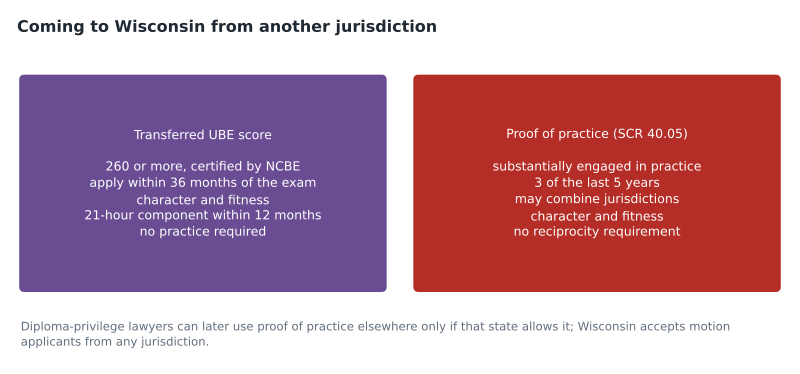
Since 2026, Wisconsin accepts UBE scores earned in other UBE jurisdictions. The requirements are set out in the court's announcements, the Board's admission page and NCBE's chart. The score must be a scaled UBE score of 260 or higher, certified as a UBE score by NCBE. The applicant must submit the score evidence and a complete application within 36 months of the exam that produced the score. NCBE lists the application fee for admission by transferred UBE score as 450 dollars, the same figure the court announced in March 2026. The applicant must satisfy the Board on character and fitness and must complete the 21-hour Wisconsin component within 12 months of filing the transfer application.
The 36-month limit is measured from the exam, not from the date of admission elsewhere. A candidate who sat the July 2024 UBE and was admitted in Minnesota in late 2024 had until July 2027 to file a complete Wisconsin transfer application. After that, the score can no longer be used in Wisconsin, and the candidate must sit again or wait until proof of practice is available.
Wisconsin's passing score of 260 helps transfer applicants. Every legacy UBE jurisdiction requires at least 260, so any passing score from any UBE jurisdiction meets Wisconsin's threshold. A candidate who failed in a 270 jurisdiction with, say, a 263 also meets Wisconsin's threshold, although he or she is not admitted in the original jurisdiction. Transfer rules for NextGen scores into Wisconsin were still to be announced in late 2026.
Admission on proof of practice
SCR 40.05 allows an experienced lawyer to be admitted without examination on proof of practice. The applicant must show that he or she was substantially engaged in the practice of law for three years within the last five years before filing. The Board's page notes that practice may be shown in more than one jurisdiction and under more than one provision of SCR 40.05. NCBE's chart lists the kinds of work that can qualify: law practice, law teaching, work for a government agency, military service, in-house corporate work and judicial service in a court of record. The filing instructions are form BE-370, and NCBE lists the fee as 850 dollars.
Two features of the Wisconsin rule make it more open than many. First, Wisconsin does not require reciprocity: it accepts proof-of-practice applicants from any jurisdiction, whether or not that jurisdiction would admit a Wisconsin lawyer on the same terms. Second, NCBE's chart notes that graduation from an ABA-approved law school is not a requirement for this route, and the MPRE is not required. The applicant must still satisfy character and fitness, which for a practicing lawyer includes good standing and disciplinary history letters from every jurisdiction of admission.
Proof-of-practice applicants do not take the 21-hour component. The component is tied to admission by exam and by transferred score.
| Requirement | Transferred UBE score | Proof of practice (SCR 40.05) |
|---|---|---|
| Minimum | UBE score of 260 or more, certified by NCBE | Substantial practice three of the last five years |
| Time limit | Complete application within 36 months of the exam | Practice measured over the five years before filing |
| Reciprocity | Not applicable | Not required |
| Wisconsin component | Yes, within 12 months of filing | No |
| MPRE | Not required | Not required |
| Fee listed by NCBE | 450 dollars | 850 dollars |
Applied to Priscilla's question, Cyrus Gilbertson has six years of full-time litigation practice in Minnesota. He easily meets three of the last five years. He can apply under SCR 40.05 with good standing and disciplinary history letters, and he will not need to take the UBE or the component. If he had instead been admitted in Minnesota only eighteen months ago on a UBE score from 2025, the transfer route would be the natural one, as long as the score was 260 or more and he filed within 36 months of that exam.
Taking a Wisconsin admission elsewhere
Selby's question runs the other way. A Wisconsin UBE score is now portable, but each receiving jurisdiction decides whether to accept it, what score it requires, how old the score may be and what local requirements apply. Minnesota, for example, has its own passing score and score-age rules and requires the MPRE. If Selby scores comfortably above Minnesota's threshold in February 2027, she can apply there by transferred score, using her MPRE score of 94 if it is still within Minnesota's time limit.
Lawyers admitted on the diploma privilege have no UBE score to transfer. When they seek admission in another state, they must usually rely on that state's admission-on-motion rules, which often require several years of practice and sometimes require that the lawyer's original admission came through a bar exam or that the lawyer's home state offer reciprocity. Some states have treated diploma-privilege lawyers differently from exam-admitted lawyers under those rules. A diploma-privilege graduate who expects to move early in a career may choose to sit the UBE to have a portable score.
Membership in the State Bar
Once admitted, a Wisconsin lawyer must join the State Bar of Wisconsin to practice. The State Bar is an integrated bar created by Supreme Court rule. Members pay annual dues and assessments, which fund the State Bar and court-related programs such as the Lawyers' Fund for Client Protection, and they file annual information including trust account certification. The Supreme Court has upheld mandatory membership while limiting how compulsory dues may be used, and the State Bar offers a dues reduction for members who object to certain uses. Lawyers who are not practicing can elect inactive status, with lower dues and no right to practice.
Continuing legal education
SCR chapter 31 requires active Wisconsin lawyers to complete continuing legal education. The requirement is 30 credit hours in each two-year reporting period, including at least 3 hours of ethics and professional responsibility. Compliance is measured through December 31 of the reporting year, and reports are due by February 1 of the following year. Lawyers admitted in even-numbered years report in even-numbered years, and those admitted in odd-numbered years report in odd-numbered years. The rules limit how many hours may come from repeated, on-demand recorded programs; the ABA's summary of the Wisconsin rule lists a limit of 15 hours. The Board of Bar Examiners administers CLE reporting through an online system, and lawyers who fail to comply face late fees and, eventually, suspension.
New lawyers should check exactly when their first reporting period begins and ends, because it depends on the admission date and the rules for new admittees. Selby, if admitted in 2027, would fall into the odd-year reporting group.
| CLE item | Wisconsin rule |
|---|---|
| Total hours | 30 per two-year reporting period |
| Ethics hours | At least 3 per period |
| Compliance date | December 31 of the reporting year |
| Report due | February 1 of the following year |
| Reporting group | Even or odd years, following the year of admission |
| Repeated on-demand limit | Capped; check SCR 31 for the current number |
| Administered by | Board of Bar Examiners |
Practice by lawyers not admitted in Wisconsin
Out-of-state lawyers sometimes need to appear in a Wisconsin case without being admitted. Wisconsin's rules allow a lawyer admitted elsewhere to appear in a particular matter with the court's permission, usually in association with an active Wisconsin lawyer, subject to fees and limits on how often the privilege may be used. Wisconsin also has rules permitting registered in-house counsel to serve their employers without full admission, within limits. These rules are no substitute for admission for a lawyer who will practice regularly in Wisconsin.
Staying in good standing
Good standing in Wisconsin requires current dues and assessments, compliance with CLE, trust account certification and freedom from disciplinary suspension. Lawyers who move away, retire or take nonlegal jobs should decide deliberately whether to remain active or go inactive, because an active lawyer who stops filing and paying can be suspended administratively, and reinstatement takes paperwork and time.
Worked problem
Transfer or proof of practice?
A hypothetical lawyer, Gemma Pfeiffer, took the UBE in Illinois in July 2023, scored 268 and was admitted there. She has practiced full-time in Chicago ever since. In January 2027 she wants to join a firm in Kenosha.
Show solution
- Transfer: her score is above 260, but July 2023 to January 2027 is more than 36 months. The score has expired for Wisconsin purposes.
- Proof of practice: she was admitted in late 2023 and has practiced full-time since, which is more than three years within the last five by January 2027 if her practice dates support it.
- Proof of practice does not require the component or the MPRE, and Wisconsin does not require reciprocity from Illinois.
- She should file under SCR 40.05 with good standing and disciplinary letters from Illinois.
Answer: Proof of practice under SCR 40.05 is her route; the score is too old to transfer.
Common mistakes
MistakeA UBE score can be transferred to Wisconsin at any time.
InsteadThe complete application must be filed within 36 months of the exam that produced the score.
MistakeWisconsin admits lawyers on motion only from reciprocal states.
InsteadWisconsin does not require reciprocity for proof of practice.
MistakeProof-of-practice applicants must complete the 21-hour component.
InsteadThe component applies to exam and transfer applicants.
MistakeWisconsin CLE is 15 hours a year with no ethics requirement.
InsteadIt is 30 hours every two years, including at least 3 ethics hours.
MistakeDiploma-privilege lawyers can transfer a score to other states.
InsteadThey have no UBE score; they rely on other states' admission-on-motion rules.
Practice problems
Work each problem on paper first, then reveal the answer to check.
What is the minimum transferred UBE score in Wisconsin?
Show answer
260, certified by NCBE.
Within what period must a transfer application be completed?
Show answer
36 months of the exam.
What practice requirement does SCR 40.05 impose?
Show answer
Substantial practice for three of the last five years.
How many CLE hours are required per period, and how many in ethics?
Show answer
30 hours, at least 3 in ethics.
When are CLE reports due?
Show answer
February 1 after the December 31 compliance date.
A first-year checklist
Hollis ended the session with the checklist she gives every newly admitted lawyer, adapted for Wisconsin. In the first month after admission, confirm State Bar membership and pay the first dues and assessments; set up the online CLE reporting account with the Board and note the reporting group; confirm the trust account arrangements at the firm and read SCR 20:1.15 in full; and register for electronic filing in the circuit courts and, if needed, in the federal district courts, which have their own admission requirements.
In the first six months, attend live CLE on topics tied to actual work, including at least one ethics program; learn where the State Bar's practice guides and forms are; build a list of local practitioners who can answer questions; and keep a log of hours toward the first reporting period. Federal court admission in the Eastern and Western Districts of Wisconsin is separate from state admission, and a lawyer who will appear in federal court should apply early.
In the first year, review the firm's malpractice insurance coverage and confirm that it applies to the new lawyer's work; keep the firm's conflict-check system current for every new matter; and calendar the CLE compliance date and the report date for the reporting period.
Selby added one item of her own: once admitted in Wisconsin, apply in Minnesota by transferred score within that state's time limits, so that Priscilla's firm could send her across the river when Minnesota clients needed help. Hollis approved. 'Two licenses in your first year is a lot of paperwork,' she said, 'but it is paperwork you will be glad you did.'
Keeping current
Admission rules continue to change. Wisconsin's NextGen details were still open in late 2026, and other states continue to adjust their transfer and motion rules. A lawyer who may move or add a license should check the receiving jurisdiction's current rules before relying on an older summary, and should keep copies of score reports, certificates of good standing and admission records in a safe place. These documents are much easier to keep than to recreate years later.
Summary and key terms
- Transferred UBE scores of 260 or more are accepted if the complete application is filed within 36 months of the exam; the component follows within 12 months.
- SCR 40.05 admits lawyers with substantial practice for three of the last five years; no reciprocity, MPRE or component.
- Qualifying practice includes law teaching, government, military, in-house and judicial work.
- Other states decide whether to accept Wisconsin scores; diploma-privilege lawyers rely on motion rules elsewhere.
- Admitted lawyers must join the State Bar and pay dues; inactive status is available.
- CLE under SCR 31: 30 hours every two years with 3 ethics hours; compliance December 31, report February 1.
- transferred UBE score
- A UBE score earned in one jurisdiction and used for admission in another.
- SCR 40.05
- The rule allowing admission on proof of practice for three of the last five years.
- reciprocity
- A requirement that the applicant's home jurisdiction admit lawyers from the receiving jurisdiction on similar terms.
- reporting period
- The two-year period in which a Wisconsin lawyer must complete 30 CLE hours.
- inactive status
- A membership status for lawyers not practicing in Wisconsin, with lower dues and no right to practice.
Lesson quiz · 5 questions
Score 60% or more to complete this lesson.
Create a free account to save your progress, take quizzes and earn a certificate.