
BAR-250 · Lesson 12 of 12 · 20 min
Capstone: Wisconsin practice questions and an exam-day plan
▶ Video coming soon A video version of this lesson is on the way.
For the last session, Hollis sent Selby a capstone packet on a Saturday afternoon and asked for her answers by Sunday evening. It had three parts: ten short questions on Wisconsin admission and Wisconsin law, an original problem to be answered in memo form, and a written plan for exam week and the months after. 'The exam itself will test national law,' Hollis wrote. 'This packet tests whether you can get admitted and survive your first month in a Wisconsin law office. Do it under time pressure: 30 minutes for Part A, 60 for Part B, 30 for Part C.'
This lesson reproduces the packet with model answers and Selby's debrief. All the questions are original and the facts are hypothetical.
Part A: ten short questions
Question 1. A graduate of a law school in Iowa, never admitted anywhere, wants to practice in Madison. List every route available to her and the one she must use. Model answer: the diploma privilege is limited to UW and Marquette graduates, proof of practice requires three of the last five years of practice and she has no UBE score, so her only route is the Wisconsin UBE with a score of 260, followed by the 21-hour component within 12 months of notice of passing and character and fitness certification.
Question 2. What three items must the Board receive before an application counts as filed? Model answer: the online application, the notarized Authorization and Release and the filing fee.
Question 3. A candidate scores 262 in Wisconsin. Has she passed, and can she transfer the score to a jurisdiction that requires 266? Model answer: she passed in Wisconsin, which requires 260. The score cannot be used in a jurisdiction that requires 266.
Question 4. Does Wisconsin require the MPRE for a candidate admitted by transferred UBE score? Model answer: no. Wisconsin does not require the MPRE for any route.
Question 5. A transfer applicant files on March 1. By when must he complete the Wisconsin component? Model answer: within 12 months of filing, so by the following March 1.
Question 6. A plaintiff is 45 percent negligent; defendant A is 40 percent; defendant B is 15 percent. Damages are 200,000 dollars. What does the plaintiff recover? Model answer: the plaintiff is compared with each defendant separately. Her 45 percent is greater than A's 40 and B's 15, so she recovers nothing from either.
Question 7. A child is injured on a city playground. The family sues 200 days later without serving any written notice. What is the problem, and what is the maximum recovery against the city? Model answer: section 893.80 requires written notice of the circumstances within 120 days and an itemized claim that is disallowed before suit. Unless the city had actual notice and the delay caused no prejudice, the claim fails. Even if it proceeds, recovery is capped at 50,000 dollars, punitive damages are unavailable, and immunity for discretionary acts may apply.
Question 8. A wife inherited stock from her aunt during the marriage and kept it in her own name; the dividends were deposited into the couple's joint checking account. At divorce, how are the stock and the dividends treated? Model answer: under section 767.61(2) the inherited stock is excluded from division unless refusing to divide it would create hardship. The dividends deposited in the joint account were mixed with marital funds; under chapter 766 income from individual property is marital absent a unilateral statement, and mixed funds are marital unless traced. They are part of the property presumed to be divided equally.
Question 9. A lawyer takes a 3,000 dollar advanced fee and deposits it in her business account with a fee letter giving only her hourly rate. Is that permitted? Model answer: no. Under SCR 20:1.5(f) advanced fees go into trust unless the lawyer complies with SCR 20:1.5(g), which requires written notice of the refund obligation, binding arbitration and the client protection fund, plus the end-of-representation steps.
Question 10. A Wisconsin lawyer admitted in 2027 must complete how many CLE hours, including how many of ethics, and when is the report due? Model answer: 30 hours in each two-year period, at least 3 in ethics; compliance by December 31 of the reporting year and the report by February 1. Admitted in an odd year, the lawyer is in the odd-year group.
Part B: the memo problem
Hollis's problem read as follows. Priscilla Heidemann has a new client, a hypothetical retired dairy farmer named Ewald Hargrove, 71, of Chippewa County. Ewald's wife, Hedda, died in August 2026. Ewald and Hedda married in 1979 and lived in Minnesota until 1994, when they moved to Wisconsin and bought the farm. Hedda's will, signed in 2010 with two witnesses, leaves everything to her daughter from an earlier marriage, Corinna. Ewald asks three questions. First, does Hedda's will give Corinna the farm? Second, what about the retirement account Ewald built while working in Minnesota from 1979 to 1994, which is in his name? Third, in September 2026 Ewald slipped on a wet floor at the Chippewa County courthouse while filing papers and broke his wrist; can he sue the county, and what must he do now?
Selby's answer, lightly edited, followed the IRAC form Hollis had taught. On the first question, the issue is what property Hedda's will could dispose of. The rule is that a Wisconsin will controls only the testator's individual property and her one-half interest in marital property. The farm was bought in 1994, after both spouses were domiciled in Wisconsin and after January 1, 1986, so the determination date had passed and the farm is presumptively marital property unless it was bought with traceable individual funds. Applying the rule, Ewald already owns one-half of the farm as his own marital property interest; Hedda's will can pass only her half to Corinna. In conclusion, Corinna takes at most Hedda's one-half interest, and Ewald keeps his half. If the farm was held as survivorship marital property or in another survivorship form, it may pass to Ewald entirely outside the will, which needs to be checked in the deed.
On the second question, the issue is the classification of the Minnesota-era retirement account. The rule is that property acquired during marriage while domiciled elsewhere, which would have been marital property had the couple lived in Wisconsin, is deferred marital property. The elective share rules in chapter 861 let a surviving spouse elect against the decedent's deferred marital property, but this account is Ewald's own, not Hedda's. Applying that, the account titled in Ewald's name, earned during the marriage in Minnesota, is Ewald's deferred marital property. Hedda's estate has no claim to it through her will, because the deferred marital property election belongs to the surviving spouse. In conclusion, Ewald keeps the account, and Corinna cannot reach it through Hedda's will. Selby added that if Hedda had owned substantial deferred marital property in her own name, Ewald might consider electing against it, which would need prompt advice because the election has a deadline.
On the third question, the issue is a premises claim against a county. The rules are the safe-place statute, section 101.11, which requires public buildings to be as safe as their nature reasonably permits; section 893.80, which requires written notice of the circumstances within 120 days of the event and an itemized claim, caps recovery at 50,000 dollars and bars punitive damages; and comparative negligence under section 895.045. Applying them, a wet courthouse floor may be an unsafe condition associated with the structure, but liability for such a condition usually requires actual or constructive notice of the wet floor. The fall was in September 2026, so the 120-day notice must be served on the county and the responsible officer before January 2027; the itemized claim must be presented to the county clerk. Ewald's own care will be compared with the county's. In conclusion, Ewald may have a claim, but recovery against the county cannot exceed 50,000 dollars, and the notice must go out immediately.
Hollis graded the memo as a strong answer. Her comments were that Selby had correctly started with classification, which is the step most out-of-state lawyers skip, and that she had spotted the 120-day clock. Her one criticism was that Selby should have opened the memo with a short summary of the three answers, because a busy supervising lawyer reads the first paragraph first.
Part C: the exam-week and admission plan
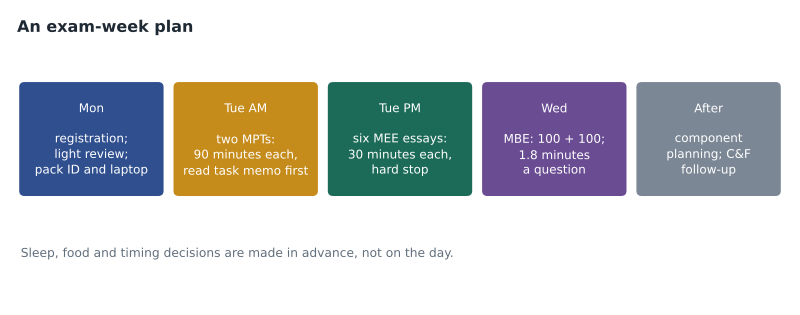
Selby's written plan had four parts. For the weeks before the exam, she would do two timed MEE essays a week through January, one MPT every weekend, and 50 MBE questions a day, tapering in the last five days. She would run the exam software practice test three times, the last one the week before the exam, and check the Board's eligibility email about three weeks before.
For travel, she planned to drive from Eau Claire to Madison on the Sunday before registration, because February weather on Interstate 94 can turn a three-hour drive into a six-hour one. She booked a room near the exam site so she could walk or drive a few minutes each morning, and she packed her identification, laptop, power cord if permitted, and the admission materials the night before registration.
For the exam days, she wrote down her timing rules: start the second MPT at 90 minutes no matter what; a hard stop at 30 minutes on every essay; about 1.8 minutes per MBE question; mark and move; no blank answers. She planned meals and a short walk at lunch on each day, and she promised not to discuss the essays with other candidates between sessions.
For after the exam, she listed what had to happen before admission: keep the character and fitness file current, especially if her job title changed; watch for results; buy and complete the 21-hour component within weeks of a passing notice, starting with the twelve core hours; and prepare for State Bar membership and her first CLE reporting period. She also noted that she would consider a Minnesota transfer application once admitted in Wisconsin, using her MPRE score while it was still within Minnesota's time limit.
The debrief
Selby answered nine of the ten short questions correctly. She missed Question 6, the three-party comparison, because she compared the plaintiff with the defendants combined. 'That is the mistake every lawyer from a combined-comparison state makes,' Hollis said. 'In Wisconsin you compare one at a time.' Selby added it to the Wisconsin traps list she had kept since the first session, which by then had eleven entries: the diploma privilege belongs only to the two Wisconsin schools; filing requires three items; 260 is the passing score and not everyone else's; no MPRE; the component's 12-month clock; 120-day notice for local governments; the 50,000 dollar cap; comparison defendant by defendant; marital property starts with classification; written fee communication above 1,000 dollars; and the mandatory part of SCR 20:1.6.
Priscilla read the memo too. 'You found the notice deadline on the courthouse fall,' she said. 'That alone justifies the time you spent on this course.'
Worked problem
Writing the opening summary
Hollis asked Selby to rewrite the first paragraph of her Part B memo as a summary for Priscilla.
Show solution
- State the bottom line for each question in one sentence.
- Flag anything with a deadline first.
- Note what facts still need to be checked.
- Keep it under 100 words.
Answer: Summary: (1) Hedda's will can pass only her one-half interest in the farm, which is presumptively marital property; Ewald keeps his half, and the deed should be checked for survivorship ownership. (2) The Minnesota-era retirement account is Ewald's deferred marital property and is not reachable through Hedda's will. (3) Ewald may have a safe-place claim against the county for the courthouse fall, capped at 50,000 dollars; written notice under section 893.80 must be served within 120 days of the September fall.
Common mistakes
MistakeComparing the plaintiff with all defendants combined.
InsteadWisconsin compares the plaintiff with each defendant separately.
MistakeStarting an estate question with the will.
InsteadStart with classification: individual, marital or deferred marital property.
MistakeTreating the 120-day notice as a formality to handle later.
InsteadServe notice on a local government immediately; the deadline runs from the event.
MistakePlanning to start the component before the exam.
InsteadSpend pre-exam time on the UBE; complete the component soon after a passing notice.
MistakeWriting the memo conclusion last and only at the end.
InsteadOpen with a short summary of each answer for a busy reader.
Practice problems
Work each problem on paper first, then reveal the answer to check.
What is the first step in any Wisconsin estate or divorce property question?
Show answer
Classify the property.
How long does a claimant have to give notice of a claim against a county?
Show answer
120 days from the event.
What is the cap on recovery against a county?
Show answer
50,000 dollars.
What timing rule governs the second MPT task?
Show answer
Start it at 90 minutes, whatever state the first one is in.
What must a Wisconsin UBE passer complete within 12 months?
Show answer
The 21-hour Wisconsin law and practice component.
Last words from the coach
Hollis closed the Wisconsin sessions with the same advice she gives every group. The exam rewards steady preparation more than brilliance: timed practice, honest review of mistakes and a plan that is fixed before exam week. Admission rewards completeness: a candid file, deadlines met and the component finished promptly. And practice rewards curiosity about local rules. Selby said she would keep the traps list on her desk after admission, adding to it whenever Wisconsin surprised her.
Summary and key terms
- The capstone tests admission rules, Wisconsin torts, marital property and the conduct rules together.
- Model answers rely on the four routes, the three filing items, 260, no MPRE and the component's 12-month window.
- Wisconsin tort answers compare the plaintiff with each defendant and watch section 893.80's notice and cap.
- Marital property questions start with classification; wills control only the testator's share.
- An exam-week plan fixes travel, timing rules, meals and sleep in advance.
- After the exam: keep the file current, complete the component quickly and prepare for State Bar membership and CLE.
- IRAC
- Issue, rule, application, conclusion: a structure for legal analysis.
- opening summary
- A short statement of the answers at the start of a memo, written for a busy reader.
- traps list
- A personal list of rules where Wisconsin differs from national law or from another state.
- hard stop
- A fixed time limit for a task on the exam that the candidate does not exceed.
- survivorship marital property
- A form of marital property that passes to the surviving spouse at death outside the will.
Lesson quiz · 5 questions
Score 60% or more to complete this lesson.
Create a free account to save your progress, take quizzes and earn a certificate.